
Using AI for Customer Segmentation and Targeting
On this page
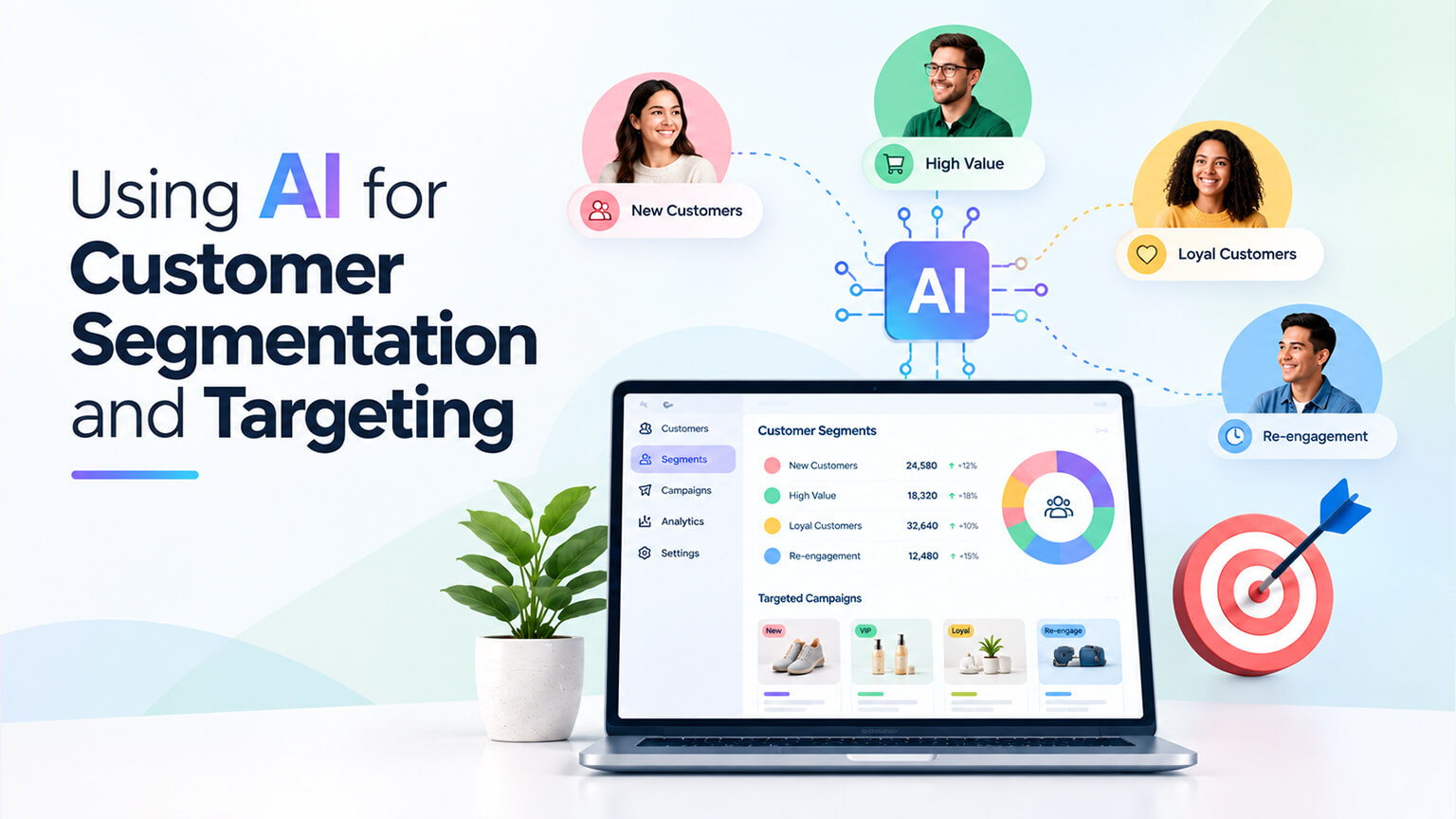
Customer segmentation — grouping customers by shared characteristics, behavior, or value to target them relevantly (with tailored marketing, offers, and experiences) — is fundamental to effective ecommerce marketing (as the retention, email, and personalisation discussions cover). Traditionally, segmentation is done manually (defining segments by rules — e.g., customers who bought X, high spenders, lapsed customers) — useful but limited (simple, rule-based, and only as good as the segments you think to define). AI can enhance segmentation and targeting: analysing customer data (behavior, purchases, engagement, and many signals) to find segments and patterns (including ones you might not have defined), predict behavior and value, and target more precisely — at a scale and sophistication beyond manual segmentation. Done well, AI-powered segmentation and targeting help you understand and target your customers more precisely and effectively (better marketing, retention, and personalisation, as those discussions cover). But, as with other AI applications, it works best combined with human judgment and strategy. So AI is a valuable enhancement to segmentation and targeting, used well. This piece covers using AI for customer segmentation and targeting: where AI helps, the role of human judgment, how to use it well, and how it connects to marketing and retention. (This connects to the personalisation, retention, and email discussions; this focuses on AI for segmentation and targeting.)
This piece covers where AI helps in segmentation and targeting, the role of human judgment, how to use it well, and how it connects to marketing and retention. Because AI can enhance segmentation and targeting (finding and targeting segments more precisely), used well with human strategy. Let me walk through it.
Where AI helps in segmentation and targeting
AI enhances segmentation and targeting in several ways beyond manual, rule-based segmentation. Finding segments and patterns — AI can analyse customer data (behavior, purchases, engagement, attributes) to find segments and patterns (groupings and patterns in your customers), including ones you might not have thought to define manually, so it can surface segments beyond your predefined rules (data-driven segments) — finding segments (a key enhancement). Predicting behavior and value — AI can predict customer behavior and value (likelihood to buy, churn, lifetime value, next purchase, as the retention discussion covers), enabling predictive segmentation and targeting (targeting based on predicted behavior/value, not just past behavior) — prediction (beyond manual). Analysing at scale and sophistication — AI analyses customer data at a scale and sophistication beyond manual segmentation (many signals, complex patterns, all customers), so segmentation can be more sophisticated and precise than manual rules — scale/sophistication. More precise targeting — AI-driven segments enable more precise targeting (targeting the right customers with the right marketing/offers based on data-driven segments and predictions), so targeting is more relevant and effective (versus broad or crude segments) — precision. Behavioral and predictive segments — AI enables behavioral segments (based on behavior patterns) and predictive segments (based on predicted behavior/value, as the retention discussion covers), richer than simple rule-based segments — richer segments. Identifying high-value and at-risk customers — AI can identify high-value customers (to prioritise and retain), at-risk customers (likely to churn, to win back, as the retention discussion covers), and other valuable segments, informing targeted retention/marketing — valuable segment identification. Powering personalisation and targeting — AI segmentation feeds personalisation and targeting (personalised marketing, offers, experiences to segments, as the personalisation and email discussions cover), enabling more relevant, targeted marketing — powering targeting. And uncovering insights — AI can uncover customer insights (patterns, segments, behaviors) that inform strategy (beyond just segments — understanding your customers), a broader analytical benefit — insights. So AI helps in segmentation and targeting by finding segments and patterns (including undefined ones), predicting behavior and value (predictive segmentation), analysing at scale and sophistication, enabling more precise targeting, creating behavioral and predictive segments (richer than rules), identifying high-value and at-risk customers, powering personalisation and targeting, and uncovering insights — enhancing segmentation and targeting beyond manual, rule-based approaches. So AI enhances segmentation and targeting (more precise, predictive, sophisticated) beyond manual rules. But it works best with human judgment. The next section covers that. So AI enhances segmentation and targeting (finding segments, predicting, precision, high-value/at-risk identification) beyond manual rules.
The role of human judgment
As with other AI applications, AI segmentation and targeting work best combined with human judgment and strategy, not handed over entirely. AI finds segments; humans decide what to do — AI can find segments and patterns, but deciding which segments matter and what to do with them (the strategy — how to target them, what marketing/offers, what goals) is human judgment (AI surfaces, humans strategise) — so the strategy is human. Segments must be meaningful and actionable — humans ensure the segments are meaningful and actionable (a data-driven segment is only useful if it’s meaningful for your business and you can act on it, as the metrics discussion touches on for meaningful metrics), so human judgment ensures the segments are useful (not just statistically-derived groupings) — meaningfulness. Strategy and goals are human — the marketing/targeting strategy and goals (what you’re trying to achieve with segmentation — retention, growth, specific goals, as the retention discussion covers) are human, guiding how AI segmentation is used — human strategy. Interpret and validate AI’s segments/predictions — AI’s segments and predictions need human interpretation and validation (do they make sense, are they accurate, are the predictions reliable?), since AI can produce spurious or misleading segments/predictions (needing human scrutiny, as the AI-CRO discussion touches on) — interpretation/validation. Brand and customer relationship — humans ensure the targeting respects the brand and customer relationship (relevant, respectful targeting, not creepy or over-targeting, as the personalisation and ethical-AI discussions cover), so targeting serves customers (versus alienating them) — brand/relationship judgment. Ethical and privacy considerations — humans ensure the segmentation and targeting are ethical and privacy-respecting (using customer data appropriately, not creepy or manipulative targeting, as the ethical-AI and personalisation discussions cover) — ethics/privacy (human responsibility). Don’t over-rely on AI — humans shouldn’t over-rely on AI segmentation (treating its segments/predictions as gospel), but use them as inputs to human strategy and judgment (AI informs, humans decide) — the pattern (AI augments, humans direct). And combine AI insight with human strategy — the combination — AI’s data-driven segments, patterns, and predictions plus human strategy, judgment, and goals — is how AI segmentation is used well (versus AI alone) — the combination. So human judgment’s role is deciding which segments matter and what to do with them (strategy), ensuring segments are meaningful and actionable, providing the marketing strategy and goals, interpreting and validating AI’s segments/predictions (scrutiny), ensuring brand-and-relationship-respecting and ethical/privacy-respecting targeting, not over-relying on AI, and combining AI’s insight with human strategy — so AI augments segmentation while humans provide the strategy, judgment, and decisions. So use AI to enhance segmentation and targeting under human judgment and strategy (AI finds/predicts, humans decide and ensure meaningfulness, ethics, and brand fit). The next section covers using it well. So AI segmentation works best with human judgment (deciding what matters, strategy, validation, ethics) — AI augments, humans direct.
How to use it well
To use AI for segmentation and targeting well, combine its capabilities with human strategy and good practices. Use AI’s strengths — use AI for its strengths: finding segments and patterns, predicting behavior and value, analysing at scale, and identifying valuable segments (high-value, at-risk), as covered — leveraging AI’s data-driven segmentation power. Keep human strategy and judgment in charge — keep human strategy and judgment in charge: deciding which segments matter, what to do with them, the marketing strategy and goals, and validating AI’s outputs (AI informs, humans decide) — human-led (the pattern). Ensure segments are meaningful and actionable — ensure the segments are meaningful (relevant to your business) and actionable (you can target and act on them), so segmentation drives action (versus interesting-but-unusable segments) — meaningful/actionable. Target relevantly and respectfully — use the segments to target relevantly and respectfully (relevant marketing, offers, experiences to segments, without creepy over-targeting, as the personalisation and email discussions cover), so targeting serves customers (better relevance, not alienation) — relevant, respectful targeting. Leverage for retention and marketing — leverage AI segmentation for retention and marketing (identifying and targeting high-value, at-risk, and other valuable segments with relevant retention/marketing, as the retention and email discussions cover), driving the retention and marketing effectiveness where much value is (as the retention discussion covers) — retention/marketing use (high-value). Use good data — ensure good customer data (the data AI segmentation relies on — accurate, sufficient data, as the first-party-data and GA4 discussions cover), since AI segmentation is only as good as the data — good data (foundational). Respect ethics and privacy — use the segmentation and targeting ethically and with privacy respect (appropriate data use, respectful targeting, compliance, as the ethical-AI and personalisation discussions cover) — ethics/privacy. Integrate with your tools — integrate AI segmentation with your marketing tools (email/SMS platform, personalisation, as the email and personalisation discussions cover), so the segments power your marketing (AI segmentation often via or feeding your marketing platform, which may have AI segmentation features) — integration. Validate and measure — validate AI’s segments and predictions (do they hold up, are they accurate?) and measure the targeting’s results (is targeting the segments effective?, as the metrics discussion covers), refining based on results — validation/measurement. And use it as part of your marketing strategy — use AI segmentation as part of your overall marketing/retention strategy (informing and enhancing your targeting, not a standalone thing), so it serves your strategy — strategic integration. So use AI for segmentation and targeting well by using AI’s strengths (finding, predicting, identifying segments), keeping human strategy and judgment in charge (deciding what matters, validating), ensuring segments are meaningful and actionable, targeting relevantly and respectfully, leveraging it for retention and marketing (high-value segments), using good data, respecting ethics and privacy, integrating with your marketing tools, validating and measuring, and using it within your marketing strategy. The keys are combining AI’s data-driven segmentation with human strategy and judgment (AI finds/predicts, humans decide and ensure meaningfulness/ethics), targeting relevantly and respectfully, and leveraging it for high-value retention/marketing with good data. So use AI segmentation to enhance your targeting (more precise, predictive) under human strategy, respectfully and effectively, integrated with your marketing. The next section covers the marketing/retention connection. So use AI segmentation well by combining its data-driven power with human strategy, targeting relevantly and respectfully for retention/marketing, with good data and ethics.
How it connects to marketing and retention
AI segmentation and targeting connect directly to effective marketing and retention — where much ecommerce value is. Enables more effective marketing — better segmentation and targeting (via AI) enable more effective marketing (targeting the right customers with relevant marketing, offers, and messaging, as the email and personalisation discussions cover), improving marketing effectiveness (relevance and results) — marketing effectiveness. Powers personalisation — AI segmentation feeds personalisation (personalising marketing, offers, and experiences to segments, as the personalisation discussion covers), enabling relevant, personalised marketing (which performs better than generic) — personalisation. Drives retention — AI segmentation and targeting drive retention (identifying and targeting at-risk customers to win back, high-value customers to retain, and tailoring retention efforts to segments, as the retention discussion covers), improving retention (where much profit is, as that discussion covers) — retention (high-value). Improves email/SMS marketing — AI segmentation enhances email/SMS marketing (targeting segments with relevant flows and campaigns, as the email discussion covers), a high-leverage channel (as that discussion covers) — email/SMS enhancement. Focuses on high-value customers — AI segmentation helps identify and focus on high-value customers and segments (prioritising and retaining them, maximising their value, as the retention discussion covers), focusing effort where it’s most valuable — high-value focus. Targets more precisely and efficiently — precise targeting (via AI segmentation) is more efficient (targeting the right customers with the right marketing, less waste), improving marketing efficiency and ROI — efficiency/ROI. Connects to lifetime value — since AI segmentation drives retention and effective marketing (targeting high-value and at-risk customers, tailoring to segments), it connects to lifetime value (retaining and maximising customer value, as the retention discussion covers) — LTV connection. And it’s part of data-driven marketing — AI segmentation is part of data-driven marketing and retention (using data and AI to target and market more effectively, as the metrics, personalisation, and retention discussions cover), enhancing your data-driven approach — data-driven marketing. So AI segmentation and targeting connect to marketing and retention by enabling more effective marketing (relevant targeting), powering personalisation, driving retention (targeting at-risk and high-value customers — where much profit is), enhancing email/SMS marketing (a high-leverage channel), focusing on high-value customers, targeting more precisely and efficiently (better ROI), connecting to lifetime value, and being part of data-driven marketing — so it enhances the marketing and retention effectiveness where much ecommerce value is. So AI segmentation and targeting, used well, enhance marketing and retention (relevance, precision, high-value focus) — driving the effectiveness and value where much ecommerce profit is. So AI segmentation connects to and enhances effective marketing and retention (relevant, precise, high-value-focused targeting) — where much ecommerce value is.
The bottom line
Customer segmentation — grouping customers by shared characteristics, behavior, or value to target them relevantly with tailored marketing, offers, and experiences — is fundamental to effective ecommerce marketing, and AI can enhance it beyond traditional manual, rule-based segmentation (which is useful but limited to the simple, rule-based segments you think to define). AI helps by analysing customer data (behavior, purchases, engagement, and many signals) to find segments and patterns (including ones you might not have defined), predict behavior and value (likelihood to buy, churn, lifetime value), analyse at a scale and sophistication beyond manual segmentation, enable more precise targeting, create richer behavioral and predictive segments, identify valuable segments (high-value customers to retain, at-risk customers to win back), power personalisation and targeting, and uncover customer insights — enhancing segmentation and targeting beyond manual rules. But, as with other AI applications, it works best combined with human judgment and strategy, not handed over entirely: AI finds segments and patterns, but humans decide which segments matter and what to do with them (the strategy), ensure the segments are meaningful and actionable, provide the marketing strategy and goals, interpret and validate AI’s segments and predictions (scrutinising for spurious or misleading ones), ensure the targeting respects the brand and customer relationship (relevant and respectful, not creepy or over-targeting) and is ethical and privacy-respecting, and don’t over-rely on AI — so AI augments segmentation while humans provide the strategy, judgment, and decisions. Use it well by leveraging AI’s strengths (finding, predicting, identifying segments), keeping human strategy and judgment in charge, ensuring segments are meaningful and actionable, targeting relevantly and respectfully, leveraging it for retention and marketing (identifying and targeting high-value and at-risk segments — where much value is), using good customer data (the foundation AI segmentation relies on), respecting ethics and privacy, integrating it with your marketing tools (email/SMS platform, personalisation), validating and measuring the results, and using it within your overall marketing and retention strategy. AI segmentation and targeting connect directly to marketing and retention — where much ecommerce value is: they enable more effective, relevant marketing, power personalisation, drive retention (targeting at-risk customers to win back and high-value customers to retain — where much profit is), enhance email/SMS marketing (a high-leverage channel), focus effort on high-value customers, target more precisely and efficiently (better ROI), connect to lifetime value, and are part of data-driven marketing. The keys are combining AI’s data-driven segmentation with human strategy and judgment (AI finds and predicts, humans decide and ensure meaningfulness, relevance, and ethics), targeting relevantly and respectfully, and leveraging it for high-value retention and marketing with good data. So use AI for customer segmentation and targeting as a valuable enhancement — finding and targeting segments more precisely and predictively than manual rules — under human strategy and judgment, respectfully and ethically, with good data, integrated with your marketing tools and strategy. Done well, it enhances the marketing, personalisation, and retention effectiveness where much ecommerce value is; done badly (over-relying on AI, unmeaningful or unactionable segments, creepy or unethical targeting), it wastes effort or alienates customers. So combine AI’s segmentation power with human strategy and judgment, and capture the more precise, effective targeting that drives better marketing and retention.
Frequently asked questions
How can AI improve customer segmentation?
AI enhances segmentation beyond traditional manual, rule-based approaches (which are limited to the simple segments you think to define, like “customers who bought X” or “high spenders”). AI can analyse your customer data — behavior, purchases, engagement, and many signals — to find segments and patterns you might not have defined, predict customer behavior and value (likelihood to buy, to churn, or lifetime value), and analyse at a scale and sophistication beyond manual segmentation. This enables richer behavioral and predictive segments (based on patterns and predicted behavior, not just past rules), more precise targeting (the right customers with the right marketing), and identification of valuable segments like high-value customers to prioritise and retain or at-risk customers likely to churn. Essentially, AI can surface data-driven segments and predictions that manual rule-based segmentation can’t, letting you understand and target your customers more precisely. But it works best combined with human judgment — AI finds the segments and patterns, while humans decide which matter, what to do with them, and ensure they’re meaningful, actionable, and used ethically.
Should I let AI handle segmentation and targeting entirely?
No — like other AI applications, it works best combined with human judgment and strategy, not handed over entirely. AI can find segments and patterns and make predictions, but humans need to decide which segments actually matter and what to do with them (the strategy — how to target them, with what marketing and offers, toward what goals), and ensure the segments are meaningful and actionable (a statistically-derived segment is only useful if it’s meaningful for your business and you can act on it). Humans also need to interpret and validate AI’s segments and predictions (since AI can produce spurious or misleading ones), ensure the targeting respects the brand and customer relationship (relevant and respectful, not creepy or over-targeting) and is ethical and privacy-respecting, and avoid over-relying on AI’s outputs as gospel. The effective pattern is AI augmenting segmentation with its data-driven power (finding, predicting, identifying segments) while humans provide the strategy, judgment, validation, and decisions. So use AI as a powerful input to human-led segmentation and targeting, not a replacement for the strategy and judgment.
How do I use AI segmentation well?
Combine AI’s capabilities with human strategy and good practices. Use AI’s strengths — finding segments and patterns, predicting behavior and value, analysing at scale, and identifying valuable segments (high-value, at-risk) — while keeping human strategy and judgment in charge (deciding which segments matter, what to do with them, and validating AI’s outputs). Ensure the segments are meaningful (relevant to your business) and actionable (you can target and act on them), and use them to target relevantly and respectfully (relevant marketing and offers without creepy over-targeting). Leverage AI segmentation for retention and marketing — identifying and targeting high-value customers to retain and at-risk customers to win back, where much value lies. Ensure good customer data (AI segmentation is only as good as the data), respect ethics and privacy (appropriate data use, respectful targeting, compliance), integrate the segmentation with your marketing tools (email/SMS platform, personalisation), validate the segments and predictions and measure the targeting’s results (refining based on what works), and use it within your overall marketing and retention strategy. The keys are combining AI’s data-driven segmentation with human strategy, targeting relevantly and respectfully, and leveraging it for high-value retention and marketing.
How does AI segmentation connect to retention and marketing?
Directly, and it enhances the effectiveness where much ecommerce value lies. Better segmentation and targeting via AI enable more effective marketing (targeting the right customers with relevant marketing, offers, and messaging), power personalisation (tailoring experiences to segments, which performs better than generic), and — importantly — drive retention: AI can identify and target at-risk customers to win back and high-value customers to retain, and tailor retention efforts to segments, improving the retention and lifetime value where much ecommerce profit is. It enhances email and SMS marketing (a high-leverage channel) by targeting segments with relevant flows and campaigns, helps you focus effort on high-value customers (maximising their value), and makes targeting more precise and efficient (less waste, better ROI). It connects to lifetime value through driving retention and effective marketing, and it’s part of a data-driven marketing and retention approach. So AI segmentation and targeting, used well under human strategy, enhance the marketing, personalisation, and retention effectiveness that drive much of ecommerce’s value — targeting the right customers, more precisely, with more relevant marketing, and focusing on the high-value and at-risk segments that matter most.