
URL Structure and Site Architecture for Shopify SEO
On this page
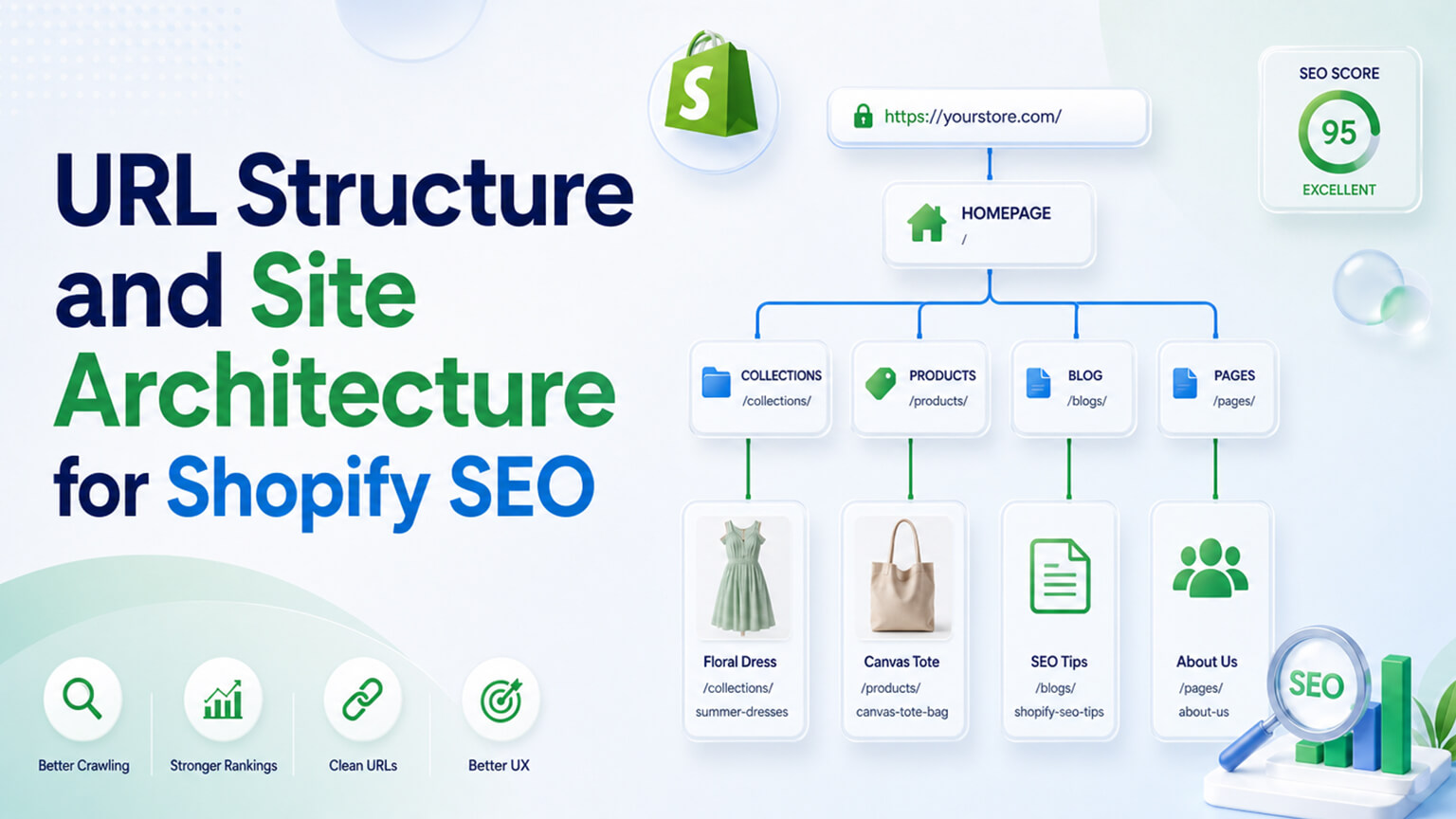
Site architecture — how your store’s pages are organised, structured, and linked — is one of the foundational, often-underappreciated parts of ecommerce SEO. It affects how search engines (and AI engines) crawl and understand your store, how authority flows through your pages, how easily users navigate, and how well your store ranks. On Shopify specifically, site architecture has some particular characteristics: Shopify imposes a fixed URL structure (with `/products/`, `/collections/`, `/pages/`, `/blogs/` prefixes you can’t remove), which has some implications, while the broader architecture (how you organise collections, the hierarchy, the internal linking, the navigation) is fully in your control and is where the SEO work lies. So getting Shopify site architecture right for SEO means understanding the fixed URL structure (and its quirks) and, more importantly, building good architecture within it — a logical, well-organised, well-linked structure that helps search engines, AI engines, and users.
This piece covers Shopify’s URL structure and its quirks, the principles of good site architecture for SEO, and how to build good architecture on Shopify. Because while you can’t change Shopify’s URL prefixes, the architecture you build within Shopify (organisation, hierarchy, linking, navigation) matters a lot for SEO and is fully yours to get right. Let me walk through it.
Shopify’s URL structure and its quirks
Shopify imposes a fixed URL structure that you should understand. The prefixes — Shopify uses fixed prefixes: `/products/` for product pages, `/collections/` for collection pages, `/pages/` for content pages, `/blogs/` for blog content — and you can’t remove these prefixes (they’re baked into Shopify’s URL structure). The product-in-collection quirk — by default, when you navigate to a product through a collection, Shopify can generate a URL like `/collections/collection-name/products/product-name`, which duplicates the product at multiple URLs; the fix is that Shopify uses canonical tags pointing to the clean `/products/product-name` URL (so the canonical handles the duplication, as the duplicate-content discussion covers), but it’s a quirk to be aware of. The handle (slug) — the part of the URL after the prefix (the product or collection “handle”) is yours to set, and it should be clean, descriptive, and keyword-relevant (e.g., `/products/merino-wool-sweater` not `/products/product-123`). And limited nesting — Shopify’s URL structure is relatively flat (prefixes plus handle), without deep folder nesting, which is fine for SEO (flat structures are crawlable) but means the “hierarchy” is expressed through linking and collections rather than URL nesting.
So Shopify’s URL structure is fixed in its prefixes (you can’t remove `/products/`, `/collections/`, etc.) and relatively flat, with the handle (slug) being the part you control and should make clean and descriptive. The main quirk to handle is the product-in-collection duplicate URL, which Shopify’s canonical tags address (pointing to the clean product URL). Beyond these fixed characteristics and the canonical-handled quirk, the URL structure is workable for SEO — the prefixes don’t hurt, flat structures are crawlable, and clean handles help. So understand the fixed URL structure (prefixes, flatness, the canonical-handled product-in-collection quirk) and control what you can (clean, descriptive handles), and Shopify’s URL structure is fine for SEO. The more important architecture work is in the broader structure you build, which is fully in your control.
Principles of good site architecture for SEO
Good site architecture, regardless of platform, follows some principles that matter for SEO. Logical organisation — pages organised logically (a sensible hierarchy and grouping that makes sense to users and search engines), so the structure is understandable. Shallow depth — important pages reachable in few clicks from the homepage (a shallow, not deeply-buried, structure), so they’re easily crawled and have authority flow to them. Authority flow — internal linking and structure flowing authority to important pages (as the internal-linking discussion covers), so your key pages (important collections, products) have the authority to rank. Clear hierarchy — a clear hierarchy (homepage → main collections → sub-collections/products) that expresses the relationships and importance of pages. Crawlability — a structure that search engines (and AI engines) can crawl and understand fully, with no important pages orphaned or buried. And user navigation — a structure that’s also good for users to navigate (good architecture serves both SEO and UX, as they align here).
So good site architecture means logical organisation, shallow depth (important pages reachable quickly), authority flow (linking and structure flowing authority to key pages), clear hierarchy, full crawlability, and good user navigation — a structure that helps search engines and AI engines crawl and understand the store, flows authority to important pages, and serves users. These principles apply to Shopify (within its URL structure) — the architecture you build (organisation, hierarchy, linking, navigation) should follow them. So good architecture is logical, shallow, authority-flowing, clearly hierarchical, crawlable, and user-friendly — principles that matter for SEO and are fully in your control on Shopify. The next section covers building this on Shopify specifically.
Building good architecture on Shopify
On Shopify, you build good architecture through several levers, all in your control. Collections as the hierarchy — collections are Shopify’s main organising structure, so use them to build a logical hierarchy (main collections for major categories, sub-collections/refinements for sub-categories), creating the structure and hierarchy of your store. This is the core architectural work — a well-organised collection structure (logical, comprehensive, hierarchical) is good architecture. Navigation — your menu/navigation expresses and provides access to the hierarchy, so design it to reflect the logical structure and make important pages reachable (shallow depth), serving both crawlability and users. Internal linking — link between pages (collections, products, content) to flow authority and express relationships (as the internal-linking discussion covers), building the architecture’s link structure. Clean handles — set clean, descriptive handles (slugs) for products, collections, and pages, contributing to clean URLs. Content structure — organise content (blog clusters, as the topical-authority discussion covers) logically and link it well, building the content architecture. And avoiding orphans/burial — ensure all important pages are linked and reachable (not orphaned or buried), so they’re crawlable and have authority.
So on Shopify, you build good architecture through your collection structure (the main hierarchy), navigation (expressing and accessing it), internal linking (flowing authority, expressing relationships), clean handles, content organisation, and avoiding orphaned/buried pages — all levers in your control, within Shopify’s fixed URL structure. Done well, this creates a logical, shallow, authority-flowing, crawlable, user-friendly architecture that helps your store rank and be understood by search and AI engines. So focus the architecture work on these controllable levers — especially the collection structure (the core hierarchy) and internal linking (authority flow) — building good architecture within Shopify’s URL structure. This architecture work, often underappreciated, is foundational SEO that pays off in crawlability, authority flow, and rankings.
A worked example: structuring an outdoor gear store
Picture an outdoor gear store with hundreds of products across camping, hiking, climbing, and water sports. A poorly-architected version of this store might dump everything into a handful of giant collections, bury important category pages three or four clicks deep in the navigation, leave many products reachable only through search, and link inconsistently — leaving search engines with a flat, undifferentiated pile of pages and no clear signal about what’s important.
A well-architected version looks different. At the top sit the major categories as main collections — Camping, Hiking, Climbing, Water Sports — each reachable in one click from the homepage navigation. Under each, logical sub-collections express the next level: under Camping, you’d have Tents, Sleeping Bags, Camp Kitchen, and so on, each a collection with its own optimised page targeting how people actually search (“two-person tents,” “down sleeping bags”). The navigation menu mirrors this hierarchy, so both users and crawlers can see the structure and reach any important category in one or two clicks. Internal linking reinforces it: category pages link to their key sub-categories and best products, related products link to each other, and buying-guide blog content links into the relevant collections (and vice versa), flowing authority from content to commercial pages and expressing topical relationships. Handles are clean and descriptive throughout (`/collections/two-person-tents`, `/products/ultralight-down-sleeping-bag`). No important collection or hero product is orphaned or buried.
The result is a store where search engines can crawl everything, clearly see the hierarchy and what’s important, and flow authority to the key category and product pages — and where users can navigate intuitively. Same products, same platform, same URL prefixes; dramatically better architecture, and dramatically better SEO foundation. That contrast is the whole point: Shopify’s fixed URL structure is not what determines your architectural SEO — the collection structure, navigation, and internal linking you build within it are, and they’re entirely yours to get right.
Common architecture mistakes on Shopify
A few architectural mistakes show up again and again on Shopify stores, and they’re worth naming so you can avoid them. The first is the “everything in one collection” trap — a store with thousands of products and only a handful of broad collections, which leaves search engines without granular category pages to rank for specific searches and gives users no way to narrow down. The fix is a proper collection hierarchy with sub-collections that match how people actually search.
The second is over-burying important pages — putting key collections four or five clicks deep, or only reachable through a mega-menu that crawlers struggle with, so authority never reaches them. The fix is shallow depth: important pages one or two clicks from the homepage, linked clearly. The third is orphaned pages — products or collections that exist but aren’t linked from anywhere navigable, so they’re effectively invisible to both crawlers and users. The fix is ensuring everything important is linked and reachable. The fourth is messy handles — auto-generated or non-descriptive slugs (`/products/copy-of-product-2`), or worse, changing handles without redirects (breaking links and losing the URL’s accumulated authority). The fix is clean, descriptive, stable handles, with 301 redirects whenever a handle must change. And the fifth is inconsistent or thin internal linking — pages that don’t link to related pages, so authority doesn’t flow and relationships aren’t expressed. The fix is deliberate internal linking between collections, products, and content.
Each of these mistakes is an architecture problem, not a URL-structure problem — which underscores the theme: Shopify’s fixed URLs aren’t what trips stores up; the architecture decisions within them are. Avoid these five, and you’ve avoided most of the architectural SEO problems Shopify stores actually suffer from.
How architecture helps AI engines too
It’s worth noting that good architecture doesn’t just help traditional search crawlers — it helps AI engines understand and cite your store too. AI crawlers, like search crawlers, need to access, crawl, and understand your content, and a logical, well-structured, well-linked, crawlable architecture makes that possible. A clear hierarchy and good internal linking help AI engines understand the relationships between your pages and the topical authority you’ve built (which content supports which, what your store is authoritative about), which feeds into being a source AI engines trust and cite, as the GEO discussion covers.
Conversely, a messy architecture — orphaned pages, buried content, no clear hierarchy, thin linking — makes it harder for AI engines (like search engines) to crawl, understand, and trust your content, undermining both your search SEO and your AI discoverability. So the same architecture work that serves traditional SEO (logical organisation, shallow depth, authority flow, clear hierarchy, crawlability, good linking) also serves AI discoverability — it’s the shared foundation that the SEO/GEO discussion describes. This is one more reason architecture is worth getting right: it’s foundational not just for ranking in search but for being understood and cited by AI engines, so the investment pays off across the whole evolving discovery landscape, not just traditional search.
Sitemaps, crawl efficiency, and Shopify’s automation
A practical note: Shopify automatically generates an XML sitemap (at `/sitemap.xml`) listing your products, collections, pages, and blog content, and submits a clean signal of your URLs to search engines. This helps crawlers discover your pages, but it doesn’t substitute for good architecture — a sitemap tells engines the pages exist, while architecture (hierarchy, linking, navigation) tells them what’s important and how pages relate, and flows authority. So lean on the automatic sitemap for discovery, but don’t mistake it for architecture; the linking and hierarchy still do the heavy lifting for rankings.
Crawl efficiency is the other practical angle. A clean, shallow, well-linked architecture lets crawlers spend their crawl budget on your important pages rather than getting lost in buried or duplicated URLs. On most Shopify stores crawl budget isn’t a pressing constraint, but for large catalogues it matters, and a tidy architecture (clear hierarchy, no orphans, canonical-handled duplicates, clean handles) keeps crawling efficient and focused on what counts. So the architecture work pays off here too — efficient, focused crawling of your important pages.
The bottom line
Site architecture — how your store’s pages are organised, structured, and linked — is foundational, often-underappreciated ecommerce SEO, affecting how search and AI engines crawl and understand your store, how authority flows, how users navigate, and how well you rank. On Shopify, architecture has two parts. The URL structure is fixed: Shopify imposes prefixes (`/products/`, `/collections/`, `/pages/`, `/blogs/`) you can’t remove, is relatively flat, and has a product-in-collection duplicate-URL quirk that Shopify’s canonical tags handle (pointing to the clean product URL) — but the handle (slug) is yours to make clean and descriptive, and overall the URL structure is fine for SEO once you understand it. The more important part — the broader architecture (collection structure, hierarchy, navigation, internal linking, content organisation) — is fully in your control and is where the real SEO work lies. Build it following good-architecture principles: logical organisation, shallow depth (important pages reachable in few clicks), authority flow (linking and structure flowing authority to key pages), clear hierarchy, full crawlability, and good user navigation. On Shopify, you do this through your collection structure (the core hierarchy), navigation (expressing and accessing it), internal linking (flowing authority, expressing relationships), clean handles, logical content organisation, and avoiding orphaned or buried pages. Done well, this creates a logical, shallow, authority-flowing, crawlable, user-friendly architecture that helps your store rank and be understood by search and AI engines. So understand and work within Shopify’s fixed URL structure, but focus your energy on the controllable architecture — especially the collection structure and internal linking — and you’ll have the foundational architectural SEO that pays off in crawlability, authority flow, and rankings.
Frequently asked questions
Can I remove the /products/ and /collections/ from Shopify URLs?
No — Shopify imposes these prefixes as part of its fixed URL structure, and you can’t remove them. But this is fine for SEO: the prefixes don’t hurt rankings, and search engines handle them without issue. What you can control is the handle (slug) after the prefix, which you should make clean, descriptive, and keyword-relevant (e.g., `/products/merino-wool-sweater` rather than `/products/product-123`). Focus on the controllable parts — clean handles and good overall architecture — rather than worrying about the fixed prefixes.
What is the Shopify product-in-collection duplicate URL issue?
By default, when a product is reached through a collection, Shopify can generate a URL like `/collections/collection-name/products/product-name`, which makes the same product accessible at multiple URLs (a form of duplicate content). Shopify handles this with canonical tags that point to the clean `/products/product-name` URL, telling search engines which version is canonical — so the duplication is managed automatically. It’s a quirk to be aware of, but Shopify’s built-in canonicalisation addresses it, so it’s not generally a problem you need to fix manually.
How important is site architecture for Shopify SEO?
Very — it’s foundational and often underappreciated. Architecture affects how search and AI engines crawl and understand your store, how authority flows to your important pages, how easily users navigate, and how well you rank. While Shopify fixes the URL structure, the broader architecture (collection structure, hierarchy, navigation, internal linking, content organisation) is fully in your control and is where the SEO work lies. Good architecture — logical, shallow, authority-flowing, crawlable, user-friendly — is a real ranking advantage, so it’s worth investing in.
How do I build good architecture on Shopify?
Use collections as your main organising hierarchy (main collections for major categories, sub-collections for sub-categories), build a logical, comprehensive structure, and design your navigation to express that hierarchy and keep important pages reachable in few clicks. Use internal linking to flow authority to key pages and express relationships, set clean descriptive handles, organise content (blog clusters) logically and link it well, and ensure no important pages are orphaned or buried. Focus especially on the collection structure (the core hierarchy) and internal linking (authority flow) — these controllable levers are where good Shopify architecture is built.
Does site architecture affect how AI engines see my store?
Yes. AI crawlers, like search crawlers, need to access, crawl, and understand your content, and a logical, well-structured, well-linked, crawlable architecture makes that possible — while a clear hierarchy and good internal linking help AI engines understand your pages’ relationships and the topical authority you’ve built, feeding into being a source AI trusts and cites. A messy architecture (orphaned pages, buried content, no clear hierarchy, thin linking) undermines both search SEO and AI discoverability. So the same architecture work serves both, which is one more reason to get it right.
Do I need to submit a sitemap on Shopify?
Shopify automatically generates an XML sitemap at `/sitemap.xml` listing your products, collections, pages, and blog content, so you don’t need to build one manually — you can submit that URL in Google Search Console to help discovery. But remember the sitemap only tells engines your pages exist; it doesn’t convey what’s important or how pages relate. That’s the job of your architecture (hierarchy, navigation, internal linking), which flows authority and expresses importance. So use the automatic sitemap for discovery and crawl efficiency, but invest in the architecture for the rankings.