
Upsells and Cross-Sells on Shopify, Done Tastefully
On this page
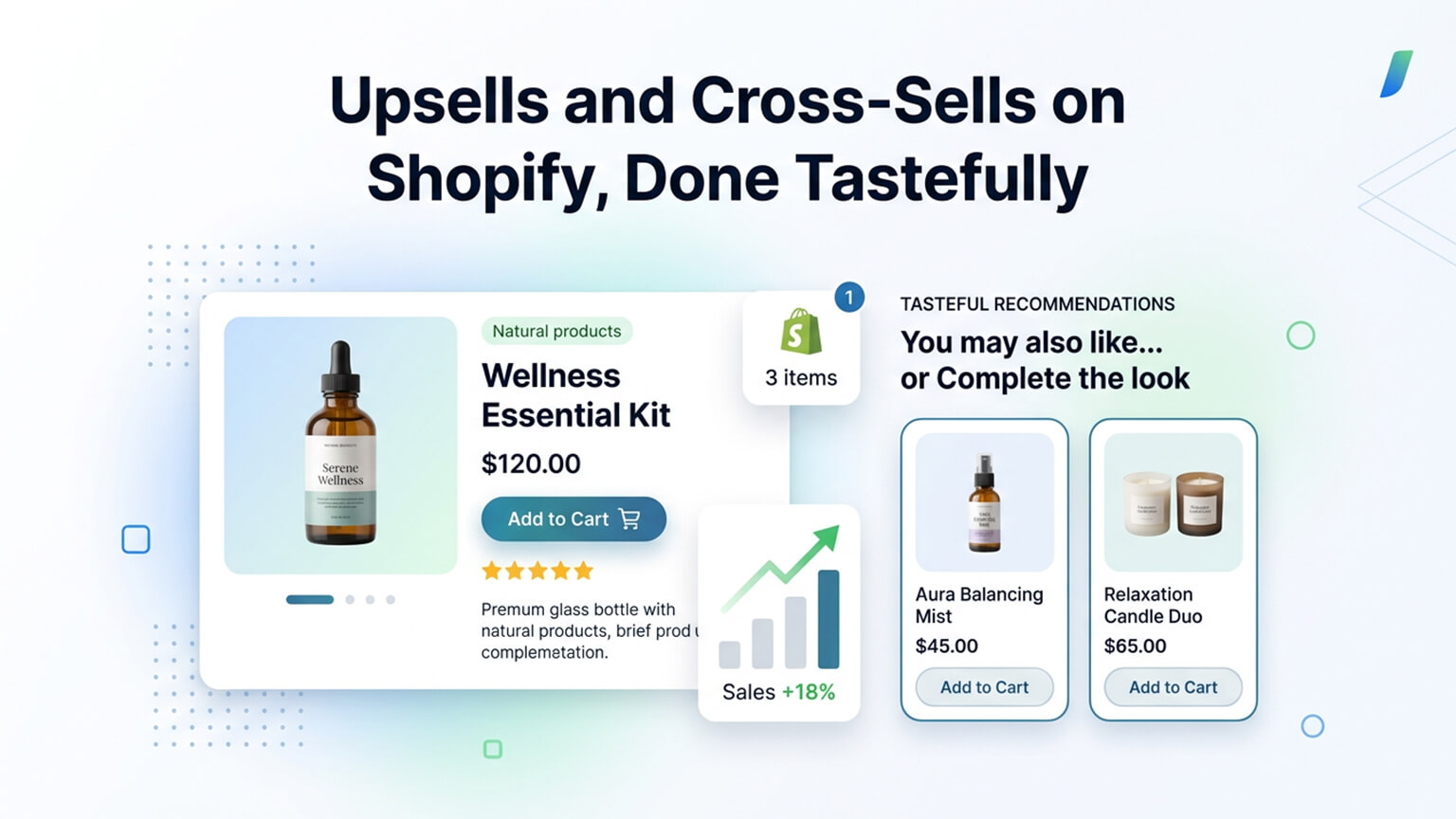
Upselling (encouraging a customer to buy a higher-end version or add-on) and cross-selling (suggesting related or complementary products) are among the most common ways to raise average order value in ecommerce. Done well, they help customers (suggesting relevant products or useful upgrades they’re glad to know about) and raise AOV (more per order), a win-win. Done badly — aggressive, irrelevant, pushy upsells and cross-sells that pressure or annoy — they harm the experience, frustrate customers, and can hurt conversion and trust. So as with email capture, the key is doing upsells and cross-sells tastefully and effectively: raising AOV by helping customers find relevant additions and upgrades, without pressuring or annoying them. It’s a balance, and getting it right turns upsells and cross-sells into a win-win (more AOV, happier customers) rather than a lose-lose (annoyed customers, hurt trust).
This piece covers the difference between upsells and cross-sells, why they work (when done well), how to do them tastefully (the balance), where and how to implement them on Shopify, and the pitfalls to avoid. Because they’re a high-impact AOV lever, but only when done tastefully — relevant and helpful, not pushy and annoying. Let me walk through it.
Upsells vs. cross-sells
First, the distinction. Upselling — encouraging the customer to buy a higher-end, upgraded, or larger version of what they’re considering (e.g., a larger size, a premium model, a bundle, an upgrade), raising the value of that purchase. The customer gets a better/bigger version; you get more revenue. Cross-selling — suggesting related or complementary products to add to the purchase (e.g., accessories for a product, items that go with it, “frequently bought together”), adding items to the order. The customer gets useful complementary products; you get more items per order. Both raise AOV — upselling by increasing the value of the item, cross-selling by adding items — and both, done well, help the customer (a better version, or useful complements) while raising AOV. The distinction matters because they’re used in slightly different ways (upsell: a better version of what they’re looking at; cross-sell: complementary additions), but the principles (relevant, helpful, tasteful) are the same.
So upselling is encouraging a higher-end/upgraded version (raising the item’s value), and cross-selling is suggesting complementary products (adding items) — both raising AOV, both helping the customer when done well (a better version, or useful complements). In practice, stores use both (upselling to a better version, cross-selling complementary items), often in the same places (product page, cart). The key for both is the same: relevant, helpful, tasteful suggestions that serve the customer while raising AOV — not pushy, irrelevant pressure. So understand the distinction (upsell: better version; cross-sell: complements) but apply the same principles (relevant, helpful, tasteful) to both, which the rest of this covers. Both are valuable AOV levers when done tastefully.
Why they work (when done well)
Upsells and cross-sells work, when done well, for several reasons. Raise AOV — the primary benefit: upselling raises the item value, cross-selling adds items, both increasing revenue per order (a high-impact AOV lever, as the AOV discussion covers). Help the customer — done well (relevant suggestions), they help: an upsell to a better version the customer is glad to know about, or a cross-sell of a complementary product they need (accessories, items that go with the purchase), so the customer benefits from relevant suggestions. Relevant timing — suggested at the right moment (considering a product, in the cart), relevant suggestions catch the customer when they’re buying and open to relevant additions/upgrades. Increase satisfaction — relevant upsells/cross-sells can increase satisfaction (the customer gets a better solution — the right version, the needed accessories), supporting a better outcome. And efficient — selling more to an existing customer (in the same order) is efficient (no additional acquisition cost), making upsell/cross-sell revenue high-margin and valuable.
So upsells and cross-sells work (done well) by raising AOV (the primary benefit), helping the customer (relevant upgrades and complements), catching them at the right moment, increasing satisfaction (a better solution), and being efficient (selling more to an existing customer, no extra acquisition cost). These benefits make them a high-impact, efficient AOV lever — when done well (relevant, helpful, tasteful). The “done well” caveat is crucial: the benefits come from relevant, helpful suggestions (serving the customer), while irrelevant, pushy upsells/cross-sells produce the opposite (annoyance, hurt trust), as the pitfalls cover. So the value is real but conditional on tasteful, relevant execution — which the next section covers. Done well, upsells and cross-sells are a win-win (more AOV, helped customers); done badly, a lose-lose.
Doing them tastefully: the balance
As with email capture, the key is the balance between effectiveness (raising AOV) and tastefulness (not annoying customers). The risk — aggressive, irrelevant, pushy upsells/cross-sells (pressuring, cluttering, irrelevant suggestions, too many) harm the experience, annoy customers, and can hurt conversion and trust (a pushy upsell at checkout can even cause cart abandonment). The goal — raising AOV through relevant, helpful suggestions while keeping the experience good (not pressuring or annoying), so you get the AOV lift without the downsides. Tasteful practices — relevant suggestions (related/complementary, or genuine upgrades — relevance is the key to tastefulness), good placement and timing (suggested at appropriate moments — product page, cart — not pushily interrupting), not pushy (suggesting, not pressuring), not cluttering (a few relevant suggestions, not overwhelming), helpful framing (presenting them as helpful suggestions — “goes well with,” “customers also bought,” “upgrade to” — not pressure), and easy to ignore (the customer can easily decline/ignore, not be trapped).
So doing upsells and cross-sells tastefully means the balance: effective (raising AOV) but tasteful (relevant, well-placed, not pushy, not cluttering, helpfully framed, easy to ignore), so you get the AOV lift without annoying customers. Relevance is the heart of tastefulness — relevant suggestions help (tasteful and effective), while irrelevant ones annoy (untasteful and ineffective), so relevance (good product relationships, recommendations) is the key. So aim for the balance: relevant, helpful, well-placed, non-pushy suggestions that raise AOV while serving the customer, not aggressive, irrelevant, cluttering pressure. This tasteful balance is what makes upsells and cross-sells a win-win. The specific implementations (where and how) should all be executed within this tasteful, relevance-driven balance.
Where and how to implement on Shopify
On Shopify, upsells and cross-sells can be implemented in several places and ways. Product page — cross-sells (“goes well with,” “complete the look,” “frequently bought together”) and upsells (upgrade options, premium versions) on the product page, suggesting relevant additions/upgrades as the customer considers a product. Cart/cart drawer — cross-sells and upsells in the cart or cart drawer (as the cart-drawer discussion covers — tasteful additions, “add this,” “you might also need”), catching the customer as they review their cart, a common high-impact placement. Post-purchase — post-purchase upsells (offered after checkout, on the thank-you page — “add this to your order”), which don’t interrupt the purchase (it’s done) and can add to the order, a tasteful, effective placement (no risk of disrupting the original conversion). Checkout (Plus) — on Shopify Plus, checkout upsells (via checkout extensibility, as that discussion covers) can be added, though tastefully (checkout pressure risks abandonment). Implementation — via apps (many upsell/cross-sell apps, weighing bloat as the app-speed discussion covers), Shopify’s native recommendations (product recommendations API), or custom development, with good product-relationship data (what complements what) driving relevance. And recommendations quality — relevance depends on good recommendations (related products, “frequently bought together” data, sensible product relationships), so the quality of recommendations drives tastefulness and effectiveness.
So implement upsells and cross-sells on the product page (relevant complements/upgrades), in the cart/cart drawer (tasteful additions — high-impact), post-purchase (on the thank-you page — tasteful, no conversion risk), and at checkout (Plus, tastefully), via apps (weigh bloat), native recommendations, or custom development, with good product-relationship data driving relevance. Post-purchase upsells are especially tasteful (they don’t risk the original conversion — the purchase is done), making them a low-risk, effective placement worth using. So choose placements (product page, cart, post-purchase, checkout) and implement with relevance (good recommendations data) and tastefulness, capturing AOV across the journey without pressuring. The combination of tasteful placements (especially product page, cart, and post-purchase) with relevant recommendations is how you implement upsells/cross-sells effectively on Shopify.
Pitfalls to avoid
Upsells and cross-sells have pitfalls to avoid. Irrelevance — irrelevant suggestions (unrelated products, nonsensical recommendations) annoy customers and don’t convert, so relevance (good recommendations) is essential (the key pitfall). Pushiness/pressure — aggressive, pressuring upsells/cross-sells (especially at checkout) harm the experience and can cause abandonment, so suggest, don’t pressure. Clutter — too many suggestions (overwhelming the page/cart with upsells/cross-sells) clutters and harms the experience, so keep it focused (a few relevant suggestions). Disrupting conversion — upsells/cross-sells that disrupt the path to purchase (interrupting checkout, distracting from completing the order) can hurt conversion, so don’t let AOV efforts undermine conversion (post-purchase upsells avoid this). App bloat — upsell/cross-sell apps add bloat (as the app-speed discussion covers), so weigh app use against the benefit and cleaner options. And bad data/recommendations — poor product-relationship data produces irrelevant recommendations, so invest in good recommendations (the foundation of relevance).
So the pitfalls to avoid are irrelevance (ensure relevance — the key one), pushiness/pressure (suggest, don’t pressure), clutter (keep it focused), disrupting conversion (don’t undermine the purchase — post-purchase avoids this), app bloat (weigh app use), and bad recommendations data (invest in good recommendations). Avoiding these — through relevant recommendations, non-pushy framing, focused (not cluttered) placement, not disrupting conversion, weighing apps, and good data — is what keeps upsells and cross-sells tasteful and effective (raising AOV, helping customers) rather than annoying and counterproductive. The biggest pitfall is irrelevance (irrelevant suggestions annoy and don’t work), so relevance (good recommendations, sensible product relationships) is the foundation of getting upsells and cross-sells right. So implement them tastefully, relevantly, and carefully, avoiding these pitfalls, and they’re a high-impact, win-win AOV lever.
A worked example: a coffee equipment store
Picture a store selling coffee equipment — grinders, espresso machines, accessories — and how tasteful upsells and cross-sells work across the journey. A shopper lands on a mid-range espresso machine. On the product page, a tasteful upsell presents the next model up (“Upgrade to the [Pro] for a built-in grinder and larger boiler — $X more”), framed as a genuine improvement for someone serious about espresso, easy to ignore if they’re happy with their choice. Below it, relevant cross-sells appear under “Complete your setup”: a grinder, a tamper, descaling solution, and a set of cups — complementary items the customer will likely need, not random products. This is helpful, not pushy: it surfaces things a new espresso-machine owner actually wants to know about.
When the shopper adds the machine to the cart, the cart drawer shows one or two high-relevance cross-sells (“Most people add a grinder — here are two that pair well”) plus the free-shipping progress, nudging a useful addition without cluttering. Crucially, the store doesn’t pile a pushy upsell into the checkout itself (where pressure risks abandonment). Instead, after the purchase completes, the thank-you page offers a tasteful post-purchase upsell: “Add a starter pack of beans and a cleaning kit to your order — one click, ships together.” Because the purchase is already done, this adds AOV with zero risk to the original conversion. The recommendations throughout are driven by real product-relationship data (what pairs with an espresso machine), so they’re relevant rather than generic. The result is a meaningful AOV lift across the journey — upgrades, complementary accessories, post-purchase additions — achieved by helping the customer build the right setup, not by pressuring them. That’s the win-win in practice: more revenue per order and a customer who feels well-served, because every suggestion was relevant, well-placed, and easy to take or leave.
Measuring whether they’re working
Like any conversion tactic, upsells and cross-sells should be measured rather than assumed to work, because a poorly-executed one can quietly cost more than it earns. The headline metric is the effect on average order value — are orders that include an upsell or cross-sell larger, and is overall AOV rising? But AOV alone isn’t enough; you also need to watch conversion rate and abandonment, because an aggressive upsell or cross-sell that lifts AOV on completed orders while suppressing the overall conversion rate (scaring some shoppers off) can be a net loss. The right question is whether total revenue (and ideally profit) is up, accounting for both AOV and conversion effects together.
Beyond that, look at the take rate of specific suggestions (which upsells and cross-sells customers actually accept), because low take rates usually signal irrelevance or poor placement — a prompt to improve the recommendations or reconsider the offer. Watch returns too, since an upsell to a product that doesn’t fit the customer’s real need can drive returns that erase the AOV gain. And test changes rather than guessing (as the A/B-testing discussion covers): try different placements, framings, and recommendation logic, and keep what lifts revenue without hurting conversion or satisfaction. This measurement discipline is what keeps upsells and cross-sells honest — ensuring they’re the win-win they should be (more revenue, helped customers) rather than a tactic that looks good on AOV while quietly costing conversions, trust, or returns. So instrument them, watch the full picture (AOV, conversion, take rate, returns), and optimise based on real results.
The bottom line
Upselling (encouraging a higher-end or upgraded version) and cross-selling (suggesting related or complementary products) are among the most common and high-impact ways to raise average order value in ecommerce — and done well, they’re a win-win, helping customers (relevant upgrades and complements they’re glad to know about) while raising AOV (more per order), efficiently (selling more to an existing customer, no extra acquisition cost). But done badly — aggressive, irrelevant, pushy suggestions that pressure, clutter, or annoy — they harm the experience, frustrate customers, and can hurt conversion and trust. So as with email capture, the key is the balance between effectiveness (raising AOV) and tastefulness (not annoying customers): relevant suggestions (relevance is the heart of tastefulness), good placement and timing (product page, cart, post-purchase), non-pushy framing (suggesting, not pressuring), focused (not cluttering), helpfully presented, and easy to ignore. Implement them on Shopify on the product page (relevant complements and upgrades), in the cart/cart drawer (tasteful additions — high-impact), post-purchase (on the thank-you page — especially tasteful, since it doesn’t risk the original conversion), and at checkout (Plus, tastefully) — via apps (weighing bloat), native recommendations, or custom development, with good product-relationship data driving relevance. And avoid the pitfalls: irrelevance (the key one — ensure relevance through good recommendations), pushiness and pressure (suggest, don’t pressure — especially avoid disrupting checkout), clutter (keep it focused), disrupting conversion (post-purchase upsells avoid this), app bloat (weigh app use), and bad recommendations data. Done tastefully and relevantly — helping customers find relevant additions and upgrades without pressuring or annoying them — upsells and cross-sells are a high-impact, win-win AOV lever (more revenue, happier customers); done badly, a lose-lose. So get the balance right, lead with relevance, and they become one of your most efficient AOV levers.
Frequently asked questions
What’s the difference between upselling and cross-selling?
Upselling encourages the customer to buy a higher-end, upgraded, or larger version of what they’re considering (a premium model, a larger size, an upgrade), raising the value of that item. Cross-selling suggests related or complementary products to add to the purchase (accessories, items that go with it, “frequently bought together”), adding items to the order. Both raise average order value — upselling by increasing the item’s value, cross-selling by adding items — and both, done well, help the customer (a better version, or useful complements). They’re often used together and in the same places (product page, cart), and the same principles apply to both: relevant, helpful, tasteful suggestions, not pushy or irrelevant pressure.
How do I do upsells and cross-sells without annoying customers?
The key is the balance between effectiveness and tastefulness, with relevance at its heart. Make suggestions relevant (related or complementary products, or genuine upgrades — irrelevant suggestions are the main thing that annoys), place them well (product page, cart, post-purchase — not pushily interrupting), frame them helpfully (“goes well with,” “customers also bought,” “upgrade to” — not pressure), keep them focused (a few relevant suggestions, not overwhelming clutter), and make them easy to ignore (suggesting, not trapping). Relevant, helpful, well-placed, non-pushy suggestions raise AOV while serving the customer; aggressive, irrelevant, cluttering pressure annoys and can hurt conversion and trust.
Where should I put upsells and cross-sells on my Shopify store?
Common high-impact placements are the product page (relevant complements and upgrades as the customer considers a product), the cart or cart drawer (tasteful additions as they review their cart), and post-purchase (on the thank-you page after checkout). Post-purchase upsells are especially tasteful and low-risk because they don’t interrupt or risk the original purchase — it’s already done — so they can add to the order without any chance of disrupting the conversion. On Shopify Plus, you can also add checkout upsells via checkout extensibility, but do so carefully, as checkout pressure risks abandonment. Across all placements, relevance (driven by good product-relationship data) is what makes them work.
What’s the biggest mistake with upsells and cross-sells?
Irrelevance — suggesting unrelated products or nonsensical recommendations that don’t match what the customer wants. Irrelevant suggestions annoy customers and don’t convert, undermining both the experience and the AOV goal, so relevance (good recommendations, sensible product relationships, quality product-relationship data) is the foundation of getting upsells and cross-sells right. The other big mistakes are pushiness/pressure (especially aggressive upsells at checkout that can cause abandonment — suggest, don’t pressure) and clutter (too many suggestions overwhelming the experience). Lead with relevance, frame helpfully rather than pushily, keep it focused, and avoid disrupting the path to purchase, and you avoid the main ways upsells and cross-sells go wrong.