
Shopify Markets: Selling Internationally With Multi-Currency and Multi-Language
On this page
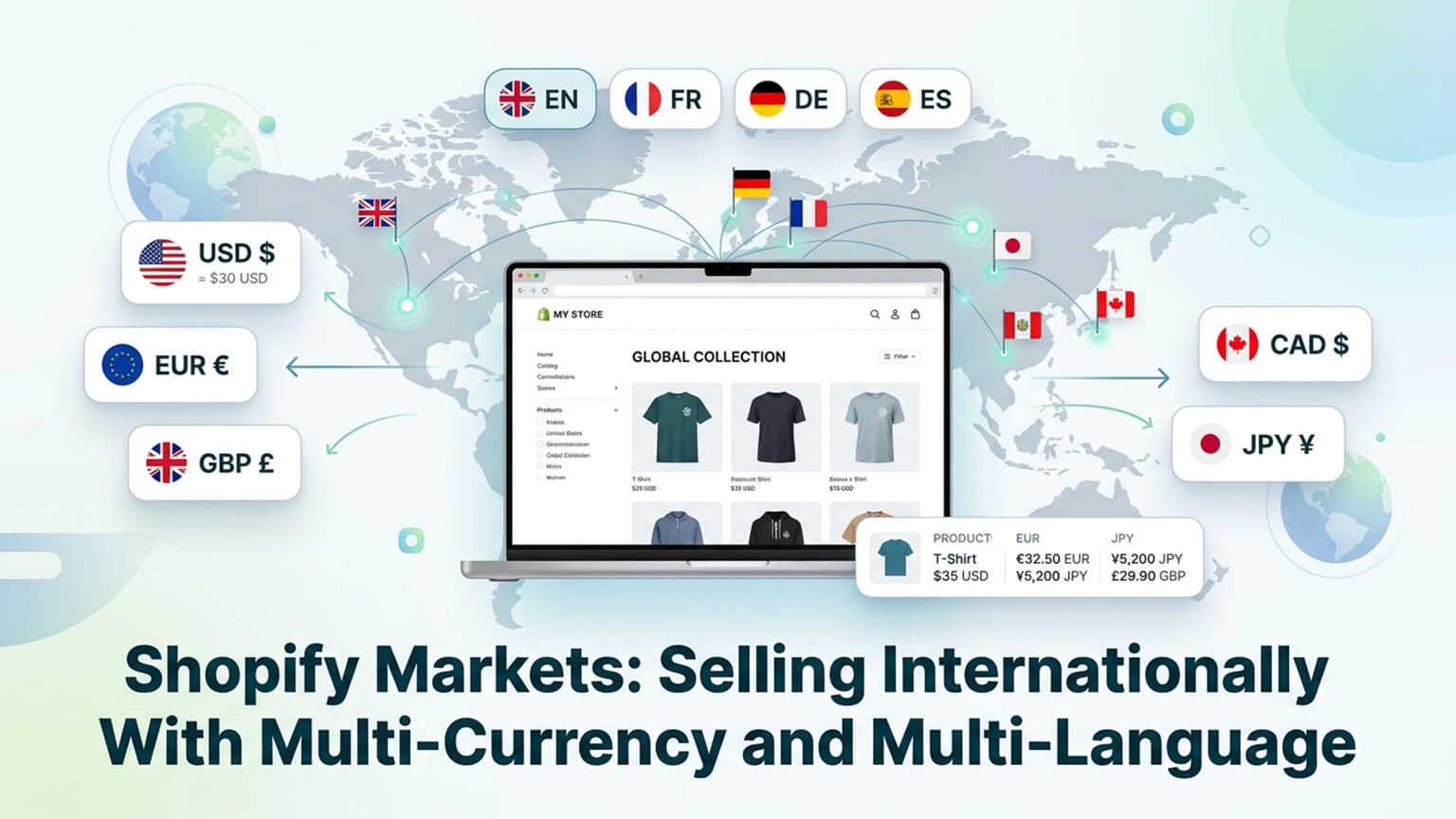
Selling internationally is a major growth opportunity for many Shopify merchants — reaching customers in other countries can substantially expand your market. But doing it well requires handling the things international customers expect: local currency (seeing prices in their currency), local language (the store in their language), local pricing (appropriate prices per market), local payment methods, duties and taxes handled correctly, and more. Shopify Markets is Shopify’s built-in feature for managing international selling — letting you sell to multiple countries/regions from your store, with multi-currency, multi-language, local pricing, and the tools to manage international commerce, without necessarily running separate stores. So Shopify Markets is the central tool for international selling on Shopify, and understanding what it does, how it works, and how to set it up well helps you expand internationally effectively. This piece explains it.
This piece covers what Shopify Markets is and does, the key capabilities (multi-currency, multi-language, local pricing, and more), how to set it up well, and the considerations for international selling. Because international expansion is a big opportunity, and Shopify Markets is the tool for it — understanding it helps you expand well. Let me walk through it. (Note: Shopify’s exact features and availability evolve, so verify current specifics; this covers the general capabilities.)
What Shopify Markets is and does
Shopify Markets is Shopify’s feature for managing international (and multi-region) selling from your store. What it does — it lets you sell to multiple countries/regions, managing the localisation each market needs (currency, language, pricing, domains, duties/taxes, payment methods) from a unified setup, rather than necessarily running separate stores per country. The concept — you define “markets” (countries or groups of countries you sell to), and for each market, you can configure localisation: currency, language, pricing, domain/URL, and other settings, so customers in each market get an appropriate localised experience. Unified management — Markets lets you manage international selling from your main store/admin (one catalogue, unified management), with per-market localisation, rather than the complexity of separate stores (though separate stores remain an option for cases needing full separation, as the going-international discussion covers). And built-in — Markets is built into Shopify (available across plans, with more capability on higher plans/Plus), so it’s the native, integrated way to sell internationally.
So Shopify Markets is the built-in feature for selling internationally from your store, letting you define markets (countries/regions) and configure per-market localisation (currency, language, pricing, domain, duties/taxes, payments), managing international commerce from a unified setup rather than separate stores. It’s the native, integrated way to handle international selling on Shopify, simplifying what used to require separate stores or complex setups. So if you’re selling or planning to sell internationally, Shopify Markets is the central tool, and understanding its capabilities (the next section) helps you use it well. It makes international selling more accessible (built-in, unified) than the old separate-store complexity, though separate stores remain an option for cases needing full separation.
Key capabilities
Shopify Markets provides several key capabilities for international selling. Multi-currency — customers can see and pay in their local currency (Markets handles currency conversion and display, showing prices in the local currency), which is important (customers expect and trust local-currency pricing). Multi-language — the store can be presented in multiple languages (Markets supports translated content per market, so customers see the store in their language), important for non-English markets (as the translation/localisation discussion covers). Local pricing — you can set market-specific pricing (different prices per market, or price adjustments, rather than just currency conversion), so pricing is appropriate per market (accounting for local conditions, costs, competition). Domains/URLs — Markets supports per-market domains or URLs (e.g., country-specific domains or subfolders), supporting localisation and international SEO (as the going-international discussion covers). Duties and taxes — Markets can handle duties and import taxes (calculating and collecting them, so customers aren’t surprised by unexpected charges — a major international friction point), via Shopify’s duties/taxes features. Local payment methods — supporting payment methods customers in each market use (local payment preferences matter for conversion). And catalog/availability — controlling product availability and catalog per market (what’s sold where).
So Shopify Markets’ key capabilities are multi-currency (local-currency pricing and payment), multi-language (the store in local languages), local pricing (market-specific prices), domains/URLs (per-market, supporting SEO), duties and taxes (handling import charges — a major friction reducer), local payment methods, and catalog/availability control per market. These capabilities cover the main things international customers expect and the main international-selling complexities, making Markets a comprehensive tool for selling internationally. So Markets handles the core international-selling needs (currency, language, pricing, duties/taxes, payments, domains) in a unified, built-in way. The most impactful capabilities are often multi-currency (expected, builds trust), duties/taxes handling (reduces a major friction/surprise), and multi-language (essential for non-English markets) — these directly affect international conversion. So leverage Markets’ capabilities to give international customers the localised experience they expect, supporting international conversion.
How to set it up well
Setting up Shopify Markets well involves several considerations. Define markets sensibly — define your markets (countries/regions) based on where you sell and where the opportunity is, grouping or separating as makes sense (e.g., a market per major country, or grouped regions), aligned with your international strategy. Configure localisation per market — for each market, configure the localisation that matters: currency (local currency), language (translated content for non-English markets, as the translation discussion covers — do translation well, not just machine translation), pricing (market-appropriate, not just converted), domains/URLs (for SEO and localisation), and payment methods (local preferences). Handle duties and taxes — set up duties and import taxes correctly (so customers see/pay them upfront, avoiding the major friction of surprise charges at delivery), a key international-conversion factor. Get international SEO right — configure domains/URLs and hreflang correctly for international SEO (so the right market’s pages rank for the right audience, as the going-international discussion covers), avoiding international-SEO pitfalls. Localise well — go beyond currency to localise (language done well, local pricing, local payment methods, local relevance), since good localisation drives international conversion. And test per market — test the experience for each market (currency, language, pricing, checkout, duties) to ensure it works well.
So set up Markets well by defining markets sensibly (aligned with strategy), configuring localisation per market (currency, language done well, market-appropriate pricing, domains, payments), handling duties and taxes correctly (reducing the major surprise-charge friction), getting international SEO right (domains/URLs, hreflang), localising (not just currency conversion), and testing per market. The recurring theme is genuine localisation — going beyond currency conversion to a properly localised experience (language, pricing, payments, duties, local relevance) — since that’s what drives international conversion (customers convert better with a properly localised experience). So invest in genuine localisation per market, handle duties/taxes (a key friction reducer), and get international SEO right — setting up Markets to give each market a properly localised experience that converts. Done well, Markets enables effective international selling; done superficially (just currency conversion, surprise duties, poor translation), it underperforms.
Considerations for international selling
Beyond Markets setup, international selling has broader considerations. Operations — international selling adds operational complexity (international shipping, returns, customer service across time zones/languages, compliance per market), which you need to handle (Markets handles the storefront/commerce localisation, but operations are broader). Shipping and fulfillment — international shipping (cost, time, carriers, tracking) and fulfillment (possibly local fulfillment/warehouses for major markets) affect the international experience and economics. Compliance and regulations — each market has regulations (consumer law, data/privacy, product regulations, tax compliance) to comply with. Localisation depth — how deeply to localise (currency and language at minimum, but also local marketing, local relevance, local customer service) depends on the market’s importance. Markets vs. separate stores — for most international selling, Markets (unified) is simpler and sufficient, but some cases (needing full separation, very different catalogs/operations per region) may warrant separate stores (as the going-international discussion covers), so choose the right structure. And phased expansion — expanding internationally can be phased (starting with a few high-opportunity markets, localising them well, then expanding), rather than everywhere at once.
So international selling considerations beyond Markets include operations (shipping, returns, service, compliance — broader than the storefront), shipping/fulfillment (cost, time, possibly local fulfillment), compliance per market, localisation depth (how far to localise per market’s importance), Markets vs. separate stores (Markets for most, separate stores for full-separation cases), and phased expansion (start focused, expand). So while Shopify Markets handles the storefront/commerce localisation well, international selling is broader (operations, compliance, fulfillment), and succeeding internationally means handling both the storefront localisation (Markets) and the broader operational/compliance/fulfillment aspects. So approach international expansion holistically — Markets for the localised storefront, plus the operational, fulfillment, and compliance work — and consider phasing (high-opportunity markets first, localised well). Done holistically and well, international selling via Markets is a major growth opportunity; done superficially (Markets set up shallowly, operations unhandled), it underdelivers.
A worked example: a UK brand expanding into Europe and the US
Picture a UK apparel brand getting meaningful traffic and the occasional order from Germany, France, and the US, and deciding to expand properly. Here’s how a sensible Markets rollout looks. They start focused rather than going everywhere at once — three markets: Germany, France, and the US, chosen because that’s where demand already shows up. For each, they configure genuine localisation. Currency: euros for Germany and France, dollars for the US, displayed natively so shoppers never see unfamiliar pounds or a jarring conversion at checkout. Language: properly translated German and French content (done well, with human review, not raw machine translation, as the translation discussion covers), while the US stays in English with adjusted spelling and terminology. Pricing: not just converted from GBP but set to sensible local price points that account for local market conditions and competition, and that look right (round, expected numbers rather than odd conversions).
Crucially, they set up duties and import taxes so that German, French, and US shoppers see and pay any applicable charges upfront at checkout — removing the single biggest international friction, the surprise customs bill at delivery that causes refused parcels and angry emails. They configure per-market domains/URLs and hreflang so each market’s localised pages rank for the right audience and don’t compete with each other in search (getting the international SEO right, as the going-international discussion covers). They add locally-preferred payment methods. Then they test each market end to end — browsing, currency, language, checkout, duties, confirmation — before promoting it. Around the storefront, they sort the operational side: international shipping options and costs, a clear international returns process, and customer service that can handle queries in the relevant languages and time zones. The result is three properly-localised markets that convert far better than the old “ships internationally in pounds with surprise duties” setup, launched in a focused, well-executed phase they can then build on by adding more markets. That phased, -localised approach is the pattern that works — depth in a few high-opportunity markets beats shallow presence everywhere.
Common international-selling mistakes
A few mistakes show up repeatedly when merchants expand internationally, and naming them helps you avoid them. The first is treating localisation as currency conversion only — showing local-currency prices but leaving everything else (language, pricing logic, payment methods, duties) unlocalised. Customers notice, and conversion suffers, because a half-localised experience still feels foreign and risky. The second is surprise duties and taxes — not handling import charges upfront, so customers get hit with unexpected bills at delivery, leading to refused parcels, chargebacks, and lost trust; this is one of the most damaging and most common international mistakes, and Markets’ duties/taxes handling exists precisely to prevent it. The third is poor translation — relying on raw machine translation that reads awkwardly or wrongly in the target language, undermining credibility (good localisation needs human review, as the translation discussion covers).
The fourth is botched international SEO — misconfigured domains, URLs, or hreflang, so the wrong market’s pages rank for the wrong audience, or localised versions compete with each other and dilute rankings. The fifth is ignoring the operational side — nailing the localised storefront but leaving international shipping, returns, and customer service unsorted, so the post-purchase experience falls apart. And the sixth is expanding too broadly too fast — switching on dozens of markets at once and localising none of them well, rather than doing a few high-opportunity markets properly. The thread through all of these is the same: international selling rewards depth and completeness (genuine localisation plus sorted operations in focused markets) and punishes shallow, partial efforts. So as you set up Markets, treat these six as a checklist of what not to do — and you’ll avoid the ways international expansion most often disappoints relative to its real, large potential.
The bottom line
Selling internationally is a major growth opportunity for Shopify merchants, but doing it well requires giving international customers the localised experience they expect — local currency, language, pricing, payment methods, and correctly-handled duties and taxes. Shopify Markets is Shopify’s built-in feature for this: it lets you sell to multiple countries/regions from your store, defining markets and configuring per-market localisation (currency, language, pricing, domains, duties/taxes, payments), managing international commerce from a unified setup rather than necessarily running separate stores. Its key capabilities — multi-currency (local-currency pricing and payment, which builds trust), multi-language (the store in local languages), local pricing (market-appropriate, not just converted), per-market domains/URLs (supporting international SEO), duties and taxes handling (reducing the major friction of surprise charges at delivery), local payment methods, and per-market catalog/availability — cover the main international-selling needs comprehensively, with multi-currency, duties/taxes handling, and multi-language often the most impactful for conversion. Set it up well by defining markets sensibly (aligned with strategy), configuring genuine localisation per market (currency, language done well, market-appropriate pricing, domains, payments — not just currency conversion), handling duties and taxes correctly, getting international SEO right (domains/URLs, hreflang), and testing per market. And remember international selling is broader than the storefront: handle the operations (international shipping, returns, service, compliance), fulfillment (cost, time, possibly local), and compliance per market too, choose Markets (unified, sufficient for most) versus separate stores (for full-separation cases) appropriately, and consider phased expansion (high-opportunity markets first, localised well, then expand). Approached holistically and well — genuine localisation via Markets plus the broader operational, fulfillment, and compliance work — international selling is a major growth opportunity; approached superficially (shallow localisation, surprise duties, unhandled operations), it underdelivers. So use Shopify Markets to give each market a properly localised, converting experience, and handle the broader international work around it, to capture the international growth opportunity effectively.
Frequently asked questions
What is Shopify Markets?
Shopify Markets is Shopify’s built-in feature for managing international and multi-region selling from your store. It lets you define “markets” (countries or groups of countries you sell to) and configure per-market localisation — currency, language, pricing, domains/URLs, duties and taxes, and payment methods — so customers in each market get an appropriate localised experience, all managed from your main store and admin rather than necessarily running separate stores per country. It’s the native, integrated way to sell internationally on Shopify, available across plans (with more capability on higher plans and Plus), and it makes international selling more accessible than the old approach of separate stores or complex custom setups.
Does Shopify Markets handle currency conversion?
Yes — multi-currency is one of its core capabilities. Customers can see prices in and pay in their local currency, with Markets handling the conversion and display, which matters because international customers expect and trust local-currency pricing. Beyond simple conversion, Markets also lets you set market-specific local pricing (different prices per market rather than just a converted price), so you can price appropriately for each market’s conditions, costs, and competition. Local-currency pricing is one of the most impactful capabilities for international conversion, as seeing unfamiliar foreign-currency prices (or being surprised by conversion at checkout) is a common friction point that local-currency display removes.
How does Shopify Markets handle duties and taxes?
Markets can calculate and collect duties and import taxes, so international customers see and pay them upfront rather than being surprised by unexpected charges when their order is delivered — which is one of the biggest friction points and sources of refused deliveries and complaints in international selling. Handling duties and taxes correctly is a key international-conversion factor, because surprise charges at delivery create a terrible customer experience and erode trust. So setting up Shopify’s duties and import-tax features correctly (so charges are transparent and handled upfront) is an important part of selling internationally well, removing a major source of international friction and dissatisfaction.
Should I use Shopify Markets or separate stores for international selling?
For most international selling, Shopify Markets (a unified setup with per-market localisation) is simpler and sufficient — one catalogue, unified management, with the localisation each market needs. Separate stores per country add significant complexity (managing multiple stores) and are warranted mainly for cases needing full separation: very different catalogues, operations, branding, or business structures per region. So start with Markets for most international expansion, as it handles currency, language, pricing, domains, duties, and payments in a unified way, and only consider separate stores if you have a specific need for full per-region separation that Markets can’t accommodate. Choosing the simpler unified Markets approach where it suffices avoids unnecessary multi-store complexity.
What are the most common international-selling mistakes?
Six recur. Treating localisation as currency conversion only (leaving language, pricing, payments, and duties unlocalised, so the experience still feels foreign). Surprise duties and taxes (not handling import charges upfront, so customers get unexpected delivery bills — one of the most damaging mistakes, which Markets’ duties handling exists to prevent). Poor translation (raw machine translation that undermines credibility — good localisation needs human review). Botched international SEO (misconfigured domains, URLs, or hreflang, so the wrong pages rank or localised versions compete). Ignoring operations (nailing the storefront but leaving shipping, returns, and service unsorted). And expanding too broadly too fast (dozens of markets, none localised well). The common thread: international selling rewards depth and completeness in focused markets and punishes shallow, partial efforts.