
Shopify Plus Security and Compliance Overview
On this page
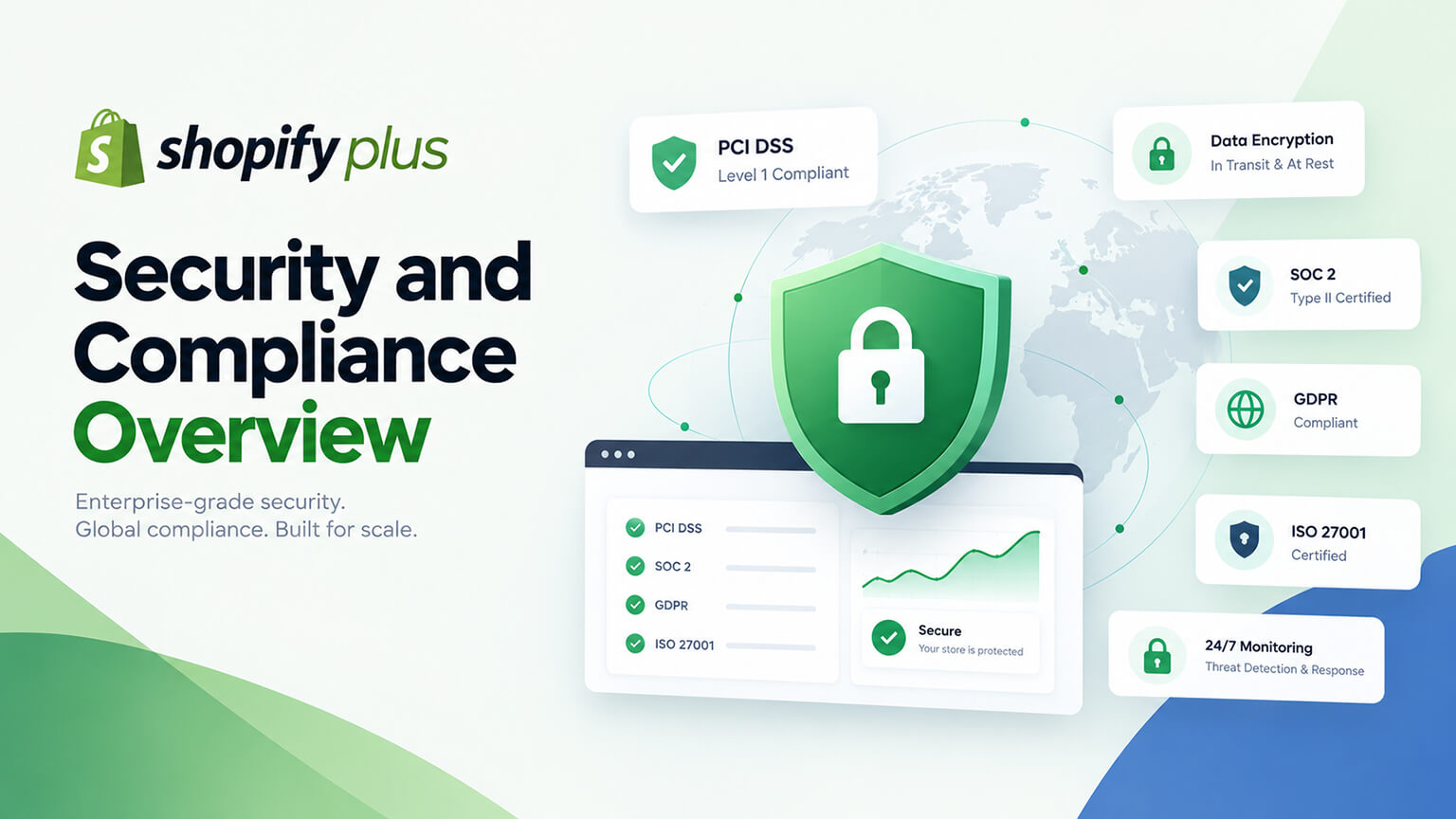
Security and compliance are critical for any ecommerce store (protecting customer data, payments, and the business, and meeting legal and regulatory requirements), and they matter more as you scale — larger stores handle more data, face higher stakes, and often have stricter compliance requirements (from regulations, partners, or enterprise standards). Shopify Plus, as the enterprise tier, provides a secure, compliant platform foundation suited to larger stores’ security and compliance needs, while — as with any Shopify store — some security and compliance responsibilities remain yours (your practices, apps, data handling, and specific compliance obligations, as the app-security discussion covers). Understanding Shopify Plus’s security and compliance — what Shopify’s platform provides, what you’re responsible for, and how to approach it — helps you meet your security and compliance needs at scale. This piece provides an overview of Shopify Plus security and compliance: what Shopify’s platform handles, the compliance it supports, your responsibilities, and how to approach security and compliance at scale. (This connects to the app-security and headless-security discussions; this focuses on Plus security and compliance. Note: security and compliance specifics evolve and vary by requirement; this is a general overview — consult experts for your specific compliance needs.)
This piece covers what Shopify’s platform provides (security foundation), the compliance Shopify supports (PCI, data protection, etc.), your responsibilities (practices, apps, data, specific compliance), and how to approach security and compliance at scale. Because security and compliance matter more at scale, and understanding Plus’s provides-and-responsibilities helps you meet them. Let me walk through it. (Reminder: for specific compliance requirements, consult legal/compliance experts — this is a general overview.)
What Shopify’s platform provides (security foundation)
Shopify (including Plus) provides a strong security foundation as a managed platform. Platform and infrastructure security — Shopify secures its platform and infrastructure (the servers, systems, and infrastructure your store runs on), so you benefit from Shopify’s platform security (versus securing your own infrastructure) — a major benefit of a managed platform (Shopify handles the infrastructure security). Secure, PCI-compliant checkout — Shopify’s checkout is secure and PCI DSS compliant (handling payment data securely and compliantly, as the keeping-checkout and headless-security discussions cover), so Shopify handles the payment security and PCI compliance (the most critical, high-stakes part) — a key benefit (Shopify handles payment security/PCI). Platform security measures — Shopify implements platform security measures (protecting against threats, securing the platform, monitoring, as a major platform does), so the platform has robust security (versus you building it) — platform security. Reliability and uptime — Shopify provides reliability and uptime (a stable, available platform, with Plus’s enterprise reliability), part of the operational security/stability — reliability. Regular security maintenance — Shopify maintains the platform’s security (updates, patches, security practices, as a managed platform), so the platform stays secure (versus you maintaining infrastructure security) — ongoing platform security. Plus’s enterprise-grade platform — Plus provides an enterprise-grade platform (suited to larger stores’ scale, reliability, and security needs, as the Plus-comparison discussion covers), so it’s a robust foundation for larger stores — enterprise-grade. Reduces your security burden — because Shopify handles the platform, infrastructure, checkout/payment, and much of the security, your security burden is reduced (you don’t secure the infrastructure or payments — Shopify does), as the headless-security discussion covers (contrasting with taking on more via headless) — reduced burden (a benefit of the managed platform). And a strong foundation — overall, Shopify (including Plus) provides a strong, secure, compliant platform foundation (infrastructure, checkout/PCI, platform security, reliability), so you build on a secure foundation (versus building security from scratch) — the foundation. So Shopify’s platform (including Plus) provides platform and infrastructure security, a secure PCI-compliant checkout (handling payment security and PCI — the most critical part), platform security measures, reliability and uptime, ongoing security maintenance, and Plus’s enterprise-grade platform — a strong security foundation that reduces your security burden (Shopify handling the infrastructure, payments, and much of the security). So Shopify’s platform provides a strong, managed security foundation (infrastructure, checkout/PCI, platform security), reducing your burden. The next section covers the compliance Shopify supports. So Shopify’s platform (including Plus) provides a strong, secure, PCI-compliant, managed foundation, reducing your security burden.
The compliance Shopify supports
Shopify (including Plus) supports various compliance areas relevant to ecommerce (the general picture; verify specifics for your requirements). PCI DSS (payment) — Shopify’s checkout is PCI DSS compliant (the payment-card security standard), so Shopify handles PCI compliance for payments processed through its checkout (a major compliance area — payment security), meaning you don’t have to achieve PCI compliance for the checkout yourself (a significant benefit, as the headless-security discussion covers) — PCI (handled by Shopify’s checkout). Data protection and privacy — Shopify provides data-protection capabilities and supports privacy compliance (GDPR, CCPA, and other privacy regulations — with tools and features for privacy compliance, data handling, and customer data requests), helping you meet privacy obligations (though you have responsibilities too, as covered) — data protection/privacy support (partly Shopify, partly you). Platform compliance and certifications — Shopify (as a major platform) maintains various compliance certifications and standards (security certifications, compliance frameworks), providing a compliant platform foundation — platform certifications. Plus for enterprise compliance — Plus (enterprise-oriented) suits stores with stricter compliance needs (enterprise, regulatory, partner requirements), providing a foundation and capabilities for enterprise compliance needs (though specific compliance is yours to ensure) — enterprise compliance support. Supports meeting requirements — Shopify’s platform and features support you in meeting various compliance requirements (providing a compliant foundation, tools, and capabilities), so you can build compliance on Shopify’s foundation — supporting compliance. But specific compliance is yours to ensure — importantly, while Shopify provides a compliant platform and supports compliance, specific compliance requirements (your particular regulatory, legal, industry, or partner obligations) are yours to ensure (Shopify provides the foundation and tools; you ensure your specific compliance, often with expert help, as covered) — so compliance is shared (Shopify’s foundation + your specific compliance) — a key point. And verify for your requirements — since compliance requirements vary (by industry, region, regulation, partners) and evolve, verify Shopify’s compliance support for your specific requirements (and consult compliance experts) — verify (compliance is specific). So Shopify (including Plus) supports compliance via PCI DSS (handled for the checkout — a major benefit), data protection and privacy (tools and features supporting GDPR, CCPA, etc.), platform compliance and certifications, and enterprise-compliance suitability (Plus) — providing a compliant foundation and supporting you in meeting requirements, while specific compliance requirements are yours to ensure (with expert help), so verify for your specific needs. So Shopify supports compliance (PCI, privacy, certifications) providing a compliant foundation, while specific compliance is your responsibility to ensure. The next section covers your responsibilities. So Shopify supports key compliance (PCI, privacy, certifications) as a foundation, with specific compliance being your shared responsibility to ensure.
Your responsibilities
While Shopify provides a strong foundation, some security and compliance responsibilities remain yours. Good security practices — you’re responsible for good security practices in your control: account security (strong access, secure staff accounts, permissions, as the app-security discussion covers), secure practices, and not undermining the platform’s security — your security hygiene. App security — you’re responsible for the security of the apps you install (choosing reputable, secure apps, managing app permissions, removing unused apps, as the app-security and app-sprawl discussions cover), since apps access your data and are part of your security surface — app security (your responsibility). Custom code/development security — if you have custom development (theme code, custom apps, headless, as those discussions cover), you’re responsible for its security (secure development, as the headless-security discussion covers) — custom-code security (yours). Data handling and privacy compliance — you’re responsible for your data handling and privacy compliance (handling customer data responsibly and compliantly, meeting your privacy obligations under GDPR/CCPA/etc., using Shopify’s tools, and your specific compliance, as the ethical-AI and privacy discussions touch on) — data/privacy responsibility (partly yours). Your specific compliance obligations — you’re responsible for your specific compliance obligations (your particular regulatory, legal, industry, or partner requirements beyond what Shopify’s platform covers), ensuring you meet them (often with legal/compliance expertise) — specific compliance (yours to ensure). Integrations and third parties — you’re responsible for the security and compliance of your integrations and third-party tools (ensuring they’re secure and compliant, handle data appropriately, as the integration and app-security discussions cover) — integration/third-party security. Policies and legal — you’re responsible for your policies (privacy policy, terms, as the trust and store-setup discussions cover) and legal compliance (meeting the legal requirements for your business) — policies/legal. And using experts for compliance — you’re responsible for ensuring your compliance, which often means using legal/compliance experts (for your specific regulatory, privacy, and legal obligations), since compliance is specialised and your responsibility — using expertise (for your compliance). So your responsibilities include good security practices (account, access, hygiene), app security (reputable apps, permissions), custom-code/development security, data handling and privacy compliance (your obligations, using Shopify’s tools), your specific compliance obligations (regulatory, legal, industry, partner), integration and third-party security/compliance, policies and legal compliance, and using experts for your compliance — the security and compliance in your control and your specific obligations (beyond Shopify’s platform foundation). So while Shopify provides the platform foundation, you’re responsible for your practices, apps, custom code, data handling, specific compliance, integrations, and policies — with expert help for compliance. So security and compliance are shared: Shopify’s platform foundation plus your responsibilities (practices, apps, data, specific compliance). The next section covers approaching it at scale. So your responsibilities include your security practices, apps, custom code, data/privacy, specific compliance obligations, integrations, and policies (beyond Shopify’s foundation).
How to approach security and compliance at scale
Approaching security and compliance well at scale (leveraging Shopify’s foundation and meeting your responsibilities) involves the right practices and expertise. Leverage Shopify’s foundation — leverage Shopify’s (Plus’s) secure, compliant platform foundation (infrastructure, checkout/PCI, platform security, as covered), building on it (versus reinventing what Shopify provides) — starting from the strong foundation. Handle your responsibilities well — handle your security and compliance responsibilities (practices, apps, custom code, data, specific compliance, integrations, policies, as covered) well, since these are yours to manage — meeting your responsibilities. Practice good security hygiene — practice good security hygiene (account security, app security, secure practices, as the app-security discussion covers), maintaining the security in your control — security hygiene. Manage apps and integrations securely — manage your apps and integrations securely (reputable, secure apps, appropriate permissions, removing unused, secure integrations, as the app-security and app-sprawl discussions cover), keeping your security surface managed — secure app/integration management. Ensure data handling and privacy compliance — ensure you handle data responsibly and meet privacy compliance (GDPR, CCPA, etc., using Shopify’s tools and your practices, with expert guidance), an increasingly important compliance area — data/privacy compliance. Get compliance expertise — get legal/compliance expertise for your specific compliance obligations (regulatory, legal, industry, privacy — since compliance is specialised and your responsibility), ensuring you meet your requirements — compliance expertise (essential for specific compliance). Get security expertise for complex needs — for complex security needs (custom development, sensitive data, high-stakes operations, as the headless-security discussion covers), get security expertise (secure development, security review), ensuring sound security — security expertise where needed. Prioritise at scale — prioritise security and compliance appropriately at scale (larger stores’ higher stakes and stricter requirements warrant more attention and investment, as the stakes grow with scale), so security and compliance get the priority they need — scale-appropriate priority. Maintain ongoing — maintain security and compliance ongoing (security maintenance, compliance monitoring, keeping current as requirements and threats evolve, as the maintenance discussion covers), since both are ongoing (not one-time) — ongoing security/compliance. And treat it as critical — treat security and compliance as critical (as they are — protecting data, payments, the business, and meeting legal/regulatory requirements), giving them the priority they deserve at scale — critical priority. So approach security and compliance at scale by leveraging Shopify’s (Plus’s) secure, compliant foundation, handling your responsibilities well (practices, apps, custom code, data, specific compliance, integrations, policies), practicing good security hygiene, managing apps and integrations securely, ensuring data handling and privacy compliance, getting compliance expertise (for your specific obligations — essential) and security expertise (for complex needs), prioritising security and compliance appropriately at scale (higher stakes), maintaining them ongoing, and treating them as critical. The keys are leveraging Shopify’s foundation, meeting your responsibilities (especially good security practices, secure app management, data/privacy compliance, and your specific compliance with expert help), and prioritising and maintaining security and compliance at scale. So approach security and compliance by building on Shopify’s foundation, meeting your responsibilities, and getting expertise for your specific compliance — treating both as critical at scale. So approach security and compliance at scale by leveraging Shopify’s foundation, meeting your responsibilities well, and getting expertise (especially for specific compliance), treating both as critical.
The bottom line
Security and compliance are critical for any ecommerce store (protecting customer data, payments, and the business, and meeting legal and regulatory requirements), and they matter more as you scale — larger stores handle more data, face higher stakes, and often have stricter compliance requirements. Shopify Plus, as the enterprise tier, provides a strong, secure, compliant platform foundation: Shopify secures its platform and infrastructure (so you don’t secure your own), provides a secure, PCI DSS compliant checkout (handling payment security and PCI compliance — the most critical, high-stakes part, so you don’t achieve PCI compliance for the checkout yourself), implements platform security measures, provides reliability and enterprise-grade infrastructure, and maintains the platform’s security ongoing — a foundation that significantly reduces your security burden (Shopify handling the infrastructure, payments, and much of the security). On compliance, Shopify supports PCI DSS (handled for the checkout — a major benefit), data protection and privacy (tools and features supporting GDPR, CCPA, and other privacy regulations), platform compliance and certifications, and enterprise-compliance suitability (Plus) — providing a compliant foundation, while specific compliance requirements (your particular regulatory, legal, industry, or partner obligations) are yours to ensure. Because security and compliance are shared, some responsibilities remain yours: good security practices (account and access security, secure hygiene), app security (reputable, secure apps, appropriate permissions, removing unused apps), custom code and development security (if you have any), data handling and privacy compliance (your obligations, using Shopify’s tools), your specific compliance obligations (regulatory, legal, industry, partner requirements beyond the platform), integration and third-party security and compliance, your policies and legal compliance, and using legal and compliance experts for your specific obligations. Approach security and compliance at scale by leveraging Shopify’s (Plus’s) secure, compliant foundation (building on it rather than reinventing it), handling your responsibilities well, practicing good security hygiene, managing apps and integrations securely, ensuring data handling and privacy compliance, getting compliance expertise for your specific obligations (essential, since compliance is specialised and your responsibility) and security expertise for complex needs (custom development, sensitive data), prioritising security and compliance appropriately at scale (higher stakes and stricter requirements warrant more attention), maintaining both on an ongoing basis (as requirements and threats evolve), and treating them as critical. The keys are leveraging Shopify’s strong foundation, meeting your responsibilities (especially security practices, secure app management, data and privacy compliance, and your specific compliance with expert help), and prioritising and maintaining security and compliance at scale. So understand Shopify Plus security and compliance as a shared model: Shopify provides a strong, secure, PCI-compliant, managed platform foundation that handles the infrastructure, payments, and much of the security (greatly reducing your burden), while you’re responsible for your practices, apps, custom code, data handling, specific compliance obligations, integrations, and policies — met with good practices and expert help. Since security and compliance matter more as you scale, approach them as the critical, shared, ongoing priorities they are — leveraging Shopify’s foundation and meeting your responsibilities with the right expertise — to protect your customers, payments, and business and meet your legal and regulatory requirements at scale. (And for your specific compliance requirements, always consult legal and compliance experts — this overview is general, and compliance is specialised and specific.)
Frequently asked questions
What security does Shopify Plus provide?
Shopify (including Plus) provides a strong, managed security foundation. It secures its platform and infrastructure (the servers and systems your store runs on, so you don’t secure your own infrastructure), provides a secure, PCI DSS compliant checkout (handling payment data securely and the PCI compliance for payments through its checkout — the most critical, high-stakes part), implements platform security measures (protecting against threats, monitoring, as a major platform does), provides reliability and uptime with enterprise-grade infrastructure on Plus, and maintains the platform’s security on an ongoing basis (updates, patches, security practices). This managed platform significantly reduces your security burden — you don’t have to secure the infrastructure or achieve PCI compliance for the checkout yourself, since Shopify handles those. So Plus gives you a strong, secure foundation to build on. That said, security is shared: while Shopify handles the platform, infrastructure, and payments, some responsibilities remain yours — your security practices, the apps you install, any custom code, your data handling, and your specific compliance obligations.
Does Shopify Plus handle compliance like PCI and GDPR?
Shopify supports these compliance areas, but the split matters. For PCI DSS (the payment-card security standard), Shopify’s checkout is PCI compliant, so Shopify handles PCI compliance for payments processed through its checkout — a major benefit, meaning you don’t have to achieve PCI compliance for the checkout yourself. For data protection and privacy (GDPR, CCPA, and other privacy regulations), Shopify provides tools and features that support privacy compliance (data handling, customer data requests, and the like), but you also have responsibilities — you’re responsible for handling customer data properly and meeting your specific privacy obligations, using Shopify’s tools alongside your own practices. Shopify also maintains various platform compliance certifications and standards, and Plus suits stores with stricter enterprise compliance needs. The key point is that compliance is shared: Shopify provides a compliant platform foundation and supporting tools, but your specific compliance requirements (regulatory, legal, industry, or partner obligations) are yours to ensure — often with legal and compliance experts. Since compliance requirements vary and evolve, verify Shopify’s support for your specific requirements and consult experts.
What am I responsible for regarding security and compliance?
While Shopify handles the platform, infrastructure, and payments, several responsibilities remain yours. Good security practices in your control — account and access security, secure staff accounts and permissions, and not undermining the platform’s security. The security of the apps you install (choosing reputable, secure apps, managing their permissions, and removing unused ones, since apps access your data and are part of your security surface). The security of any custom code or development you have (theme code, custom apps, headless). Your data handling and privacy compliance (handling customer data responsibly and meeting your privacy obligations, using Shopify’s tools and your own practices). Your specific compliance obligations (your particular regulatory, legal, industry, or partner requirements beyond what the platform covers). The security and compliance of your integrations and third-party tools. And your policies (privacy policy, terms) and legal compliance. Because these are your responsibility and compliance is specialised, you often need legal and compliance experts for your specific obligations and security expertise for complex needs. So security and compliance are a shared model — Shopify’s foundation plus your responsibilities.
How should I approach security and compliance as I scale?
Treat them as critical, shared, ongoing priorities, and give them more attention as your stakes grow. Leverage Shopify’s (Plus’s) secure, compliant platform foundation (building on it rather than reinventing what Shopify provides), and handle your own responsibilities well — practicing good security hygiene (account and access security), managing your apps and integrations securely (reputable apps, appropriate permissions, removing unused ones), securing any custom development, and ensuring responsible data handling and privacy compliance. Crucially, get legal and compliance expertise for your specific compliance obligations, since compliance is specialised and your responsibility, and get security expertise for complex needs (custom development, sensitive data, high-stakes operations). Prioritise security and compliance appropriately at scale — larger stores’ higher stakes and stricter requirements (from regulations, partners, or enterprise standards) warrant more attention and investment — and maintain both on an ongoing basis as requirements and threats evolve. The keys are leveraging Shopify’s strong foundation, meeting your responsibilities (especially security practices, secure app management, data and privacy compliance, and specific compliance with expert help), and prioritising and maintaining security and compliance as the critical concerns they are at scale. And always consult legal and compliance experts for your specific requirements.