
Planning a Phased Headless Migration Roadmap
On this page
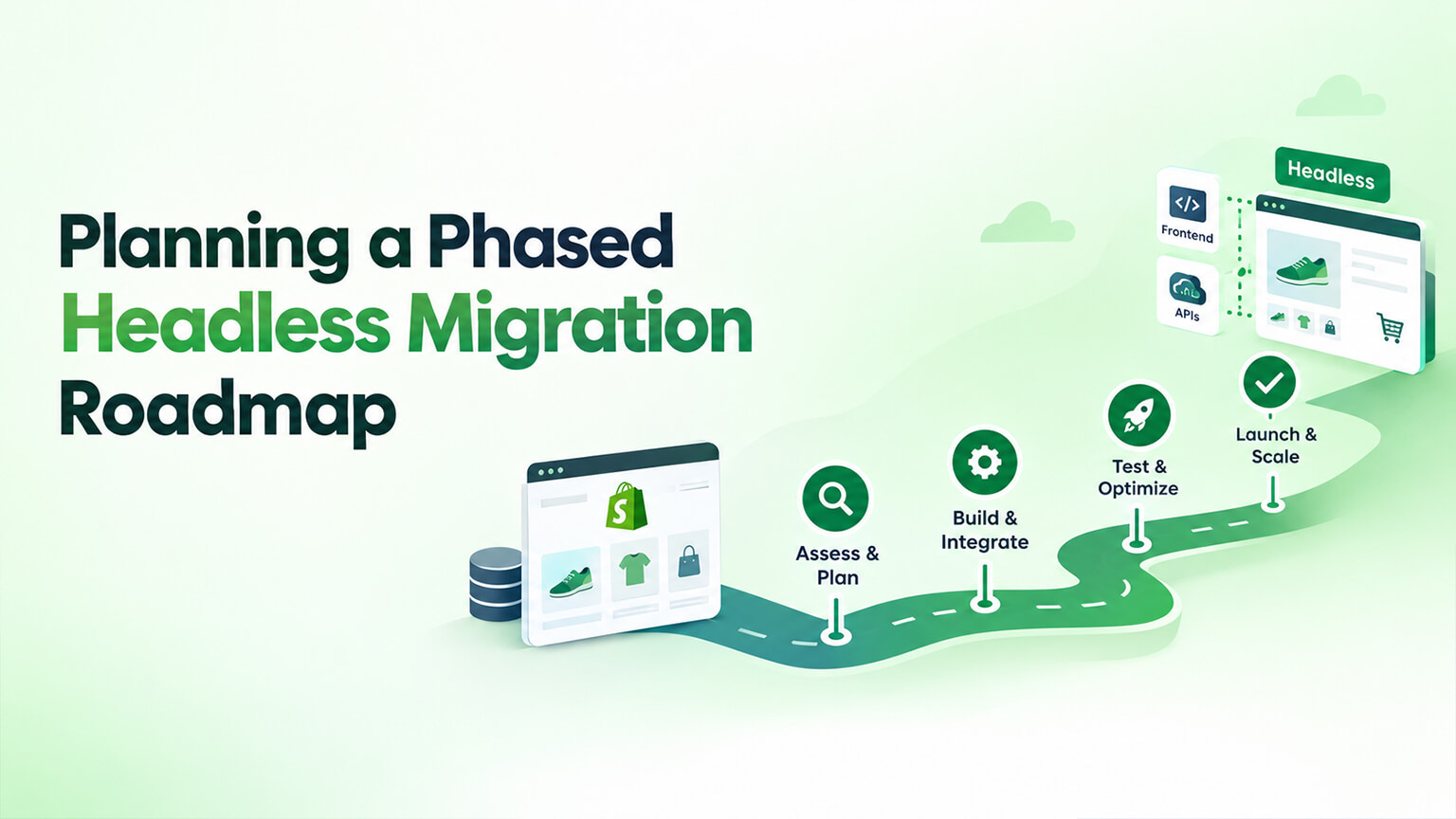
If you’ve decided headless is right for your store (a considered decision, as the is-headless-worth-it discussion covers), the next question is how to get there — and it doesn’t have to be a risky big-bang rebuild (replacing your whole store at once). A phased headless migration — moving to headless incrementally, in planned stages — reduces the risk and lets you deliver value along the way (versus a big, all-at-once rebuild that’s riskier and delays value). Planning a phased headless roadmap means mapping how you’ll move to headless in stages (which parts first, in what order, how each phase delivers value and reduces risk), so the migration is manageable, lower-risk, and value-delivering. This connects to the hybrid and architecture-patterns discussions (headless isn’t all-or-nothing, so a phased/hybrid path is often sensible). This piece covers planning a phased headless migration roadmap: why phase it, how to plan the phases, what a roadmap looks like, and how to execute it well. (This connects to the is-headless-worth-it, hybrid-headless, and architecture-patterns discussions; this focuses on planning a phased headless roadmap.)
This piece covers why phase a headless migration, how to plan the phases, what a phased roadmap looks like, and how to execute it well. Because a phased headless migration reduces risk and delivers value incrementally, and planning the roadmap makes it manageable. Let me walk through it.
Why phase a headless migration
Phasing a headless migration (versus a big-bang rebuild) has real benefits. Reduces risk — a big-bang headless migration (rebuilding and switching the whole store at once) is risky (a large, complex change all at once, with more that can go wrong, and high stakes if it does), while phasing it (moving incrementally) reduces the risk (smaller, manageable stages, less at stake per phase) — the core benefit (lower risk). Delivers value incrementally — phasing delivers value along the way (each phase delivering some benefit — e.g., a headless section or improvement), versus a big-bang that delays all value until the whole rebuild is done — so phasing delivers value incrementally (versus a long wait) — incremental value. More manageable — a phased migration is more manageable (smaller stages, each planned and executed manageably), versus a huge all-at-once project (harder to manage), so phasing makes the migration manageable — manageability. Allows learning and adjustment — phasing lets you learn and adjust (from each phase, applying learnings, adjusting the approach), versus committing everything to a big-bang plan upfront — so you can learn and adapt as you go — learning/adaptation. Spreads cost and effort — phasing spreads the cost and effort over time (versus a big upfront cost/effort), which can be more manageable financially and operationally — spread cost/effort. Reduces disruption — phasing reduces disruption (smaller changes at a time, versus a big disruptive switchover), so the business is less disrupted — less disruption. Aligns with hybrid/incremental patterns — phasing aligns with the hybrid and incremental headless patterns (as those discussions cover — headless isn’t all-or-nothing, so you can adopt it incrementally), so a phased approach fits the flexibility of headless patterns — pattern alignment. And it’s often the sensible approach — for these reasons, a phased approach is often the sensible way to go headless (versus a risky big-bang), especially given headless’s complexity and stakes (as the is-headless-worth-it discussion covers) — the sensible default. So phasing a headless migration reduces risk (smaller stages, less at stake per phase), delivers value incrementally (versus delaying all value), is more manageable (smaller planned stages), allows learning and adjustment, spreads cost and effort, reduces disruption, aligns with hybrid/incremental patterns, and is often the sensible approach — versus a risky, value-delaying big-bang rebuild. So phase your headless migration (versus big-bang) for lower risk, incremental value, and manageability. The next section covers planning the phases. So phasing a headless migration reduces risk, delivers value incrementally, and is more manageable than a big-bang rebuild.
How to plan the phases
Planning the phases of a headless migration involves deciding what to move when, and how each phase delivers value and reduces risk. Assess your store and goals — start by assessing your store and headless goals (what you’re moving to headless and why, as the is-headless-worth-it discussion covers), so the phasing serves your goals — the foundation. Identify what to move headless — identify the parts to move headless (the whole storefront eventually, or specific parts — pages, sections, the front-end, as the architecture-patterns and hybrid discussions cover), and consider whether you’re going fully headless or a hybrid (as those discussions cover) — defining the scope. Sequence the phases sensibly — sequence the phases sensibly: what to move first (e.g., starting with a specific high-value or lower-risk part, or a section, as the hybrid discussion covers), then expanding, in an order that delivers value and manages risk — sequencing (a sensible order). Start with high-value or lower-risk parts — often, start with a high-value part (delivering benefit early — e.g., a high-traffic page or performance-critical section) or a lower-risk part (proving the approach with less risk), then expand — so early phases deliver value and/or reduce risk (versus starting with the riskiest, hardest part) — sensible starting points. Ensure each phase delivers value — plan each phase to deliver value (a benefit — performance, a new experience, an improvement), so the migration delivers value along the way (versus phases that only build toward a distant payoff) — value per phase. Manage the transition/coexistence — plan how the headless and non-headless parts coexist during the phased migration (the headless parts and the remaining theme working together, as the hybrid discussion covers), since during phasing you’ll have a hybrid state (part headless, part theme) — coexistence (managing the hybrid transition state). Plan the technical approach per phase — plan the technical approach for each phase (the architecture, framework, rendering, integration, as those discussions cover), building each phase well (as the headless-team discussion covers) — technical planning per phase. Include SEO, analytics, and testing per phase — plan for SEO (as the headless-SEO discussion covers), analytics (as the headless-analytics discussion covers), and testing in each phase, so each phase maintains SEO, tracking, and quality (versus overlooking them per phase) — SEO/analytics/testing per phase. And define the roadmap — define the roadmap: the phases, their order, what each delivers, the timeline, and the end state (the target headless architecture) — a clear phased plan (as covered next). So plan the phases by assessing your store and goals, identifying what to move headless (and whether full or hybrid), sequencing the phases sensibly (starting with high-value or lower-risk parts, then expanding), ensuring each phase delivers value, managing the headless/non-headless coexistence during the transition, planning the technical approach per phase, including SEO/analytics/testing per phase, and defining the roadmap. So plan the phases to sequence the migration sensibly (value and risk-managed), with each phase delivering value and maintaining SEO/analytics/quality. The next section covers what a phased roadmap looks like. So plan the phases by sequencing sensibly (high-value/lower-risk first, expanding), ensuring value per phase, managing coexistence, and including SEO/analytics/testing.
What a phased roadmap looks like
A phased headless roadmap maps the migration in stages (an illustrative shape; the specifics depend on your store and goals). Phase 0: planning and foundation — an initial phase of planning (the roadmap, architecture, team, as those discussions cover) and foundation-setting (setting up the framework, hosting, integration foundations, as the architecture and team discussions cover), preparing for the migration — the foundation phase. Early phases: high-value or contained parts — early phases moving high-value or contained parts to headless (e.g., a specific high-traffic page, a performance-critical section, or a landing-page system, as the hybrid discussion covers), delivering early value and proving the approach with contained risk — early value-delivering phases. Middle phases: expanding headless — middle phases expanding headless to more of the store (more pages, sections, or the broader front-end), progressively moving toward the headless target, delivering value and building on the earlier phases — expansion phases. Later phases: completing the migration — later phases completing the migration (moving the remaining parts, reaching the target headless architecture, whether full headless or the intended hybrid end-state, as the architecture-patterns discussion covers) — completion phases. Throughout: coexistence and quality — throughout, managing the headless/non-headless coexistence (as the hybrid discussion covers), and maintaining SEO, analytics, performance, and quality per phase (as those discussions cover) — the ongoing quality management. Each phase: plan, build, test, launch — each phase follows a mini-project cycle (plan, build, test, launch that phase, as the QA and launch discussions cover), so each phase is executed well — per-phase execution. The end state — the roadmap targets the end state (your intended headless architecture — full or hybrid, as the architecture-patterns discussion covers), which the phases progressively reach — the target. And it’s illustrative and adaptable — this shape is illustrative; your actual roadmap depends on your store, goals, scope (full or hybrid), and priorities, and should be planned for your situation (and adapted as you learn, as the phasing benefit covers) — adaptable to you. So a phased roadmap looks like: a planning/foundation phase, early phases moving high-value or contained parts (early value, proving the approach), middle phases expanding headless, later phases completing the migration (reaching the target architecture), with coexistence and quality (SEO, analytics, performance) managed throughout and each phase executed as a mini-project (plan, build, test, launch) — targeting your intended end state (full or hybrid), illustrative and adaptable to your store and goals. So a phased roadmap sequences the migration from foundation through early value-delivering phases to completion, reaching your target headless architecture, adaptably. The next section covers executing it well. So a phased roadmap runs from planning/foundation through early value-delivering phases and expansion to completion, managing coexistence and quality throughout, targeting your end state.
How to execute it well
Executing a phased headless migration well involves good planning, execution, and management across the phases. Plan the roadmap well — plan the roadmap thoughtfully (the phases, sequence, value per phase, timeline, end state, as covered), since good planning underpins a well-executed phased migration (versus an unplanned, chaotic one) — good roadmap planning. Use the right team — use a capable headless team (as the headless-team discussion covers) to plan and execute the phases, since headless requires the right expertise (and a phased migration needs it across the phases) — the right team (key to success). Execute each phase well — execute each phase as a well-run mini-project (planning, building, testing, launching that phase, as the QA and launch discussions cover), so each phase is done well (quality, tested, working) — good per-phase execution. Deliver and validate value per phase — ensure each phase delivers its intended value and validate it (does the phase deliver the benefit — performance, experience, improvement?), so the migration delivers value along the way (and you confirm it) — value delivery/validation. Manage coexistence and transitions — manage the headless/non-headless coexistence and the transitions between phases well (as the hybrid discussion covers), so the store works during the phased migration (the hybrid states functioning) — coexistence management. Maintain SEO, analytics, and quality throughout — maintain SEO (as the headless-SEO discussion covers), analytics (as the headless-analytics discussion covers), performance, and quality throughout the phases (each phase maintaining them), so the migration doesn’t harm SEO, tracking, or quality — quality maintenance (critical throughout). Learn and adjust between phases — learn from each phase and adjust the roadmap/approach as needed (a benefit of phasing), so the migration improves as it progresses (versus rigidly following an initial plan) — learning/adjustment. Monitor and test — monitor and test throughout (each phase, and the overall store, as the testing and monitoring discussions cover), catching issues per phase — monitoring/testing. Manage as a program — manage the phased migration as an ongoing program (across the phases, with good project/program management), since it’s a multi-phase effort over time — program management. And keep the end state in view — keep the target end state in view (the intended headless architecture), so the phases progress coherently toward it (versus drifting) — end-state focus. So execute a phased headless migration well by planning the roadmap thoughtfully, using the right headless team, executing each phase as a well-run mini-project, delivering and validating value per phase, managing coexistence and transitions, maintaining SEO/analytics/quality throughout, learning and adjusting between phases, monitoring and testing, managing it as a program, and keeping the end state in view. The keys are good roadmap planning, the right team, good per-phase execution (with value delivery and quality maintenance), and managing the coexistence and program across phases. So execute the phased migration well through good planning, the right team, quality per-phase execution, and managing the program and coexistence toward the end state. So a phased headless migration, executed well (planned, right team, quality phases, managed coexistence and program), delivers headless incrementally with lower risk. So execute a phased headless migration with good planning, the right team, quality per-phase execution, and program management toward the end state.
The bottom line
If you’ve decided headless is right for your store, the next question is how to get there — and it doesn’t have to be a risky big-bang rebuild that replaces your whole store at once. A phased headless migration — moving to headless incrementally, in planned stages — reduces the risk and delivers value along the way, versus a big, all-at-once rebuild that’s riskier and delays value until it’s all done. Phasing reduces risk (smaller, manageable stages with less at stake per phase, versus a large complex change all at once), delivers value incrementally (each phase delivering some benefit, versus a long wait for the whole rebuild), is more manageable (smaller planned stages), allows learning and adjustment as you go, spreads the cost and effort over time, reduces disruption, and aligns with the hybrid and incremental headless patterns (headless isn’t all-or-nothing) — so it’s often the sensible way to go headless. Plan the phases by assessing your store and headless goals, identifying what to move headless (and whether you’re going fully headless or a hybrid), sequencing the phases sensibly (often starting with a high-value part to deliver early benefit, or a lower-risk part to prove the approach, then expanding), ensuring each phase delivers value, managing how the headless and non-headless parts coexist during the transition (a hybrid state), planning the technical approach per phase, including SEO, analytics, and testing in each phase, and defining a clear roadmap (the phases, their order, what each delivers, the timeline, and the target end state). A phased roadmap typically looks like a planning and foundation phase, early phases moving high-value or contained parts (delivering early value and proving the approach), middle phases expanding headless to more of the store, and later phases completing the migration to the target architecture (full headless or the intended hybrid end-state) — with coexistence and quality (SEO, analytics, performance) managed throughout and each phase executed as a mini-project (plan, build, test, launch) — illustrative and adaptable to your store and goals. Execute it well by planning the roadmap thoughtfully, using a capable headless team (key to success across the phases), executing each phase as a well-run mini-project, delivering and validating value per phase, managing the coexistence and transitions, maintaining SEO, analytics, performance, and quality throughout (critical, so the migration doesn’t harm them), learning and adjusting between phases (a benefit of phasing), monitoring and testing throughout, managing the whole thing as an ongoing program, and keeping the target end state in view so the phases progress coherently toward it. The keys are good roadmap planning, the right team, quality per-phase execution (with value delivery and quality maintenance), and managing the coexistence and program across phases toward the end state. So if you’re going headless, plan a phased migration roadmap rather than attempting a risky big-bang rebuild — moving incrementally in planned, value-delivering, risk-managed stages toward your target headless architecture — which reduces risk, delivers value along the way, and makes the migration manageable, executed well by a capable team maintaining quality throughout. A phased approach is usually the sensible, lower-risk, value-delivering way to migrate to headless.
Frequently asked questions
Why do a phased headless migration instead of all at once?
Because a big-bang headless migration — rebuilding and switching your whole store to headless at once — is risky and delays value, while a phased approach reduces both problems. Phasing reduces risk: instead of one large, complex change with a lot that can go wrong and high stakes if it does, you move in smaller, manageable stages with less at stake per phase. It delivers value incrementally: each phase can deliver some benefit (a performance improvement, a new experience, a headless section) rather than making you wait until the entire rebuild is done for any payoff. It’s more manageable (smaller planned stages versus a huge all-at-once project), lets you learn and adjust as you go (rather than committing everything to an upfront plan), spreads the cost and effort over time, and reduces business disruption. It also aligns with the reality that headless isn’t all-or-nothing — you can adopt it incrementally or in a hybrid way. For these reasons, a phased approach is often the sensible way to go headless, especially given headless’s complexity and stakes.
How do I plan the phases of a headless migration?
Start by assessing your store and your headless goals (what you’re moving to headless and why), and identify what to move — the whole storefront eventually, or specific parts — and whether you’re going fully headless or a hybrid. Then sequence the phases sensibly: decide what to move first and in what order, in a way that delivers value and manages risk. Often it’s smart to start with a high-value part (to deliver benefit early, like a high-traffic or performance-critical page) or a lower-risk part (to prove the approach with limited risk), then expand from there. Plan each phase to deliver value (rather than only building toward a distant payoff), and plan how the headless and non-headless parts will coexist during the transition, since you’ll have a hybrid state while migrating. Plan the technical approach for each phase, and crucially include SEO, analytics, and testing in every phase so each maintains your rankings, tracking, and quality. Finally, define the roadmap: the phases, their order, what each delivers, the timeline, and the target end state (your intended headless architecture, full or hybrid).
What does a phased headless roadmap look like?
Typically it runs from foundation to completion in stages. An initial planning and foundation phase sets up the roadmap, architecture, team, framework, hosting, and integration foundations. Early phases move high-value or contained parts to headless (a specific high-traffic page, a performance-critical section, or a landing-page system), delivering early value and proving the approach with limited risk. Middle phases expand headless to more of the store (more pages, sections, or the broader front-end), progressively moving toward the target. Later phases complete the migration, moving the remaining parts and reaching the intended end state (full headless or a hybrid end-state). Throughout, you manage the coexistence of the headless and non-headless parts and maintain SEO, analytics, performance, and quality in each phase, and each phase is run as a mini-project (plan, build, test, launch). This shape is illustrative — your actual roadmap depends on your store, goals, scope (full or hybrid), and priorities, and it should be planned for your situation and adapted as you learn from each phase. The point is a coherent, staged progression toward your target headless architecture.
How do I execute a phased headless migration well?
Plan the roadmap thoughtfully (phases, sequence, value per phase, timeline, end state), and use a capable headless team — the right expertise is key to success, and a phased migration needs it across all the phases. Execute each phase as a well-run mini-project (planning, building, testing, and launching that phase), and ensure each phase delivers and you validate its intended value, so the migration delivers benefit along the way. Manage the coexistence of the headless and non-headless parts and the transitions between phases so the store works throughout the migration. Critically, maintain SEO, analytics, performance, and quality in every phase, so the migration doesn’t harm your rankings, tracking, or quality. Learn from each phase and adjust the roadmap and approach as needed (a key benefit of phasing), monitor and test throughout, manage the whole effort as an ongoing program with good project management, and keep the target end state in view so the phases progress coherently toward it. The keys are good roadmap planning, the right team, quality per-phase execution with value delivery and quality maintenance, and managing the coexistence and program across the phases toward your intended headless architecture.