
Shopify Payments vs Third-Party Gateways
On this page
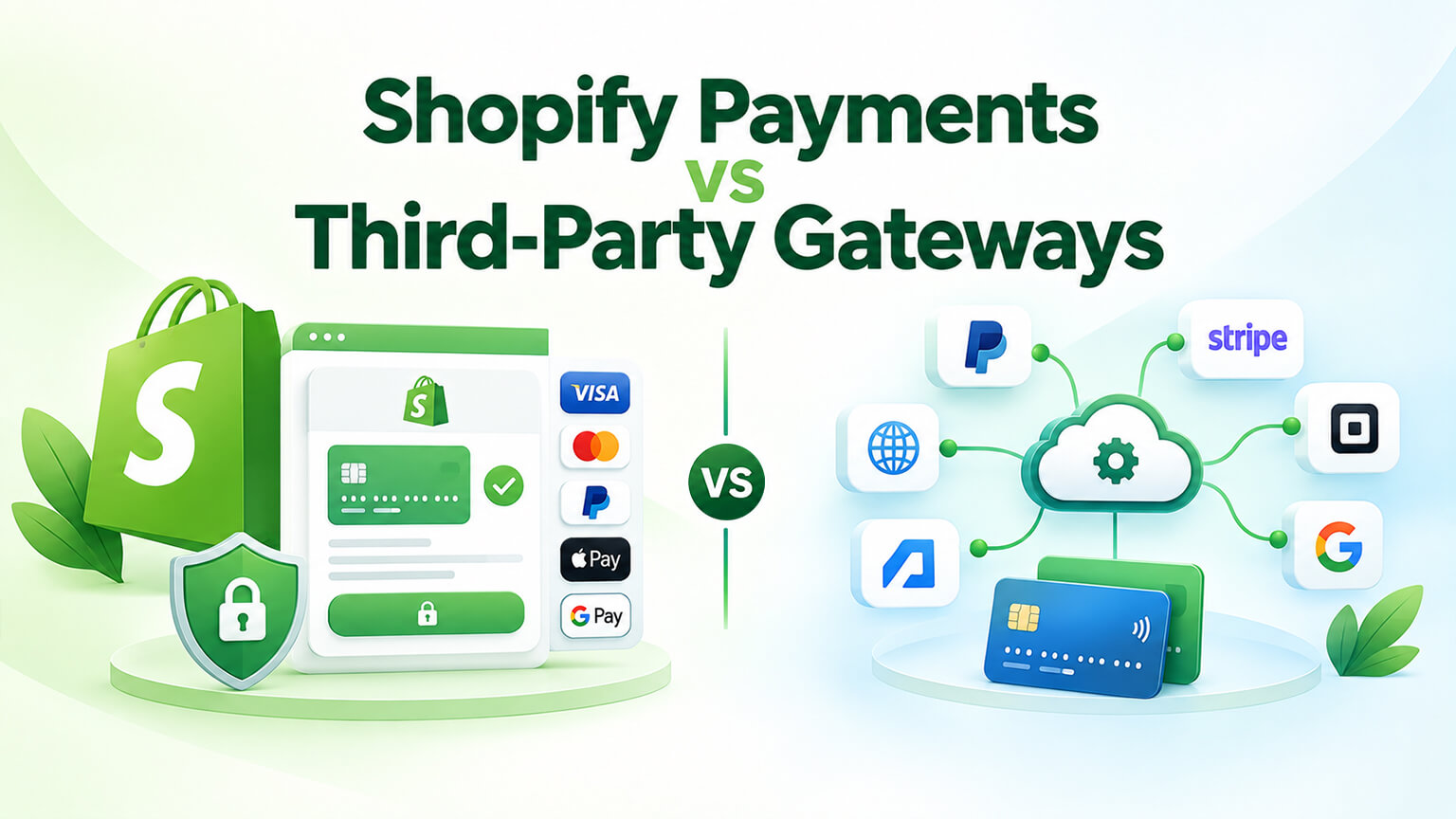
This decision looks trivial and often is not. For most merchants it takes ten seconds: use Shopify Payments, avoid the extra fee, move on. For a meaningful minority it is worth real analysis, because getting it wrong costs a percentage of every order forever.
Let me explain the mechanics, then who should actually think hard about it.
How the fee structure works
Shopify’s arrangement is straightforward once stated plainly.
If you use Shopify Payments as your gateway, you pay the card processing rate associated with your plan and nothing else to Shopify on the transaction. Higher plans give better rates.
If you use a third-party gateway — your own merchant account, or a provider like a regional processor — you pay that provider’s rate, and Shopify adds its own additional transaction fee on top. That additional fee decreases as you move up plan tiers and is lowest on Plus, but it does not disappear.
So using an outside gateway means paying twice: once to your processor, once to Shopify for the privilege. That is the whole mechanic, and it is why most merchants simply use Shopify Payments.
The straightforward case: use Shopify Payments
For the large majority of merchants, this is correct and there is little to debate.
You avoid the additional fee entirely. Setup is immediate — no separate merchant account application, no underwriting delay. Payouts, refunds, and chargebacks are handled inside the Shopify admin rather than across two systems. Accelerated wallet payments including Shop Pay work natively, and Shop Pay in particular converts noticeably better for returning customers because the details are stored. Fraud tooling is integrated.
If Shopify Payments is available where you operate, your volumes are normal, and you have no existing processing relationship worth protecting, use it. The convenience is real and the economics are better.
When a third-party gateway still makes sense
Four situations, and they are not rare.
Shopify Payments is unavailable in your market. This is the most common reason and it is not a choice. In countries where Shopify Payments has not launched, you must use a third-party gateway and you pay Shopify’s additional fee permanently on every order. At volume this becomes a serious annual cost, and it is a legitimate reason to compare platforms that do not charge it — which is exactly the BigCommerce argument covered elsewhere in this cluster.
You have a negotiated rate that beats Shopify Payments. Established merchants with volume often hold merchant accounts on rates negotiated over years. If your negotiated rate is meaningfully better, the question is whether the saving exceeds Shopify’s additional fee. Sometimes it does. Run the arithmetic rather than assuming either way.
Your business type is restricted. Shopify Payments has prohibited and restricted categories. Some legitimate businesses — certain supplements, CBD in some jurisdictions, firearms accessories, adult products, some financial and regulated services — cannot use it. A specialist high-risk processor is then the only route, and you accept the additional fee as a cost of operating.
You need local payment methods Shopify Payments does not support. In markets where conversion depends on specific local methods — certain bank transfer schemes, regional wallets, instalment providers — a local gateway may be the only way to offer them. Losing sales because you cannot accept how customers prefer to pay costs far more than a transaction fee.
The arithmetic
Straightforward, and worth doing properly rather than guessing.
Take your monthly card volume. Calculate what you pay under Shopify Payments: volume multiplied by your plan’s rate, plus per-transaction fees.
Then calculate the alternative: volume multiplied by your negotiated processor’s rate, plus their per-transaction fees, plus Shopify’s additional fee on the same volume.
Compare. If the third-party option is lower, it is worth the operational complexity. If it is higher, use Shopify Payments.
Two refinements. First, the additional fee falls as you move up plan tiers, so your plan level changes the answer. Second, if you are on or near Plus, the fee is at its lowest, which narrows the gap and sometimes flips the decision — worth modelling alongside any Plus evaluation.
At low volume this rarely justifies the effort. At high volume it can be a substantial annual figure, and it deserves a spreadsheet.
What the arithmetic misses
Cost is not the whole picture, and three non-financial factors matter.
Shop Pay. Shopify Payments unlocks Shop Pay, which converts better for returning shoppers because payment and address details are already stored. That conversion uplift is real revenue, and for a store with meaningful repeat traffic it can exceed the fee difference entirely. Any comparison ignoring this is incomplete, and it is the factor most often left out.
Operational simplicity. With Shopify Payments, payouts, refunds, chargebacks, and reconciliation live in one system. With a third party you are working across two, which means more admin, more reconciliation effort, and more places for a discrepancy to hide. That is a real cost in staff time even if it never appears on an invoice.
Fraud and chargebacks. Shopify Payments includes integrated fraud analysis and a chargeback process inside the admin. Third-party arrangements vary, and some are considerably more painful.
Weigh these alongside the percentages. A small rate advantage that costs you Shop Pay conversion and adds reconciliation work is not the win the spreadsheet suggests.
A worked example: the calculation that surprised everyone
A homeware brand doing substantial volume held a merchant account on a rate negotiated years earlier and assumed keeping it was obviously correct. Their finance team had never modelled it against Shopify Payments plus the fee difference.
When we ran it, three things emerged. Their negotiated rate was better than Shopify Payments, but only slightly — the market had moved and their “excellent” rate was now merely decent. Shopify’s additional fee more than consumed that advantage at their plan tier. And they were forgoing Shop Pay entirely, on a store where a large share of revenue came from repeat customers.
Switching to Shopify Payments reduced their effective cost of processing, simplified reconciliation for their finance team, and enabled Shop Pay, which improved checkout completion among returning customers.
The lesson is that negotiated rates age. A rate that was excellent five years ago may be unremarkable now, and the assumption that it must be better is worth testing rather than inheriting.
The other direction: when to keep the gateway
To be even-handed, a different brand we looked at reached the opposite conclusion. Operating in a market where Shopify Payments was unavailable, they had no choice on the main question — but the analysis still mattered, because it showed that Shopify’s additional fee was costing them enough annually to justify seriously evaluating other platforms.
They stayed on Shopify, having concluded the ecosystem and operational advantages outweighed the fee. But they made that decision with the number in front of them rather than discovering it later, and they factored it into their plan-tier choice, since moving up reduced the fee enough to partly offset the subscription increase.
That is the right way to handle it: know the number, decide deliberately.
Practical notes
Check availability first. Whether Shopify Payments operates in every country you sell from — not sell to — determines whether you have a choice at all.
Review your rate periodically. Processing is competitive and rates move. An arrangement you set up three years ago deserves a look.
Consider multiple gateways. You can offer additional payment methods alongside your primary gateway, and for international selling local methods often lift conversion more than the fee costs. This frequently needs integration work to do cleanly.
Model at your plan tier and the next one. Because the additional fee falls as you move up, this interacts with your plan decision.
Do not ignore the conversion side. Testing checkout completion with and without accelerated payment options is a standard CRO exercise and it often matters more than the rate.
Side by side
| Factor | Shopify Payments | Third-party gateway |
|---|---|---|
| Shopify’s additional fee | None | Yes, lower on higher plans |
| Processing rate | Set by plan tier | Yours or negotiated |
| Shop Pay | Available | Not available |
| Setup | Immediate | Merchant account application |
| Payouts & refunds | Inside Shopify admin | Two systems |
| Chargebacks | Managed in admin | Via processor |
| Fraud tooling | Integrated | Varies by provider |
| Reconciliation | Single source | Cross-system |
| Country availability | Limited to supported markets | Broad |
| Restricted categories | Some prohibited | Specialist processors exist |
| Local payment methods | Growing, varies by market | Often broader |
Beyond the card rate: the costs hiding underneath
The headline percentage is not the whole cost of accepting payments, and a few of these can exceed the rate difference entirely.
Currency conversion. If you sell internationally, how each option handles conversion — and what it charges for it — can outweigh a rate difference on the base transaction. Check the conversion margin, not just the processing rate.
Chargeback fees and handling. Every disputed transaction carries a fee, and processors differ in what they charge and how much work they leave you. A cheaper rate with a painful dispute process is not cheaper.
Payout timing. How quickly money reaches your bank affects working capital, which matters more than most merchants account for when inventory is the constraint on growth.
Failed payment recovery. Decline rates differ between processors, and a gateway that approves a slightly higher share of legitimate transactions is worth more than a marginally better rate. This is particularly significant for subscription businesses, where a declined renewal often becomes a cancelled customer.
Reconciliation labour. Two systems means someone matching payouts to orders across both. That is real staff time, every month, and it is invisible on any rate comparison.
Refund handling. Whether processing fees are returned on refunds varies, and for categories with high return rates this can be a meaningful line.
When you build the comparison, include these rather than stopping at the percentage. Several merchants we have worked with found the apparently cheaper option was more expensive once decline rates and reconciliation time were counted honestly.
Wallets, BNPL, and why payment choice affects conversion
Payment methods are a conversion factor as much as a cost factor, and this side of the decision gets far less attention than the rate.
Accelerated wallets — Shop Pay, Apple Pay, Google Pay, and similar — collapse a whole checkout form into a single authentication. For returning shoppers, particularly on mobile where typing an address is tedious, this removes the largest source of checkout friction there is. Any store where a meaningful share of traffic is mobile should treat wallet availability as a first-order concern rather than a nice extra.
Buy now, pay later options change conversion meaningfully in some categories, particularly at higher price points where the purchase feels like a commitment. Whether they suit your brand is a separate question, and the provider fees are higher than card processing — but for considered purchases the uplift can justify it comfortably.
Local methods matter more than most merchants realise. In several markets, a substantial share of shoppers strongly prefer a bank transfer scheme, a domestic wallet, or an instalment provider over card payment, and stores offering only cards see it directly in their conversion rate by country. If you sell internationally and your conversion is notably worse in particular markets, the payment method mix is one of the first things to check.
The practical implication for this comparison: a gateway decision that costs you wallet support or a key local method is not a cost saving. Test checkout completion with and without these options if your volume allows, because the conversion difference frequently dwarfs the fee difference you were optimising.
A five-minute decision framework
Work through these in order and you will land in the right place.
One: is Shopify Payments available where you operate? Not where you sell to — where your business is registered. If no, your decision is made and you should skip to step five.
Two: is your category permitted? Check Shopify Payments’ restricted and prohibited list against what you actually sell. Certain supplements, regulated products, and some service categories are excluded. If you are excluded, you need a specialist processor.
Three: do you hold a negotiated rate? If not, use Shopify Payments — there is nothing to weigh. If you do, run the arithmetic: your rate plus per-transaction fees plus Shopify’s additional fee, against Shopify Payments at your plan rate.
Four: add Shop Pay to the comparison. If a meaningful share of your revenue comes from repeat customers, estimate what the conversion uplift is worth. This frequently reverses a marginal rate advantage.
Five: whatever you conclude, quantify the fee annually. If you are paying Shopify’s additional fee with no alternative, you should know the number. It informs your plan tier — the fee falls as you move up — and at high volume it is a legitimate input into whether Shopify is the right platform at all.
Most merchants reach step three and stop, because the answer is Shopify Payments and there is nothing further to consider. The minority who continue tend to find the exercise pays for itself many times over.
The bottom line
For most merchants the answer is Shopify Payments, and the reasoning is simple: you avoid the additional fee, you get Shop Pay and its conversion benefit, and you keep everything in one system. Unless you have a specific reason not to, take the default.
The specific reasons are real though. If Shopify Payments is unavailable where you operate, you have no choice and should understand what the fee costs you annually — it is a legitimate input into your plan tier and even your platform decision. If you hold a negotiated rate, model it honestly rather than assuming it wins, because negotiated rates age and Shop Pay is worth something the spreadsheet does not show. If your category is restricted or you need local payment methods, the decision is made for you.
The mistake to avoid is treating this as too small to analyse. A fraction of a percent on every order compounds into a meaningful annual figure at volume, and it is one of the few costs in ecommerce you can reduce with an afternoon of arithmetic rather than months of work.
Frequently asked questions
Does Shop Pay really make a measurable difference to conversion?
For stores with meaningful repeat traffic, yes — and it is the factor most often left out of gateway comparisons. Shop Pay stores a customer’s payment and address details across the whole Shopify network, so a returning shopper can complete checkout in a couple of taps rather than filling a form. On mobile, where typing an address is the single most tedious part of buying, that removes the largest source of checkout friction there is. The uplift varies by store and category, so measure yours rather than trusting a headline figure. But if a large share of your revenue comes from customers who have bought before, the conversion gain can comfortably exceed a modest processing rate advantage from a third-party gateway.
Why does Shopify charge a fee for using another payment gateway?
Shopify Payments is a significant revenue stream, so the additional transaction fee on third-party gateways is how Shopify recovers value when you process elsewhere. The fee decreases as you move up plan tiers and is lowest on Plus, but it never disappears. The practical effect is that using an outside gateway means paying twice — your processor’s rate plus Shopify’s fee — which is why most merchants use Shopify Payments where it is available. Where it is not available, you pay the fee permanently with no alternative, and that is worth quantifying because at volume it becomes a serious annual cost.
Is my negotiated merchant account rate better than Shopify Payments?
Possibly, but test it rather than assuming, because negotiated rates age. A rate that was excellent five years ago may be unremarkable now, since processing has become more competitive. Run the arithmetic properly: your negotiated rate plus per-transaction fees plus Shopify’s additional fee, against Shopify Payments at your plan’s rate. Then add the factor most comparisons omit — Shop Pay, which is only available with Shopify Payments and converts noticeably better for returning customers. For stores with meaningful repeat traffic, that conversion difference can outweigh a modest rate advantage entirely.
What if Shopify Payments isn’t available in my country?
Then you use a third-party gateway and pay Shopify’s additional fee on every order, with no way to avoid it. The practical responses are to model what that costs annually, factor it into your plan tier decision since the fee falls as you move up, and be aware it is a legitimate consideration when comparing platforms — BigCommerce, for instance, charges no additional transaction fee on any gateway. Most merchants in this position stay on Shopify because the ecosystem and operational advantages outweigh the fee, but you should make that choice with the number in front of you.
Can I offer more than one payment gateway?
Yes, and for international selling it is often worthwhile. You can run Shopify Payments as your primary method while adding local payment options that customers in specific markets prefer — regional wallets, bank transfer schemes, or instalment providers. In many markets, conversion depends heavily on offering the method people actually use, and the sales you would otherwise lose far exceed the transaction fees involved. Setting this up cleanly, especially across multiple regions, usually needs some integration work, but it is one of the higher-return changes available for a brand selling internationally.