
Shopify Markets vs Separate Regional Stores
On this page
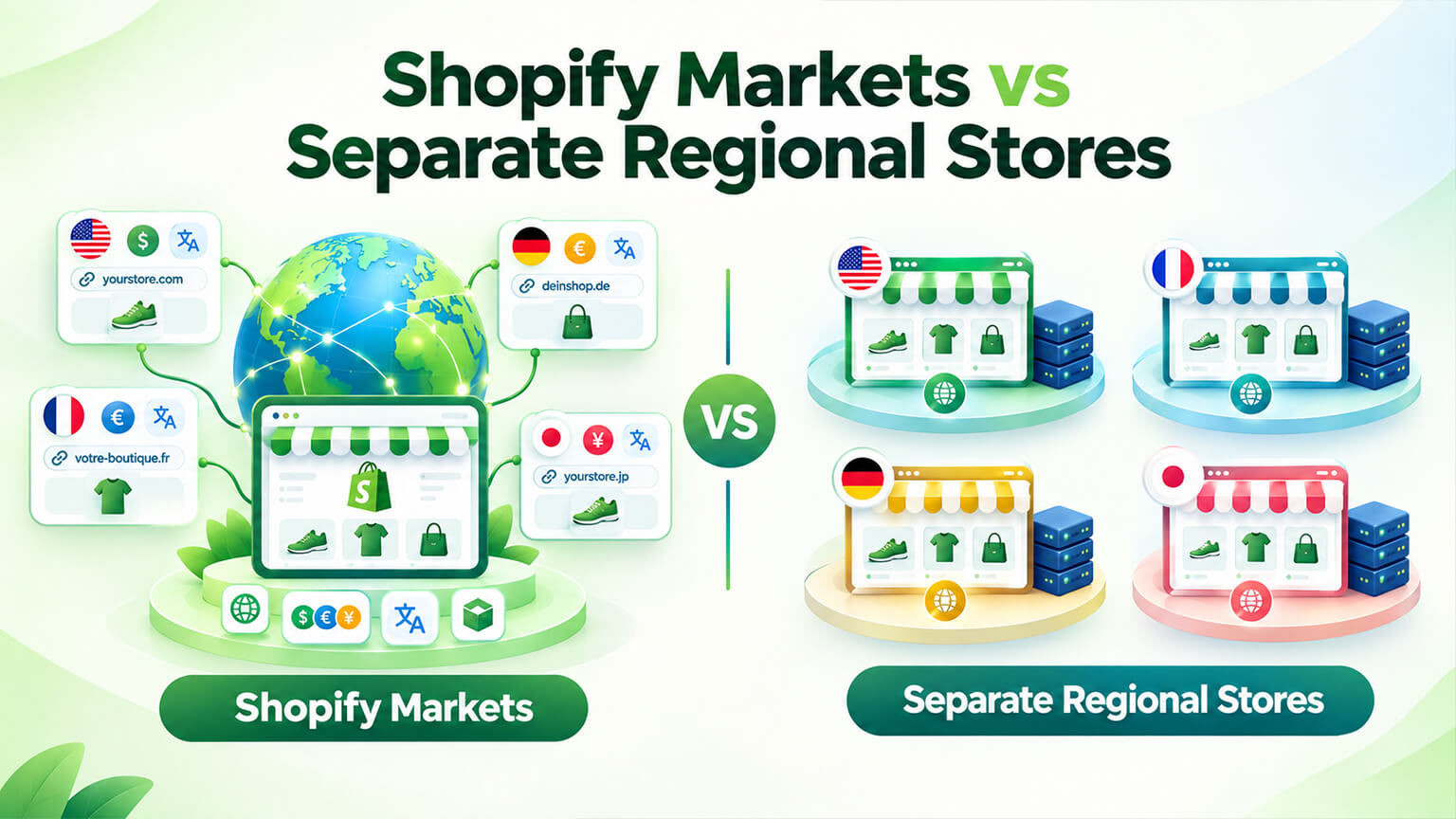
Once a brand starts selling internationally in earnest, this question arrives and it is consequential. Get the structure right and expansion is straightforward. Get it wrong and you spend years managing duplicated catalogues, split analytics, and a team that never quite knows where to make a change.
There are two models, and the honest answer is that most brands should start with the first and only move to the second for specific reasons.
The two models
Shopify Markets lets one store serve multiple countries or regions. You configure markets with their own currencies, pricing, domains or subfolders, languages, tax handling, and — to a degree — product availability. One admin, one catalogue, one set of orders, one inventory pool.
Separate regional stores means running distinct Shopify stores for different countries or regions. Each has its own admin, catalogue, theme, apps, inventory, and orders. On Plus, these are expansion stores under one arrangement.
The difference is essentially centralisation against autonomy. One system that handles variation, versus several systems each doing its own thing.
Where Markets is the right answer
For most brands expanding internationally, and the reasons are practical rather than ideological.
One catalogue to maintain. Add a product once and it exists everywhere you sell. With separate stores, every product, image, description, and price update happens multiple times or requires syncing tooling. That overhead is small at fifty products and substantial at five thousand.
One inventory pool. Stock is stock, and any market can sell it. Separate stores mean either splitting inventory — which risks one region selling out while another sits on stock — or building syncing to keep them aligned.
One set of orders and customers. Your team works in one admin. Your reporting covers the whole business without stitching exports together. Your customer records are unified, which matters enormously for email and lifetime value analysis.
One app stack, one subscription set. Every app you use is configured once and paid for once, rather than multiplied across stores.
Faster to launch a new region. Adding a market is configuration. Launching a store is a project.
For a brand selling broadly similar products across several countries with a consistent brand, Markets is comfortably the better structure and the operational savings compound every week.
Where separate stores earn their keep
There are real cases, and they cluster around genuine divergence rather than mild variation.
different assortments. If the products you sell in one region barely overlap with another — different SKUs, different suppliers, different regulatory requirements — a shared catalogue becomes an exercise in hiding most of it from most people. At that point separate stores are simpler.
Different brands or trading names. Operating under distinct identities in different markets, with different positioning and design, is what expansion stores exist for.
Regulatory separation. Some categories face rules that differ enough by market — labelling, claims, permitted ingredients, age verification — that keeping them apart is safer and easier to audit.
Separate business entities. If regions are run by different legal entities, franchisees, or distributors with their own operations and finances, separate stores often match the organisational reality better than one shared system.
Radically different operations. Different fulfilment partners, different payment providers, different support teams working different systems.
Deep localisation beyond translation. If a market needs a substantially different site structure, navigation, or merchandising approach rather than translated versions of the same thing.
Notice the pattern: separate stores make sense when the businesses are actually separate, not when the language or currency differs.
The SEO question
This comes up constantly and deserves a clear answer.
Both structures can work well for international SEO, and the deciding factor is implementation rather than architecture.
With Markets, you typically use subfolders or country-specific domains within one store, with hreflang annotations telling search engines which version serves which audience. Authority accumulates to one property, which is an advantage — links earned anywhere benefit the whole site. The risk is hreflang being implemented poorly, which causes regions to compete or the wrong version to rank.
With separate stores, each has its own domain and builds authority independently. That means starting from zero in each new market, which is slower, though it can suit brands wanting distinct market identities. Cross-domain hreflang is still required and is more fiddly to maintain.
For most brands, consolidating authority in one property is the stronger position, which is another point for Markets. The exception is where country-code domains carry genuine local trust benefit in your category — some markets favour a local domain noticeably — and that is worth weighing.
Either way, hreflang is the part that goes wrong most often, and it is worth getting someone to verify it rather than assuming.
Cost and operations
Markets is cheaper to run, usually by a wide margin, and the gap widens with each region.
With separate stores you pay a subscription per store — mitigated on Plus, where expansion stores are included in the arrangement, which is a large part of why Plus becomes attractive for multi-region brands. But you also pay for apps per store, maintain themes per store, and absorb the labour of running several systems in parallel. A change to your product page means implementing it in every store.
With Markets you maintain one store. Changes ship once. Apps are configured once.
The operational difference is larger than the subscription difference, and it is the one people underestimate. Teams running five stores spend a surprising amount of time on synchronisation, and that cost never appears as a line item — it appears as a team that is always slightly behind.
A worked example: the brand that consolidated
An apparel brand had grown into four separate Shopify stores — home market, Europe, North America, and Australia — added one at a time as expansion happened, each seeming sensible in isolation.
By the time we met them the structure was costing them badly. Every product launch meant four setups. Pricing updates happened four times. Inventory was split, so their European store sold out of a bestseller while stock sat unsold elsewhere. Their marketing team maintained four themes and four app configurations. Reporting meant exporting from four admins into a spreadsheet. And their customer data was fragmented, so someone who bought in two regions appeared as two people.
Their assortment was substantially the same everywhere. The variation was currency, language, pricing, and shipping — all of which Markets handles.
We consolidated to one store with markets for each region. Catalogue management went from four jobs to one, inventory unified, reporting became coherent, and their customer records merged. The migration was a real project — redirects across four domains, careful handling of existing customer accounts and order history, and rebuilding their app configuration — but it paid back within a year on operational time alone.
The instructive detail is that nobody had ever chosen the four-store structure. It had accumulated, one reasonable decision at a time, until it was expensive. That is the most common way brands end up in the wrong structure, and it is worth auditing before it compounds further.
The other direction
For balance, a case that went the other way.
A supplements brand operating in two markets with meaningfully different regulations — different permitted ingredients, different labelling requirements, different permissible claims, and a partly different product range as a result. They had been running a single store with market-level product availability rules and it was becoming precarious, because a configuration error risked showing a non-compliant product in the wrong market.
They split into two stores. The overhead was real, and it was worth accepting because the compliance risk of getting it wrong in a regulated category outweighed the operational saving.
That is the shape of a good case for separate stores: an actual reason the businesses must be distinct, not a preference for tidiness.
How to choose
How similar is your assortment?
Substantially the same products with local variation points to Markets. different ranges point to separate stores.
Is it one brand or several?
Distinct brands or trading names per region is what expansion stores are for.
Are there regulatory differences that create risk?
If a misconfiguration could mean selling something you should not in a given market, separation reduces that risk.
How separate are the operations and the entities?
Different legal entities, fulfilment partners, and teams often justify different stores.
How many regions, and how fast are you adding them?
The more regions, the more the maintenance overhead of separate stores compounds.
What does your team look like?
A small central team almost always does better with one store. Autonomous regional teams may prefer their own.
If you are on or considering Shopify Plus, expansion stores are included in the arrangement, which changes the cost side — though not the operational overhead, which is the bigger factor.
Side by side
| Factor | Shopify Markets (one store) | Separate regional stores |
|---|---|---|
| Catalogue management | Once | Per store |
| Inventory | One pool | Split or synced |
| Orders & customers | Unified | Fragmented |
| Reporting | Whole business in one view | Stitched from exports |
| Apps | Configured and paid once | Per store |
| Theme changes | Ship once | Repeat per store |
| Launching a new region | Configuration | A project |
| Subscription cost | One | Per store (included on Plus) |
| SEO authority | Consolidated | Independent per domain |
| Brand flexibility | One brand, localised | Distinct brands possible |
| Regulatory separation | Configuration-dependent | Structurally separate |
| Team model | Central team | Autonomous regional teams |
| Best for | Similar assortment, one brand | separate businesses |
What Markets actually handles
Worth being specific, because brands often assume Markets is thinner than it is and reach for separate stores unnecessarily.
Currency and pricing. Sell in local currencies with either automatic conversion or explicitly set per-market prices, including rounding rules so you are not showing awkward converted figures.
Domains and URL structure. Serve each market on a country-code domain, a subdomain, or a subfolder, with automatic redirection based on visitor location where you want it.
Languages. Translated content per market, covering products, collections, navigation, and theme content.
Duties and import tax. Calculating and collecting duties at checkout so customers are not ambushed by a bill on delivery — one of the largest causes of international refusal and complaint.
Product availability. Control which products are offered in which markets, useful for regional exclusives or items you cannot ship somewhere.
Payment methods. Present the local methods that matter for conversion in each market.
Shipping. Market-specific rates and delivery options.
What it does not do well is present a fundamentally different site — different navigation architecture, different brand, radically different merchandising. For that you want separate stores.
The hidden costs of running several stores
Brands underestimate these consistently, because none of them appear as an invoice line.
Change multiplication. Every improvement — a better product page, a new section, a conversion fix — gets built once and then implemented again per store. A team shipping improvements weekly across four stores is doing four times the work for the same customer benefit.
Configuration drift. Over time the stores diverge. One has an app the others do not. One is a theme version behind. One has a setting nobody remembers changing. Debugging becomes “which store, and how does that one differ?”
Fragmented customer data. A customer who buys in two regions is two customers. Lifetime value calculations are wrong, email segmentation is incomplete, and loyalty or subscription programmes cannot see the full relationship.
Reporting friction. Every question about the business requires exports from several admins, reconciled by hand. Teams stop asking questions that are tedious to answer, which is a subtle but real cost.
Inventory inefficiency. Split stock means one region running out while another holds excess. Syncing tooling helps and adds its own integration maintenance.
Slower expansion. Each new market is a build rather than a configuration, which quietly discourages testing new regions.
None of these is catastrophic alone. Together they mean a team that spends its capacity on maintenance rather than improvement — which is exactly the pattern that makes consolidation pay back so quickly.
Migrating between the structures
Both directions happen and both are real projects rather than settings changes.
Consolidating several stores into one with Markets means mapping every URL across every old domain to its new equivalent and implementing those redirects carefully, since you are protecting rankings built across several properties. Customer accounts and order history need migrating so returning customers are not orphaned and your lifetime value data stays intact. Inventory unifies, which is straightforward mechanically and needs an operational plan. Apps get reconfigured once in the consolidated store, and anything that was set up differently per store needs a decision about which approach wins.
Splitting one store into several is the less common direction and is usually driven by regulatory or brand separation. The work is duplicating catalogue and configuration, deciding how existing customers and order history are allocated, and handling the SEO implications of content moving to new domains.
In both cases the SEO work is what determines whether the project is a success or a setback. Enterprise and multi-region stores accumulate significant search equity, and losing it costs far more than the operational savings the restructure was meant to deliver. Treat the redirect map as the first workstream, not a launch-week task.
The bottom line
Start with Markets. For the large majority of brands selling similar products across multiple countries, one store with market-level configuration is cheaper, faster to expand, far simpler to operate, and better for consolidating search authority.
Move to separate stores when there is a genuine reason the businesses are distinct: materially different assortments, different brands, regulatory separation that carries real risk, or different operating entities. Those are legitimate and not rare — they are simply narrower than the number of brands that end up with multiple stores by accident.
If you already have several stores that accumulated rather than being chosen, it is worth auditing whether the structure still fits. Consolidating is a real project involving redirects, customer and order history, and app reconfiguration, and our migration team handles these regularly. In our experience it pays back on operational time alone within the first year, quite apart from the unified reporting and customer data that come with it.
Frequently asked questions
Can a hybrid approach work — Markets for most regions, a separate store for one?
Yes, and it is often the most pragmatic structure for brands with one different market. You run a single store with Markets covering the regions that share an assortment and a brand, and maintain a separate store only for the market that truly diverges — a different regulatory environment, a distinct brand identity, or a local entity running its own operation. That keeps the operational overhead of multiple stores confined to the one place it is justified, rather than applying it everywhere. The main thing to plan is reporting, since you will still be combining data from two systems for that market, and hreflang across both properties so they do not compete in search.
Is Shopify Markets good enough for serious international selling?
For most brands, yes. Markets handles multiple currencies, market-specific pricing, local domains or subfolders, translated content, regional tax and duty handling, and product availability by market — all from one admin with one catalogue and one inventory pool. That covers the requirements of the large majority of international operations. Where it stops being sufficient is when regions need different assortments, distinct brand identities, or regulatory separation carrying real compliance risk. Those are real cases, but they are narrower than the number of brands running multiple stores, most of which accumulated that structure rather than choosing it.
Which is better for international SEO?
Both work; implementation decides it. Markets consolidates authority into one property, so links earned anywhere strengthen the whole site — a meaningful advantage, particularly for newer markets that would otherwise start from zero. Separate stores build authority independently per domain, which is slower but suits brands wanting distinct market identities, and can help where a country-code domain carries real local trust in your category. Either way, hreflang is what goes wrong most often: misconfigured annotations cause regions to compete or the wrong version to rank. Have it verified rather than assumed.
Do I need Shopify Plus to run multiple stores?
Not strictly — you can run separate Shopify stores on any plan by paying for each subscription individually. What Plus provides is expansion stores included within the arrangement, which removes the per-store subscription cost and is a significant part of why Plus becomes attractive to multi-region brands. It is worth noting that Plus changes the subscription maths but not the operational overhead, which is the larger cost: maintaining several catalogues, themes, and app configurations consumes team time regardless of what the stores cost. Weigh that before assuming Plus makes multiple stores cheap.
Can I consolidate several stores into one with Markets?
Yes, and it is a common project for brands whose multi-store structure accumulated rather than being deliberately chosen. It is a real migration rather than a configuration change: you need redirects across every old domain to protect rankings, careful handling of existing customer accounts and order history so nothing is orphaned, inventory unification, and rebuilding your app configuration in the consolidated store. Plan it properly and the payback is usually within a year on operational time alone — one catalogue instead of several, unified inventory, coherent reporting, and merged customer records that finally show lifetime value accurately.