
EEAT for Ecommerce: Building Trust Signals That Rank
On this page
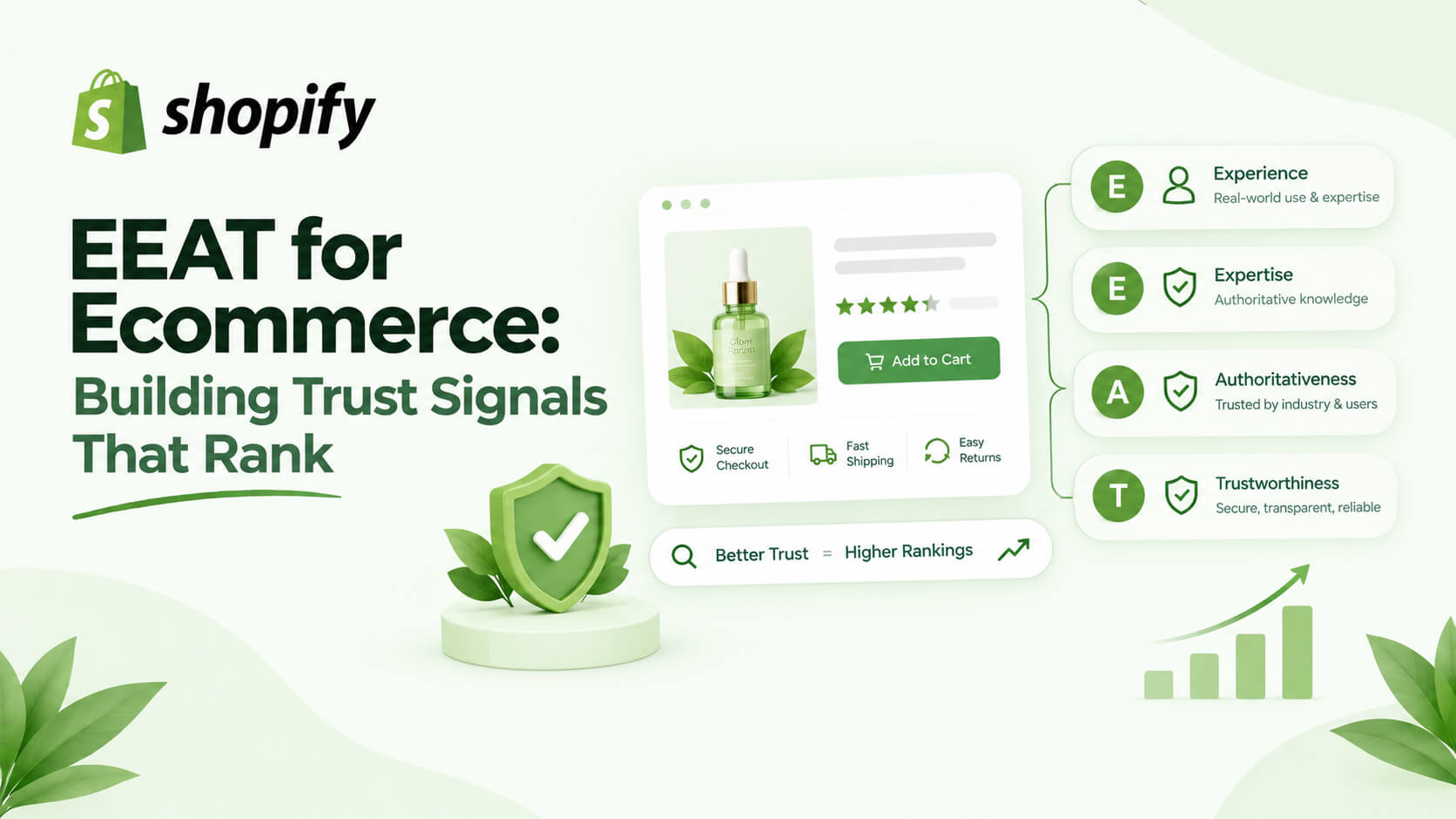
EEAT — standing for Experience, Expertise, Authoritativeness, and Trust (Google added the first “E,” Experience, to what was previously E-A-T) — is a framework Google uses to assess the quality and trustworthiness of content and sites, and it increasingly shapes how sites rank. For ecommerce, EEAT matters: as search increasingly favours trustworthy, authoritative, expert sources (and as AI engines rely on authority too, as the GEO and entity-SEO discussions cover), building your store’s EEAT — demonstrating experience, expertise, authoritativeness, and trust — supports ranking (and being surfaced by AI) and, importantly, aligns with actually being a trustworthy, quality brand (which serves customers too). EEAT isn’t a single ranking factor you optimise directly; it’s a quality-and-trust framework you build toward through many signals and practices. This piece covers EEAT for ecommerce: what it means, why it matters, how to build each element, and how it connects to trust and AI. (This connects to the entity-SEO, trust, and GEO discussions, which overlap; this focuses on EEAT for ecommerce.)
This piece covers what EEAT is and why it matters for ecommerce, how to build each element (Experience, Expertise, Authoritativeness, Trust), the practical trust signals, and how EEAT connects to trust and AI. Because EEAT increasingly shapes ranking and aligns with being a quality brand, building it is worthwhile. Let me walk through it.
What EEAT is and why it matters for ecommerce
Let’s understand EEAT and its ecommerce relevance. What EEAT is — EEAT is Google’s framework for assessing content and site quality and trustworthiness: Experience (first-hand experience with the topic/product), Expertise (knowledge and skill in the subject), Authoritativeness (being a recognised, authoritative source), and Trust (being trustworthy — accurate, safe, legitimate) — with Trust being central (the others support trust). Google uses EEAT (via its quality guidelines and systems) to favour trustworthy, quality content and sites. Why it matters for ecommerce — EEAT matters for ecommerce for several reasons. Ranking — search increasingly favours EEAT (trustworthy, authoritative, expert sources), so building EEAT supports ranking (being seen as a quality, trustworthy source), while lacking it can limit ranking (especially in competitive or trust-sensitive areas) — a real ranking consideration. Trust-sensitive commerce — ecommerce involves trust (customers giving money and data, as the trust discussion covers), and EEAT (demonstrating trustworthiness) aligns with the trust ecommerce requires — so EEAT and ecommerce trust connect. AI relies on authority/trust — AI engines favour authoritative, trustworthy sources (as the GEO and entity-SEO discussions cover), so EEAT (authority and trust) supports being surfaced/cited by AI too — increasingly important. Aligns with being a quality brand — building EEAT means actually being (and demonstrating being) an experienced, expert, authoritative, trustworthy brand — which aligns with genuine quality (serving customers, building a real brand), not just SEO — so EEAT is about genuine quality, not gaming. And it’s increasingly emphasised — Google increasingly emphasises EEAT (especially trust) in its quality assessment, so it’s an increasingly important framework — worth building toward. So EEAT (Experience, Expertise, Authoritativeness, Trust — with Trust central) is Google’s quality-and-trust framework, and it matters for ecommerce because it supports ranking (search favours EEAT), aligns with the trust ecommerce requires, supports being surfaced by AI (which favours authority/trust), aligns with being a genuine quality brand (not gaming), and is increasingly emphasised. So building EEAT is worthwhile — supporting ranking and AI-discoverability while aligning with genuine brand quality and trust. So understand EEAT as a quality-and-trust framework to build toward (not a single factor to game), which the next sections cover building. So build EEAT to support ranking, AI, and genuine brand quality.
How to build Experience and Expertise
The first two elements — Experience and Expertise — are about demonstrating genuine knowledge and first-hand experience. Experience (first-hand) — Experience is about first-hand experience with what you’re writing about or selling. For ecommerce, demonstrate experience: content showing real experience with your products/domain (real product knowledge, real use, real insight — e.g., genuine product content, guides from real experience, as the content discussions cover), and signals of real experience (real reviews, real usage, real expertise behind the brand) — showing you have first-hand experience, not just surface content. Expertise — Expertise is knowledge and skill in your subject. Demonstrate expertise: content demonstrating genuine knowledge and expertise in your domain (expert product and category content, helpful expert guidance, depth of knowledge, as the topical-authority and content discussions cover), and expertise signals (expert authors, credentials where relevant, demonstrated knowledge) — showing you know your subject expertly. For ecommerce specifically — for ecommerce, Experience and Expertise mean demonstrating you know and have experience with your products and domain: through quality, knowledgeable, experience-based content (product content, guides, expertise, as the content and topical-authority discussions cover), showing real expertise and experience (versus thin, generic, or surface content). Author expertise — where relevant, showing the expertise/experience of authors or the brand (who’s behind the content, their expertise/experience), supporting Experience and Expertise (as the author/EEAT signals). Depth and quality — depth and quality of content (comprehensive, knowledgeable, useful content, as the topical-authority discussion covers) demonstrates expertise/experience (versus thin content) — so build quality, in-depth, knowledgeable content. And genuine, not faked — Experience and Expertise should be genuine (real experience and knowledge demonstrated), not faked (which fails and risks trust) — so build genuine expertise and experience into your content and brand. So build Experience and Expertise by demonstrating genuine first-hand experience (real product knowledge, use, insight) and genuine expertise (knowledgeable, expert, in-depth content and signals) in your domain — through quality, knowledgeable, experience-and-expertise-based content, author/brand expertise signals, and depth/quality, (not faked). So demonstrate genuine experience and expertise in your products and domain, especially through quality content. The next section covers Authoritativeness and Trust.
How to build Authoritativeness and Trust
The next two elements — Authoritativeness and Trust (Trust being central) — are about being a recognised authority and a trustworthy source. Authoritativeness — Authoritativeness is being a recognised, authoritative source in your domain. Build it: build your brand’s authority and recognition (as the entity-SEO discussion covers) — being known and recognised as an authority in your domain, through a strong, authoritative brand presence, being referenced and cited, topical authority (comprehensive authoritative content, as that discussion covers), and being a recognised entity (as the entity-SEO discussion covers) — so search (and AI) recognise you as authoritative. Reputation and mentions — authority is built partly through reputation, mentions, references, and citations (others recognising/referencing you), so build your brand’s reputation and presence (as the entity-SEO discussion covers) — being a recognised, referenced authority. Trust (central) — Trust is central to EEAT (the others support trust), and it’s about being trustworthy: accurate, honest, safe, legitimate, and reliable. Build trust: trust signals (as the trust discussion covers) — reviews and social proof (as those discussions cover), security (HTTPS, secure checkout, trust badges), transparency (clear policies, contact information, about information, as the trust discussion covers), professionalism (a quality, professional, legitimate-seeming store), accuracy and honesty (accurate content, honest practices, as the ethical discussions cover), and a good reputation — all demonstrating trustworthiness. For ecommerce trust specifically — ecommerce trust (as the trust discussion covers) includes the store being professional and legitimate, having reviews and social proof, clear policies (returns, privacy, shipping), secure checkout, accurate product information, good customer service, and a good reputation — the trust signals that make customers (and search) trust the store. NAP and legitimacy — accurate business information (NAP — name, address, phone), clear contact and about information, and legitimacy signals support trust (a real, legitimate, contactable business, as the trust and local-SEO discussions cover). And genuine trustworthiness — Trust (and EEAT overall) should reflect genuine trustworthiness (actually being trustworthy — accurate, honest, safe, legitimate), not just signals (though signals demonstrate it) — so be trustworthy and demonstrate it. So build Authoritativeness (being a recognised authority — brand authority, reputation, mentions, topical authority, entity recognition, as the entity-SEO discussion covers) and Trust (central — trust signals: reviews, security, transparency, professionalism, accuracy, clear policies, legitimacy, good reputation, as the trust discussion covers), reflecting genuine authority and trustworthiness. So build your brand’s authority (recognition, reputation) and trust (the trust signals and genuine trustworthiness) — the authoritativeness and trust that are central to EEAT. The next section covers how EEAT connects to trust and AI.
How EEAT connects to trust and AI
EEAT connects closely to ecommerce trust and to AI, reinforcing why it matters. Connection to trust — EEAT (especially Trust, its central element) deeply connects to ecommerce trust (as the trust discussion covers): building EEAT’s Trust element is largely building the trust that ecommerce requires (reviews, security, transparency, professionalism, legitimacy, good reputation), so EEAT and ecommerce trust overlap heavily — building one builds the other. So EEAT isn’t just SEO; it’s building the genuine trust that serves customers and conversion too (as the trust discussion covers) — EEAT and trust align. Connection to entity SEO and authority — EEAT (especially Authoritativeness) connects to entity SEO (as that discussion covers): being a recognised, authoritative entity is much of Authoritativeness, so building entity recognition builds EEAT’s authority (and vice versa) — they overlap. Connection to AI/GEO — EEAT connects to AI/GEO (as those discussions cover): AI engines favour authoritative, trustworthy, expert sources (much like EEAT), so building EEAT (authority, expertise, trust) supports being surfaced and cited by AI (the GEO benefit) — EEAT and AI-discoverability align. The unified goal — EEAT, trust, entity SEO, and AI-discoverability all point to the same underlying goal: being a experienced, expert, authoritative, trustworthy brand — which serves ranking (EEAT), customers and conversion (trust), being understood (entity SEO), and being surfaced by AI (GEO) — all together. So building EEAT is a unified investment serving SEO, trust/conversion, entity recognition, and AI-discoverability. It’s about being a quality brand — fundamentally, building EEAT is about being (and demonstrating being) a quality, experienced, expert, authoritative, trustworthy brand — which aligns with real quality (serving customers, building a real brand), not gaming SEO — so it’s a worthwhile, aligned investment. So EEAT connects to and reinforces trust (its central element overlapping with ecommerce trust), entity SEO (authority), and AI/GEO (AI favouring authority/trust/expertise) — all pointing to being a quality, authoritative, trustworthy brand, which serves ranking, customers/conversion, understanding, and AI-discoverability together. So build EEAT as a unified investment in being a quality, trustworthy, authoritative brand — serving SEO, trust, entity recognition, and AI together. So EEAT, trust, entity SEO, and AI-discoverability are interconnected facets of the same goal (a genuine quality brand), and building EEAT serves them all.
A worked example: building EEAT for a specialist brand
Picture a specialist brand — say, a coffee company selling single-origin beans and brewing gear — deliberately building EEAT, and how the four elements come together into something that’s both good SEO and a better brand. On Experience, it publishes content that clearly reflects first-hand experience: real brewing guides written by people who actually roast and brew, tasting notes grounded in genuine cupping, honest product insight rather than generic manufacturer copy — the kind of content only someone with real experience could write. On Expertise, it builds depth: comprehensive, knowledgeable content on origins, roast levels, and brewing methods, with the expertise of its roasters visible behind it, demonstrating it knows its subject. On Authoritativeness, it works to become recognised in its niche — a consistent, authoritative brand presence, mentions and references from coffee publications and communities, topical authority across its domain, and entity recognition (as the entity-SEO discussion covers) — so search and AI increasingly treat it as an authority on specialty coffee. And on Trust — the central element — it demonstrates trustworthiness thoroughly: genuine reviews and customer photos, secure checkout, clear and fair policies, transparent contact and about information, accurate product details, good service, and a solid reputation.
The payoff is unified. Search increasingly favours the brand as a trustworthy, authoritative, expert source (better rankings, especially on competitive and trust-sensitive terms); AI engines, which lean on the same authority and trust, increasingly surface and cite it (the GEO benefit); and — crucially — customers experience a brand that visibly knows its craft and is trustworthy, which lifts conversion and loyalty. Notice that none of this was gaming a ranking factor: it was being, and demonstrating being, an experienced, expert, authoritative, trustworthy brand. That’s the essence of EEAT for ecommerce — the SEO benefit and the brand benefit are the same investment. A store that builds real experience, expertise, authority, and trust ranks better, gets cited by AI, and serves customers better, all at once. And because these elements compound over time (authority and trust build slowly but durably), the brand that invests in EEAT builds an advantage that’s hard for thinner, less trustworthy competitors to replicate — which is exactly why, as search and AI increasingly favour quality and trust, EEAT is worth building deliberately.
The bottom line
EEAT — Experience, Expertise, Authoritativeness, and Trust (Google added the “Experience” to the earlier E-A-T) — is Google’s framework for assessing content and site quality and trustworthiness, with Trust being central (the others support it), and it increasingly shapes how sites rank. For ecommerce, EEAT matters because search increasingly favours trustworthy, authoritative, expert sources (so building EEAT supports ranking), it aligns with the trust ecommerce inherently requires (customers giving money and data), it supports being surfaced and cited by AI engines (which favour authority and trust, the GEO connection), and — importantly — building it means being and demonstrating being a quality, experienced, expert, authoritative, trustworthy brand, aligning with real quality and serving customers, not gaming SEO. EEAT isn’t a single factor you optimise directly; it’s a quality-and-trust framework you build toward through many signals and practices. Build Experience and Expertise by demonstrating genuine first-hand experience (real product knowledge, use, and insight) and genuine expertise (knowledgeable, expert, in-depth content and signals) in your domain — through quality, knowledgeable content, author and brand expertise signals, and depth, rather than faked. Build Authoritativeness by becoming a recognised, authoritative source in your domain (strong, authoritative brand presence, reputation, mentions and references, topical authority, and entity recognition, as the entity-SEO discussion covers), and build Trust — the central element — through trust signals (reviews and social proof, security like HTTPS and secure checkout, transparency via clear policies and contact and about information, professionalism, accuracy and honesty, accurate business information/NAP, good customer service, and a good reputation) reflecting genuine trustworthiness. Crucially, EEAT connects to and reinforces ecommerce trust (its central Trust element overlaps heavily with the trust ecommerce requires, so building EEAT builds the trust that serves customers and conversion too), entity SEO (Authoritativeness overlaps with being a recognised entity), and AI/GEO (AI engines favour the authority, expertise, and trust EEAT represents, so EEAT supports being surfaced by AI) — all pointing to the same underlying goal of being a experienced, expert, authoritative, trustworthy brand, which serves ranking, customers and conversion, understanding, and AI-discoverability together. So building EEAT is a unified, worthwhile investment: it’s fundamentally about being (and demonstrating being) a quality, trustworthy, authoritative brand, which aligns with real quality and serves customers, not just SEO. So build your store’s EEAT — genuine experience and expertise (quality knowledgeable content), authoritativeness (recognition, authority, entity presence), and trust (trust signals and genuine trustworthiness, the central element) — as a unified investment that supports ranking and AI-discoverability while making you a better, more trustworthy brand that serves customers. As search and AI increasingly favour quality, trust, and authority, building EEAT is increasingly important — and it aligns SEO with being the quality brand your customers deserve.
Frequently asked questions
What is EEAT and does it matter for ecommerce?
EEAT stands for Experience, Expertise, Authoritativeness, and Trust — Google’s framework for assessing the quality and trustworthiness of content and sites (Google added “Experience” to the earlier E-A-T), with Trust being the central element the others support. It matters for ecommerce because search increasingly favours trustworthy, authoritative, expert sources, so building EEAT supports your ranking (and lacking it can limit it). It also aligns with the trust ecommerce inherently requires (customers give money and personal data, so trust is fundamental), and it supports being surfaced and cited by AI engines, which favour authoritative, trustworthy sources (the GEO connection). Importantly, EEAT isn’t a single ranking factor you optimise directly or can game — it’s a quality-and-trust framework you build toward through many signals and practices, and building it means being and demonstrating being a quality, experienced, expert, authoritative, trustworthy brand. So it aligns SEO with real brand quality that serves customers, making it a worthwhile investment.
How do I build Experience and Expertise for my store?
Demonstrate genuine first-hand experience and knowledge in your domain, primarily through quality content. For Experience, show real, first-hand experience with your products and domain — genuine product knowledge, real use and insight, content that reflects actually knowing and using what you sell (rather than thin, generic, surface content). For Expertise, demonstrate genuine knowledge and skill in your subject — expert product and category content, helpful expert guidance, and depth of knowledge (as topical-authority content builds). Where relevant, show the expertise and experience of the authors or brand behind the content (who they are and why they’re knowledgeable). The key is depth and quality — comprehensive, knowledgeable, useful content demonstrates experience and expertise, while thin content doesn’t — and it must be genuine, not faked, since faked expertise fails and risks trust. So build real expertise and experience into your content and brand, especially through quality, in-depth, knowledgeable content about your products and domain.
How do I build Authoritativeness and Trust?
For Authoritativeness, become a recognised, authoritative source in your domain: build a strong, authoritative brand presence, a good reputation, and mentions and references from others, develop topical authority through comprehensive, authoritative content, and build entity recognition (being a recognised entity, as entity SEO covers) — so search and AI recognise you as authoritative. For Trust — the central EEAT element — build the trust signals that demonstrate trustworthiness: reviews and social proof, security (HTTPS, secure checkout, trust badges), transparency (clear returns, privacy, and shipping policies, plus contact and about information), professionalism (a quality, legitimate-seeming store), accuracy and honesty (accurate content and honest practices), accurate business information (name, address, phone), good customer service, and a good reputation. Crucially, both should reflect genuine authority and trustworthiness — actually being authoritative and trustworthy — not just surface signals. Since Trust is central to EEAT and overlaps heavily with the trust ecommerce requires, building it serves both your ranking and your customers.
How does EEAT relate to trust, entity SEO, and AI?
They’re deeply interconnected — all pointing to the same underlying goal of being a experienced, expert, authoritative, trustworthy brand. EEAT’s central Trust element overlaps heavily with the trust ecommerce requires (reviews, security, transparency, professionalism, legitimacy, good reputation), so building EEAT’s trust is largely building the trust that serves customers and conversion too — EEAT isn’t just SEO. EEAT’s Authoritativeness overlaps with entity SEO (being a recognised, authoritative entity is much of authoritativeness), so building entity recognition builds EEAT’s authority and vice versa. And EEAT connects to AI and GEO because AI engines favour authoritative, trustworthy, expert sources — much like EEAT — so building EEAT supports being surfaced and cited by AI. So EEAT, ecommerce trust, entity SEO, and AI-discoverability are interconnected facets of the same goal, and building EEAT is a unified investment that serves ranking, customers and conversion, being understood, and being surfaced by AI all together — while making you a better, more trustworthy brand.