
Shopify Development Trends to Watch
On this page
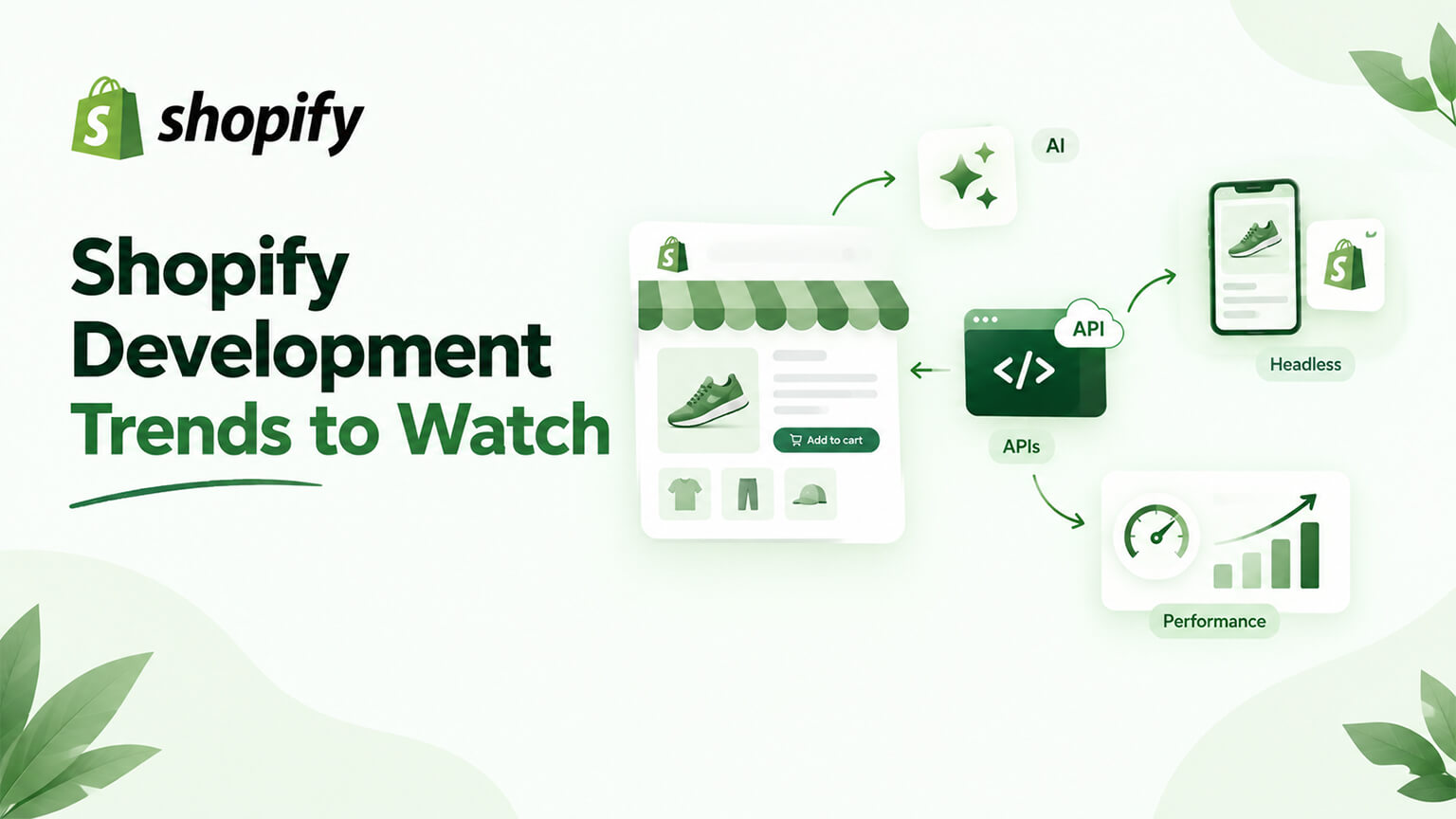
Shopify and ecommerce development don’t stand still — the platform, the tools, and the practices keep evolving, and staying aware of the key trends helps you make informed decisions about your store (what to adopt, what to prepare for, what’s hype versus substance). This isn’t about chasing every new thing (much “trend” talk is hype, and stability matters), but about understanding the meaningful directions Shopify development is heading, so you can position your store well. Several genuine trends are shaping Shopify development: the maturation of modern theme architecture (Online Store 2.0 and beyond), the evolution of checkout and extensibility, the growth of headless and modern front-end approaches, the pervasive impact of AI (on development, discovery, and commerce), and the ongoing importance of performance and the fundamentals. This piece covers the key Shopify development trends to watch and what they mean for your store — separating meaningful directions from hype, and helping you position your store sensibly. (This connects to the OS 2.0, headless, checkout-extensibility, and AI discussions; this consolidates the trends. Note: trends evolve, and this reflects the general directions as of writing; verify current specifics.)
This piece covers the key trends — modern theme architecture, checkout and extensibility, headless and modern front-end, AI’s impact, and performance and fundamentals — and what each means for your store. Because staying aware of meaningful trends helps you position your store well, separating substance from hype. Let me walk through them.
Modern theme architecture (Online Store 2.0 and beyond)
A key trend is the maturation of modern theme architecture. Online Store 2.0 — Shopify’s Online Store 2.0 (sections everywhere, app blocks, flexible content, metafields, as that discussion covers) has become the modern standard for themes, enabling flexible, marketer-manageable, well-architected stores — a mature, established direction (versus older theme architecture). What it means — for your store, this means building on modern theme architecture (OS 2.0, as that and the architecture discussions cover) — flexible, editable, well-structured themes the team can manage — is the standard, so ensure your theme is modern (OS 2.0) to benefit (flexibility, maintainability) and not be on outdated architecture. Continued evolution — theme architecture continues evolving (Shopify enhancing themes, sections, and the editing experience), so the direction is toward more flexible, capable, marketer-friendly themes — worth staying current with. More flexibility and control for merchants — the trend is toward giving merchants more flexibility and control (managing content, building pages, customising via the editor, as the OS 2.0 discussion covers) without needing developers for everything — empowering merchants. And metafields/metaobjects for flexible content — the growing use of metafields and metaobjects (as that discussion covers) for flexible, structured content is part of this trend (richer, more flexible content architecture) — worth leveraging. So the modern-theme-architecture trend (OS 2.0 and beyond) means flexible, editable, well-architected, marketer-friendly themes are the standard and continue evolving — meaning for your store, being on modern architecture (OS 2.0, using sections/blocks and metafields well) to benefit from the flexibility and maintainability. So ensure your store is on modern theme architecture, benefiting from this mature, evolving trend. This is a substantive, established trend (not hype) worth being aligned with.
Checkout and extensibility
Another key trend is the evolution of checkout and extensibility. Checkout extensibility — Shopify’s move to checkout extensibility (checkout UI extensions replacing checkout.liquid, as those discussions cover) is a significant, ongoing trend — the modern, supported way to customise the checkout (safely, upgrade-safely), which Shopify continues developing. What it means — for your store (especially Plus, where checkout customisation applies), this means the checkout is customised via extensibility (extensions, not checkout.liquid, which is deprecated) — so migrate to and use checkout extensibility (as those discussions cover), the modern approach, and expect continued development of checkout capabilities. Shopify Functions — Shopify Functions (custom backend logic for discounts, shipping, etc., as those discussions cover) are a growing capability (the modern way to add custom logic, replacing Scripts) — an ongoing trend (Shopify expanding Functions’ capabilities), worth leveraging for custom logic (on Plus). More extensibility generally — the trend is toward more extensibility (extensions, Functions, APIs) enabling customisation in supported, upgrade-safe ways (versus older, less-safe customisation) — so customisation increasingly happens via these modern extensibility mechanisms. And a more customisable but stable platform — the direction is a platform that’s more customisable (via extensibility) while staying stable and upgrade-safe (Shopify maintaining the core while enabling customisation via extensions) — beneficial (customisation without instability). So the checkout-and-extensibility trend means customisation (checkout, logic) increasingly via modern extensibility (checkout extensions, Functions) — safe, supported, upgrade-safe — which Shopify continues developing, meaning for your store, using these modern extensibility approaches (checkout extensibility, Functions) for customisation. So adopt and leverage the modern extensibility (checkout extensions, Functions) for customisation, aligned with this trend. This is a substantive, ongoing trend (the modern customisation direction) worth being aligned with.
Headless and modern front-end approaches
The growth of headless and modern front-end approaches is a notable trend (though with important nuance). Headless growth — headless commerce (custom front-ends, as those discussions cover) has grown as an approach, with Shopify supporting it (Hydrogen, Oxygen, the Storefront API, as those discussions cover) and modern front-end technologies (React, Next.js, RSC, as those discussions cover) advancing — a real trend (more headless capability and adoption). Modern front-end tech — modern front-end technologies (React Server Components, modern frameworks, edge rendering, as those discussions cover) are advancing, improving what headless can do (performance, capabilities) — an evolving technical trend. But nuance: not for everyone — importantly (as the is-headless-worth-it and when-not-headless discussions cover), headless isn’t right for most stores (the trade-offs), and much “go headless” talk is hype — so the trend is real (headless is more capable and adopted) but the nuance is that it’s for stores that need it, not a default. What it means — for your store, this means headless is a more capable, viable option for those who need it (with better tools and tech), but most stores are still well-served by modern themes (OS 2.0) — so consider headless only if you need it (as those discussions cover), while recognising the trend without being swept by hype. Hybrid and flexible approaches — the trend also includes more hybrid and flexible headless approaches (as the hybrid-headless and architecture-patterns discussions cover), so headless is increasingly not all-or-nothing (partial/hybrid options), giving more flexibility in how much headless to adopt. So the headless-and-front-end trend means headless is more capable and adopted (better tools, tech, and hybrid options), a real direction — but with the crucial nuance that it’s for stores that need it (not a default, and much talk is hype), meaning for your store, considering headless only if warranted while staying on modern themes otherwise. So watch the headless trend, but adopt headless only if you need it (per the headless discussions), separating the real trend from the hype. This trend has substance (headless is advancing) but requires the nuance (not for most stores) to navigate sensibly.
AI’s impact, and performance and fundamentals
Two more key trends: AI’s pervasive impact, and the enduring importance of performance and fundamentals. AI’s pervasive impact — AI is a major, pervasive trend (as the many AI discussions cover): AI is impacting development (AI-assisted development), commerce operations and marketing (AI for content, personalisation, support, analysis, as those discussions cover), and discovery (AI search, AI Overviews, GEO, as those discussions cover) — a transformative, ongoing trend across ecommerce. What it means — for your store, AI means using AI well (for operations and marketing, with oversight, as the ethical-AI and AI discussions cover) and being ready for AI-driven discovery (GEO, being found by AI, as those discussions cover) — the two-front AI readiness (as that discussion covers) — so engage with AI (using it well, being AI-discoverable), a significant ongoing trend to be ready for. Performance and Core Web Vitals — performance (speed, Core Web Vitals, as those discussions cover) remains critically important (a ranking and conversion factor), an enduring “trend” (not new, but persistently important, and Shopify and the ecosystem continue emphasising it) — so keep performance a priority. The fundamentals endure — amid the trends, the fundamentals (good content, technical health, performance, maintainability, UX, trust, as those discussions cover) endure and remain what most determines success — so don’t lose sight of the fundamentals chasing trends (the fundamentals are the enduring foundation). Balance trends with fundamentals — the meta-point: watch and adopt meaningful trends (modern architecture, extensibility, AI, headless where warranted) while staying grounded in the enduring fundamentals (performance, quality, content, UX) — balancing innovation with the fundamentals that endure. And avoid hype-chasing — avoid chasing hype (adopting trends for their own sake, over-investing in the latest thing) — adopt trends where they benefit your store, grounded in the fundamentals. So AI’s pervasive impact (across development, operations, marketing, and discovery — engage with it via two-front AI readiness) and the enduring importance of performance and fundamentals (which persist amid the trends) are key — meaning for your store, engaging with AI while keeping performance and the fundamentals central, and balancing meaningful trends with the enduring fundamentals (avoiding hype-chasing). So engage with AI, keep performance and fundamentals central, and balance trends with fundamentals — the sensible way to navigate the trends. So AI and the enduring fundamentals frame how to approach all the trends: adopt meaningful trends grounded in the fundamentals, engaging with AI, without chasing hype.
A worked example: separating substance from hype
Picture a store owner reading the endless stream of “the future of ecommerce” content and trying to decide what actually to do about it. The trends discussion becomes practical when you run each one through a simple filter: is this a substantive direction that affects my store, and if so, what’s the sensible action? Take modern theme architecture: substantive and near-universal, so the action is concrete — make sure the store is on Online Store 2.0 and using sections, blocks, and metafields well (a real, worthwhile alignment). Take checkout extensibility and Functions: substantive, especially for a Plus store, so the action is to migrate off checkout.liquid and use the modern extensibility for any checkout customisation (again concrete and worthwhile). Take AI: substantive and pervasive, so the action is two-front AI readiness — use AI well operationally and get AI-discoverable (a real, ongoing engagement). Each of these passes the filter as substance with a clear, sensible action.
Now take “everyone’s going headless”: run it through the filter and the nuance surfaces. Headless is a real trend, but for this particular store — well-served by a modern theme, without the specific needs or engineering resources headless demands — the sensible action is not to go headless, but to understand it and revisit only if genuine needs emerge. The trend is real; the right action for this store is restraint. This is the whole skill of navigating trends: not reflexively adopting or ignoring, but filtering each for substance-versus-hype and genuine-benefit-for-me, and — crucially — never letting trend-chasing crowd out the fundamentals. The same store, whatever it decides about the trends, should keep its images optimised, its Core Web Vitals healthy, its content good, and its UX and trust strong, because those fundamentals determine success regardless of which trends come and go. That’s the balance the whole topic points to: engage with the meaningful directions where they benefit you, ground every decision in the enduring fundamentals, and treat the hype with the skepticism it deserves. A store run that way stays well-positioned as Shopify evolves without being whipsawed by every “next big thing.”
The bottom line
Shopify and ecommerce development keep evolving, and staying aware of the key trends helps you make informed decisions about your store — not by chasing every new thing (much trend talk is hype, and stability matters), but by understanding the meaningful directions so you can position your store well. The modern-theme-architecture trend (Online Store 2.0 and beyond) means flexible, editable, well-architected, marketer-friendly themes are the standard and continue evolving (toward more merchant flexibility and control, and richer content via metafields/metaobjects) — so ensure your store is on modern architecture (OS 2.0, using sections, blocks, and metafields well) to benefit from the flexibility and maintainability, a substantive, established trend. The checkout-and-extensibility trend means customisation (of the checkout and logic) increasingly happens via modern extensibility — checkout UI extensions (replacing the deprecated checkout.liquid) and Shopify Functions (replacing Scripts) — in safe, supported, upgrade-safe ways that Shopify continues developing, so adopt and leverage these modern extensibility approaches for customisation. The headless-and-modern-front-end trend is real (headless is more capable and adopted, with advancing front-end technologies like React Server Components and edge rendering, and more hybrid/flexible options) but carries the crucial nuance that headless isn’t right for most stores (the trade-offs, and much “go headless” talk is hype) — so consider headless only if you need it while staying on modern themes otherwise, separating the real trend from the hype. AI’s pervasive impact is a major, transformative, ongoing trend across development, commerce operations and marketing, and discovery (AI search, AI Overviews, GEO) — so engage with AI on both fronts (using it well with oversight, and being ready for AI-driven discovery — two-front AI readiness), a significant trend to be ready for. And amid all the trends, performance (speed, Core Web Vitals) and the fundamentals (good content, technical health, maintainability, UX, trust) endure and remain what most determines success — so keep performance and the fundamentals central, balancing meaningful trends with the enduring fundamentals and avoiding hype-chasing (adopting trends where they benefit your store, grounded in the fundamentals). So the sensible way to navigate Shopify development trends is to stay on modern theme architecture, adopt modern extensibility for customisation, consider headless only if warranted, engage with AI on both fronts, and — crucially — keep performance and the enduring fundamentals central while balancing them with meaningful trends, avoiding hype-chasing. Watch the trends to position your store well, but ground your decisions in genuine benefit and the enduring fundamentals — adopting the meaningful directions (modern architecture, extensibility, AI readiness, headless where warranted) while not losing sight of the performance, quality, content, and UX that endure and most determine success. That balance — engaging with meaningful trends while staying grounded in the fundamentals — is how to keep your store well-positioned as Shopify development evolves.
Frequently asked questions
What are the key Shopify development trends to watch?
Several meaningful directions. The maturation of modern theme architecture (Online Store 2.0 and beyond) — flexible, editable, marketer-friendly themes as the standard, with more merchant control and richer content via metafields and metaobjects. The evolution of checkout and extensibility — customisation increasingly via modern extensibility (checkout UI extensions replacing checkout.liquid, and Shopify Functions replacing Scripts) in safe, upgrade-safe ways. The growth of headless and modern front-end approaches (Hydrogen, the Storefront API, React Server Components, edge rendering, and hybrid options) — though with the important nuance that headless isn’t right for most stores. AI’s pervasive impact across development, commerce operations and marketing, and discovery (AI search, AI Overviews, GEO). And the enduring importance of performance (Core Web Vitals) and the fundamentals. The key is to watch these meaningful directions to position your store well, while separating substance from hype and grounding decisions in genuine benefit and the enduring fundamentals rather than chasing every new thing.
Should I go headless because it’s trending?
No — this is exactly where separating trend from hype matters. Headless is a real, growing trend (more capable, with advancing front-end technologies and better tooling and hybrid options), but it isn’t right for most stores: it brings significant trade-offs (complexity, cost, the need for engineering capability, SEO risk if done poorly), and much “go headless” talk is hype. Most stores are still well-served by modern Online Store 2.0 themes, which deliver good design, performance, and flexibility without headless’s costs. So you should consider headless only if you need what it offers (front-end control, specific performance, unique experiences) and can resource it — a considered decision based on genuine need, as the headless discussions cover — not because it’s trending. The fact that headless is advancing and more adopted doesn’t mean it’s right for you. Watch the trend, understand it, but adopt headless only if it fits your needs and resources, while recognising that for most stores, modern themes remain the better choice.
How does AI affect Shopify development and my store?
AI is a major, pervasive trend affecting ecommerce on multiple fronts. It impacts development itself (AI-assisted development), commerce operations and marketing (AI for content, personalisation, customer support, analysis, imagery, and more — used well with human oversight), and — increasingly — how customers discover products (AI search, AI assistants, AI Overviews, and being found and cited by AI engines, which is the GEO side of things). For your store, this means engaging with AI on two fronts: using AI well to operate and market more effectively and efficiently (responsibly, with human oversight), and being ready to be discovered and well-represented by AI-driven discovery (the GEO work). This “two-front AI readiness” is an increasingly important way to be prepared for how AI is reshaping ecommerce. So AI is a significant, ongoing trend to engage with thoughtfully — capturing its operational and marketing benefits responsibly, and positioning your store to be found by AI — rather than either ignoring it or chasing every AI hype.
How do I keep up with trends without chasing hype?
Balance engaging with meaningful trends against staying grounded in the enduring fundamentals, and adopt trends based on genuine benefit rather than novelty. Stay aware of the substantive directions (modern theme architecture, checkout extensibility and Functions, headless where warranted, AI’s impact) and position your store sensibly — for example, being on modern Online Store 2.0 architecture, using modern extensibility for customisation, and engaging with AI. But don’t chase every new thing or adopt trends for their own sake: much trend talk is hype, stability matters, and over-investing in the latest thing can be wasteful. Crucially, keep performance (Core Web Vitals) and the fundamentals (good content, technical health, maintainability, UX, trust) central, since these endure and most determine success regardless of trends. The sensible approach is to adopt the meaningful trends where they benefit your store, grounded in the enduring fundamentals — engaging with innovation while never losing sight of the performance, quality, content, and UX that consistently drive results.