
Using AI for Merchandising and Product Recommendations
On this page
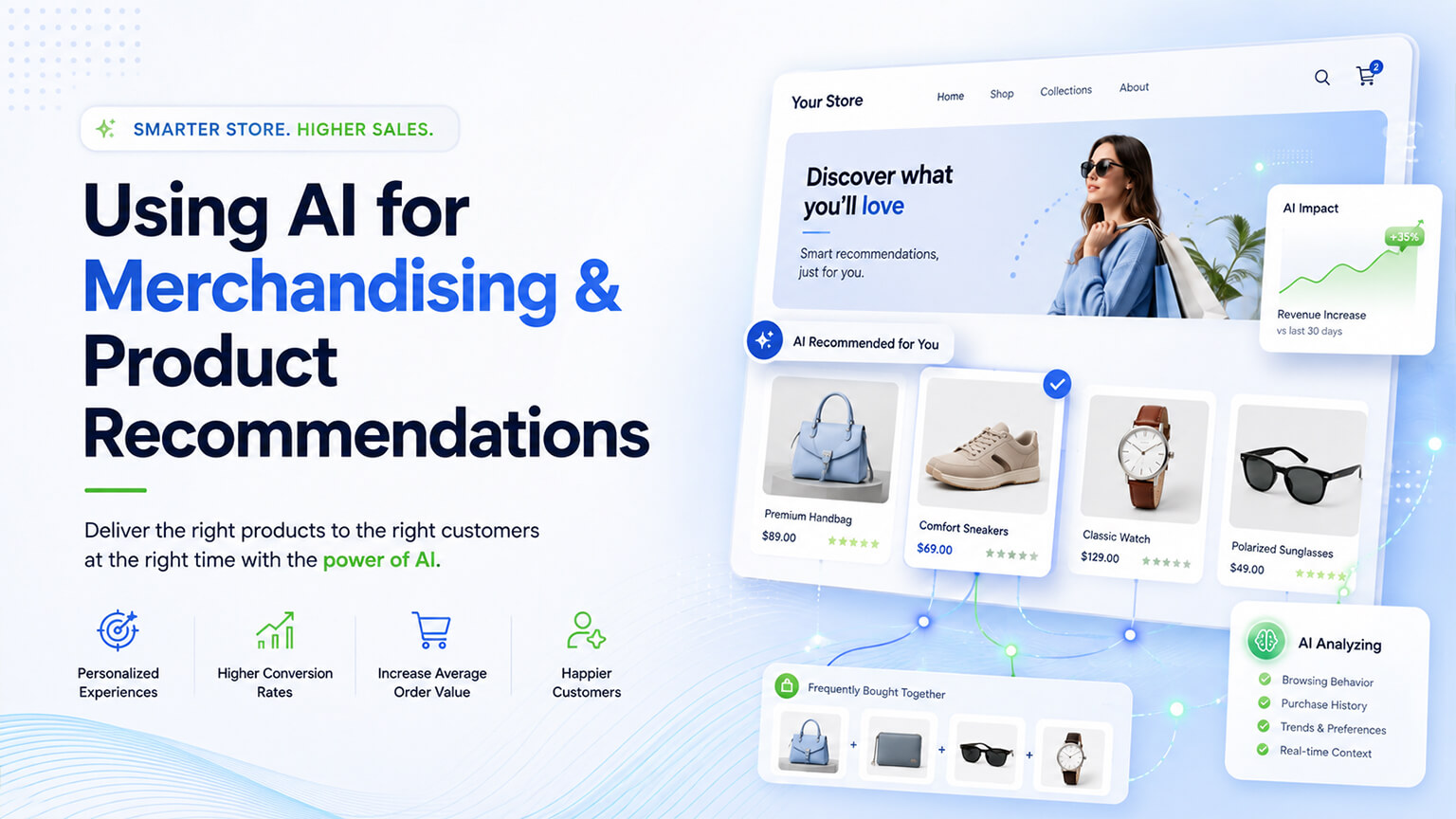
Merchandising — deciding which products to show, where, and how, to drive sales — is a core ecommerce discipline, and product recommendations (suggesting relevant products to shoppers) are a key part of it. AI is useful for both: it can analyse shopper behaviour and product data to surface relevant products (recommendations), order and arrange products intelligently (merchandising), and personalise what each shopper sees — at a scale and granularity humans can’t match manually. Done well, AI-powered merchandising and recommendations help shoppers discover relevant products (supporting conversion and AOV) and help the store surface the right products to the right shoppers (better than static, manual merchandising). But, as with other AI applications, it works best combined with human judgment (merchandising strategy, business goals, brand) rather than handed over entirely. So AI is a valuable tool for merchandising and recommendations, used well (AI’s data-driven relevance plus human strategy). This piece covers where it helps and how to use it well.
This piece covers what AI does for merchandising and recommendations, where it helps, the role of human judgment, and how to use it well on Shopify. Because it’s a valuable application of AI (surfacing the right products), used well with human strategy. Let me walk through it.
What AI does for merchandising and recommendations
AI brings data-driven intelligence to merchandising and recommendations in several ways. Product recommendations — AI analyses shopper behaviour (what they view, buy, and how shoppers with similar behaviour act) and product data to recommend relevant products (“recommended for you,” “you might also like,” “frequently bought together”), surfacing relevant products to each shopper, more relevantly than static recommendations. Personalised merchandising — AI can personalise what each shopper sees (the products, order, and arrangement shown to them), based on their behaviour and preferences, so each shopper sees more relevant products (personalisation, as that discussion covers), rather than everyone seeing the same static merchandising. Intelligent product ordering — AI can order and arrange products (in collections, search results, recommendations) based on relevance, performance, and likelihood to convert, optimising what’s surfaced (better than manual or arbitrary ordering). Behaviour analysis — AI analyses shopper behaviour at scale (patterns, preferences, what drives conversion) to inform merchandising, surfacing insights and driving recommendations. And scale and granularity — AI does this at a scale and granularity humans can’t manually (per-shopper personalisation, real-time, across the whole catalog), which is its key advantage over manual merchandising. So AI does product recommendations (relevant suggestions per shopper), personalised merchandising (what each shopper sees), intelligent product ordering (optimising what’s surfaced), behaviour analysis (informing merchandising), and all at a scale/granularity humans can’t match manually. The core value is data-driven relevance at scale — surfacing the right products to the right shoppers, personalised and optimised, beyond what static manual merchandising achieves. So AI’s contribution is data-driven, personalised, scalable relevance in merchandising and recommendations, which the next section grounds in where it helps.
Where it helps
AI-powered merchandising and recommendations help in several places. Product discovery — helping shoppers discover relevant products they might not have found (relevant recommendations, personalised surfacing), supporting discovery and conversion, especially for larger catalogs (where discovery is harder). Recommendations that convert — relevant AI recommendations (better than static or random) drive conversion and AOV (surfacing products shoppers are likely to want, as the upsell/cross-sell discussion covers — AI improves recommendation relevance). Personalised experience — personalising what shoppers see (relevant to them) improves the experience and conversion (a more relevant store for each shopper, as the personalisation discussion covers). Optimised merchandising — AI ordering/arranging products by relevance and conversion likelihood optimises what’s surfaced (better-performing merchandising than manual). Scale — handling merchandising and recommendations at scale (large catalogs, many shoppers, real-time, per-shopper) that manual merchandising can’t, making good merchandising feasible at scale. And surfacing the long tail — AI can surface relevant products from across the catalog (including the long tail) to shoppers who’d want them, beyond the few products manual merchandising highlights. So AI helps with product discovery (relevant surfacing), recommendations that convert (better relevance), personalised experience, optimised merchandising (relevance/conversion ordering), scale (feasible good merchandising at scale), and surfacing the long tail. These are real benefits — AI improves the relevance, personalisation, and scale of merchandising and recommendations, supporting discovery, conversion, and AOV beyond static manual approaches. So AI is valuable for merchandising and recommendations, especially for larger catalogs and at scale (where its relevance-at-scale advantage matters most). The value is real and worth capturing — better, more relevant, personalised, scalable merchandising and recommendations.
The role of human judgment
But, as with other AI applications, AI merchandising and recommendations work best combined with human judgment, not handed over entirely. Merchandising strategy — humans set the merchandising strategy (what to prioritise, promote, and feature, aligned with business goals — pushing certain products, margins, new arrivals, brand priorities), which AI relevance alone doesn’t capture (AI optimises for what it’s told to, but the strategy — what to optimise for — is a human decision). Business goals and margins — humans ensure merchandising serves business goals (promoting high-margin products, strategic priorities, inventory to move), which pure behaviour-based AI relevance might not (AI might surface popular-but-low-margin products without human goals factored in). Brand and curation — humans ensure merchandising reflects the brand (curation, brand presentation, the brand’s point of view), which AI relevance doesn’t inherently capture (a curated, brand-aligned experience vs. pure algorithmic relevance). Override and oversight — humans oversee and can override AI (catching when AI surfaces something off-brand, inappropriate, or counter to goals), ensuring quality and alignment. And judgment on trade-offs — humans judge trade-offs (relevance vs. discovery, personalisation vs. serendipity, optimisation vs. brand) that AI alone doesn’t. So human judgment provides the merchandising strategy, business-goal and margin alignment, brand and curation, oversight/override, and trade-off judgment that AI relevance alone doesn’t — making AI a powerful tool guided by human strategy, rather than a replacement for merchandising judgment. The pattern (as with AI content, recommendations, and other applications) is AI providing data-driven relevance and scale while humans provide strategy, goals, brand, and judgment. So use AI for its strengths (data-driven relevance, personalisation, scale) guided by human merchandising judgment (strategy, goals, brand, oversight) — the combination, not AI alone. This combination is how to use AI merchandising and recommendations well.
How to use it well on Shopify
For Shopify, using AI merchandising and recommendations well involves some specifics. Native and app options — Shopify offers product recommendations (native recommendations API, “you may also like,” used in themes) and the Search & Discovery app (with recommendations), plus many merchandising/recommendation apps (with AI-powered recommendations, personalisation, intelligent merchandising) — so options range from native to dedicated AI apps. Choose for your needs — choose based on your needs and scale: native/Search & Discovery recommendations may suffice for smaller stores, while larger stores or those wanting advanced AI personalisation/merchandising may use dedicated AI merchandising/recommendation apps (weighing the app cost/bloat, as the app-speed discussion covers, against the benefit). Good data — AI merchandising/recommendations rely on good data (product data, behaviour data), so ensure good product data (as the metafields discussion covers) and let the AI learn from behaviour. Combine with human strategy — configure and guide the AI with your merchandising strategy (business goals, margins, brand, what to prioritise), so it serves your goals (the human-judgment role), rather than pure algorithmic relevance. Place recommendations well — place recommendations where they help (product pages, cart, collections, as the upsell/cross-sell discussion covers — tastefully and relevantly). And measure and optimise — measure the impact (do AI recommendations/merchandising improve conversion, AOV, discovery?) and optimise (as the A/B-testing and metrics discussions cover), ensuring the AI is actually helping. So use AI merchandising/recommendations on Shopify by choosing the right option for your needs/scale (native to dedicated AI apps), ensuring good data, combining AI with your human merchandising strategy (goals, margins, brand), placing recommendations well (tastefully, relevantly), and measuring and optimising. The keys are matching the tool to your needs, good data, human strategy guiding the AI, and measuring impact. So implement AI merchandising/recommendations appropriately for your store, guided by human strategy and good data, measured for impact — capturing the relevance-and-scale benefit while serving your business goals and brand. Done this way, AI merchandising and recommendations are a valuable, well-guided tool.
A worked example: a large catalogue store guiding the AI
Picture a store with thousands of SKUs across many categories — the kind of catalogue where manual merchandising can only ever touch the top handful of products and everything else relies on whatever default order exists. They turn on AI-powered recommendations and personalised merchandising, and the relevance improves immediately: shoppers start seeing “recommended for you” products related to their browsing, collection pages reorder to surface what each shopper is more likely to want, and previously-buried long-tail products start getting discovered by the shoppers who actually want them. Conversion and AOV tick up, and crucially this happens across the whole catalogue, not just the few products a human could manually feature.
But the store doesn’t simply let the algorithm run unguided — and this is the instructive part. Left purely to behaviour-based relevance, the AI started over-surfacing a few popular but low-margin items and pushing a discontinued line the store actually wanted to wind down, while under-featuring a new high-margin collection the business was trying to establish. So the merchandising team layered their strategy on top: they told the system to prioritise the new collection and key-margin products where relevance allowed, to suppress the discontinued line, and to keep the brand’s hero products visible regardless of pure algorithmic ranking. They also kept a human eye on the results, catching the occasional odd or off-brand pairing the AI produced. The outcome was the best of both: AI’s data-driven relevance and scale surfacing the right products to the right shoppers across thousands of SKUs, but steered by human strategy so it served the business’s goals, margins, and brand rather than just raw popularity. That combination — AI relevance at scale, guided by human merchandising strategy and oversight — is exactly the pattern that makes AI merchandising pay off, and it’s why handing it over entirely (or refusing to use it at all) both leave value on the table.
Avoiding the filter-bubble trap
One subtle risk worth understanding with AI merchandising and recommendations is the filter-bubble or over-personalisation trap: if the AI relentlessly shows each shopper only more of what they’ve already engaged with, the experience can narrow to the point of hurting discovery and feeling repetitive. A shopper who looked at one category might get shown almost nothing else, never discovering the breadth of your range; a returning customer might see the same recommendations endlessly. Pure relevance optimisation, pushed too hard, can collapse the experience into a narrow loop that actually reduces discovery and long-term value, even if it looks good on short-term relevance metrics.
The remedy is, again, human judgment guiding the AI — deliberately balancing relevance with discovery and serendipity. Good merchandising surfaces relevant products and introduces shoppers to things they didn’t know they wanted (new arrivals, complementary categories, brand heroes, seasonal pushes), keeping the experience fresh and the catalogue’s breadth visible. So when configuring AI merchandising, don’t optimise for relevance alone; build in room for discovery, variety, and the products your strategy wants shoppers to see, and watch for signs the experience is narrowing too far (declining discovery, repetitive recommendations, shoppers stuck in one category). This is one more reason the human-strategy layer matters: the AI is excellent at relevance, but a great merchandising experience balances relevance with discovery, freshness, and brand storytelling — judgments that belong to humans. Get that balance right, and AI merchandising enhances discovery rather than quietly shrinking it, which protects both the experience and the long-term value of surfacing your full range to the shoppers who’d love it.
The bottom line
Merchandising (deciding which products to show, where, and how, to drive sales) and product recommendations (suggesting relevant products) are core ecommerce disciplines, and AI is useful for both — analysing shopper behaviour and product data to recommend relevant products, personalise what each shopper sees, and order and arrange products intelligently, at a scale and granularity humans can’t match manually. Its core value is data-driven relevance at scale: surfacing the right products to the right shoppers, personalised and optimised, beyond what static manual merchandising achieves. AI helps with product discovery (relevant surfacing, especially for larger catalogs), recommendations that convert (better relevance driving conversion and AOV), personalised experience, optimised merchandising (relevance/conversion-based ordering), feasibility at scale, and surfacing the long tail — real benefits, especially for larger catalogs where relevance-at-scale matters most. But, as with other AI applications, it works best combined with human judgment, not handed over entirely: humans provide the merchandising strategy (what to prioritise and promote, aligned with business goals), business-goal and margin alignment (so merchandising serves the business, not just popularity), brand and curation (a brand-aligned, curated experience), oversight and override (catching off-brand or counter-to-goal AI choices), and trade-off judgment — while AI provides data-driven relevance, personalisation, and scale. The pattern is AI’s relevance-and-scale plus human strategy-and-judgment, not AI alone. On Shopify, use it well by choosing the right option for your needs and scale (from native recommendations and the Search & Discovery app to dedicated AI merchandising/recommendation apps, weighing app trade-offs), ensuring good product and behaviour data, combining the AI with your human merchandising strategy (goals, margins, brand), placing recommendations well (tastefully and relevantly), and measuring and optimising the impact. Used this way — AI’s data-driven relevance and scale guided by human merchandising strategy and good data, measured for impact — AI merchandising and recommendations are a valuable tool that surfaces the right products to the right shoppers, supporting discovery, conversion, and AOV, while serving your business goals and brand. Used badly (handed over entirely, ignoring strategy, goals, and brand), it optimises for the wrong things. So combine AI’s strengths with human judgment, and capture the real value — AI for data-driven relevance and scale across your whole catalogue, humans for the strategy, goals, brand, and the balance between relevance and discovery that turn that relevance into a great merchandising experience.
Frequently asked questions
What can AI do for merchandising and product recommendations?
AI analyses shopper behaviour (what people view, buy, and how similar shoppers act) and product data to recommend relevant products to each shopper (“recommended for you,” “frequently bought together”), personalise what each shopper sees (the products, order, and arrangement shown to them), and intelligently order and arrange products (in collections, search, and recommendations) by relevance and conversion likelihood — all at a scale and granularity humans can’t match manually (per-shopper, real-time, across the whole catalog). Its core value is data-driven relevance at scale: surfacing the right products to the right shoppers, personalised and optimised, beyond what static manual merchandising achieves. This supports product discovery, recommendations that convert, a personalised experience, and surfacing relevant products from across the catalog.
Does AI merchandising actually improve conversion?
It can, when done well, by improving the relevance of what shoppers see — relevant AI recommendations (better than static or random) help shoppers discover products they want, driving conversion and AOV; personalisation (a store more relevant to each shopper) improves the experience and conversion; and intelligent product ordering surfaces better-performing products. The benefits are real, especially for larger catalogs and at scale where relevance-at-scale matters most and manual merchandising can’t keep up. But you should measure the impact (does it actually improve conversion, AOV, and discovery for your store?) rather than assuming, and combine the AI with human merchandising strategy so it optimises for your business goals, not just raw popularity. Measured and well-guided, AI merchandising supports conversion.
Should I just let the AI handle merchandising?
No — like other AI applications, it works best combined with human judgment, not handed over entirely. Humans need to set the merchandising strategy (what to prioritise and promote, aligned with business goals), ensure business-goal and margin alignment (pure behaviour-based AI relevance might surface popular-but-low-margin products without your goals factored in), maintain brand and curation (a brand-aligned, curated experience versus pure algorithmic relevance), oversee and override the AI (catching off-brand or counter-to-goal choices), and judge trade-offs. The pattern is AI providing data-driven relevance and scale while humans provide strategy, goals, brand, and judgment. So guide the AI with your merchandising strategy rather than handing merchandising over entirely — the combination is what works.
How do I use AI merchandising and recommendations on Shopify?
Choose the right option for your needs and scale: Shopify’s native product recommendations and the Search & Discovery app may suffice for smaller stores, while larger stores or those wanting advanced AI personalisation and merchandising may use dedicated AI merchandising/recommendation apps (weighing app cost and bloat against the benefit). Ensure good data (product data and behaviour data, since AI relies on it), combine the AI with your human merchandising strategy (configuring it for your business goals, margins, brand, and priorities rather than pure algorithmic relevance), place recommendations where they help (product pages, cart, collections — tastefully and relevantly), and measure and optimise the impact (do they improve conversion, AOV, and discovery?). The keys are matching the tool to your needs, good data, human strategy guiding the AI, and measuring impact.
Can AI recommendations narrow the shopping experience too much?
Yes — it’s a real risk worth guarding against. If the AI relentlessly shows each shopper only more of what they’ve already engaged with, the experience can collapse into a narrow filter bubble: a shopper who looked at one category sees almost nothing else and never discovers your range, and returning customers see the same recommendations endlessly. Pure relevance optimisation, pushed too hard, can actually reduce discovery and long-term value even while looking good on short-term relevance metrics. The remedy is human judgment guiding the AI — deliberately balancing relevance with discovery and serendipity (new arrivals, complementary categories, brand heroes, seasonal pushes), keeping the experience fresh and the catalogue’s breadth visible. So don’t optimise for relevance alone; build in room for discovery and watch for signs the experience is narrowing too far.