
Using AI for Ecommerce Email and SMS Content
On this page
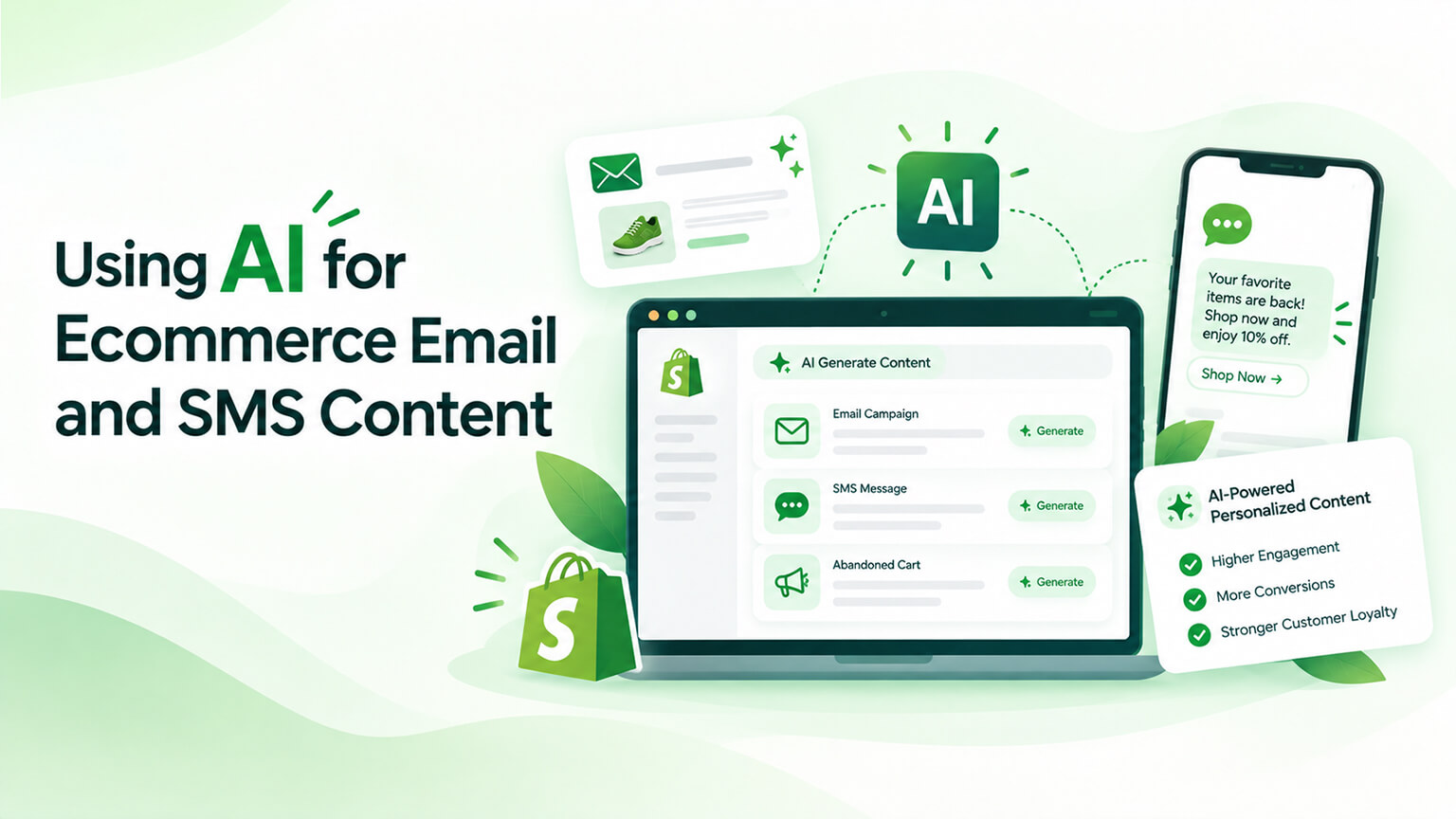
Email and SMS marketing are important ecommerce channels (email for newsletters, promotions, abandoned-cart recovery, post-purchase, retention; SMS for timely, direct messages — driving sales and retention, as the retention discussions cover), but creating email and SMS content takes effort (writing messages, subject lines, copy — repeatedly, for many campaigns and flows). AI can help create email and SMS content — drafting messages, subject lines, and copy; personalising content; and helping optimise — potentially making content creation faster and easier. AI-assisted email/SMS content can improve efficiency and support your marketing, so understanding how to use AI for it helps you leverage it. But it must be used well (quality, brand voice, accuracy, not spammy, human oversight — as the AI content discussions cover). This piece covers using AI for ecommerce email and SMS content: what AI can help with, how to use it well, the cautions, and best practices. (This connects to the email-marketing and AI-content discussions; this focuses on AI for email/SMS content.)
This piece covers what AI can help with for email and SMS content, how to use it well, the cautions, and best practices. Because AI can help create email/SMS content efficiently but must be used well, and understanding this helps you leverage it. Let me walk through it.
What AI can help with for email and SMS content
Let’s cover what AI can help with in creating email and SMS content. Drafting messages — AI can draft email and SMS messages (writing copy for campaigns, newsletters, promotions, flows — a starting draft), speeding content creation — drafting (a core help). Writing subject lines — AI can write subject lines (and preview text) — often generating several options to choose from — helping with these crucial, effort-intensive elements — subject lines (a help). Generating variations — AI can generate variations of content (multiple versions of a message, subject line, or copy — for testing or choice), enabling options and testing — variations. Personalising content — AI can help personalise content (tailoring messages to segments or individuals — as the personalisation and segmentation discussions cover), aiding personalisation at scale — personalisation. Writing flows — AI can help write email/SMS flows (the messages in automated flows — welcome, abandoned cart, post-purchase, win-back), helping populate flows — flows. Adapting tone/length — AI can adapt content (adjusting tone, length, style — e.g., concise SMS vs. fuller email), fitting the channel and voice — adaptation. Overcoming blank-page/scale — AI helps overcome the blank page and scale (drafting quickly, producing content for many campaigns/flows), easing the volume of content marketing needs — scale/blank page. Ideas and angles — AI can suggest ideas and angles (campaign ideas, messaging angles, hooks), aiding ideation — ideas. And editing/improving — AI can help edit and improve content (refining drafts, tightening copy), aiding refinement — editing. So AI can help with email and SMS content by drafting messages, writing subject lines (and variations), generating variations, personalising content, writing flows, adapting tone and length to the channel, overcoming the blank page and scaling content, suggesting ideas and angles, and editing/improving. The value is faster, easier content creation at scale — helping marketing produce the volume of email/SMS content it needs. But it must be used well (later sections). The next section covers using it well. So AI can help draft messages, write subject lines, generate variations, personalise, write flows, adapt tone, and scale content — making email/SMS content creation faster and easier.
How to use AI for email and SMS content well
To use AI for email/SMS content effectively, use it well. Use it to draft, then refine — use AI to draft, then refine (AI produces drafts, you edit and improve — AI as a starting point, not the final word), leveraging speed while ensuring quality — draft-then-refine (a core practice). Ensure brand voice — ensure content matches your brand voice (AI defaults to generic; guide it with your voice and edit to fit, as the AI-content discussions cover), so content sounds like you (not generic AI) — brand voice (essential). Prompt well — prompt AI well (clear instructions — the message purpose, audience, tone, key points, channel — as good prompts yield better content), improving output — prompting (do it well). Edit and add value — edit AI content and add your value (your knowledge, offers, specifics, brand personality), so content is polished and specific (not generic) — editing (add value). Verify accuracy — verify accuracy (check facts, offers, details, links — AI can be wrong, and errors in customer messages are bad), a key practice (especially for offers/prices/details) — accuracy (verify). Personalise appropriately — use AI to personalise, appropriately (relevant personalisation, respecting privacy, not creepy, as the personalisation discussions cover) — personalisation (appropriate). Keep it non-spammy — keep content non-spammy and valuable (AI can produce generic, salesy, or spammy content; ensure messages are valuable and respectful, especially SMS — which is intimate and easily annoying), so you don’t annoy or spam — non-spammy (important, especially SMS). Fit the channel — fit content to the channel (concise, timely SMS; appropriate email — AI can adapt, but ensure it fits), respecting each channel’s norms — channel fit. Test content — test AI-assisted content (subject lines, copy — A/B test, as the testing discussions cover), optimising based on results — testing. Keep human oversight — keep human oversight (review AI content before sending — you’re messaging customers, so ensure quality, accuracy, appropriateness), essential (don’t auto-send unreviewed AI content) — oversight (essential). And maintain compliance — maintain compliance (email/SMS marketing has rules — consent, opt-outs, regulations; ensure AI content complies), important (compliance matters) — compliance. So use AI for email/SMS content well by using it to draft then refine (a core practice), ensuring brand voice, prompting well, editing and adding value, verifying accuracy, personalising appropriately, keeping content non-spammy and valuable (especially SMS), fitting the channel, testing content, keeping human oversight (essential), and maintaining compliance. The keys are draft-then-refine, brand voice, verifying accuracy, non-spammy value, and human oversight. So use AI well by drafting-then-refining, ensuring brand voice, verifying accuracy, keeping content valuable, and keeping human oversight. The next section covers cautions. So use AI for email/SMS content well via draft-then-refine, brand voice, accuracy, non-spammy value, channel fit, testing, and human oversight.
The cautions
AI-assisted email/SMS content has cautions to heed. Generic content — AI defaults to generic content (bland, non-specific, sounding like AI), which underperforms and doesn’t fit your brand; so guide voice and edit — generic (a key caution). Brand voice mismatch — AI may not match your brand voice (sounding off-brand), so ensure and edit for voice — voice mismatch. Accuracy errors — AI can produce inaccurate content (wrong offers, details, facts, links — errors in customer messages are bad and can mislead or embarrass), so verify accuracy — accuracy (verify — important). Spammy/salesy content — AI can produce spammy or overly salesy content (annoying customers, hurting the brand — especially bad in SMS, which is intimate), so keep content valuable and respectful — spammy (a caution). Over-automation/volume — AI’s ease can lead to over-messaging (sending too much because it’s easy to produce), annoying customers and hurting deliverability/opt-outs; so don’t over-message (quality and restraint over volume) — over-messaging (a caution). Compliance risks — AI might produce non-compliant content (missing required elements, or content that breaks rules), so ensure compliance — compliance (a caution). Impersonal/inauthentic — over-relying on AI can make content impersonal or inauthentic (customers can sense generic AI content), hurting connection; so add human authenticity — inauthenticity (a caution). Sending unreviewed content — sending AI content without review is risky (errors, off-brand, inappropriate content reaching customers), so always review — unreviewed (a caution). Privacy in personalisation — AI personalisation uses data (respect privacy, avoid creepy personalisation, as the privacy discussions cover) — privacy (a caution). And SMS sensitivity — SMS is especially sensitive (intimate, immediate, easily annoying, with strict rules), so be especially careful with AI SMS content (valuable, wanted, compliant) — SMS (extra caution). So the cautions for AI email/SMS content are: generic content (guide voice, edit), brand-voice mismatch (ensure voice), accuracy errors (verify — important), spammy/salesy content (keep valuable), over-messaging (restraint over volume), compliance risks (ensure compliance), impersonal/inauthentic content (add authenticity), sending unreviewed content (always review), privacy in personalisation (respect it), and SMS sensitivity (extra care). The key cautions: generic/off-brand content, accuracy errors, spammy content, over-messaging, and always reviewing before sending. So heed the cautions — generic/off-brand content, accuracy errors, spam, over-messaging, and compliance — by guiding voice, verifying, keeping value, and reviewing. The next section covers best practices. So the key cautions are generic/off-brand content, accuracy errors, spam/over-messaging, and compliance — addressed by guiding voice, verifying, restraint, and human review.
Best practices
Here are best practices for using AI for email and SMS content. Draft with AI, finalise with humans — use AI to draft and humans to finalise (AI speeds drafting; humans ensure quality, voice, accuracy, appropriateness — the core workflow) — draft-with-AI-finalise-with-humans (the key practice). Guide with brand voice — guide AI with your brand voice (voice guidelines, examples, editing to fit), keeping content on-brand — brand voice. Prompt clearly — prompt clearly (purpose, audience, tone, key points, channel), improving output — clear prompts. Always review before sending — always review AI content before sending (a non-negotiable — you’re messaging real customers), catching errors and issues — review (always). Verify facts and offers — verify facts, offers, prices, and links (accuracy in customer messages matters), preventing costly errors — verify. Keep content valuable — keep content valuable and non-spammy (respect customers, provide value, avoid over-selling — especially SMS), maintaining goodwill and deliverability — value (non-spammy). Practise restraint — practise restraint in volume (don’t over-message just because AI makes content easy — quality over quantity), respecting customers — restraint. Test and optimise — test AI-assisted content (subject lines, copy, flows via A/B testing), optimising performance — test. Personalise responsibly — personalise responsibly (relevant, privacy-respecting personalisation, using AI to help), improving relevance — responsible personalisation. Ensure compliance — ensure compliance (consent, opt-outs, regulations — for both email and SMS), staying compliant — compliance. Maintain authenticity — maintain authenticity (human touch, genuine brand personality, not generic AI), keeping connection — authenticity. And use AI as an aid — use AI as an aid to your marketing (augmenting your team’s content creation, not replacing marketing judgment), leveraging AI within good marketing — aid (augment, not replace). So best practices are: draft with AI and finalise with humans (the key workflow), guide with brand voice, prompt clearly, always review before sending, verify facts and offers, keep content valuable and non-spammy, practise restraint in volume, test and optimise, personalise responsibly, ensure compliance, maintain authenticity, and use AI as an aid. The overarching practice: AI drafts and assists, humans ensure quality, voice, accuracy, value, and compliance — always reviewing before sending. So the best practice is AI-assisted, human-finalised email/SMS content — on-brand, accurate, valuable, compliant, and always reviewed. So best practices: AI drafts, humans finalise and review; keep content on-brand, accurate, valuable, and compliant; practise restraint; and use AI as an aid within good marketing.
The bottom line
Email and SMS marketing are important ecommerce channels — email for newsletters, promotions, abandoned-cart recovery, post-purchase, and retention; SMS for timely, direct messages — but creating the content takes ongoing effort (writing messages, subject lines, and copy for many campaigns and flows). AI can help create email and SMS content by drafting messages, writing subject lines and preview text (often several options), generating variations (for testing or choice), personalising content to segments or individuals, writing the messages in automated flows (welcome, abandoned cart, post-purchase, win-back), adapting tone and length to the channel (concise SMS versus fuller email), overcoming the blank page and scaling content, suggesting ideas and angles, and editing and improving drafts — making content creation faster and easier at the scale marketing needs. But it must be used well. Use AI to draft and then refine (AI as a starting point, not the final word), ensure content matches your brand voice (AI defaults to generic — guide it and edit), prompt it clearly (purpose, audience, tone, key points, channel), edit and add your own value (offers, specifics, personality), verify accuracy (facts, offers, prices, links — errors in customer messages are costly), personalise appropriately (relevant and privacy-respecting), keep content valuable and non-spammy (especially SMS, which is intimate and easily annoying), fit the channel, test your content, keep human oversight, and maintain compliance (consent, opt-outs, regulations). Heed the cautions: generic content, brand-voice mismatch, accuracy errors, spammy or overly salesy content, over-messaging (AI’s ease can tempt you to send too much, annoying customers and hurting deliverability), compliance risks, impersonal or inauthentic content, sending unreviewed content, privacy issues in personalisation, and SMS’s particular sensitivity (intimate, immediate, and tightly regulated). The best-practice workflow is draft with AI, finalise with humans — guide with brand voice, prompt clearly, always review before sending (non-negotiable, since you’re messaging real customers), verify facts and offers, keep content valuable and non-spammy, practise restraint in volume, test and optimise, personalise responsibly, ensure compliance, maintain authenticity, and use AI as an aid that augments your marketing rather than replacing marketing judgment. So use AI to help create your ecommerce email and SMS content — drafting, personalising, generating options, and scaling — but always as an aid whose output you guide to your brand voice, verify for accuracy, keep valuable and compliant, and review before it reaches a single customer. Done well, AI makes your email and SMS content faster to produce and easier to scale while staying on-brand and effective; done poorly (generic, inaccurate, spammy, or over-sent), it damages the customer relationships these channels exist to build — so let AI speed the work while humans keep the quality, judgment, and restraint.
Frequently asked questions
What can AI help with for email and SMS content?
Quite a lot of the content-creation work. AI can draft the actual messages for campaigns, newsletters, promotions, and automated flows, giving you a starting draft to refine rather than a blank page. It’s particularly useful for subject lines and preview text (often generating several options to choose from or test), and for generating variations of a message or copy for A/B testing. It can help personalise content to segments or individuals, write the messages that populate automated flows (welcome series, abandoned-cart recovery, post-purchase, and win-back), and adapt tone and length to fit the channel — concise, punchy SMS versus a fuller email. Beyond writing, it can suggest campaign ideas, messaging angles, and hooks, and help edit and tighten existing drafts. The overall value is producing the volume of content that email and SMS marketing demands faster and more easily. But across all of these, AI works best as a drafting and assistance tool whose output you guide to your brand voice, verify, and review — not as something that writes and sends customer messages unsupervised.
How do I keep AI-generated email and SMS content on-brand and high-quality?
Use a draft-then-refine workflow and guide the AI actively. Let AI produce drafts, then edit and finalise them yourself so you control quality, voice, accuracy, and appropriateness — AI is the starting point, not the final word. Guide it with your brand voice (provide voice guidelines and examples, and edit output to fit), since AI defaults to generic, bland copy that won’t sound like you. Prompt it clearly with the message’s purpose, audience, tone, key points, and channel, and then edit to add your own value — your specific offers, details, and brand personality — so the content is specific rather than generic. Verify accuracy every time (facts, offers, prices, and links), since errors in customer messages are costly and embarrassing, and always review content before sending, because you’re messaging real customers. Fit the content to the channel (concise for SMS, appropriate for email), keep it valuable rather than spammy, and test subject lines and copy to see what actually performs. The through-line is that AI speeds the drafting while humans ensure the voice, accuracy, and quality.
What should I watch out for when using AI for email and SMS?
Several things. AI defaults to generic, bland content that won’t fit your brand or perform well, so guide its voice and edit heavily. It can produce inaccurate content — wrong offers, prices, details, or links — which is especially damaging in customer messages, so verify everything. It can also produce spammy or overly salesy copy that annoys customers and hurts your brand, which is particularly risky in SMS because that channel is intimate and easily irritating. Watch out for over-messaging: because AI makes content easy to produce, it’s tempting to send too much, which annoys customers and hurts deliverability and opt-out rates — practise restraint and prioritise quality over volume. Be careful with compliance (email and SMS have rules around consent, opt-outs, and regulations, and AI won’t ensure these on its own), with privacy in personalisation (relevant, not creepy), and with authenticity (over-reliance on AI makes content feel impersonal, which customers can sense). Above all, never send AI content without human review — errors, off-brand messaging, or inappropriate content reaching customers is the biggest risk, and reviewing before sending is non-negotiable.
Can AI replace my email and SMS marketing work?
No — it’s an aid that augments your marketing, not a replacement for it. AI can speed up and scale the content-creation side (drafting messages, subject lines, variations, and flows, and helping personalise and adapt content), which frees up time and helps you produce the volume these channels need. But it doesn’t replace marketing judgment: deciding strategy, understanding your customers, knowing what offers and messages fit your brand and moment, exercising restraint about how much to send, ensuring compliance, and maintaining authentic brand voice and relationships all require human judgment. AI also can’t be trusted to send unsupervised, given the risks of generic, inaccurate, spammy, or non-compliant content reaching customers. So the right model is AI-assisted, human-led: use AI to draft, generate options, personalise, and scale, while your team guides the voice, verifies accuracy, keeps content valuable and compliant, decides what and how much to send, and reviews everything before it goes out. Used that way, AI makes your email and SMS marketing more efficient without sacrificing the judgment and authenticity that make those channels work.