
Using AI for Ecommerce Competitive Analysis
On this page
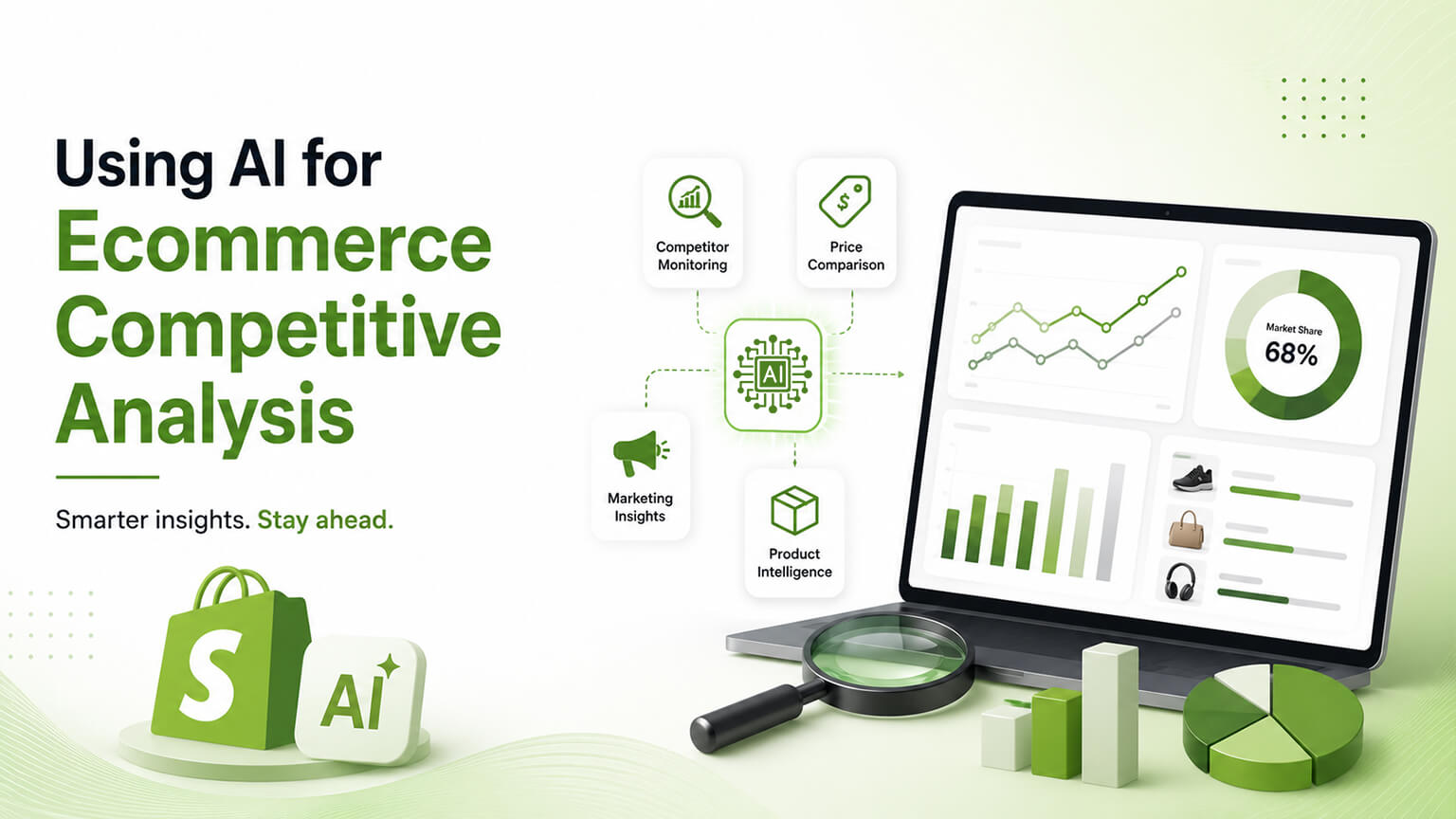
Competitive analysis — understanding your competitors’ positioning, products, pricing, marketing, content, and strategy — is valuable for ecommerce: it informs your own strategy (differentiation, gaps to exploit, threats to counter, ideas to adapt), helps you understand your market, and keeps you aware of the competitive landscape. But thorough competitive analysis is time-consuming (gathering and synthesising a lot of information about competitors), which is why it’s often done sporadically or shallowly. AI is useful for accelerating and deepening competitive analysis: it can help gather, synthesise, and analyse competitor information (their content, positioning, marketing, and more) faster and at greater scale than manual analysis, and help surface insights. But, as with other AI applications, it works best augmenting human judgment (which interprets the analysis, draws strategic conclusions, and decides) rather than replacing it, and it has limits (accuracy, the need to verify, ethical and legal boundaries). So AI is a useful accelerator for competitive analysis, used well. This piece covers using AI for ecommerce competitive analysis: where it helps, the limits and human role, the boundaries, and how to use it well. (This connects to the AI-for-ecommerce and keyword-research discussions; this focuses on AI for competitive analysis.)
This piece covers where AI helps in competitive analysis, the limits and the human role, the ethical and legal boundaries, and how to use it well. Because competitive analysis is valuable but time-consuming, AI can accelerate and deepen it, used well with human judgment. Let me walk through it.
Where AI helps in competitive analysis
AI is useful for several parts of competitive analysis. Gathering and synthesising information — AI can help gather and synthesise information about competitors (from their websites, content, marketing, public information) faster than manual research, digesting a lot of information quickly (e.g., summarising a competitor’s positioning, content themes, or approach from their site/content) — accelerating the information-gathering and synthesis that competitive analysis requires. Analysing competitor content — AI can analyse competitors’ content and messaging at scale (their content themes, positioning, messaging, SEO content, as the keyword-research and content discussions cover), surfacing what they’re doing (their content strategy, topics, positioning) faster than reading it all manually. Identifying patterns and themes — AI can identify patterns and themes across competitor information (common positioning, content themes, approaches in your market), surfacing the competitive landscape’s patterns. Summarising positioning and strategy — AI can summarise competitors’ apparent positioning, value propositions, and strategy (from their public presence), helping you understand how competitors position themselves (versus manually piecing it together). Comparing and benchmarking — AI can help compare and benchmark (your offering, content, or positioning versus competitors’), surfacing differences, gaps, and opportunities. Surfacing gaps and opportunities — AI can help surface gaps and opportunities (topics competitors cover or miss, positioning gaps, content opportunities, as the keyword/content discussions cover), informing your strategy. And accelerating the research-heavy work — overall, AI accelerates the information-gathering, synthesis, and analysis that make competitive analysis time-consuming, letting you do more thorough analysis faster (versus sporadic, shallow manual analysis). So AI helps in competitive analysis by gathering and synthesising competitor information faster, analysing competitor content at scale, identifying patterns and themes, summarising positioning and strategy, comparing and benchmarking, surfacing gaps and opportunities, and accelerating the research-heavy work — making competitive analysis faster, deeper, and more feasible to do thoroughly and regularly. So AI is a useful accelerator for the information-heavy parts of competitive analysis, enabling more thorough, regular analysis. But it has limits and needs human judgment, covered next.
The limits and the human role
AI in competitive analysis has limits, and human judgment remains essential. AI gathers and synthesises; humans interpret — AI can gather and synthesise competitor information and surface patterns, but interpreting what it means strategically (what a competitor’s positioning implies, what a gap represents, what to do about it) is human judgment — AI surfaces, humans interpret and strategise. Strategic conclusions are human — the strategic conclusions (how to differentiate, which opportunities to pursue, how to respond to competitors) are human decisions informed by the analysis, not something AI decides — the strategy is human. AI can be inaccurate or superficial — AI can produce inaccurate, superficial, or plausible-but-wrong analysis (misreading competitor information, missing nuance, or generating plausible-but-incorrect summaries), so its output needs human scrutiny and verification (not taken at face value) — accuracy isn’t guaranteed. Verify the information — competitive information (especially anything AI gathers or summarises) should be verified (AI can misgather or misrepresent), so verify key facts (competitor claims, data) rather than trusting AI’s synthesis blindly — important for accurate analysis. Nuance and context — competitive analysis involves nuance and context (understanding your specific market, the meaning behind competitors’ moves, strategic implications) that AI may miss, so human understanding of your market and context is essential to meaningful analysis. Not just what, but so-what — AI can help surface what competitors do, but the valuable “so-what” (the strategic implications and actions for your business) is human — so use AI for the “what” (information) and apply human judgment for the “so-what” (strategy). And avoid over-relying — avoid over-relying on AI’s competitive analysis (treating its output as the analysis), since it’s an input to human strategic thinking, not a replacement for it. So AI’s limits mean human judgment remains essential: AI gathers, synthesises, and surfaces, but humans interpret the meaning, draw strategic conclusions, verify accuracy, apply market nuance and context, and decide the “so-what” (strategy and actions) — with AI as an input to human strategic thinking, not a replacement. The pattern (as with other AI applications) is AI accelerating the information work while humans provide the strategic judgment. So use AI to accelerate the information-gathering and analysis, but keep human judgment for interpretation, verification, and strategy. The next section covers the ethical and legal boundaries.
The ethical and legal boundaries
Competitive analysis with AI (as with any competitive analysis) has ethical and legal boundaries to respect. Use public information — competitive analysis should use publicly available information (competitors’ public websites, content, marketing, public data) — analysing what’s publicly out there, which is legitimate. Don’t access private/unauthorised information — don’t use AI (or any means) to access private, confidential, or unauthorised competitor information (hacking, unauthorised access, misappropriating confidential information) — which is illegal and unethical; competitive analysis is about public information, not illicit access. Respect terms and laws — respect websites’ terms and applicable laws when gathering information (e.g., scraping may violate terms of service or laws in some cases, so gather information appropriately and legally) — staying within legal boundaries. Don’t misuse or misrepresent — use competitive analysis to inform your own legitimate strategy (differentiation, improvement), not to misuse competitor information illegitimately (e.g., copying protected content/IP, as the IP considerations apply, or deceptive practices) — legitimate competitive analysis, not IP infringement or deception. Respect intellectual property — don’t use AI to copy competitors’ protected intellectual property (content, designs, branding) — analyse and learn from competitors (legitimate), but don’t infringe their IP (illegitimate), a boundary to respect. Ethical competitive conduct — conduct competitive analysis ethically (understanding and competing with competitors fairly, using public information and your own strategy), not through illicit or unethical means. And AI doesn’t change the boundaries — AI accelerates competitive analysis but doesn’t change these boundaries (public information, legal/ethical conduct, no IP infringement or illicit access) — the same boundaries apply, just with AI as a faster tool within them. So the ethical and legal boundaries are: use publicly available information, don’t access private/unauthorised information (illegal and unethical), respect websites’ terms and applicable laws when gathering, don’t misuse or misrepresent competitor information or infringe IP, conduct analysis ethically, and remember AI doesn’t change these boundaries. So use AI for competitive analysis within these boundaries — analysing public information legally and ethically to inform your legitimate strategy, not through illicit access or IP infringement. So respect the boundaries (public info, legal/ethical, no IP infringement) while using AI to accelerate legitimate competitive analysis. The next section covers using it well overall.

How to use it well
To use AI well for competitive analysis, combine its acceleration with human strategy, within the boundaries. Use it to accelerate information work — use AI for its strength: accelerating the information-gathering, synthesis, and analysis (digesting competitor content and information faster, surfacing patterns, summarising positioning) — capturing the speed and scale benefit for the research-heavy work. Keep humans interpreting and strategising — keep human judgment for interpreting the analysis (what it means), drawing strategic conclusions (differentiation, opportunities, responses), and deciding (your strategy) — AI informs, humans strategise. Verify AI’s output — verify AI’s gathered information and analysis (checking accuracy, not trusting blindly), since AI can be inaccurate or superficial — ensuring your analysis is based on accurate information. Focus on the “so-what” — focus your effort on the “so-what” (the strategic implications and actions for your business), using AI for the “what” (the information) — since the strategic value is in the human interpretation and action, not just the information. Stay within the boundaries — conduct the analysis within the ethical and legal boundaries (public information, legal/ethical conduct, no IP infringement or illicit access), using AI as a faster tool within them. Use it regularly — since AI makes thorough competitive analysis faster and more feasible, use it to do competitive analysis more regularly (staying aware of the competitive landscape over time), versus sporadic manual analysis — a benefit of the acceleration. Integrate with your strategy — integrate the competitive insights into your strategy (informing your positioning, differentiation, content, and decisions, as the keyword/content and metrics discussions cover), so the analysis actually informs action (versus analysis that isn’t used). And apply your market expertise — apply your own market expertise and context (which AI lacks) to make the analysis meaningful (interpreting competitors’ moves in your market’s context, understanding the nuance) — human expertise making the AI-accelerated analysis strategically valuable. So use AI well for competitive analysis by using it to accelerate the information work (its strength), keeping human judgment for interpretation and strategy (the “so-what”), verifying its output (accuracy), staying within the ethical/legal boundaries, using it to do analysis more regularly, integrating the insights into your strategy, and applying your market expertise. The combination — AI accelerating the information-gathering and analysis, humans providing the strategic interpretation, verification, and action, within the boundaries — is how to use AI well for competitive analysis. So treat AI as an accelerator for the information-heavy parts of competitive analysis, under human strategic judgment and within the boundaries — capturing the speed and depth benefit while ensuring accurate, strategically-meaningful, ethical, and legal analysis that informs your strategy. So AI makes competitive analysis faster, deeper, and more regular, used well with human judgment and within the boundaries.
A worked example: AI-accelerated competitor research in practice
Picture a brand that has always meant to do proper competitive analysis but never finds the time, so it happens once a year, hastily. Using AI to accelerate the research changes what’s feasible. In an afternoon, the brand uses AI to digest the public presence of its main competitors — summarising each one’s apparent positioning and value proposition from their sites, mapping the content themes and topics they cover (and, tellingly, the topics none of them cover well), and surfacing patterns across the set (common messaging angles, shared gaps). What would have taken days of manual reading is compressed into a structured overview the brand can actually work with. Crucially, the brand treats this as the “what,” not the “so-what”: a human then interprets it in the context of their specific market — recognising, say, that every competitor is positioning on price while none is addressing a particular customer concern the brand is well-placed to own, which points to a differentiation opportunity and a content gap worth filling.
The brand also stays disciplined about the limits and boundaries. It verifies key facts the AI surfaced (rather than trusting summaries blindly, since AI can misread or oversimplify), works only from publicly available information (no illicit access, no copying competitors’ protected content — analysing and learning, not infringing), and applies its own market judgment to turn the analysis into strategy (the differentiation angle, the content opportunities, how to respond to a competitor’s move). Because the AI made the research fast, the brand can now do this quarterly instead of once a year, staying aware of the competitive landscape over time. The net effect is exactly what AI competitive analysis should deliver: faster, deeper, more regular analysis on the information side, with human judgment providing the strategic interpretation and action, all within ethical and legal bounds. The AI didn’t decide the strategy — it cleared away the time-consuming information work so the humans could spend their effort on the strategic thinking that actually creates advantage. That division of labour, done regularly and within the boundaries, is what turns competitive analysis from a neglected annual chore into an ongoing input to strategy.
The bottom line
Competitive analysis — understanding your competitors’ positioning, products, pricing, marketing, content, and strategy — is valuable for ecommerce because it informs your own strategy (differentiation, gaps to exploit, threats to counter, ideas to adapt), helps you understand your market, and keeps you aware of the competitive landscape. But thorough competitive analysis is time-consuming (gathering and synthesising a lot of competitor information), so it’s often done sporadically or shallowly. AI is useful for accelerating and deepening it: it can gather and synthesise competitor information faster, analyse competitors’ content and messaging at scale, identify patterns and themes, summarise positioning and strategy, compare and benchmark, and surface gaps and opportunities — making competitive analysis faster, deeper, and more feasible to do thoroughly and regularly (versus sporadic manual analysis). But, as with other AI applications, it has limits and works best augmenting human judgment: AI gathers, synthesises, and surfaces, but humans must interpret what it means strategically, draw the strategic conclusions (differentiation, opportunities, responses), verify its accuracy (AI can be inaccurate, superficial, or plausible-but-wrong, so its output needs scrutiny and key facts should be verified), apply market nuance and context (which AI may miss), and decide the valuable “so-what” (the strategic implications and actions) — with AI as an input to human strategic thinking, not a replacement. It also has ethical and legal boundaries that AI doesn’t change: use publicly available information, don’t access private, confidential, or unauthorised competitor information (illegal and unethical), respect websites’ terms and applicable laws when gathering, don’t misuse competitor information or infringe intellectual property (analyse and learn from competitors, but don’t copy their protected IP or use illicit means), and conduct the analysis ethically. Use AI well for competitive analysis by using it to accelerate the information-gathering, synthesis, and analysis (its strength), keeping human judgment for interpretation and strategy (the “so-what”), verifying its output for accuracy, staying within the ethical and legal boundaries, using it to do competitive analysis more regularly (leveraging the acceleration to stay aware over time), integrating the insights into your strategy (so the analysis informs action), and applying your own market expertise and context (which makes the AI-accelerated analysis strategically meaningful). The combination — AI accelerating the information-heavy work, humans providing the strategic interpretation, verification, and action, within the boundaries — is how to use AI well for competitive analysis. Used this way, AI makes competitive analysis faster, deeper, and more regular, capturing the speed and depth benefit while ensuring accurate, strategically-meaningful, ethical, and legal analysis that informs your strategy. Used badly (over-relying on AI, taking its output at face value, skipping human strategy and verification, or crossing the ethical/legal boundaries), it produces inaccurate, superficial, or improper analysis. So use AI as an accelerator for competitive analysis under human strategic judgment and within the boundaries, and capture the real value.
Frequently asked questions
How can AI help with competitive analysis?
AI is useful for accelerating and deepening the information-heavy parts of competitive analysis. It can help gather and synthesise information about competitors (from their public websites, content, and marketing) far faster than manual research — for example, summarising a competitor’s positioning, content themes, or apparent approach from their site. It can analyse competitors’ content and messaging at scale (their content strategy, topics, SEO content, positioning), identify patterns and themes across the competitive landscape, summarise how competitors position themselves and their apparent strategy, help compare and benchmark your offering against theirs, and surface gaps and opportunities (topics competitors cover or miss, positioning gaps). Overall, AI accelerates the gathering, synthesis, and analysis that make thorough competitive analysis time-consuming, letting you do deeper analysis faster and more regularly rather than sporadically and shallowly. It works best as an accelerator for the research work, with human judgment providing the strategic interpretation.
What are the limits of using AI for competitive analysis?
AI can gather, synthesise, and surface competitor information, but it can’t replace human strategic judgment, and it has accuracy limits. Interpreting what the analysis means strategically — what a competitor’s positioning implies, what a gap represents, how to respond — is human judgment, as are the strategic conclusions (how to differentiate, which opportunities to pursue). AI can also be inaccurate, superficial, or plausible-but-wrong (misreading competitor information, missing nuance, or generating incorrect summaries), so its output needs human scrutiny and verification of key facts rather than being trusted blindly. Competitive analysis involves nuance and context — understanding your specific market and the meaning behind competitors’ moves — that AI may miss, so your market expertise is essential to meaningful analysis. And the valuable “so-what” (the strategic implications and actions for your business) is human. So AI is an input to human strategic thinking, not a replacement — use it for the information-gathering and analysis, and apply human judgment for interpretation, verification, and strategy.
Are there ethical or legal limits to AI competitive analysis?
Yes, and AI doesn’t change them — the same boundaries apply to any competitive analysis, just with AI as a faster tool within them. Use publicly available information (competitors’ public websites, content, marketing, and public data — analysing what’s publicly out there is legitimate). Don’t use AI or any other means to access private, confidential, or unauthorised competitor information (hacking, unauthorised access, misappropriating confidential information), which is illegal and unethical. Respect websites’ terms of service and applicable laws when gathering information (some scraping may violate terms or laws). Don’t misuse competitor information or infringe intellectual property — you can analyse and learn from competitors (legitimate), but don’t copy their protected content, designs, or branding, or use deceptive practices. And conduct the analysis ethically, competing fairly. In short, use AI to accelerate legitimate competitive analysis of public information within legal and ethical bounds — not to access private information illicitly or infringe IP.
How do I use AI well for competitive analysis?
Combine its acceleration with human strategy, within the boundaries. Use AI for its strength — accelerating the gathering, synthesis, and analysis of competitor information (digesting competitor content faster, surfacing patterns, summarising positioning). Keep human judgment for interpreting the analysis (what it means), drawing strategic conclusions (differentiation, opportunities, responses), and deciding your strategy — AI informs, you strategise. Verify AI’s gathered information and analysis for accuracy rather than trusting it blindly, since it can be inaccurate or superficial. Focus your effort on the “so-what” (the strategic implications and actions for your business), using AI for the “what” (the information). Stay within the ethical and legal boundaries (public information, no illicit access or IP infringement). Use AI to do competitive analysis more regularly (leveraging the speed to stay aware of the landscape over time), integrate the insights into your actual strategy (so the analysis informs decisions), and apply your own market expertise and context — which is what makes the AI-accelerated analysis strategically meaningful rather than just a pile of competitor information.