
Native B2B on Shopify Plus: A Complete Guide
On this page
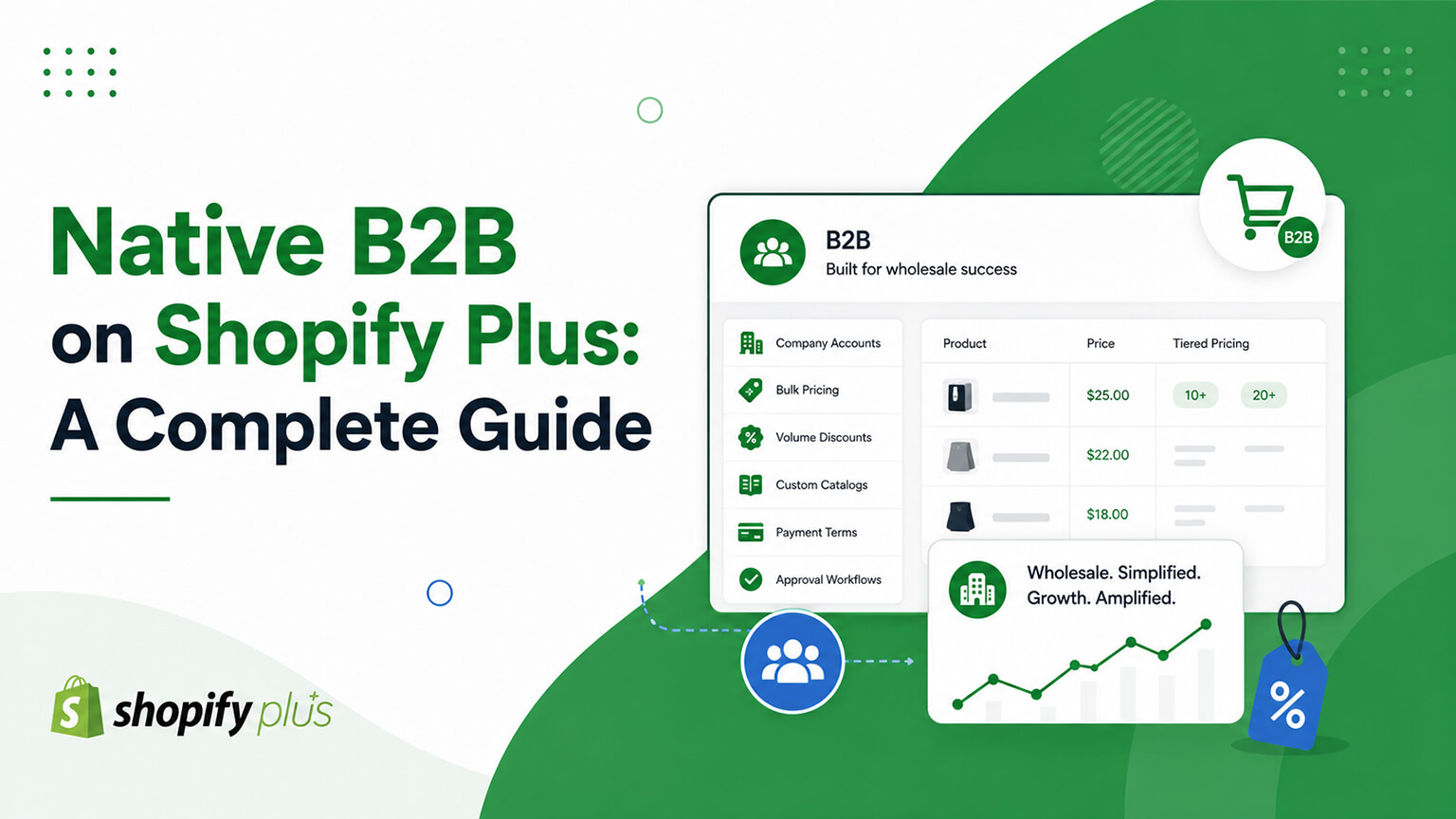
For a long time, doing B2B (business-to-business, wholesale) selling on Shopify meant workarounds — separate stores, apps, or custom builds to handle the things B2B needs that standard (B2C/DTC) commerce doesn’t: customer-specific pricing, wholesale catalogs, quantity rules, net payment terms, company accounts, and more. Shopify Plus changed this with native B2B: built-in B2B functionality that handles wholesale and business selling within Shopify, without the workarounds. Native B2B lets you sell to business customers with the features B2B requires — B2B customer/company accounts, customer-specific pricing and catalogs, quantity rules, payment terms, and B2B-appropriate experiences — natively in Shopify Plus, and it can run alongside your DTC store (B2B and DTC together, as that discussion covers). For merchants doing or expanding into B2B, native B2B is a major reason to consider Shopify Plus, and understanding what it does, how it works, and when to use it helps you evaluate and use it well. This piece is a complete guide to native B2B on Shopify Plus. (This connects to the running-B2B-and-DTC and wholesale-pricing discussions; this focuses on native B2B comprehensively.)
This piece covers what native B2B is and does, its key features, how it works (and B2B + DTC together), and when to use it. Because native B2B is a major Plus capability for wholesale/business selling, and understanding it helps you evaluate and use it. Let me walk through it. (Note: Shopify’s B2B features evolve; this covers the general capabilities, with specifics to verify.)
What native B2B is and does
Native B2B is Shopify Plus’s built-in functionality for business/wholesale selling. What it is — native B2B is B2B functionality built into Shopify Plus (not requiring separate stores, apps, or custom builds), enabling you to sell to business customers with the features B2B requires, natively within Shopify. What it does — it handles the things B2B selling needs that standard B2C/DTC commerce doesn’t: B2B customer and company accounts (business customers, companies with multiple buyers), customer-specific pricing (different prices for different customers/companies, wholesale pricing, as the wholesale-pricing discussion covers), wholesale catalogs (specific products/catalogs for B2B customers), quantity rules (minimums, increments, case quantities), payment terms (net terms, as that discussion covers), and B2B-appropriate purchasing experiences — so you can serve business customers properly. Versus the old workarounds — before native B2B, doing this required workarounds (separate wholesale stores, B2B apps, custom development), which were more complex and limited; native B2B provides it built-in, more cleanly and capably. Integrated with your store — native B2B is integrated into your Shopify Plus store (same admin, catalog, and infrastructure), and can run alongside DTC (as the running-B2B-and-DTC discussion covers), so you manage B2B and DTC together rather than separate systems. So native B2B is Shopify Plus’s built-in B2B functionality, handling the customer accounts, pricing, catalogs, quantity rules, payment terms, and experiences that business/wholesale selling requires, natively (versus old workarounds), integrated into your store (and able to run alongside DTC). So understand native B2B as Plus’s built-in solution for B2B selling — a major capability for wholesale/business merchants. The next section covers its key features.
The key features of native B2B
Native B2B includes several key features for business selling. Company accounts and profiles — B2B is organised around companies (business customers), with company profiles, multiple buyers/contacts per company, and company-specific settings — modeling business customers properly (a company with several people who buy, versus individual consumers). Customer-specific pricing — you can set customer/company-specific pricing (different prices, price lists, or discounts for different B2B customers, as the wholesale-pricing discussion covers) — essential for B2B (where pricing is often negotiated/tiered per customer), so each B2B customer sees their pricing. Price lists and catalogs — B2B price lists and catalogs let you offer specific products and prices to specific B2B customers/groups (a wholesale catalog, customer-specific product availability and pricing), tailoring the offering per customer. Quantity rules — quantity rules (minimum order quantities, increments, case quantities) enforce B2B purchasing patterns (e.g., minimum orders, ordering in cases), as B2B often requires. Payment terms — payment terms (net terms — net 30/60, etc., letting B2B customers pay on terms rather than upfront, as the net-terms discussion covers), standard in B2B. B2B customer experience — a B2B-appropriate buying experience (login, their pricing and catalog, reordering, purchasing on terms), suited to business buyers (versus the consumer DTC experience). Self-serve B2B — native B2B enables self-serve B2B purchasing (B2B customers logging in and ordering themselves with their pricing/terms), rather than manual order processing, scaling B2B. And integration — B2B integrates with the rest of Shopify (orders, inventory, and integrations like ERP, as those discussions cover), so B2B operations connect to your systems. So native B2B’s key features are company accounts (modeling business customers), customer-specific pricing (per-customer/tiered), price lists and catalogs (tailored offerings), quantity rules (B2B purchasing patterns), payment terms (net terms), a B2B-appropriate experience, self-serve purchasing, and integration — the features B2B selling requires, built-in. So native B2B provides the comprehensive B2B feature set, enabling proper business selling. The next section covers how it works, including with DTC.

How it works (and B2B + DTC together)
A bit on how native B2B works, including running alongside DTC. B2B in your Plus store — native B2B operates within your Shopify Plus store: you set up companies, their pricing/catalogs/terms, and B2B customers access their B2B experience (logging in to see their pricing, catalog, and purchase on their terms), all managed in your Shopify admin. B2B and DTC together — a key capability (as the running-B2B-and-DTC discussion covers) is running B2B and DTC together: you can serve both business customers (B2B, with their pricing/catalogs/terms) and consumers (DTC, standard retail) from your Shopify Plus setup, managing both — whether on one store (with B2B and DTC experiences) or with an expansion store for B2B (as the expansion-stores discussion covers), depending on your needs and setup. This lets merchants who do both B2B and DTC manage them together rather than as entirely separate systems. Setting up B2B — you set up native B2B by configuring companies, price lists/catalogs, quantity rules, and payment terms for your B2B customers (defining who gets what pricing, catalog, and terms), and providing the B2B customer experience — setup that a Plus merchant (or their agency/developer) configures. Managing B2B operations — B2B orders, customers, and operations are managed in Shopify (alongside DTC), integrated with your systems (inventory, ERP, fulfillment, as those discussions cover), so B2B fits your operations. The experience — B2B customers get a login-based experience showing their specific pricing and catalog, with B2B purchasing (quantity rules, terms, reordering), suited to business buying. And it scales B2B — native B2B enables scaling B2B through self-serve purchasing (business customers ordering themselves) and integrated operations, versus manual wholesale processing. So native B2B works within your Shopify Plus store (configuring companies, pricing, catalogs, rules, terms, and the B2B experience), can run alongside DTC (serving both from your Plus setup, on one store or with an expansion store), is managed in Shopify integrated with your operations, provides B2B customers a tailored login-based experience, and scales B2B via self-serve. So native B2B is a comprehensive, integrated B2B solution within Plus, able to serve B2B and DTC together. The next section covers when to use it.
When to use native B2B
When should you use native B2B on Shopify Plus? When you do or want to do B2B — the clearest case: you sell (or want to sell) to business customers (wholesale, business buyers) and need B2B features (customer pricing, catalogs, quantity rules, terms, company accounts) — native B2B provides them. When you’re outgrowing B2B workarounds — if you’re doing B2B via workarounds (separate stores, apps, manual processing) and finding them limiting or cumbersome, native B2B is a cleaner, more capable solution. When you do B2B and DTC — if you do both B2B and DTC (or want to add B2B to your DTC store, or DTC to your B2B), native B2B (running alongside DTC) lets you manage both together, a major benefit (as the running-B2B-and-DTC discussion covers). When you’re on (or considering) Plus — native B2B is a Plus feature, so it applies if you’re on Plus or considering upgrading (and B2B is often a strong reason to consider Plus, as the when-to-upgrade discussion covers). When you want to scale B2B — if you want to scale B2B (self-serve purchasing, integrated operations, versus manual wholesale), native B2B enables it. Conversely, you don’t need it when — you don’t do B2B (pure DTC/consumer), in which case native B2B isn’t relevant; or your B2B is very small/simple (a few wholesale accounts you handle manually), where the workaround might suffice for now (though native B2B still helps). And weigh it in the Plus decision — since native B2B is a Plus feature, factor it into the Plus decision (if you need B2B, native B2B is a strong reason for Plus; as the when-to-upgrade discussion covers). So use native B2B when you do or want to do B2B (needing its features), when you’re outgrowing B2B workarounds, when you do B2B and DTC (managing both together), when you’re on or considering Plus, and when you want to scale B2B — while it’s not relevant for pure DTC or, arguably, very small/simple B2B. So if you do or plan B2B (especially alongside DTC, or scaling B2B), native B2B on Plus is the capable, built-in solution, and a strong reason to consider Plus. So evaluate native B2B based on your B2B needs, and it’s a major capability for wholesale/business merchants on Plus.
A worked example: a DTC brand adding a wholesale channel
Picture a successful DTC brand — selling direct to consumers on Shopify — that starts getting wholesale interest: retailers and businesses wanting to stock its products at wholesale prices, order in bulk, and pay on terms. Initially the brand handles this manually: emailing price lists, taking wholesale orders over email or a clunky separate system, invoicing for net-30 payment, and tracking it all in spreadsheets. It works at a small scale but quickly becomes a burden — manual order entry, pricing errors, no self-serve, and a wholesale operation bolted awkwardly onto a DTC business. This is exactly the situation native B2B on Plus is built for.
The brand upgrades to Plus and sets up native B2B. It creates company accounts for its wholesale customers (each retailer as a company, with its buyers), sets customer-specific wholesale pricing and price lists (so each account sees its negotiated prices), builds a wholesale catalog (the products available to wholesale, at wholesale prices), configures quantity rules (minimum order quantities and case increments appropriate for wholesale), and enables net payment terms (so approved accounts can pay net 30 rather than upfront). Now its wholesale customers log in and self-serve: they see their pricing and catalog, order in the required quantities, and check out on their terms — no manual order entry, no emailed price lists, no spreadsheet tracking. Crucially, all of this runs alongside the brand’s existing DTC store: consumers still shop the normal retail experience, wholesale customers get their B2B experience, and the brand manages both from one Shopify Plus admin with shared catalog, inventory, and integrated operations (feeding the same ERP and fulfilment, as those discussions cover). The wholesale channel goes from a manual burden to a scalable, self-serve operation, and the brand runs B2B and DTC together rather than as two disconnected systems. That transformation — from B2B workarounds to integrated, scalable native B2B alongside DTC — is the core value native B2B delivers, and it’s why adding or scaling a wholesale channel is one of the most common and compelling reasons a growing DTC brand moves to Plus.
B2B as part of the Plus decision
Native B2B is worth understanding not just on its own but as a factor in the broader Shopify Plus decision (as the when-to-upgrade discussion covers), because for many merchants it’s the capability that tips the balance. A store weighing whether Plus is worth its higher cost should count native B2B heavily if B2B is part of its present or planned business: the alternative to native B2B is workarounds (separate wholesale stores, B2B apps, custom builds, or manual processing) that are more complex, more limited, and often more expensive and fragile in aggregate than they first appear. When you tally the cost and friction of those workarounds against the clean, integrated, scalable B2B that Plus provides natively, the Plus investment often becomes clearly justified for a merchant with real B2B needs — which is why B2B is one of the strongest single reasons to move to Plus.
Conversely, a pure-DTC merchant with no B2B plans shouldn’t weight native B2B in their Plus decision at all — it’s simply not relevant to them, and Plus should be justified on other grounds (checkout customisation, Functions, scale, as the what-is-Plus and when-to-upgrade discussions cover). The practical takeaway is to be honest about where B2B sits in your business: if you’re actively wholesaling, planning to, or straining against B2B workarounds, native B2B is a major, concrete benefit that belongs prominently in your Plus cost-benefit analysis, and it often justifies the upgrade largely on its own. If B2B isn’t part of your picture, set native B2B aside and evaluate Plus on the capabilities that do matter to you. Either way, understanding what native B2B offers — the company accounts, customer pricing, catalogs, quantity rules, terms, and self-serve experience that replace the old workarounds and let B2B and DTC run together — lets you weigh it accurately in the Plus decision rather than under- or over-valuing it. For the many merchants for whom B2B is real or growing, it’s frequently the feature that makes Plus pay off.
The bottom line
For a long time, doing B2B (wholesale, business selling) on Shopify meant workarounds — separate stores, apps, or custom builds to handle what B2B needs that standard DTC commerce doesn’t. Shopify Plus changed this with native B2B: built-in functionality that handles wholesale and business selling within Shopify, without the workarounds. Native B2B handles the things B2B selling requires — B2B company accounts (modeling business customers, with multiple buyers per company), customer-specific pricing (different prices, price lists, or discounts per customer/company, essential for B2B’s negotiated/tiered pricing), wholesale price lists and catalogs (tailored product offerings and pricing per customer/group), quantity rules (minimums, increments, case quantities), payment terms (net terms like net 30/60), a B2B-appropriate login-based purchasing experience, self-serve B2B purchasing (business customers ordering themselves, scaling B2B beyond manual processing), and integration with the rest of Shopify (orders, inventory, ERP) — all natively in Shopify Plus. It operates within your Plus store (configuring companies, pricing, catalogs, rules, and terms), can run alongside DTC (serving both business customers and consumers from your Plus setup — on one store or with an expansion store — so you manage B2B and DTC together rather than as separate systems, a major benefit), is managed in Shopify integrated with your operations, and scales B2B via self-serve purchasing. Use native B2B when you do or want to do B2B and need its features, when you’re outgrowing B2B workarounds (separate stores, apps, manual processing), when you do both B2B and DTC (managing them together), when you’re on or considering Plus, and when you want to scale B2B — while it’s not relevant for pure DTC, and very small/simple B2B might manage with a workaround for now. Since native B2B is a Plus feature, it’s often a strong reason to consider Plus if you do or plan B2B (as the when-to-upgrade discussion covers). So for merchants doing or expanding into B2B — especially alongside DTC or scaling B2B — native B2B on Shopify Plus is the capable, built-in, integrated solution that replaces the old workarounds, and a major reason to consider Plus. Evaluate it based on your B2B needs, and it’s one of Plus’s most valuable capabilities for wholesale and business selling.
Frequently asked questions
What is native B2B on Shopify Plus?
Native B2B is built-in B2B (business-to-business, wholesale) functionality in Shopify Plus that lets you sell to business customers with the features B2B requires — without the workarounds (separate stores, apps, or custom builds) that B2B on Shopify used to demand. It handles B2B company accounts (business customers, with multiple buyers per company), customer-specific pricing (different prices per customer or group), wholesale price lists and catalogs, quantity rules (minimums, increments, case quantities), payment terms (net terms), and a B2B-appropriate purchasing experience — all natively within Shopify Plus. It’s integrated into your store (same admin, catalog, and infrastructure) and can run alongside your DTC store, so you can serve both business customers and consumers and manage them together. For merchants doing or expanding into B2B, it’s a major reason to consider Shopify Plus.
What features does native B2B include?
The features business selling requires: company accounts and profiles (modeling business customers as companies with multiple buyers/contacts, versus individual consumers), customer-specific pricing (different prices, price lists, or discounts per B2B customer or group — essential for B2B’s often-negotiated, tiered pricing), B2B price lists and catalogs (offering specific products and prices to specific customers), quantity rules (minimum order quantities, increments, case quantities to enforce B2B purchasing patterns), payment terms (net terms like net 30/60, letting B2B customers pay on terms rather than upfront), a B2B-appropriate login-based buying experience (showing each customer their pricing and catalog, with reordering and purchasing on terms), self-serve B2B purchasing (business customers ordering themselves rather than manual processing, which scales B2B), and integration with the rest of Shopify (orders, inventory, and systems like ERP). Together these let you serve business customers properly and at scale.
Can I run B2B and DTC together on Shopify Plus?
Yes — this is one of native B2B’s key benefits. You can serve both business customers (B2B, with their specific pricing, catalogs, and payment terms) and consumers (DTC, standard retail) from your Shopify Plus setup, managing both together rather than as entirely separate systems. Depending on your needs, this can be done on one store (offering both B2B and DTC experiences) or using an expansion store for B2B, but either way you manage B2B and DTC within your Plus setup, with shared catalog and infrastructure and integrated operations. For merchants who do both — which is common (a brand selling direct to consumers and also wholesaling to business customers) — this ability to run B2B and DTC together, rather than juggling separate systems, is a significant advantage of native B2B on Plus.
When should I use native B2B (and do I need Shopify Plus for it)?
Use native B2B when you sell (or want to sell) to business customers and need B2B features — customer-specific pricing, wholesale catalogs, quantity rules, payment terms, company accounts — particularly if you’re outgrowing B2B workarounds (separate stores, apps, manual processing) that feel limiting, if you do both B2B and DTC and want to manage them together, or if you want to scale B2B through self-serve purchasing and integrated operations. It’s not relevant if you’re pure DTC/consumer, and very small, simple B2B (a handful of wholesale accounts handled manually) might manage without it for now. Native B2B is a Shopify Plus feature, so yes, you generally need Plus for it — which means B2B needs are often a strong reason to consider upgrading to Plus. If you do or plan meaningful B2B, native B2B is a capable, built-in reason the Plus investment can pay off.