
Reviews and UGC: Turning Customers Into Your Best Marketing
On this page
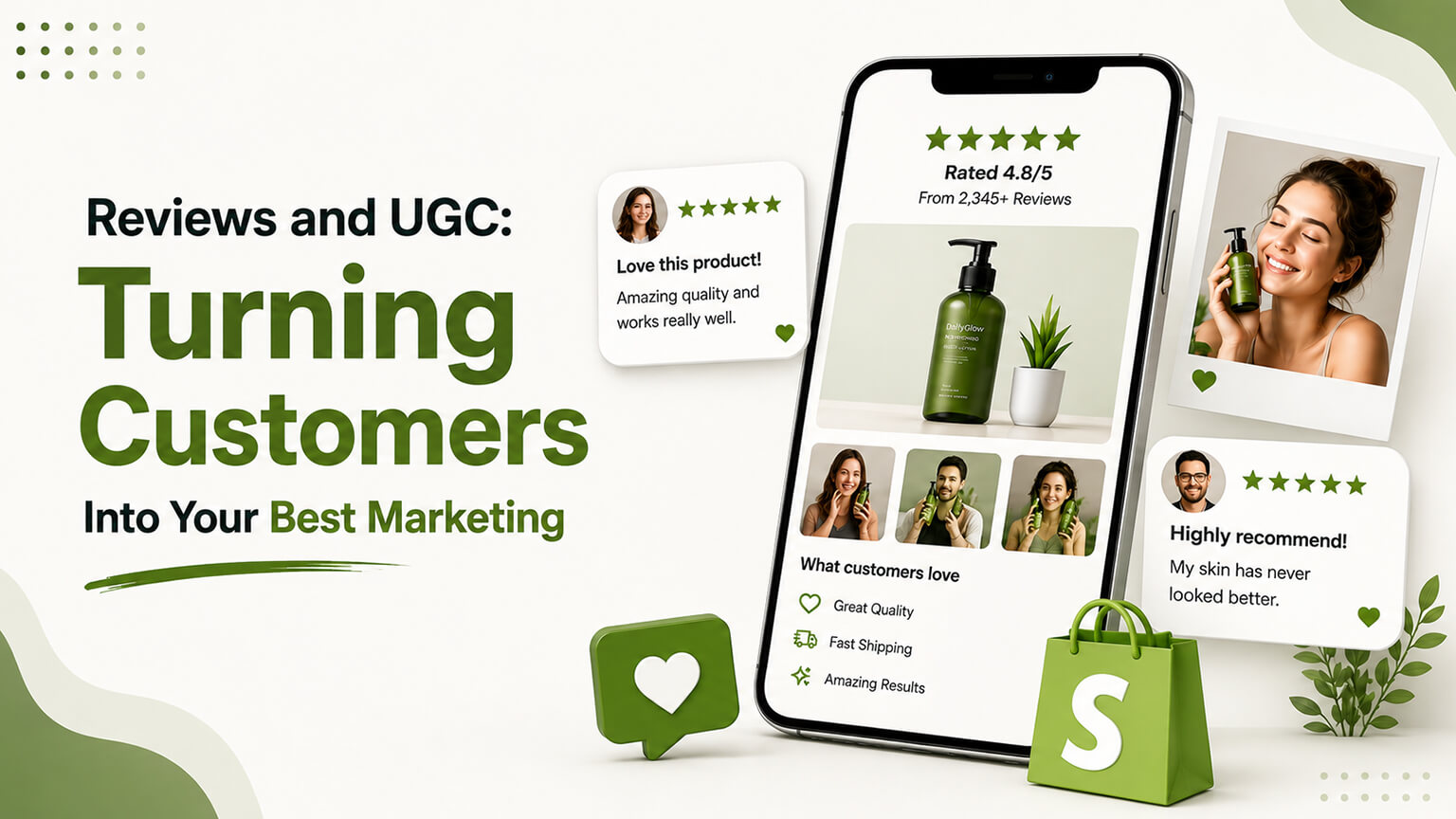
There’s a marketing channel sitting in plain sight that most stores barely use, and it’s more persuasive than anything you could write about yourself: your customers. People trust other people far more than they trust brands, which is why a handful of genuine reviews and a few real customer photos will do more to convince a hesitant shopper than the most polished brand copy. Reviews and user-generated content aren’t just nice-to-haves bolted onto a product page — handled well, they’re among your most effective marketing assets, working across your store, your ads, and your email.
Yet most stores treat reviews as a passive widget — install an app, hope reviews trickle in, display them in a corner — and never use UGC as the marketing it could be. This piece is about doing it properly: collecting reviews actively, displaying them where they persuade, handling the awkward bits (negative reviews, authenticity), gathering and using UGC, and turning the whole thing into a marketing engine rather than a forgotten plugin. Let me walk through it.
Why social proof is so powerful
Start with why this works, because understanding the mechanism shapes how you use it. Buying online involves uncertainty — the shopper can’t touch the product, hasn’t bought from you before, isn’t sure it’ll be right for them or that you’re trustworthy. Social proof reduces that uncertainty by showing what real people experienced. When a shopper sees genuine reviews, especially from people like them, and real photos of the product in real life, the uncertainty that holds them back shrinks. They think “other people bought this, it worked for them, this brand is real” — and they buy.
This is why social proof consistently ranks among the most influential factors in purchase decisions, and why it punches above brand messaging: it’s perceived as honest in a way that the brand’s own claims never can be, because the brand has an obvious incentive to praise itself and customers (mostly) don’t. The persuasive power comes precisely from the fact that it’s not you saying it. That insight drives everything that follows — your job is to gather authentic social proof and surface it where it does the most work, because its credibility is the whole point and anything that compromises that credibility (like faking it) destroys the value.
Reviews and UGC: the distinction
Quick definitions, since these overlap but aren’t identical. Reviews are customers’ explicit feedback on your products — ratings and written (and increasingly photo/video) assessments, usually on your product pages. UGC, user-generated content, is broader: any content your customers create featuring your products — social media posts, photos, videos, unboxings, tagged stories — that you can potentially gather and use in your marketing. Reviews are a specific, structured form of UGC focused on product feedback; UGC in the wider sense includes all the organic content customers create. Both are social proof, both are persuasive, and a complete strategy uses both — reviews to reassure on the product page, broader UGC to bring authentic content into your marketing everywhere. I’ll cover reviews first since they’re the foundation, then the wider UGC opportunity.
Reviews do triple duty
Reviews aren’t just trust signals; they work in three ways at once, which is why they’re such high-value. They build trust and convert (the obvious one — social proof reducing purchase uncertainty). They generate content and SEO value: genuine reviews add fresh, unique, keyword-rich content to your product pages in the words real customers use, fighting the thinness that plagues product pages, and review schema makes you eligible for the star ratings that earn more clicks in search. And they give you product and customer insight: reviews tell you what people love, what disappoints, what confuses — feedback you can use to improve products, copy, and experience. So investing in reviews pays off in conversion, SEO, and insight simultaneously, which makes it one of the better-justified investments in a store. Keep this triple value in mind, because it means the effort to gather and use reviews well returns more than just the conversion lift you’d expect.
Getting more reviews
The most common review problem is simply not having enough, and the fix is to ask, actively and well, rather than passively hoping. A few principles for collecting reviews effectively.
Ask at the right time. The post-purchase moment, after the customer has received and used the product, is the natural time to request a review — not too soon (before they’ve experienced it) and not too late (after they’ve forgotten). An automated post-purchase flow that requests a review at the right interval is the workhorse here, and tuning that interval to when customers have actually had time to form an opinion matters.
Make it easy. Every bit of friction reduces the number of reviews you get, so make leaving one as effortless as possible — a simple, quick process, ideally letting customers review directly from the request without hoops. The easier it is, the more reviews you collect.
Encourage photos and video. Reviews with customer photos and videos are dramatically more persuasive than text alone, because they show the real product as a real customer received it, countering the fear that the polished brand images hide something. So actively encourage visual reviews — prompt for them, maybe incentivize them a little more — because they’re the most valuable kind.
Incentivize carefully. A small incentive (a discount on a next order, loyalty points, entry into a draw) can lift review rates, but tread carefully: incentives must not be conditioned on leaving a positive review (that’s unethical and runs into legal/regulatory problems), only on leaving an honest one. Incentivizing honest reviews is fine; incentivizing positive reviews is not. Keep it clearly the former.
Just ask more. Many stores simply under-ask. Beyond the automated flow, you can request reviews in other touchpoints, remind non-responders gently, and generally treat review collection as an active, ongoing effort rather than a passive trickle. More asking, done respectfully, means more reviews.
Displaying reviews so they persuade
Collecting reviews is half the job; displaying them well is the other half, and placement matters as much as presence. Put the star rating high on the product page, near the title, where it reassures immediately — a strong rating up front gives the shopper permission to keep going. Put the detailed reviews further down, where serious shoppers go to dig in, and make them browsable: let people filter and sort, surface reviews with photos, and show enough genuine detail to be useful. Highlight the visual reviews, since they’re the most persuasive. And show reviews honestly — a mix that includes the occasional critical one reads as more trustworthy than a wall of uniform five stars, which can trigger suspicion.
Beyond the product page, reviews and ratings can reinforce trust across your store — aggregate ratings, featured testimonials, review counts as social proof on collection pages and elsewhere. The goal is to surface authentic social proof at the moments shoppers feel uncertainty, throughout their journey, not just bury it on the product page. Reviews displayed where doubt strikes do far more work than reviews tucked away in a tab nobody opens.
Don’t fear negative reviews
A counterintuitive but important point: negative reviews are not the disaster brands fear, and trying to eliminate them does more harm than good. A perfect wall of five-star reviews actually reads as suspicious — shoppers know no product pleases everyone, and uniformly glowing reviews trigger “are these fake?” skepticism that undermines the trust you’re trying to build. A scattering of critical or mixed reviews, by contrast, makes the positive ones credible, because the whole set reads as authentic.
Beyond credibility, negative reviews are an opportunity. How you respond to them is visible to every future shopper, and a thoughtful, helpful response to a complaint demonstrates that you care and stand behind your product — which can build more trust than the complaint cost. They’re also honest feedback you can use to improve. So don’t suppress or fear negative reviews; respond to them well (helpfully, not defensively), use them to improve, and recognize that their presence makes your positive reviews believable. The brands that handle negative reviews with grace turn a perceived liability into a trust-builder, while the ones that try to scrub all criticism end up with review sets that read as fake. Authenticity, including the imperfect bits, is the asset.
The wider UGC opportunity
Beyond reviews on your product pages, your customers are creating content about your products out in the world — social posts, photos, videos, stories — and that broader UGC is a marketing goldmine most stores underuse. This content is authentic, it’s persuasive for the same reasons reviews are, and it’s content you didn’t have to create.
The opportunity is to gather and use it. Encourage customers to share (a branded hashtag, prompts, making your product photogenic and share-worthy). Find the content they’re already creating (tagged posts, mentions). Get permission to use it — always secure rights before repurposing someone’s content in your marketing, which is both respectful and legally necessary. Then put it to work: featuring real customer photos and videos on your product pages and across your site, in your ads (UGC-style ads often outperform polished brand creative precisely because they feel authentic), in your email, and in shoppable UGC galleries. This authentic customer content, woven through your marketing, is more persuasive than brand-produced creative, and it scales your content production by turning your customers into contributors. A store that systematically gathers and uses UGC has a marketing advantage over one relying solely on its own polished (and obviously self-interested) content.
Using reviews and UGC across your marketing
The biggest missed opportunity is treating reviews and UGC as confined to the product page when they can power marketing everywhere. Pull strong reviews and customer content into your ads (social proof in ad creative is powerful, and UGC-style ads feel native and authentic). Feature them in your email and SMS (a glowing review or great customer photo in a campaign adds credibility). Build landing pages around customer stories and social proof. Use ratings and review counts as trust signals throughout. The principle is that authentic customer voice is persuasive wherever shoppers encounter uncertainty, so surface it across every channel, not just where it’s collected. The stores getting the most from reviews and UGC don’t think of them as a product-page feature; they think of them as a body of authentic, persuasive content to deploy across all their marketing, which multiplies their value far beyond the conversion lift on the product page alone.
The tools, briefly
On Shopify, reviews are powered by review apps — Judge.me and Yotpo being two well-known options (I’ve compared them elsewhere), among others — which handle collection (including automated post-purchase requests), display, photo/video reviews, and schema. Some, like Yotpo, extend into broader UGC, loyalty, and SMS. For wider UGC, there are tools that help gather, get rights to, and display customer social content. As always, the tool enables the strategy; the strategy — actively collecting, displaying well, handling authenticity, and using it across marketing — is what makes it work. An app installed and left passive produces a trickle of unused reviews; the same app used actively, as part of a real reviews-and-UGC strategy, produces a marketing asset.
Authenticity is non-negotiable
A firm warning, because it’s tempting and it’s a trap: never fake reviews or UGC. Fake or incentivized-for-positivity reviews are unethical, increasingly illegal (regulators including the FTC have taken a hard line on fake and deceptive reviews), and destructive to the very trust that makes social proof valuable. The entire persuasive power of reviews and UGC comes from their authenticity — the moment they’re fake, they’re worthless if discovered and a serious legal and reputational risk. And shoppers are increasingly good at spotting inauthenticity. So the foundation of any reviews-and-UGC strategy is genuine, honest content: collect real reviews (incentivizing honesty, never positivity), use real customer content (with permission), respond authentically, and never manufacture social proof. The authenticity isn’t just an ethical nicety; it’s the source of all the value, which is why protecting it is non-negotiable. Build your social proof honestly, and it’s a durable asset; fake it, and you’ve built a liability.
Build the system, then let it compound
The encouraging thing about reviews and UGC is that, once you set up the system, much of it runs itself and compounds over time. The automated post-purchase review request keeps gathering reviews from every new customer, forever, with no ongoing effort. Your growing library of reviews and customer content keeps getting richer, giving you ever more social proof to display and more material to deploy across your marketing. And the trust and SEO benefits accumulate as the volume of authentic content grows.
So the work front-loads: set up active review collection (the automated flow, the easy process, the encouragement of photos), establish good display, create a habit of gathering and getting rights to UGC, and build the practice of using it across your marketing. Then it largely sustains itself, compounding as your customer base grows. A store two years into a solid reviews-and-UGC practice has a deep, persuasive library of authentic social proof working across every channel; a store that never set up the system is still hoping reviews trickle in and still writing all its own marketing from scratch. The difference isn’t heroic ongoing effort — it’s having built the system that turns every customer into a contributor to your marketing. Set it up well, keep it authentic, and let it compound, and your customers become a marketing asset that grows more valuable the longer you run it, with little incremental work once the machine is in place.
Respond to reviews, don’t just collect them
One practice that separates brands getting the most from reviews from those treating them as a passive widget: actually engaging with the reviews you collect. Responding to reviews — thanking customers for positive ones, and especially handling negative or critical ones thoughtfully — does several things at once. It shows future shoppers (who read the responses) that you’re attentive and stand behind your products, which builds trust beyond the reviews themselves. It can turn an unhappy reviewer into a satisfied one, or at least demonstrate good faith to everyone watching. And it signals that real people run this business and care, which is itself reassuring in a landscape of faceless stores.
The negative reviews especially are where response matters. A thoughtful, non-defensive reply to a complaint — acknowledging the issue, offering to make it right — is visible to every future shopper and often does more for trust than the complaint cost, because it shows how you handle things when they go wrong, which is what people really want to know. Brands that ignore their reviews leave this value on the table, treating reviews as a one-way display rather than a conversation. The ones that engage turn their review section into an ongoing demonstration of care and responsiveness, which compounds the trust-building power of the reviews themselves. So don’t just collect reviews and display them — read them, respond to them, learn from them, and let your responses become part of the social proof. It’s a small ongoing effort that meaningfully amplifies the value of everything you’ve collected.
The bottom line
Your customers are among your most persuasive marketing, because people trust other people far more than brands, and authentic social proof reduces the uncertainty that holds shoppers back. Reviews do triple duty — building trust and converting, generating fresh SEO content and star ratings, and giving you product insight — so collect them actively (ask at the right time, make it easy, encourage photos and video, incentivize honesty not positivity, and simply ask more) and display them where they persuade (rating up high, browsable detail below, visual reviews highlighted, throughout the journey). Don’t fear negative reviews — they make the positive ones credible and let you demonstrate care by responding well. Then go beyond the product page: gather your customers’ broader UGC (with permission), and deploy reviews and UGC across your ads, email, and landing pages, where authentic customer voice outperforms polished brand creative. Use the right tools to enable it, but remember the strategy is what matters. Above all, keep it authentic — fake or positivity-incentivized reviews are unethical, increasingly illegal, and self-defeating, because authenticity is the entire source of social proof’s power. Turn your customers into your marketing, honestly, and you’ve built one of the most persuasive and cost-effective assets a store can have.
Frequently asked questions
How do I get more product reviews on Shopify?
Ask actively rather than hoping. Set up an automated post-purchase flow that requests a review at the right interval (after the customer has used the product), make leaving one effortless, and encourage photos and video since they’re far more persuasive. You can offer a small incentive — but for an honest review, never a positive one. Many stores simply under-ask; treating review collection as an active, ongoing effort is the fix.
Are negative reviews bad for my store?
Not really. A perfect wall of five-star reviews reads as suspicious and triggers fake-review skepticism, whereas a scattering of critical reviews makes the positive ones credible. Negative reviews are also a chance to demonstrate you care by responding helpfully (visible to all future shoppers), and they’re honest feedback for improving. Don’t fear or suppress them — handle them with grace and they build trust rather than costing it.
What’s the difference between reviews and UGC?
Reviews are customers’ explicit product feedback (ratings and written/photo/video assessments, usually on product pages). UGC (user-generated content) is broader — any content customers create featuring your products, like social posts, photos, and videos. Reviews are a structured form of UGC; the wider category includes all the organic content customers make. A complete strategy uses both: reviews to reassure on the product page, broader UGC across your marketing.
Is it okay to incentivize reviews?
You can offer a small incentive for leaving an honest review, but never condition it on the review being positive — that’s unethical and increasingly illegal, with regulators like the FTC cracking down on fake and deceptive reviews. The entire value of social proof is its authenticity, so incentivize honesty, never positivity, and never fake reviews. Faking them is a serious legal and reputational risk and self-defeating, since inauthentic social proof is worthless once spotted.