
React Server Components for Commerce, Explained
On this page
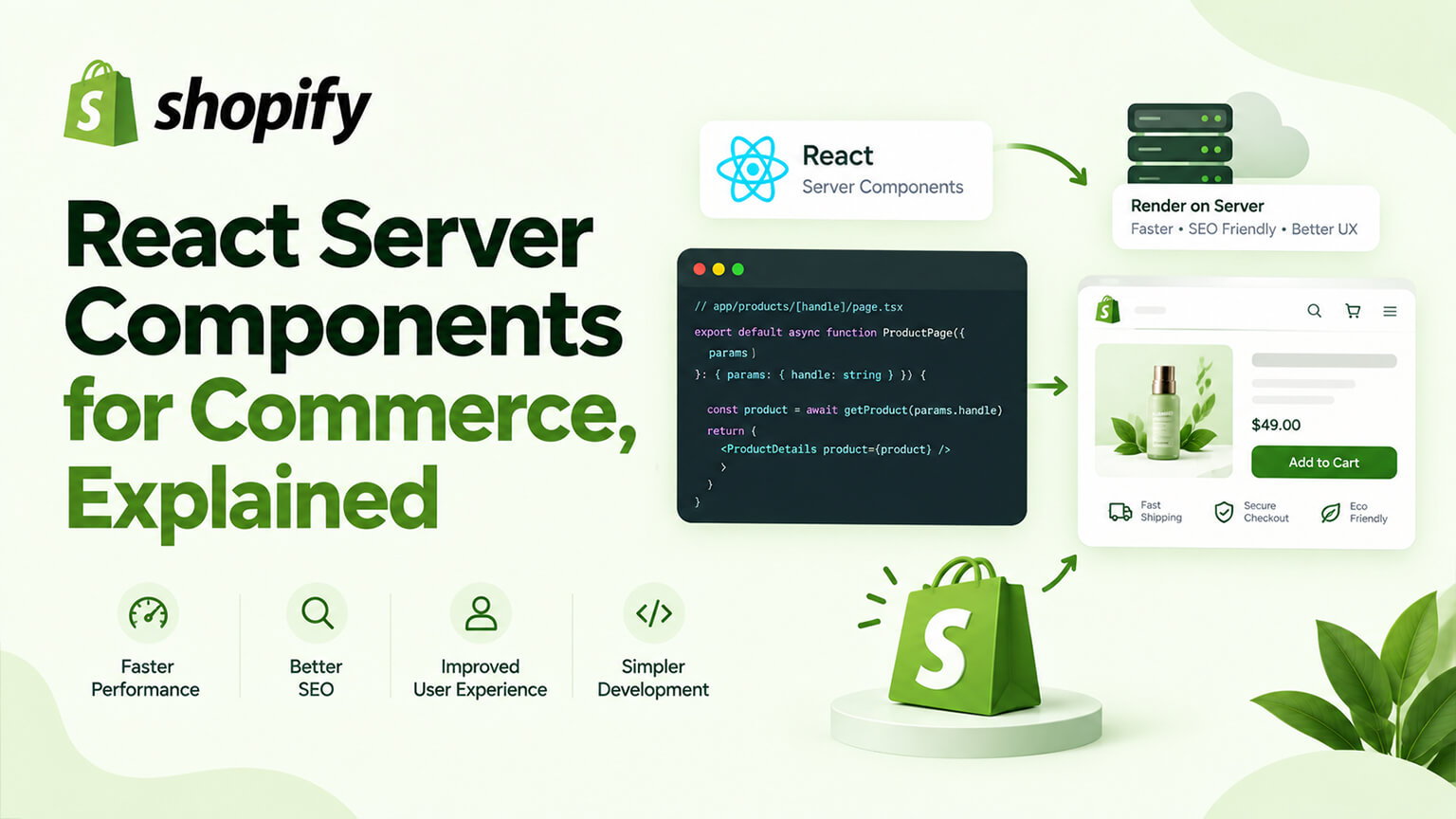
If you’re building or considering a headless Shopify storefront with a modern React framework (Next.js, Shopify’s Hydrogen), you’ll encounter React Server Components (RSC) — a significant evolution in how React applications are built that’s central to modern frameworks and particularly relevant to commerce. React Server Components are a somewhat technical concept, but the core idea is understandable and worth grasping if you’re involved in headless commerce decisions: they let parts of your React application render on the server (rather than in the browser), which brings performance and other benefits particularly valuable for commerce (where performance, SEO, and data-fetching matter, as those discussions cover). This is developer territory (the implementation), but understanding what RSC is and why it matters helps you understand modern headless architecture and its benefits. This piece explains React Server Components for commerce in plain English: what they are, why they matter for commerce, and how they fit into headless architecture. (This connects to the Hydrogen-vs-Next and caching/ISR discussions; this focuses on React Server Components.)
This piece covers what React Server Components are (the shift), why they matter for commerce, how they fit into modern headless frameworks, and the practical implications. Because RSC is central to modern headless storefronts and brings commerce-relevant benefits, and understanding it (conceptually) helps you understand modern headless architecture. Let me walk through it. (Note: RSC and framework implementations evolve; this covers the general concept and its relevance.)
What React Server Components are (the shift)
Let’s explain React Server Components in plain terms. Traditional React: client-side — traditionally, React applications render largely on the client (in the browser): the browser downloads the React code (JavaScript) and renders the components client-side — which means shipping a lot of JavaScript to the browser and rendering there (with implications for performance, as covered). The shift: rendering on the server — React Server Components let some components render on the server instead of the client: these “server components” run and render on the server, sending the rendered result (rather than the component’s JavaScript) to the browser — so less JavaScript is shipped to the client, and rendering happens server-side for those components. Server and client components — in the RSC model, an application is composed of server components (rendering on the server, for things that can — data-fetching, static content) and client components (rendering on the client, for interactivity that needs the browser) — a mix, with server components handling what they can server-side (reducing client JavaScript). Less client JavaScript — a key effect: server components don’t ship their JavaScript to the client (they render on the server and send the result), so RSC reduces the JavaScript shipped to the browser — improving performance (less JS to download, parse, and execute, as the performance discussions cover). Server-side data fetching — server components can fetch data on the server (directly, efficiently) rather than the client fetching after load — so data-fetching happens server-side (efficient, and the data is there when the rendered result reaches the browser). And it’s a significant React evolution — RSC is a significant evolution in React (changing how applications are architected, toward server rendering of components), central to modern React frameworks (Next.js App Router, Hydrogen, as those discussions cover). So React Server Components let some components render on the server (versus traditional client-side React), composing applications of server components (rendering server-side, fetching data server-side, shipping less JS) and client components (for interactivity) — a significant React evolution reducing client JavaScript and moving rendering and data-fetching server-side. So understand RSC as the shift toward server-rendering components (less client JS, server-side data-fetching), central to modern frameworks. The next section covers why it matters for commerce.
Why React Server Components matter for commerce
RSC brings benefits particularly relevant to commerce. Performance (less JavaScript) — the big one: by rendering components on the server and shipping less JavaScript to the browser, RSC improves performance (faster loading, less JS to download/parse/execute, better Core Web Vitals, as those discussions cover) — and performance matters greatly for commerce (conversion, SEO, as the speed discussions cover), so RSC’s performance benefit is valuable for commerce storefronts. Efficient data-fetching — commerce storefronts fetch a lot of data (products, collections, prices, from Shopify’s Storefront API, as that discussion covers), and RSC’s server-side data-fetching (components fetching data on the server efficiently) suits commerce’s data-fetching needs — fetching product data server-side efficiently (versus client-side fetching after load, which is slower). Better initial load and SEO — server-rendering components (with data) means the initial page arrives rendered (with content) — good for performance (fast initial content) and SEO (search engines get the rendered content, as the headless-SEO discussion covers — rendering for indexability) — both valuable for commerce. Reduced client burden — less client JavaScript reduces the burden on the browser (especially on mobile/lower-powered devices, as the mobile and performance discussions cover), improving the experience where it matters (mobile commerce). Suits commerce’s mix — commerce storefronts have a mix of static/data content (products, collections — suited to server components) and interactivity (cart, filters — suited to client components), which RSC’s server/client component model fits well — server-rendering the content, client-rendering the interactivity. And modern frameworks use it for commerce — modern commerce frameworks (Hydrogen, Next.js, as those discussions cover) use RSC, so building headless commerce with them involves RSC’s benefits (performance, data-fetching, SEO) — RSC is part of why these modern frameworks are good for commerce. So RSC matters for commerce because of performance (less JavaScript — valuable for commerce’s conversion and SEO), efficient server-side data-fetching (suiting commerce’s data needs), better initial load and SEO (rendered content — good for performance and indexability), reduced client burden (better mobile experience), suiting commerce’s mix (server for content, client for interactivity), and being used by modern commerce frameworks. So RSC’s benefits (performance, data-fetching, SEO) are particularly valuable for commerce, which is why it’s relevant to modern headless commerce. So RSC brings commerce-relevant benefits, part of why modern headless frameworks suit commerce. The next section covers how it fits into headless frameworks.
How it fits into modern headless frameworks
RSC is central to the modern headless frameworks used for Shopify storefronts. Next.js App Router — Next.js’s App Router (the modern Next.js architecture, as the Hydrogen-vs-Next discussion covers) is built around React Server Components — so building a headless Shopify storefront with Next.js App Router involves RSC (server and client components, server-side data-fetching), leveraging RSC’s benefits. Shopify Hydrogen — Shopify’s Hydrogen (its React framework for headless storefronts, as that discussion covers) uses React Server Components (Hydrogen is built with modern React including RSC) — so building with Hydrogen involves RSC, with its commerce benefits. Part of modern React architecture — RSC is part of modern React architecture (the direction React and its frameworks have taken), so modern headless storefronts built with current React frameworks use RSC — it’s the modern way these frameworks work. Fits with rendering strategies — RSC fits with the rendering and caching strategies (SSR, SSG, ISR, as the caching/ISR discussion covers) — server components render server-side, and the frameworks combine RSC with these strategies for performance (server-rendering, caching, as those discussions cover) — RSC is part of the modern rendering approach. Developer implementation — implementing with RSC (composing server and client components, server-side data-fetching) is developer work (as the headless-team discussion covers), so it’s part of what your headless developers/team work with in modern frameworks — the technical implementation. And it’s the modern standard — RSC is becoming the modern standard for building React applications (including commerce storefronts), so modern headless commerce increasingly uses it — understanding it is understanding modern headless architecture. So RSC fits into modern headless frameworks as a central part: Next.js App Router and Shopify Hydrogen are built around/with RSC, it’s part of modern React architecture, it fits with the rendering/caching strategies, it’s developer-implemented, and it’s the modern standard — so modern headless Shopify storefronts (built with current frameworks) use RSC and its benefits. So RSC is central to modern headless commerce frameworks, part of how they work and deliver their benefits. So understand RSC as integral to modern headless architecture (Next.js App Router, Hydrogen), which the next section covers the practical implications of. So RSC is a core part of modern headless commerce frameworks.
The practical implications
What are the practical implications of RSC for a merchant or someone involved in headless commerce decisions? It’s part of modern headless — RSC is part of how modern headless storefronts (built with current frameworks) work, so if you’re building headless with Next.js App Router or Hydrogen, RSC is involved — it’s a feature of the modern approach, bringing its benefits (performance, data-fetching, SEO). It’s mostly developer territory — the implementation of RSC (composing server/client components, server-side data-fetching) is developer work (as the headless-team discussion covers), so as a merchant, you don’t implement RSC yourself — your headless developers/team do, using the modern frameworks — you need the conceptual understanding, not the implementation. It contributes to headless benefits — RSC contributes to the performance and SEO benefits that make well-built modern headless good (as the headless-SEO and performance discussions cover) — so it’s part of why modern headless can be fast and SEO-friendly (when built well) — a reason modern headless frameworks deliver their benefits. It requires the right expertise — building with RSC (and modern frameworks) requires developers who understand it (as the headless-team discussion covers), so it’s part of the skills your headless team needs — reinforcing that headless needs the right expertise (as those discussions cover). It’s evolving — RSC and its framework implementations are evolving (a relatively new, developing part of React), so it’s a modern, evolving area — your team stays current with it. And understanding it aids decisions — understanding RSC (conceptually) helps you understand modern headless architecture and its benefits, aiding your headless decisions and discussions with developers — the value of the conceptual understanding. So the practical implications are: RSC is part of modern headless (involved if you build headless with current frameworks), it’s mostly developer territory (you need conceptual understanding, not implementation), it contributes to headless’s performance and SEO benefits, it requires the right expertise (part of your headless team’s skills), it’s evolving, and understanding it conceptually aids your headless decisions and developer discussions. So for a merchant, the practical takeaway is that RSC is part of modern headless architecture (contributing to its benefits, implemented by your developers), and understanding it conceptually helps you understand modern headless — while the implementation is developer territory requiring the right expertise. So understand RSC as part of modern headless commerce architecture (bringing performance, data-fetching, and SEO benefits), implemented by your headless team, with conceptual understanding aiding your decisions. So RSC is a modern, developer-implemented part of headless commerce that contributes to its benefits, worth understanding conceptually if you’re involved in headless decisions.
An analogy that makes it click
Since RSC can feel abstract, an analogy helps. Think of a traditional client-rendered React storefront like being shipped a flat-pack of furniture plus all the tools and instructions: the browser receives the “parts” (a lot of JavaScript) and has to assemble everything itself before you can use it — which takes time and effort, especially on a weaker device (a mid-range phone). React Server Components are like receiving key pieces already assembled: the server builds the parts that can be pre-built (the product content, the data-driven sections) and ships them ready-made, so the browser only has to assemble the bits that need on-site assembly (the interactive parts — cart, filters). Less arrives as raw parts-and-tools (less JavaScript), more arrives ready to use, and the data needed was gathered at the workshop (server-side data-fetching) rather than the browser having to go fetch it after delivery.
For a commerce storefront, that “pre-assembled where possible” model maps almost perfectly onto the job: product and collection content can be server-rendered with its data already fetched (fast to display, and visible to search engines for SEO), while interactive elements stay as client components. The shopper gets content faster, the browser does less work (which matters most on mobile), and the data-fetching is efficient. That’s the whole reason RSC is such a natural fit for modern headless commerce — the split between “content that can be pre-built on the server” and “interactivity that needs the browser” is exactly the split a storefront has. You don’t need to know how the workshop assembles the pieces (that’s your development team’s job with the modern frameworks), but understanding that this is what’s happening under the hood makes it clear why well-built modern headless storefronts using RSC can be both fast and SEO-friendly — and why the frameworks (Next.js App Router, Hydrogen) built around it are well-suited to commerce.
The bottom line
If you’re building or considering a headless Shopify storefront with a modern React framework (Next.js, Shopify’s Hydrogen), you’ll encounter React Server Components (RSC) — a significant evolution in how React applications are built that’s central to modern frameworks and particularly relevant to commerce. The core idea is understandable: traditionally, React applications render largely in the browser (shipping a lot of JavaScript to the client and rendering there), but React Server Components let some components render on the server instead — these “server components” run and render server-side, sending the rendered result (rather than their JavaScript) to the browser, while “client components” handle interactivity that needs the browser. This reduces the JavaScript shipped to the client (improving performance) and moves data-fetching server-side (components fetching data on the server efficiently). RSC matters for commerce because its benefits are particularly valuable there: performance (less JavaScript means faster loading and better Core Web Vitals — valuable for commerce’s conversion and SEO), efficient server-side data-fetching (suiting commerce storefronts’ heavy data-fetching from Shopify’s Storefront API), better initial load and SEO (server-rendering components with data means the page arrives rendered, good for performance and for search engines getting the content — indexability), reduced client burden (less JavaScript improves the experience, especially on mobile), and suiting commerce’s mix (server components for content like products and collections, client components for interactivity like cart and filters). RSC is central to the modern headless frameworks used for Shopify: Next.js’s App Router is built around RSC, and Shopify’s Hydrogen uses it, so building modern headless Shopify storefronts with current frameworks involves RSC and its benefits, and it fits with the rendering and caching strategies (SSR, SSG, ISR) these frameworks use. The practical implications for a merchant are: RSC is part of how modern headless storefronts work (involved if you build headless with current frameworks, bringing performance, data-fetching, and SEO benefits), but its implementation is developer territory (composing server and client components and server-side data-fetching — your headless team does this, using the modern frameworks, so you need the conceptual understanding, not the implementation), it contributes to the performance and SEO benefits that make well-built modern headless good, it requires the right developer expertise (part of your headless team’s skills), it’s an evolving area, and understanding it conceptually helps you understand modern headless architecture and aids your headless decisions and developer discussions. So React Server Components are a modern, developer-implemented part of headless commerce architecture that contributes to its performance, data-fetching, and SEO benefits — worth understanding conceptually if you’re involved in headless commerce decisions, even though the implementation is your development team’s work. Understanding RSC (the shift to server-rendering components, and why it benefits commerce) is part of understanding modern headless architecture and why well-built modern headless storefronts can be fast and SEO-friendly.
Frequently asked questions
What are React Server Components in simple terms?
React Server Components (RSC) let some parts of a React application render on the server instead of in the browser. Traditionally, React applications render largely on the client: the browser downloads the React code (JavaScript) and renders the components. With RSC, “server components” run and render on the server, sending the rendered result (rather than their JavaScript) to the browser, while “client components” handle the interactivity that needs the browser (like a cart or filters). So an application becomes a mix of server components (rendering server-side, for things like data-fetching and content) and client components (rendering in the browser, for interactivity). The key effects are that less JavaScript is shipped to the browser (since server components don’t send their code to the client, just the rendered result), improving performance, and data-fetching can happen efficiently on the server. RSC is a significant evolution in React, central to modern frameworks like Next.js and Shopify’s Hydrogen.
Why do React Server Components matter for ecommerce?
Because their benefits are particularly valuable for commerce. Performance is the big one: by rendering components on the server and shipping less JavaScript to the browser, RSC improves loading speed and Core Web Vitals — and performance matters greatly for commerce (conversion and SEO). Commerce storefronts also fetch a lot of data (products, collections, prices from Shopify’s Storefront API), and RSC’s server-side data-fetching suits this well (fetching product data efficiently on the server rather than in the browser after load). Server-rendering components with their data means the initial page arrives rendered with content, which is good for both performance (fast initial content) and SEO (search engines get the rendered content — important for indexability in headless). Less client JavaScript also reduces the burden on the browser, improving the experience especially on mobile. And commerce’s natural mix — static/data content (products) plus interactivity (cart, filters) — fits RSC’s server/client component model well. So RSC brings performance, efficient data-fetching, and SEO benefits that are especially relevant to commerce.
Do I need to understand React Server Components as a merchant?
Not in technical depth, but a conceptual understanding is useful if you’re involved in headless commerce decisions. The implementation of RSC (composing server and client components, server-side data-fetching) is developer territory — your headless development team handles it using modern frameworks, so you don’t implement it yourself. What’s valuable for you is understanding the concept: that RSC lets components render on the server, reducing client JavaScript and enabling efficient data-fetching, which contributes to the performance and SEO benefits that make well-built modern headless storefronts good. This conceptual understanding helps you understand modern headless architecture and why it can deliver its benefits, and it aids your discussions with developers and your headless decisions. It also reinforces that headless needs the right expertise — developers who understand RSC and modern frameworks are part of the skills a headless project requires. So understand RSC conceptually as part of modern headless architecture, while leaving the implementation to your development team.
How do React Server Components relate to Next.js and Hydrogen?
They’re central to both. Next.js’s App Router (the modern Next.js architecture) is built around React Server Components, so building a headless Shopify storefront with Next.js App Router involves RSC — server and client components, server-side data-fetching, and their benefits. Shopify’s Hydrogen (its React framework for headless storefronts) is also built with modern React including RSC, so building with Hydrogen involves RSC too. RSC is part of modern React architecture — the direction React and its frameworks have taken — so modern headless storefronts built with current React frameworks use it as the standard way these frameworks work. It also fits with the rendering and caching strategies (server-side rendering, static generation, incremental static regeneration) that these frameworks use for performance. So if you’re building headless Shopify with a current framework (Next.js App Router or Hydrogen), React Server Components are part of how it works and delivers its performance and SEO benefits — which is why understanding RSC is part of understanding modern headless commerce architecture.