
Free Shipping Strategy: Thresholds, Psychology, and Margins
On this page
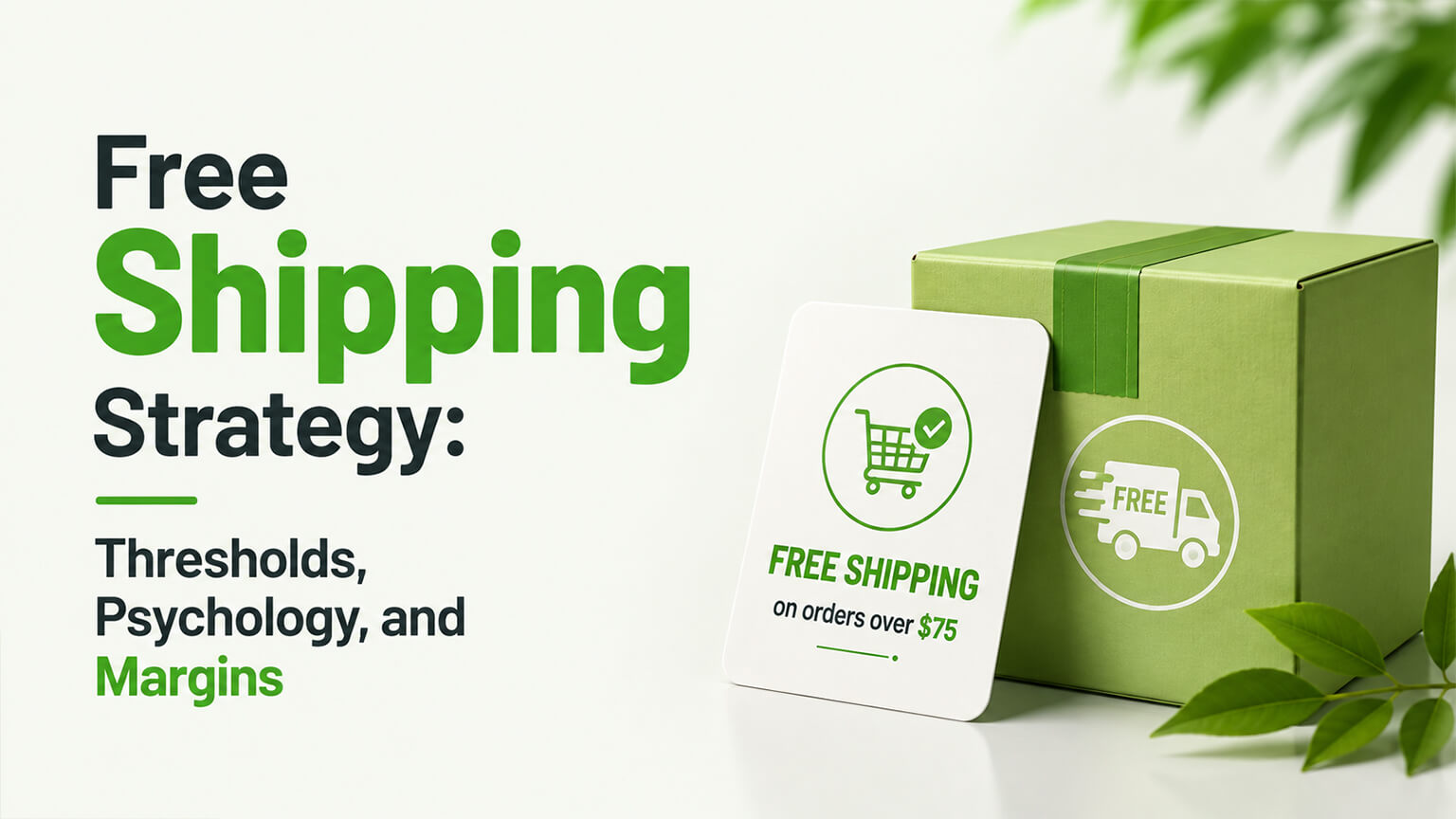
“Free shipping” might be the two most powerful words in ecommerce, and also two of the most misunderstood. Shoppers love free shipping with an intensity that isn’t entirely rational — they’ll add product to qualify for it, abandon carts over a shipping charge smaller than what they happily added, and choose one store over another largely because of it. At the same time, free shipping isn’t free; someone pays for that shipping, and if you’re not thoughtful, that someone is your margin. So a free shipping strategy is a balancing act: leveraging the enormous psychological pull of “free shipping” while protecting your profitability.
Most stores handle this on autopilot — copy a competitor’s threshold, or offer free shipping everywhere and quietly eat the cost, or charge for shipping and wonder about their abandonment rate. Doing it deliberately, understanding the psychology and the economics, is one of the more impactful and under-considered decisions a store makes. Let me walk through the options, the psychology, the margin reality, and how to actually decide.
Why shoppers care so much about shipping
First, the psychology, because it explains everything else. Unexpected shipping costs are consistently the number-one reason shoppers abandon carts — they’ve mentally committed to a price, reach checkout, see a shipping charge that changes the math, and leave, often irritated. And the irrationality is real: a shopper will happily add $15 of product to hit a free-shipping threshold to avoid a $7 shipping charge, which makes no strict economic sense but is deeply human. Free shipping feels like a reward; paying for shipping feels like a penalty, even when the totals say otherwise.
This is the core insight a free shipping strategy exploits: shoppers are far more sensitive to a separate, visible shipping charge than to the same cost baked into the product price or reached via a threshold. The word “free” carries disproportionate weight, and a surprise shipping cost at checkout carries disproportionate damage. Your strategy is essentially about managing this psychology — avoiding the penalty feeling of a surprise charge, and leveraging the reward feeling of “free,” while making sure the economics underneath still work. Understanding that the shopper’s reaction is more emotional than rational is what lets you design a strategy that works with that emotion rather than against it.
The options on the table
There are a few core approaches, each with trade-offs.
Free shipping on everything. The simplest and most appealing to shoppers — no charge ever. It maximizes the conversion benefit of free shipping but means you absorb all shipping costs, which only works if your margins, prices, or order values support it. Many brands build the shipping cost into their product prices to make this sustainable (more on that below).
Threshold-based free shipping. Free shipping over a certain order value, paid below it. This is the most popular approach because it captures much of the free-shipping benefit while also nudging order values upward — shoppers add product to hit the threshold. The art is in setting the threshold (covered below).
Paid shipping (flat rate or calculated). Charging for shipping, either a flat rate or calculated by weight/destination. This protects margin most directly but sacrifices the conversion benefit of free shipping and risks the abandonment that surprise shipping costs cause. It can work for certain products or markets but fights the strong shopper preference for free shipping.
Conditional free shipping. Free shipping on certain products, for certain customers (members, subscribers), during promotions, or in certain regions. A more tailored approach that offers free shipping where it makes economic sense and charges where it doesn’t.
Most stores land on threshold-based free shipping or free-shipping-everywhere-with-cost-in-price, because both capture the psychological benefit, but the right choice depends on your margins, prices, products, and market. There’s no universal answer, which is exactly why doing it deliberately beats defaulting.
The threshold strategy in depth
Since threshold-based free shipping is so common and so effective, it’s worth going deep on setting the threshold, because that number does a lot of work. Set it too low and you give away free shipping on orders that would have happened anyway, sacrificing margin for little nudge. Set it too high and it feels unreachable, so shoppers don’t bother trying to hit it and you get the abandonment of paid shipping without the AOV benefit. The sweet spot is usually somewhat above your current average order value — high enough that hitting it requires adding a bit, low enough that it feels achievable.
Placed there, the threshold becomes a powerful AOV lever: shoppers who’d have ordered just below it add product to qualify, raising your average order. And you can amplify this with a progress indicator in the cart — “you’re $12 away from free shipping” — which makes the threshold concrete and turns hitting it into a small game. This nudge is remarkably effective because it reframes spending more as saving money on shipping, leveraging exactly the psychology described above. So the threshold isn’t just a shipping policy; it’s a conversion-and-AOV tool, and setting it thoughtfully (a bit above AOV, with a progress nudge) is one of the higher-return small optimizations available. Just revisit it as your AOV changes, since a threshold that was well-placed can drift out of the sweet spot as your orders grow.
The margin reality you can’t ignore
Here’s the part the “just offer free shipping!” advice skips: someone pays for the shipping, and if you’re not deliberate, it’s your margin, and shipping costs can be substantial. So a free shipping strategy has to reckon with the economics, not just the psychology.
The most common way to make free shipping sustainable is to build the shipping cost into your product prices — effectively, prices are a little higher and shipping is “free,” which leverages the free-shipping psychology while recovering the cost. Shoppers vastly prefer a slightly higher price with free shipping over a lower price plus a visible shipping charge, even at the same total, because of the penalty-versus-reward framing. So this isn’t a trick so much as a smart alignment of pricing with psychology: you recover your shipping cost in a way that feels good to shoppers rather than a way that feels like a penalty.
The threshold approach manages margin differently — you only give free shipping above a value where the order is large enough to absorb the shipping cost, and below that the customer pays. This protects margin on small orders while still offering the free-shipping carrot. Whatever approach you take, the discipline is to know your shipping costs and your margins and design a strategy where the free-shipping benefit doesn’t quietly eat your profitability. Free shipping that wins conversions but loses money on every order is not a strategy, it’s a slow bleed. The goal is to capture the powerful conversion and AOV benefits of free shipping while keeping the economics sound, usually by recovering the cost through pricing or thresholds rather than simply absorbing it.
Free shipping versus lower prices
A strategic question worth posing: given the shipping-cost psychology, is your money better spent on free shipping or lower prices? The answer leans toward free shipping in many cases, precisely because of the framing. A dollar “spent” on free shipping (by absorbing or building in the cost) tends to influence shoppers more than a dollar spent on a lower price, because eliminating the penalty-feeling shipping charge has outsized psychological impact compared to a slightly lower price. This is why brands often find free shipping a more effective use of margin than equivalent price cuts.
That’s not universal — in very price-competitive categories, price matters enormously — but it’s a useful frame: the same margin, deployed as free shipping rather than lower prices, frequently does more for conversion because of how shoppers weigh shipping charges. So when you’re deciding how to use your pricing flexibility, free shipping deserves serious consideration as often a higher-leverage lever than an across-the-board price reduction. Understanding this helps you allocate your margin where it influences shoppers most, rather than defaulting to price competition that may move them less than removing a shipping charge would.
The membership and subscription angle
A model worth knowing: free shipping as a membership or subscription benefit. Some brands offer free shipping (among other perks) to members or subscribers, which both incentivizes the membership/subscription and reserves the free-shipping cost for your committed, higher-value customers. This can be a smart way to offer free shipping where it makes economic sense (to customers worth the cost) while not absorbing it universally. It ties free shipping to loyalty and recurring revenue, turning a cost into a retention tool. Whether it fits depends on your model, but it’s a creative option beyond the basic free/threshold/paid choices, and it aligns the cost of free shipping with the customers who justify it.
International shipping is a different beast
A note for brands shipping internationally: cross-border shipping costs are higher and more variable, plus there are duties, taxes, and customs complexities, which makes universal free shipping internationally far harder to sustain. Many brands offer free shipping domestically but charge (or set higher thresholds) internationally, where the economics demand it. The transparency principle still applies — surprise international shipping and customs charges are even more damaging to conversion than domestic ones — so being clear upfront about international costs (and ideally handling duties/taxes transparently so customers aren’t surprised at the border) matters a lot. International shipping strategy deserves its own consideration rather than just extending your domestic free-shipping policy globally, because the costs and complexities are different and absorbing them universally usually isn’t viable.
Testing and deciding your strategy
Like most things in conversion, your shipping strategy benefits from testing where your traffic allows, and from deliberate decision-making where it doesn’t. Test thresholds (does a different threshold lift AOV or conversion?), test free shipping versus equivalent discounts, and watch the impact on both conversion and margin, not just one. The right strategy depends on your specific margins, prices, products, average order value, and market, so the decision is to understand those, weigh the psychology and economics, and choose deliberately rather than copying a competitor or defaulting.
To decide: know your shipping costs and margins. Consider building shipping into prices for a free-shipping-everywhere approach if your category and positioning support it. Consider a threshold set a bit above your AOV with a progress nudge to capture the free-shipping benefit while lifting order values and protecting small-order margin. Handle international separately. And revisit as your numbers change. Done deliberately, your shipping strategy becomes a conversion and AOV asset that respects your margins; done on autopilot, it’s either a margin leak or an abandonment driver. Given how much shoppers care about shipping, it’s a decision worth real thought.
A worked example: same total, very different results
To see the psychology in action, picture the same product sold two ways. Store A prices it at $40 and charges $8 shipping. Store B prices it at $48 with free shipping. The total to the customer is identical — $48 either way. Yet Store B will almost certainly convert better, because Store A’s customer mentally commits to $40, then feels the $8 as a penalty added at checkout, while Store B’s customer sees $48 with “free shipping” and feels nothing but the reward of free delivery. Same money, opposite emotional experience, different conversion.
Now add a threshold to the picture. Store B sets free shipping at $50 and the customer’s cart is at $44. The “$6 away from free shipping” nudge prompts them to add a small item, pushing the order to $52. Store B just lifted its average order value using the customer’s own desire to avoid a shipping charge — and the customer feels good about it, having “earned” free shipping rather than paid for delivery. The shipping cost is recovered in the order value, the customer is happy, and the AOV rose. Compare that to Store A, where the $8 charge sat there as friction with no upside, nudging nothing and souring the experience.
These scenarios are simplified, but they capture why deliberate shipping strategy matters so much: identical economics produce very different outcomes depending on how shipping is framed and structured. The brand that understands the psychology — recover the cost in price or via a threshold, never spring a visible charge, use the threshold to nudge AOV — captures conversion and order-value gains that the brand charging visible shipping at checkout simply leaves on the table. It’s the same money handled two ways, and the handling is worth real conversion and AOV. That’s the whole argument for treating shipping as a strategy rather than an afterthought.
The hidden cost of getting it wrong
It’s worth dwelling on what a poor shipping strategy actually costs, because it’s larger and more invisible than it looks. Charging visible shipping at checkout doesn’t just lose the occasional sale to abandonment — it taxes every transaction with friction and a penalty feeling, suppressing conversion across the board in a way that never shows up as an obvious line item. You don’t see the customers who quietly left at the shipping charge; they just don’t appear in your sales. So a brand charging visible shipping can be bleeding conversions continuously without ever connecting it to the shipping policy, because the lost sales are invisible.
Equally, giving away free shipping carelessly — no threshold, cost not recovered in price — bleeds margin on every order, also invisibly, until someone looks at the unit economics and wonders why margins are thin. Both failure modes are quiet and continuous, which is exactly why shipping deserves deliberate attention rather than autopilot: the costs of getting it wrong don’t announce themselves, so they persist unexamined. A brand that never thinks hard about shipping is almost certainly either suppressing conversion with visible charges or leaking margin with careless free shipping, and probably doesn’t realize it. Bringing the strategy into the open — knowing your costs, choosing your approach deliberately, recovering the cost sensibly — surfaces and fixes a problem most stores don’t know they have. Given that shipping touches every single order, getting it right (or wrong) compounds across your entire sales volume, which is what makes this unglamorous decision one of the higher-leverage ones a store makes. The leverage cuts both ways and applies to every transaction you’ll ever process, which is precisely why a few hours spent getting your shipping strategy right — knowing your costs, choosing your approach deliberately, recovering the cost sensibly, and revisiting the threshold as you grow — returns far more than the effort suggests. It’s the kind of decision that feels minor in the moment and turns out to have been quietly shaping your conversion and margin all along.
The bottom line
Free shipping is enormously powerful because shoppers are far more sensitive to a visible shipping charge than to the same cost baked into prices or reached via a threshold — surprise shipping costs are the top cause of cart abandonment, and “free” carries disproportionate weight. But free shipping isn’t free, so the strategy is to capture that psychological benefit while protecting margin. The main approaches: free shipping everywhere (often with the cost built into prices, which shoppers prefer to a visible charge at the same total); threshold-based free shipping (the popular choice, which also lifts AOV when set a bit above your average order with a progress nudge); and paid or conditional shipping where the economics demand it. Know your shipping costs and margins, recover the cost through pricing or thresholds rather than simply absorbing it, consider that free shipping is often a higher-leverage use of margin than equivalent price cuts, handle international separately, and revisit as your numbers change. Done deliberately, your shipping strategy lifts conversion and order value while keeping the economics sound — which, given how much shoppers care about shipping, makes it one of the more impactful decisions a store can get right.
Frequently asked questions
Should I offer free shipping on my Shopify store?
In most cases some form of free shipping helps, because shoppers strongly prefer it and surprise shipping charges are the top cause of cart abandonment. The question is which form: free everywhere (often with the cost built into prices), threshold-based (free over a certain order value), or conditional. The right choice depends on your margins, prices, and average order value — but charging visible shipping with no free option fights a strong shopper preference and risks abandonment.
How do I set a free shipping threshold?
Set it somewhat above your current average order value — high enough that hitting it requires adding a bit of product (which lifts your AOV), but low enough to feel achievable so shoppers actually try. Too low and you give away free shipping on orders that would’ve happened anyway; too high and it feels unreachable. Add a cart progress indicator (“$12 away from free shipping”) to make it concrete, and revisit the threshold as your AOV changes.
How do I offer free shipping without losing money?
Recover the cost rather than simply absorbing it. The common approach is building shipping cost into your product prices — shoppers strongly prefer a slightly higher price with free shipping over a lower price plus a visible shipping charge at the same total. Alternatively, a threshold ensures you only give free shipping on orders large enough to absorb the cost. Know your shipping costs and margins, and design so free shipping doesn’t quietly eat your profitability.
Is free shipping better than lowering prices?
Often, yes, because of the psychology — eliminating a penalty-feeling shipping charge tends to influence shoppers more than an equivalent price cut. The same margin deployed as free shipping frequently does more for conversion than an across-the-board price reduction. It’s not universal (very price-competitive categories are different), but free shipping deserves serious consideration as often a higher-leverage use of your margin than lower prices.