
Social Proof That Actually Lifts Conversion
On this page
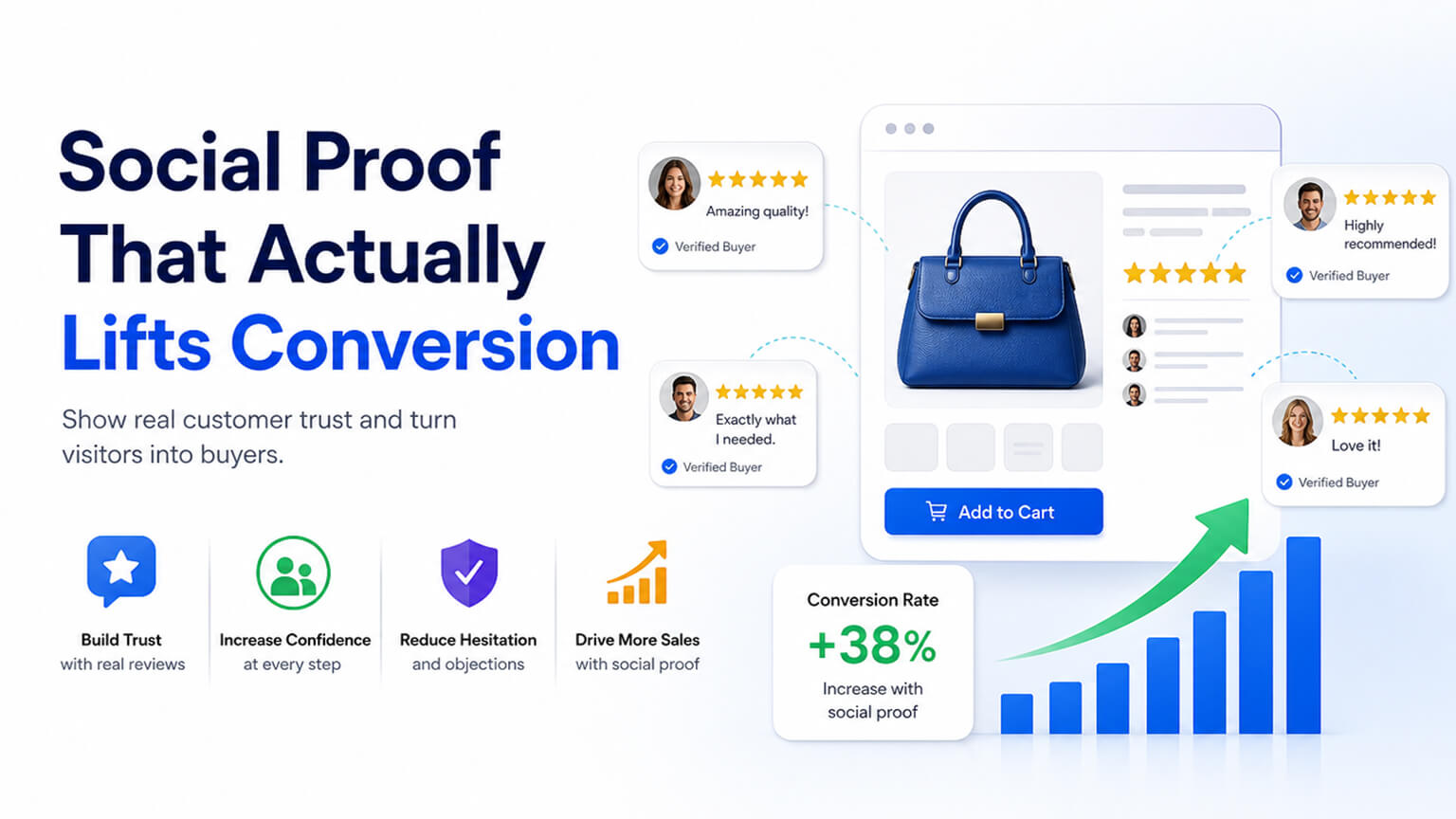
Social proof — evidence that other people have bought, used, and been happy with your products — is one of the most powerful conversion levers in ecommerce, because it addresses a fundamental barrier: trust. A first-time visitor doesn’t know if your products are good, if your store is legitimate, or if they’ll be happy with their purchase — and seeing that many others have bought and been satisfied provides reassurance that lowers that risk and lifts conversion. Reviews, ratings, testimonials, user-generated content, social following, “bestseller” and popularity signals, and other forms of social proof all tap the same psychology: people look to others’ behavior and experiences to guide their own decisions, especially under uncertainty. But social proof only works when it’s credible and used well — fake or thin social proof backfires (as the trust and urgency/scarcity discussions cover), and even genuine social proof needs to be presented effectively to lift conversion. This piece covers social proof that actually lifts conversion: the types that work, why they work, how to use them well, and the pitfalls. (This connects to the reviews/UGC and trust discussions; this focuses on social proof for conversion.)
This piece covers why social proof works, the types that lift conversion, how to use social proof well, and the pitfalls to avoid. Because social proof is a powerful, evidence-backed conversion lever, and using it well (credible, effective) captures the benefit. Let me walk through it.
Why social proof works
Social proof works because of deep-seated psychology and the trust problem it solves. People look to others — humans look to others’ behavior and experiences to guide their decisions, especially under uncertainty (a well-established psychological principle): if others have done something (bought a product) and been happy, it signals it’s a good choice, reducing perceived risk. Addresses the trust barrier — for ecommerce, especially for first-time visitors, trust is a fundamental barrier (is this store legitimate? are the products good? will I be happy? as the trust discussion covers) — and social proof addresses it directly: seeing that many others have bought and been satisfied provides reassurance that lowers the perceived risk of buying. Reduces perceived risk — buying involves perceived risk (will it be good? worth it?), and social proof (others’ positive experiences) reduces that perceived risk, making people more comfortable buying. Provides validation — social proof validates the decision (others chose this, so it’s a validated choice), giving confidence. Leverages the wisdom of crowds — many positive experiences (lots of good reviews, many happy customers) signal quality (the crowd’s collective experience), which people trust more than the brand’s own claims (others’ experiences are more credible than self-promotion). And it’s especially powerful online — online, where shoppers can’t physically examine products or the store, social proof is especially important (it substitutes for the reassurance of a physical store/product), making it a key conversion driver for ecommerce. So social proof works because people look to others under uncertainty, it addresses the fundamental trust barrier (especially for first-time online shoppers), reduces perceived risk, provides validation, leverages the wisdom of crowds (more credible than self-promotion), and is especially powerful online (substituting for physical reassurance). This makes social proof one of the most powerful conversion levers — it directly addresses the trust-and-risk barrier that stops people buying. So leverage social proof to build the trust and reduce the risk that drive conversion. The next section covers the types that work.
The types of social proof that lift conversion
Several types of social proof lift conversion, each valuable. Reviews and ratings — customer reviews and star ratings are the most important social proof for ecommerce (as the reviews/UGC discussion covers): they provide detailed, credible evidence of others’ experiences and product quality, powerfully reassuring buyers. Prominent, plentiful, positive reviews and ratings (on product pages especially) strongly lift conversion. User-generated content (UGC) — customer photos, videos, and content showing real people using your products (as the reviews/UGC discussion covers) provide authentic, relatable social proof (real customers, real use), which is highly persuasive (more authentic than brand imagery). Testimonials — customer testimonials (quotes, stories, especially with names/photos or from recognisable customers) provide credible endorsement. Ratings and review counts — showing high ratings and many reviews (e.g., “4.8 stars, 2,000 reviews”) signals popularity and quality (the wisdom of crowds), reassuring buyers. Popularity and bestseller signals — signals of popularity (“bestseller,” “X sold this month,” “trending,” “popular”), when genuine, indicate others are buying (social proof of demand), reassuring buyers — though these must be genuine (fake popularity backfires, as the urgency/scarcity discussion covers). Social following and mentions — social media following, mentions, press, and endorsements (when relevant and genuine) provide broader social proof of the brand’s popularity and credibility. Expert or authority endorsements — endorsements from experts, authorities, or credible sources (reviews from trusted publications, expert recommendations) provide authoritative social proof. And trust badges and certifications — trust signals (security badges, certifications, guarantees, as the trust discussion covers), while not “social” proof per se, similarly reassure and reduce risk, complementing social proof. So the types of social proof that lift conversion are reviews and ratings (the most important), UGC (authentic, relatable), testimonials, ratings/review counts (wisdom of crowds), genuine popularity/bestseller signals, social following/mentions, expert endorsements, and trust badges/certifications (complementary). Reviews, ratings, and UGC are usually the most impactful for ecommerce (credible, detailed, authentic evidence of others’ positive experiences). So use these types of social proof — especially reviews, ratings, and UGC — to reassure buyers and lift conversion. The next section covers using them well.
How to use social proof well
Having social proof isn’t enough; using it well (presenting it effectively) is what lifts conversion. Make it prominent — display social proof prominently where it matters (reviews and ratings on product pages near the buying decision, as the product-page discussion covers; social proof on the homepage, throughout the journey), so buyers see it at decision points. Hidden social proof doesn’t help. Put it at decision points — place social proof at the moments of decision (product pages, add-to-cart, checkout), where reassurance most helps conversion. Make it credible and authentic — ensure social proof is credible and authentic (real reviews, real UGC, genuine popularity signals), since credibility is essential (fake or thin social proof backfires, as the pitfalls cover). Authentic social proof (real customers, real experiences) is far more persuasive than polished-but-fake. Show quantity and quality — show both quantity (many reviews, many customers — wisdom of crowds) and quality (high ratings, positive experiences), since both reassure (many positive experiences is powerful). Include detail and authenticity — detailed, authentic reviews and UGC (specific, real, relatable — including some imperfection, since all-perfect reviews seem fake, as the reviews discussion covers) are more credible and persuasive than generic or suspiciously-perfect ones. Make reviews easy to engage — make reviews easy to read, filter, and engage with (helpful reviews surfaced, filterable, as the reviews discussion covers), so buyers can find the reassurance they need. Use relevant social proof — use social proof relevant to the buyer and product (reviews of that product, relevant UGC, relevant endorsements), since relevant proof is more persuasive than generic. And integrate it naturally — integrate social proof naturally into the experience (not cluttering or feeling forced), enhancing rather than cluttering the pages. So use social proof well by making it prominent (where it matters, at decision points), ensuring it’s credible and authentic (real, not fake), showing quantity and quality, including detail and authenticity (real, relatable, not suspiciously perfect), making reviews easy to engage with, using relevant proof, and integrating it naturally. Effective presentation — prominent, credible, authentic, relevant social proof at decision points — is what turns having social proof into lifting conversion. So don’t just collect social proof; present it effectively (prominent, credible, at decision points) to capture its conversion power. The next section covers the pitfalls.

The pitfalls to avoid
Social proof has pitfalls that undermine or backfire. Fake or fabricated social proof — fake reviews, fabricated testimonials, or fake popularity signals are the biggest pitfall: they’re deceptive (unethical), customers increasingly detect them (backfiring — destroying trust when caught, as the trust and urgency/scarcity discussions cover), and they can carry legal risk (fake reviews are illegal deceptive practices in many places). Never fake social proof. Thin or weak social proof — too few reviews, no UGC, weak social proof can fail to reassure (or even signal unpopularity), so build genuine social proof (generate reviews and UGC, as the reviews discussion covers) rather than displaying thin proof. Suspiciously perfect proof — all-5-star, all-glowing, suspiciously-perfect reviews seem fake and reduce credibility (real reviews have some variation and imperfection, as the reviews discussion covers), so authentic (imperfect) social proof is more credible than fake-seeming perfection. Ignoring negative feedback — hiding or deleting all negative reviews (leaving only perfect ones) seems fake and misses the credibility that some balanced, well-handled negative reviews provide (and responding to them shows you care, as the reviews discussion covers). Irrelevant social proof — generic or irrelevant social proof (unrelated reviews, irrelevant endorsements) is less persuasive than relevant proof. Cluttering or overdoing it — overdoing social proof (cluttering pages with excessive badges, popups, notifications — e.g., aggressive “someone just bought” popups that feel fake or spammy) can annoy and reduce credibility, so use it tastefully. And not collecting it — failing to actively collect social proof (reviews, UGC) leaves you without this powerful lever, so invest in generating genuine social proof (as the reviews discussion covers). So the pitfalls to avoid are fake/fabricated social proof (the biggest — deceptive, detectable, legally risky), thin/weak proof (build genuine proof instead), suspiciously-perfect proof (authenticity beats fake perfection), hiding all negatives (some balance is more credible), irrelevant proof, cluttering/overdoing it (use tastefully), and not collecting it (invest in generating it). Avoiding these — genuine, authentic, sufficient, relevant, tasteful social proof, actively collected — is what makes social proof credible and effective (rather than backfiring or failing). The overriding principle is authenticity: genuine social proof works, fake backfires. So build and present genuine, authentic social proof well, avoiding the pitfalls (especially fakery), and it’s a powerful, credible conversion lever. So use social proof authentically and effectively, capturing its conversion power while maintaining the credibility on which it depends.
A worked example: social proof across the journey
Picture a store that has genuine social proof but isn’t using it well — reviews exist but are buried on a separate tab, UGC sits unused in a folder, and the homepage says nothing about the brand’s happy customers. Simply presenting that existing social proof effectively, at the right moments, can lift conversion without collecting a single new review. Here’s the journey done well. On the homepage, the brand surfaces a headline signal — “Rated 4.8 stars by 12,000+ customers” — plus a few authentic customer photos, immediately reassuring first-time visitors that others trust the brand. On category and product pages, star ratings appear next to products (so shoppers see quality signals while browsing), and on the product page itself, reviews and ratings sit prominently near the add-to-cart button — right where the buying decision happens — with real customer photos (UGC) showing the product in use, and reviews that are easy to read and filter (including some balanced, less-than-perfect ones that make the whole set credible).
Near the decision and into the cart, subtle reassurance continues: relevant “customers also loved” signals, genuine popularity indicators where true, and trust badges/guarantees that complement the social proof by further reducing risk. Crucially, everything is real — genuine reviews, real customer content, honest signals — and presented tastefully rather than cluttering the pages or firing spammy “someone just bought” popups. The effect is cumulative: at each step where a shopper might hesitate over trust or risk, they encounter credible evidence that others bought and were happy, lowering the barrier to purchase. The store didn’t need new social proof to get this lift — it needed to take the genuine proof it already had and place it prominently, authentically, and relevantly at the decision points. That’s the practical heart of using social proof well: collect genuine proof, then present it effectively where it matters. Many stores are sitting on powerful, underused social proof simply because it’s buried or absent from the moments that count.
Social proof, trust, and honesty as a system
It’s worth seeing social proof as part of a larger trust system rather than an isolated tactic, because that framing keeps you on the right side of the line that makes it work. Social proof, trust signals (as the trust discussion covers), authentic reviews and UGC (as the reviews discussion covers), and honest urgency and scarcity (as that discussion covers) all serve the same underlying goal: reducing the perceived risk that stops people buying, honestly. They reinforce each other — genuine reviews build trust, trust signals reduce risk, authentic UGC adds relatability, honest popularity signals show demand — and together they make a first-time shopper comfortable enough to buy. The common thread across all of them is authenticity: they work precisely because they’re credible, and they backfire precisely when they’re faked.
This is why the temptation to fake social proof is so self-defeating. Fake reviews, fabricated popularity, and manufactured urgency might borrow the appearance of trust for a moment, but they undermine the very thing — credibility — that gives social proof its power, and when detected (increasingly likely with savvy customers) they destroy trust across the whole store, not just the faked element. Conversely, investing in genuine social proof compounds: real reviews and UGC accumulate over time into an ever-stronger, ever-more-credible body of evidence that lifts conversion durably and can’t be easily replicated by competitors. So the strategic move is to treat social proof as one pillar of an honest trust system: actively collect genuine reviews and UGC (as the reviews discussion covers), present them and your trust signals effectively at decision points, use only honest urgency and scarcity, and never fake any of it. Built this way, social proof isn’t a trick you apply to a page — it’s the accumulated, authentic evidence of a brand that satisfies its customers, presented where it helps them decide. That’s both the most ethical approach and, because authenticity is what makes it persuasive, by far the most effective and durable one.
The bottom line
Social proof — evidence that other people have bought, used, and been happy with your products — is one of the most powerful conversion levers in ecommerce, because it addresses a fundamental barrier: trust. It works because humans look to others’ behavior and experiences to guide their decisions under uncertainty, so it directly addresses the trust barrier (especially for first-time online shoppers wondering if the store is legitimate and the products good), reduces perceived risk, provides validation, leverages the wisdom of crowds (others’ experiences are more credible than the brand’s self-promotion), and is especially powerful online (substituting for the reassurance of physically examining products and stores). The types that lift conversion include reviews and ratings (the most important for ecommerce — detailed, credible evidence of others’ experiences and quality), user-generated content (authentic, relatable — real customers using your products), testimonials, ratings and review counts (wisdom of crowds), genuine popularity and bestseller signals, social following and mentions, expert endorsements, and complementary trust badges and certifications — with reviews, ratings, and UGC usually the most impactful. But having social proof isn’t enough; using it well is what lifts conversion: make it prominent and at decision points (reviews on product pages near the buying decision), ensure it’s credible and authentic (real, not fake), show both quantity and quality, include detail and authenticity (real, relatable, not suspiciously perfect), make reviews easy to read and engage with, use relevant proof, and integrate it naturally. And avoid the pitfalls: fake or fabricated social proof (the biggest — deceptive, increasingly detectable, legally risky, and trust-destroying when caught — never fake it), thin or weak proof (build genuine proof instead), suspiciously-perfect proof (authenticity beats fake-seeming perfection), hiding all negative feedback (some balance is more credible), irrelevant proof, cluttering or overdoing it (use tastefully), and failing to collect it (invest in generating genuine reviews and UGC). The overriding principle is authenticity: genuine social proof powerfully lifts conversion, while fake backfires. So build and present genuine, authentic, sufficient, relevant, tasteful social proof effectively — prominent and credible at decision points — capturing its substantial conversion power while maintaining the credibility on which it entirely depends. Done well, social proof is one of the highest-impact, most durable conversion levers you have.
Frequently asked questions
Why is social proof so powerful for conversion?
Because it directly addresses the fundamental barrier to buying: trust. Humans look to others’ behavior and experiences to guide their own decisions, especially under uncertainty — so when a first-time visitor (who doesn’t know if your store is legitimate, your products are good, or they’ll be happy) sees that many others have bought and been satisfied, it provides reassurance that lowers the perceived risk of buying. Social proof reduces perceived risk, validates the decision (others chose this), and leverages the wisdom of crowds (others’ experiences are more credible than the brand’s own claims). It’s especially powerful online, where shoppers can’t physically examine products or the store, so social proof substitutes for that reassurance. This is why social proof — reviews, ratings, UGC, and the like — is one of the most powerful conversion levers in ecommerce: it tackles the trust-and-risk barrier that stops people buying.
What types of social proof work best?
For ecommerce, reviews and ratings are usually the most important — they provide detailed, credible evidence of others’ experiences and product quality, and prominent, plentiful, positive reviews on product pages strongly lift conversion. User-generated content (customer photos and videos showing real people using your products) is also highly persuasive because it’s authentic and relatable. Other effective types include testimonials, ratings and review counts (signalling popularity and quality — the wisdom of crowds), genuine popularity and bestseller signals, social following and mentions, and expert or authority endorsements. Trust badges and certifications complement social proof by similarly reducing perceived risk. Reviews, ratings, and UGC are generally the highest-impact for ecommerce because they’re credible, detailed, authentic evidence of real customers’ positive experiences — which is exactly the reassurance buyers need.
How do I use social proof effectively?
Having it isn’t enough — present it well. Make it prominent and place it at decision points (reviews and ratings on product pages near the add-to-cart, social proof throughout the journey), so buyers see reassurance when it matters. Ensure it’s credible and authentic (real reviews and UGC, genuine signals), since authenticity is what makes it persuasive. Show both quantity (many reviews and customers) and quality (high ratings, positive experiences). Include detail and authenticity — specific, real, relatable reviews and UGC, including some imperfection, since suspiciously-perfect reviews seem fake. Make reviews easy to read, filter, and engage with. Use social proof relevant to the specific product and buyer (reviews of that product, relevant UGC). And integrate it naturally into the experience rather than cluttering pages. Effective presentation — prominent, credible, authentic, relevant social proof at decision points — is what turns having social proof into actually lifting conversion.
What social proof mistakes should I avoid?
The biggest is fake or fabricated social proof — fake reviews, invented testimonials, or fake popularity signals. It’s deceptive and unethical, customers increasingly detect it (destroying trust when caught), and fake reviews are illegal deceptive practices in many places, so never fake it. Other pitfalls: thin or weak social proof (too few reviews fails to reassure — build genuine proof by actively collecting reviews and UGC), suspiciously-perfect proof (all-5-star, all-glowing reviews seem fake — authentic reviews have some variation, which is more credible), hiding all negative feedback (some balanced, well-handled negatives are more credible than only-perfect reviews, and responding shows you care), irrelevant social proof, and cluttering or overdoing it (excessive badges or aggressive “someone just bought” popups can feel fake and spammy). The overriding principle is authenticity: genuine social proof works powerfully, while fake backfires — so build and present real proof well.