
An Ecommerce Growth Roadmap: Bringing It All Together
On this page
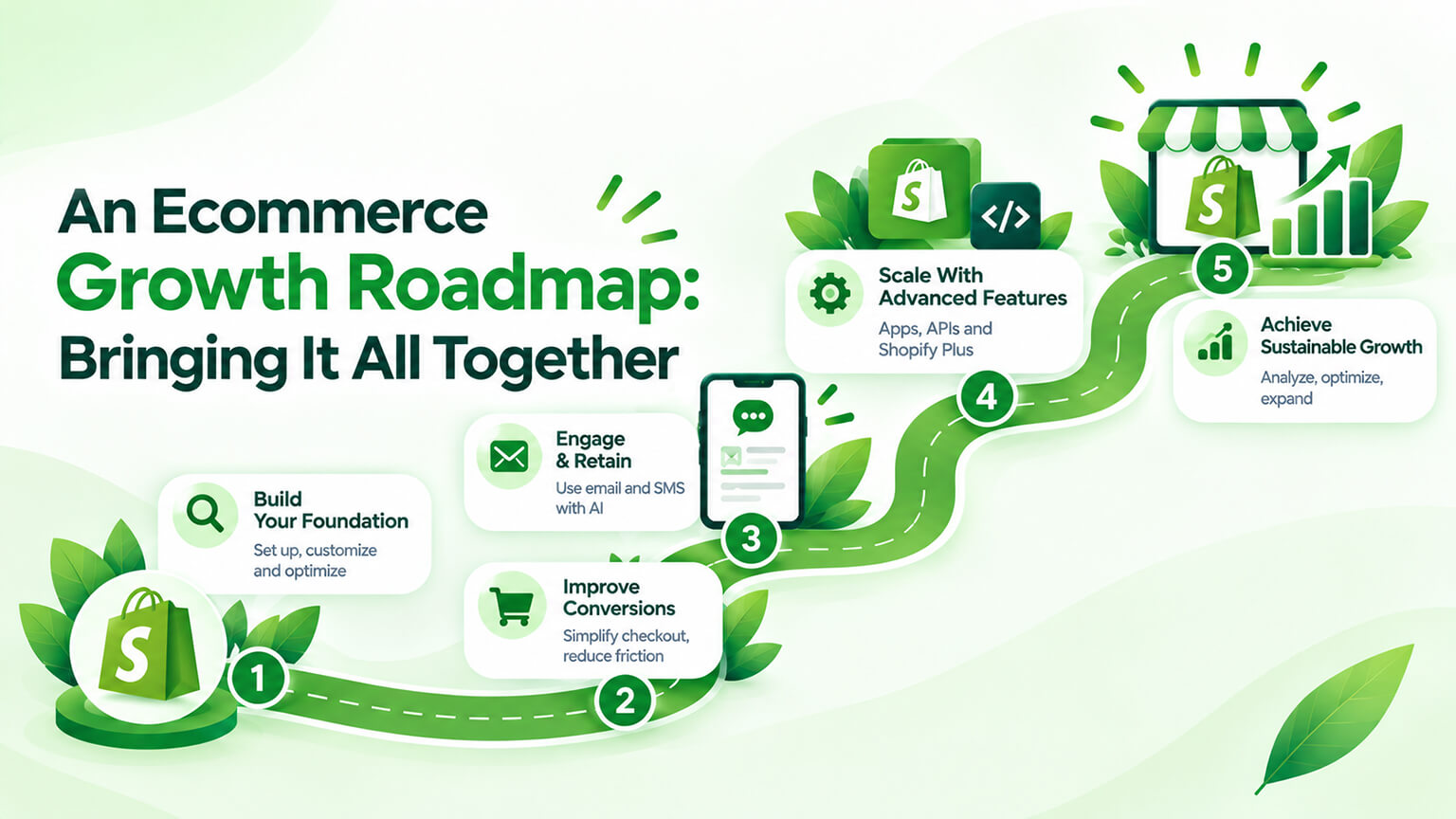
Growing a Shopify store isn’t about any single tactic — it’s about bringing together many pieces (a solid, fast, well-built store; SEO to be found; conversion optimisation to turn visitors into customers; retention to keep them; and the right use of platform capabilities, apps, and increasingly AI) into a coherent growth roadmap. It’s easy to focus on one thing (chasing traffic, or tweaking the checkout) while neglecting others, but sustainable growth comes from the whole system working together (traffic that converts, customers who return, a store that supports it all). This piece — the capstone bringing together the themes across all these articles — lays out an ecommerce growth roadmap: the key pieces (foundation, traffic, conversion, retention, and leverage), how they fit together, how to prioritise and sequence them, and how to approach growth sustainably. It’s a high-level synthesis, pointing to the detailed pieces for each area (the many articles covering development, SEO, CRO, retention, Plus, headless, apps, and AI). Let me bring it all together.
This piece covers the key pieces of an ecommerce growth roadmap (foundation, traffic, conversion, retention, leverage), how they fit together as a system, how to prioritise and sequence them, and how to approach growth sustainably. Because sustainable growth comes from the whole system working together, and a roadmap helps you build it coherently. Let me walk through it.
The key pieces of the roadmap
An ecommerce growth roadmap has several key pieces (each covered in depth across the other articles). The foundation: a solid store — a well-built, fast, reliable, well-designed store (good Shopify development, performance, mobile experience, UX — the foundation everything else builds on), since growth needs a solid store (as the development, speed, and UX discussions cover) — foundation (the base). Traffic: being found — traffic (getting visitors — SEO to be found in search and increasingly AI/GEO, plus other channels like ads, email, social, content), since you need visitors to grow (as the SEO, GEO, and content discussions cover) — traffic (getting visitors). Conversion: turning visitors into customers — conversion optimisation (turning visitors into customers — product pages, checkout, trust, reducing friction, testing, as the CRO discussions cover), since traffic must convert (as the CRO discussions cover) — conversion (turning visitors to customers). Retention: keeping customers — retention (keeping customers and increasing their value — post-purchase experience, email/SMS, loyalty, LTV, as the retention discussions cover), since retaining customers drives sustainable growth (repeat business, LTV) — retention (keeping customers). Leverage: capabilities, apps, and AI — leverage (using platform capabilities — Plus, headless where warranted; apps for functionality; and AI to work smarter — as those discussions cover), amplifying your efforts — leverage (working smarter/bigger). Measurement and improvement — measurement and continuous improvement (analytics, tracking, testing — measuring and improving across all pieces, as the analytics and testing discussions cover), since data-driven improvement drives growth — measurement (improving). And the right help — the right help (expertise — a good developer/agency, as the agency discussions cover — for what you can’t do alone), enabling quality execution — help (execution). So the key pieces of the roadmap are: the foundation (a solid, fast, well-built store — the base), traffic (being found — SEO/GEO and other channels), conversion (turning visitors into customers — CRO), retention (keeping customers — retention/LTV), leverage (capabilities, apps, and AI — working smarter), measurement and improvement (data-driven growth), and the right help (expertise for execution). These are the pillars of ecommerce growth — each detailed in the other articles. The next section covers how they fit together. So the roadmap’s key pieces are the foundation (solid store), traffic (SEO/GEO/channels), conversion (CRO), retention (LTV), leverage (capabilities/apps/AI), measurement, and the right help.
How the pieces fit together (as a system)
The pieces aren’t separate — they form a system, and growth comes from them working together. A funnel and lifecycle — the pieces form a funnel and lifecycle: the foundation supports everything; traffic brings visitors in; conversion turns them into customers; retention keeps them and grows their value — a flow from foundation through traffic, conversion, and retention (the customer journey and lifecycle) — the system (a funnel/lifecycle). Each piece depends on the others — the pieces depend on each other: traffic without conversion wastes visitors; conversion without traffic has no one to convert; neither matters without a solid foundation; and retention multiplies the value of acquired customers — so they’re interdependent (weak links limit the whole) — interdependence (weak links limit growth). The foundation underpins all — the foundation (a solid, fast store) underpins everything (traffic converts better on a good store, conversion needs a good store, retention needs good experience) — so the foundation is the base for all pieces — foundation (underpins all). Leverage amplifies — leverage (capabilities, apps, AI) amplifies the other pieces (better tools and capabilities make traffic, conversion, and retention efforts more effective and efficient) — so leverage multiplies the system — leverage (amplifies). Measurement ties it together — measurement and improvement tie the system together (measuring across pieces, finding weak points, improving) — so measurement optimises the whole system — measurement (ties together). Weak links limit growth — because the pieces are a system, weak links limit growth (a great store with no traffic, or lots of traffic that doesn’t convert, or converting customers who never return — each weak link caps growth) — so growth requires addressing the whole system (not just one piece) — weak links (the key insight). Balance across pieces — sustainable growth comes from balance across the pieces (a solid foundation, sufficient traffic, good conversion, strong retention, smart leverage — working together), not from maxing one while neglecting others — balance (across the system). And it’s ongoing — the system is ongoing (continuously running and improving the pieces — growth is a continuous process, not a one-time effort) — ongoing (a continuous system). So the pieces fit together as a system — a funnel and lifecycle (foundation → traffic → conversion → retention) where the pieces are interdependent (weak links limit growth), the foundation underpins all, leverage amplifies, and measurement ties it together — meaning sustainable growth comes from the whole system working together in balance, continuously improved, not from any single piece. This is the key insight: growth is systemic. The next section covers prioritising and sequencing. So the pieces form an interdependent system (a funnel/lifecycle) where weak links limit growth — so sustainable growth comes from the whole system working together in balance, continuously improved.
How to prioritise and sequence the roadmap
Given the system, how do you prioritise and sequence the pieces? Start with the foundation — start with a solid foundation (a well-built, fast, working store), since everything builds on it (traffic and conversion falter on a poor store), so get the foundation right first — foundation (start here). Address your biggest weak link — prioritise your biggest weak link/constraint (the piece most limiting your growth — no traffic? poor conversion? no retention? — fix the binding constraint first), since addressing the weak link yields the most growth (versus improving an already-strong piece) — weak link (prioritise the constraint). Ensure traffic and conversion together — ensure both traffic and conversion (you need visitors and conversion — don’t over-invest in one while neglecting the other; balance acquiring traffic and converting it), since both are needed — traffic + conversion (balance). Build retention as you grow — build retention as you acquire customers (don’t neglect keeping customers — retention compounds value, and it’s efficient), so develop retention alongside acquisition — retention (build it). Use leverage appropriately — use leverage (capabilities, apps, AI) where it helps (adopting tools and capabilities that amplify your efforts — appropriately, not over-adopting), so leverage supports the pieces — leverage (appropriately). Measure to guide priorities — measure to guide priorities (use data to find weak points and opportunities, prioritising based on evidence, as the analytics discussions cover), so prioritisation is data-driven — measurement (guides priorities). Sequence sensibly — sequence sensibly (foundation first; then the biggest constraints; building traffic, conversion, and retention; leveraging tools; continuously measuring and improving) — a sensible order (foundation → constraints → balanced growth → continuous improvement) — sequencing (sensible order). Iterate continuously — iterate continuously (growth is ongoing — keep measuring, improving, and addressing new constraints as they emerge), so the roadmap is a continuous process — iteration (ongoing). And get help where needed — get expert help where needed (for pieces you can’t execute well alone — development, SEO, CRO, as the agency discussions cover), enabling quality execution — help (where needed). So prioritise and sequence by starting with the foundation, then addressing your biggest weak link/constraint (for the most growth), ensuring traffic and conversion together (balanced), building retention as you grow, using leverage appropriately, measuring to guide priorities (data-driven), sequencing sensibly (foundation → constraints → balanced growth → continuous improvement), iterating continuously, and getting help where needed. The keys: foundation first, then the biggest constraint, balanced growth across pieces, guided by measurement, iterated continuously. So prioritise the foundation, then your biggest constraint, growing traffic/conversion/retention in balance, guided by data and iterated continuously. The next section covers approaching growth sustainably. So prioritise foundation first, then the biggest constraint, balancing traffic/conversion/retention, guided by measurement and iterated continuously — with help where needed.
How to approach growth sustainably
Finally, how to approach ecommerce growth sustainably (the mindset). Think systemically — think of growth as a system (not isolated tactics) — the whole (foundation, traffic, conversion, retention, leverage) working together, addressing weak links, and balancing the pieces — systemic thinking (the core mindset). Be data-driven — be data-driven (measure, test, and improve based on evidence, not guesses, as the analytics and testing discussions cover), so decisions and improvements are grounded — data-driven. Focus on customers — focus on customers (good experience, real value, trust — since sustainable growth comes from serving customers well, as the trust and UX discussions cover), so growth is built on genuine customer value — customer focus. Improve continuously — improve continuously (ongoing testing, optimisation, and refinement across the system — growth is a continuous process), so you keep growing — continuous improvement. Prioritise ruthlessly — prioritise ruthlessly (focus on the highest-impact pieces/constraints, not everything at once — limited resources demand focus), so effort goes where it matters most — prioritisation (ruthless). Balance quick wins and foundations — balance quick wins (fast improvements) with foundational work (the store, retention, capabilities that pay off over time), so you get near-term results and long-term growth — balance (quick wins/foundations). Avoid chasing fads — avoid chasing every fad/tactic (focus on the fundamentals — a solid store, traffic, conversion, retention — over shiny objects), so effort stays on what works — fundamentals (over fads). Use leverage wisely — use leverage (apps, capabilities, AI) wisely (adopting what helps, not everything, and using AI as an aid with oversight, as the AI discussions cover), so leverage helps without adding bloat/risk — leverage (wisely). Get the right help — get the right help (expertise for what you can’t do well alone — a good partner amplifies growth, as the agency discussions cover), enabling quality execution and growth — help (right help). And be patient and consistent — be patient and consistent (sustainable growth takes time and consistent effort — not overnight; compounding over time), so you build lasting growth — patience/consistency. So approach growth sustainably by thinking systemically (the core mindset), being data-driven, focusing on customers (genuine value), improving continuously, prioritising ruthlessly, balancing quick wins and foundations, avoiding fads (focus on fundamentals), using leverage wisely, getting the right help, and being patient and consistent. The keys: systemic thinking, data-driven and customer-focused, continuous improvement, ruthless prioritisation, and patience. So approach growth as a customer-focused, data-driven, continuously-improved system — prioritising ruthlessly, focusing on fundamentals, and being patient. So approach growth sustainably by thinking systemically, staying data-driven and customer-focused, improving continuously, prioritising ruthlessly, focusing on fundamentals, and being patient and consistent.
The bottom line
Growing a Shopify store isn’t about any single tactic — it’s about bringing together many pieces into a coherent growth roadmap. The key pieces are the foundation (a solid, fast, well-built, well-designed store — the base everything builds on), traffic (getting visitors through SEO and increasingly AI/GEO, plus channels like ads, email, social, and content), conversion (turning visitors into customers through CRO — product pages, checkout, trust, reducing friction, and testing), retention (keeping customers and growing their value through the post-purchase experience, email and SMS, loyalty, and LTV), leverage (using platform capabilities like Plus and headless where warranted, apps for functionality, and AI to work smarter), measurement and continuous improvement (analytics, tracking, and testing across all the pieces), and the right help (expertise for what you can’t execute well alone). These pieces aren’t separate — they form a system: a funnel and lifecycle (foundation → traffic → conversion → retention) in which the pieces are interdependent, so weak links limit the whole (a great store with no traffic, lots of traffic that doesn’t convert, or converting customers who never return each caps growth). The foundation underpins everything, leverage amplifies the other pieces, and measurement ties the system together — which means sustainable growth comes from the whole system working together in balance, continuously improved, not from maxing one piece while neglecting others. To build the roadmap, prioritise and sequence sensibly: start with a solid foundation, then address your biggest weak link or binding constraint (where you’ll get the most growth), ensure traffic and conversion together (balanced, not one at the expense of the other), build retention as you acquire customers, use leverage appropriately, measure to guide your priorities with evidence, sequence sensibly (foundation → constraints → balanced growth → continuous improvement), iterate continuously, and get expert help where needed. And approach growth sustainably: think systemically (the core mindset), be data-driven, focus on customers and genuine value, improve continuously, prioritise ruthlessly (limited resources demand focus on the highest-impact pieces), balance quick wins with foundational work, avoid chasing every fad (focus on the fundamentals), use leverage wisely (adopting what helps, and using AI as an aid with oversight), get the right help, and be patient and consistent (sustainable growth compounds over time). This capstone brings together the themes running through all of these articles — development, SEO and GEO, CRO, retention, Shopify Plus, headless, apps, and AI — each of which is covered in depth in its own piece. The synthesis is simple even if the execution isn’t: build a solid store, bring in traffic, convert it, keep your customers, leverage the right capabilities, measure and improve continuously, and get help where you need it — treating growth as one coherent, customer-focused, continuously-improved system rather than a scramble of disconnected tactics. Do that, patiently and consistently, and you build the kind of ecommerce growth that lasts. And whenever you need expert help executing any piece of this roadmap — from development and performance to SEO, CRO, Plus, headless, apps, or AI — that’s exactly what a specialist Shopify partner is for.
Frequently asked questions
What are the key pieces of an ecommerce growth roadmap?
There are a handful of core pillars. First, the foundation — a solid, fast, well-built, and well-designed store, since everything else builds on it. Second, traffic — getting visitors through SEO (and increasingly AI-driven discovery and GEO) plus channels like ads, email, social, and content. Third, conversion — turning those visitors into customers through conversion rate optimisation, covering product pages, checkout, trust, reducing friction, and testing. Fourth, retention — keeping customers and growing their lifetime value through the post-purchase experience, email and SMS, and loyalty. Fifth, leverage — using platform capabilities (Shopify Plus or headless where warranted), apps for functionality, and AI to work smarter. And underpinning all of it, measurement and continuous improvement (analytics, tracking, and testing) plus the right help (expertise for what you can’t execute well alone). Each of these is a deep topic in its own right, but the roadmap is about seeing them together: a solid store that attracts traffic, converts it, retains customers, and is amplified by the right tools and continuously improved through measurement.
How do the pieces of the roadmap fit together?
They form a system, not a list of separate tactics. Think of a funnel and lifecycle: the foundation supports everything, traffic brings visitors in, conversion turns them into customers, and retention keeps them and grows their value. Crucially, the pieces are interdependent — traffic without conversion wastes visitors, conversion without traffic has no one to convert, neither matters on a poor foundation, and retention multiplies the value of every customer you acquire. Because of that interdependence, weak links limit the whole system: a great store with no traffic, lots of traffic that doesn’t convert, or converting customers who never return each caps your growth. The foundation underpins all the other pieces, leverage (capabilities, apps, and AI) amplifies them, and measurement ties the system together by showing you where the weak points are. The key insight is that growth is systemic — it comes from the whole system working together in balance and being continuously improved, rather than from maxing out one piece while neglecting the others.
How should I prioritize and sequence my growth efforts?
Start with the foundation, then fix your biggest constraint. First, get a solid, fast, working store in place, because traffic and conversion both falter on a poor foundation. Then identify and prioritise your biggest weak link — the piece most limiting your growth right now (is it a lack of traffic? poor conversion? no retention?) — because fixing the binding constraint yields far more growth than improving an already-strong area. From there, ensure traffic and conversion advance together (don’t pour everything into acquiring visitors while neglecting whether they convert, or vice versa), build retention as you acquire customers (it compounds value efficiently), and adopt leverage (apps, capabilities, AI) where it helps. Let measurement guide your priorities so decisions are evidence-based rather than guesses, sequence sensibly (foundation → biggest constraints → balanced growth across traffic, conversion, and retention → continuous improvement), iterate continuously as new constraints emerge, and get expert help for the pieces you can’t execute well on your own. The short version: foundation first, then your biggest constraint, then balanced, data-guided, continuously-iterated growth.
What’s the key to sustainable ecommerce growth?
Treating growth as one coherent, customer-focused system that you improve continuously — rather than chasing isolated tactics. The core mindset is systemic thinking: recognise that the foundation, traffic, conversion, retention, and leverage work together, that weak links limit the whole, and that balance across the pieces matters more than maxing out any single one. Beyond that, be data-driven (measure, test, and improve based on evidence), focus on your customers (good experience, real value, and trust are what growth is ultimately built on), and improve continuously since growth is an ongoing process, not a one-time push. Prioritise ruthlessly given limited resources, balance quick wins with foundational work that pays off over time, avoid chasing every fad in favour of the fundamentals (a solid store, traffic, conversion, retention), use leverage like apps and AI wisely (adopting what truly helps, with human oversight), get the right expert help where you need it, and be patient and consistent — sustainable growth compounds over time. In short: build a solid store, attract traffic, convert it, keep your customers, leverage the right tools, and measure and improve continuously, treating it all as one system and giving it time.