
AI-Powered Upsell and Bundle Recommendations
On this page
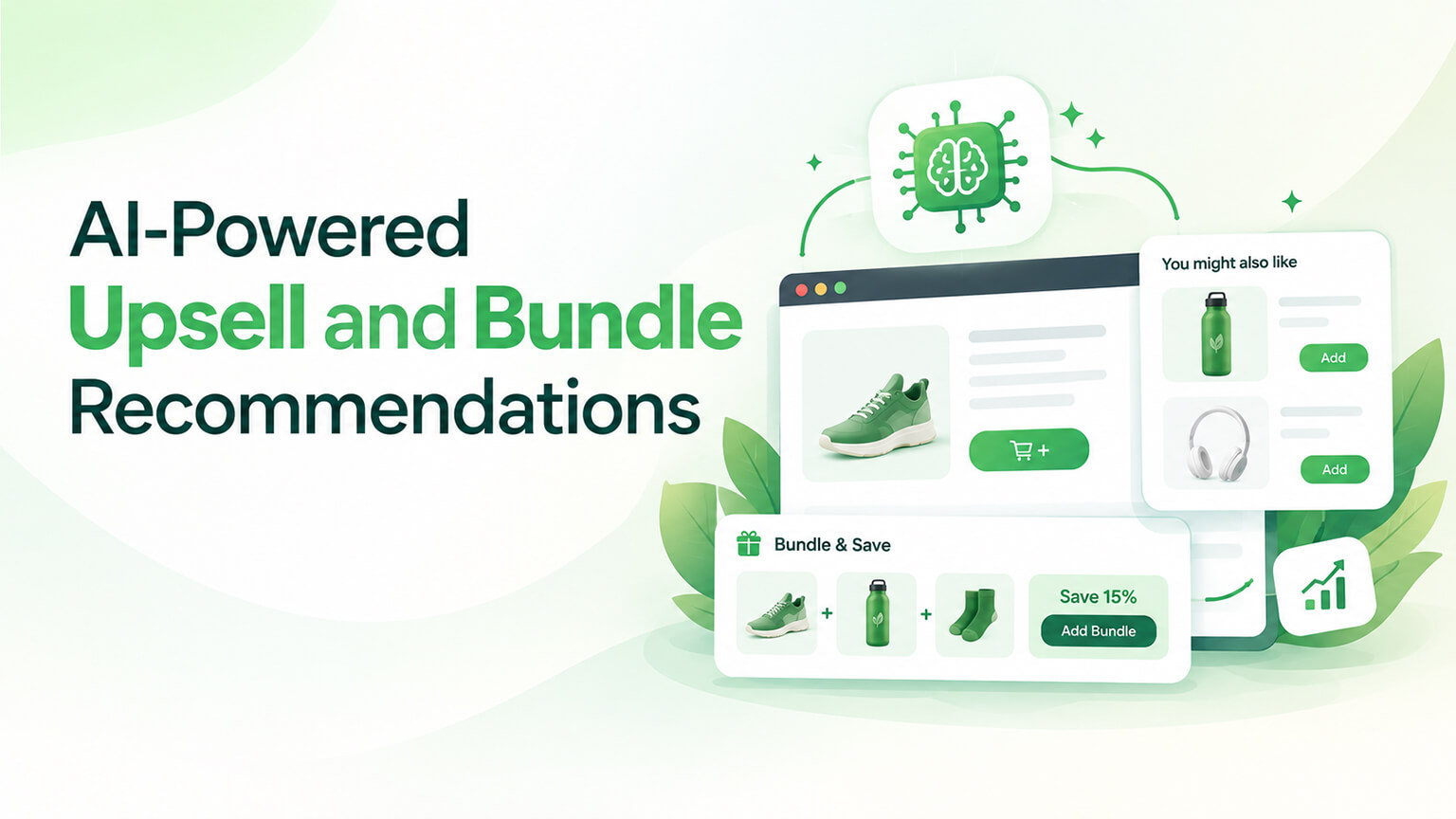
Upselling, cross-selling, and bundling (suggesting relevant additional or higher-value products, or product bundles) are proven ways to increase average order value and revenue (as the AOV discussions cover), but doing them well requires relevant, well-targeted recommendations (suggesting products the customer is likely to want — irrelevant suggestions don’t work and can annoy). AI can power upsell, cross-sell, and bundle recommendations — analysing data (products, purchases, behaviour) to suggest relevant add-ons, complementary products, and bundles, potentially more relevant and effective than manual or rule-based recommendations. AI-powered recommendations can improve AOV and revenue (better recommendations sell more), so understanding how they work and how to use them helps you leverage them. But they must be used well (relevance, experience, not being pushy). This piece covers AI-powered upsell and bundle recommendations: how they work, the benefits, how to use them well, and considerations. (This connects to the AOV and AI discussions; this focuses on AI-powered recommendations.)
This piece covers how AI-powered upsell and bundle recommendations work, their benefits, how to use them well, and key considerations. Because AI can power effective recommendations that increase AOV, and understanding this helps you use them. Let me walk through it.
How AI-powered recommendations work
Let’s cover how AI-powered upsell, cross-sell, and bundle recommendations work. Analysing data — AI analyses data (products and their relationships, customer purchase history and behaviour, what products are bought together, what customers like this one bought), finding patterns that inform recommendations — data analysis (the foundation). Finding relevant products — from the data, AI finds relevant products to recommend (complementary products, frequently-bought-together items, higher-value alternatives, products similar customers bought), identifying what to suggest — relevance (finding relevant products). Personalising recommendations — AI can personalise recommendations to the customer (based on their behaviour, preferences, and context, as the personalisation discussions cover), tailoring suggestions to the individual (more relevant than generic recommendations) — personalisation. Suggesting upsells — AI suggests upsells (higher-value alternatives or upgrades to what the customer is considering), aiming to increase the value of the purchase — upsells. Suggesting cross-sells — AI suggests cross-sells (complementary or related products — “goes well with”), aiming to add items to the order — cross-sells. Suggesting bundles — AI can suggest or inform bundles (products that go well together as a bundle, based on what’s bought together), enabling effective bundling — bundles. Learning and improving — AI learns and improves (from data on what recommendations work — what gets bought — refining its recommendations over time), improving effectiveness — learning. And delivering in context — AI-powered recommendations are delivered in context (on product pages, in cart, post-purchase, via apps that surface recommendations, as the AOV discussions cover), placing suggestions where they work — delivery (in context). So AI-powered recommendations work by analysing data (products, purchases, behaviour), finding relevant products to recommend, personalising to the customer, suggesting upsells (higher-value), cross-sells (complementary), and bundles (products that go together), learning and improving from results, and delivering recommendations in context (product pages, cart, post-purchase). The core is AI analysing data to find and personalise relevant recommendations, delivered where they work — potentially more relevant and effective than manual/rule-based approaches. The next section covers benefits. So AI-powered recommendations analyse data to find and personalise relevant upsells, cross-sells, and bundles, delivered in context and improving over time.
The benefits of AI-powered recommendations
AI-powered recommendations offer benefits over manual or rule-based approaches. More relevant recommendations — AI can produce more relevant recommendations (analysing data and patterns to find what customers actually want, versus manual guesses or simple rules), and relevance is key to recommendations working — relevance (the core benefit). Personalisation — AI can personalise recommendations to each customer (versus generic ones), making suggestions more relevant to the individual (personalised recommendations convert better) — personalisation (a benefit). Scale — AI can generate recommendations at scale (across many products and customers, automatically), versus the effort of manual recommendations (AI scales) — scale. Discovering non-obvious relationships — AI can discover non-obvious product relationships (things bought together you might not expect, patterns in the data), surfacing recommendations you might miss manually — discovery (non-obvious relationships). Higher AOV and revenue — better, more relevant, personalised recommendations sell more (more upsells, cross-sells, and bundles taken), increasing AOV and revenue (the goal) — AOV/revenue (the payoff). Continuous improvement — AI learns and improves (refining recommendations from results), so recommendations get better over time (versus static manual/rule-based ones) — improvement. Efficiency — AI-powered recommendations are efficient (automated, scaling without manual effort per recommendation), saving effort — efficiency. And better customer experience — relevant recommendations can improve the customer experience (helpful suggestions of things customers want, versus irrelevant or no suggestions), when done well — experience (a benefit when relevant). So the benefits of AI-powered recommendations are more relevant recommendations (the core benefit — relevance drives results), personalisation (to each customer), scale (across products and customers), discovering non-obvious relationships, higher AOV and revenue (the payoff), continuous improvement (getting better over time), efficiency (automated), and a better customer experience (when relevant). The key benefits: more relevant, personalised recommendations at scale that increase AOV. But realising these requires using them well (the next section). So AI-powered recommendations offer more relevant, personalised recommendations at scale that increase AOV — improving over time and efficiently. The next section covers using them well. So the benefits are more relevant, personalised recommendations at scale, discovering non-obvious relationships, increasing AOV, improving over time, and efficiency.
How to use AI-powered recommendations well
To realise the benefits, use AI-powered recommendations well. Use quality tools/apps — use quality AI recommendation tools or apps (Shopify apps or platform features that provide AI-powered recommendations, as the apps and AOV discussions cover), since the tool’s quality affects the recommendations — quality tools (choose well). Ensure relevance — ensure recommendations are relevant (the key — relevant suggestions work, irrelevant ones don’t and annoy), monitoring and tuning for relevance — relevance (ensure it). Place recommendations well — place recommendations well (in context — product pages, cart, post-purchase — where they work, as the AOV discussions cover), so they’re seen at the right moments — placement (do it well). Don’t be pushy — don’t be pushy or overwhelming (too many or too aggressive recommendations annoy and hurt experience), keeping recommendations helpful, not pushy — not pushy (balance). Personalise appropriately — personalise recommendations (leveraging AI’s personalisation for relevance), while respecting privacy (as the personalisation and privacy discussions cover) — personalise (appropriately). Test and measure — test and measure recommendations (do they increase AOV? are they working? A/B test them, as the testing discussions cover), optimising based on results — test/measure (do it). Monitor quality — monitor recommendation quality (are they relevant? sensible? not embarrassing or wrong?), since AI can occasionally produce poor recommendations (monitor and correct) — monitor quality. Keep the experience good — keep the customer experience good (recommendations that help, not annoy — relevant, well-placed, not pushy), since experience matters — experience (keep it good). Combine with good merchandising — combine AI recommendations with good merchandising judgment (AI plus your knowledge of your products and customers), for the best results — combine (AI plus judgment). And ensure they fit your brand — ensure recommendations fit your brand and make sense (sensible, on-brand suggestions), avoiding odd or off-brand ones — brand fit. So use AI-powered recommendations well by using quality tools/apps, ensuring relevance (the key), placing recommendations well (in context), not being pushy, personalising appropriately (respecting privacy), testing and measuring (optimising), monitoring quality, keeping the customer experience good, combining AI with good merchandising judgment, and ensuring they fit your brand. The keys are relevance, good placement, not being pushy, testing/measuring, and a good experience. So use recommendations well by ensuring relevance, placing them well, not being pushy, testing them, and keeping the experience good. The next section covers considerations. So use AI recommendations well via quality tools, relevance, good placement, not being pushy, testing, and a good experience.
Key considerations
A few considerations for AI-powered recommendations. Relevance is everything — relevance is the key to recommendations working (relevant suggestions increase AOV, irrelevant ones fail and annoy), so prioritise relevance above all — relevance (the top consideration). Experience over aggressiveness — prioritise the customer experience over aggressive selling (pushy recommendations hurt experience and can backfire), so be helpful, not pushy — experience (over aggressiveness). Data and privacy — AI recommendations use data (purchase, behaviour), so respect privacy and handle data properly (as the privacy discussions cover) — privacy (respect it). Tool/app dependence — AI recommendations often depend on tools/apps (their quality, cost, and fit matter), so choose good tools and factor their cost (as the apps discussions cover) — tools (choose and budget). Measure the impact — measure the actual impact on AOV and revenue (are recommendations working? worth it?), so you know they’re delivering (versus assuming) — measurement (verify impact). Don’t over-automate blindly — don’t over-automate blindly (letting AI recommend without oversight — monitor quality and relevance, keep judgment involved), avoiding poor or odd recommendations — oversight (keep it). Fit your store and products — ensure recommendations fit your store and products (they make sense for what you sell — some stores/products suit recommendations more than others), so they’re appropriate — fit (your store). And it’s one AOV lever — remember recommendations are one lever for AOV (alongside bundling, thresholds, and other tactics, as the AOV discussions cover), part of a broader AOV strategy (not the only tactic) — one lever (context). So key considerations for AI-powered recommendations: relevance is everything (the top priority), prioritise experience over aggressiveness (don’t be pushy), respect data and privacy, mind tool/app dependence (choose and budget), measure the actual impact (verify they work), don’t over-automate blindly (keep oversight), ensure they fit your store and products, and remember they’re one AOV lever among several. The key considerations: relevance and experience above all, measure the impact, and keep oversight. So consider relevance and experience above all, measure impact, keep oversight, and treat recommendations as one AOV lever. So consider that relevance and experience are paramount, measure the impact, keep oversight, and treat recommendations as one lever in your AOV strategy.
A worked example: recommendations on a coffee store
To make this concrete, picture [PLACEHOLDER: Client Name], a store selling coffee beans, brewing equipment, and accessories. Before adding AI-powered recommendations, its product pages showed a generic “you may also like” strip that mostly surfaced whatever was newest — rarely relevant, rarely clicked.
The team added an AI recommendation app and let it analyse purchase history and what customers actually bought together. The patterns it surfaced were useful and, in a few cases, non-obvious. Customers buying a particular pour-over dripper very often bought a specific filter size and a gooseneck kettle within the same or next order — so the app began suggesting those as a cross-sell and, eventually, as a “complete your pour-over setup” bundle. Customers buying a mid-range bag of beans frequently upgraded to the larger, better-value size when it was shown as an upsell on the product page. And customers who bought espresso beans often returned for a descaling product a few weeks later — a relationship the team hadn’t merchandised at all.
Crucially, the team used it well rather than turning everything on and walking away. They kept recommendations to a small, relevant set per page (not a wall of suggestions), placed the bundle prompt on the product page and a single complementary add-on in the cart, and left the checkout uncluttered. They A/B tested the changes and watched AOV, confirming the bundle and the size-upgrade upsell lifted order value while the cart cross-sell added a smaller but real bump. They also monitored quality, quietly suppressing one odd suggestion (the app briefly recommended a gift card as a “complement” to beans, which made no sense).
The result was a measurable AOV increase driven by relevant, well-placed suggestions — and a better experience, because customers were being shown things that fit what they were buying. The lesson mirrors the whole piece: the AI found the relevant relationships and scaled the recommendations, but the humans ensured relevance, restraint, good placement, and measurement — which is what turned the recommendations into revenue rather than clutter.
The bottom line
Upselling, cross-selling, and bundling — suggesting relevant additional or higher-value products, or product bundles — are proven ways to increase average order value and revenue, but doing them well requires relevant, well-targeted recommendations, since irrelevant suggestions don’t work and can annoy customers. AI can power these recommendations by analysing data (products and their relationships, customer purchase history and behaviour, and what products are bought together) to find relevant products, personalising suggestions to each customer, suggesting upsells (higher-value alternatives or upgrades), cross-sells (complementary products), and bundles (products that go well together), learning and improving from results, and delivering recommendations in context (on product pages, in the cart, and post-purchase). The benefits over manual or rule-based approaches are more relevant recommendations (the core benefit — relevance drives results), personalisation to each customer, scale across many products and customers, the discovery of non-obvious product relationships, higher AOV and revenue (the payoff), continuous improvement over time, efficiency, and — when done well — a better customer experience through helpful suggestions. To realise these benefits, use AI-powered recommendations well: use quality recommendation tools or apps, ensure relevance above all (the key), place recommendations well in context, avoid being pushy or overwhelming, personalise appropriately while respecting privacy, test and measure whether they actually increase AOV, monitor recommendation quality (AI can occasionally produce poor or odd suggestions), keep the customer experience good, combine AI with your own merchandising judgment, and ensure recommendations fit your brand. Keep the key considerations in mind: relevance is everything (irrelevant recommendations fail and annoy), prioritise the customer experience over aggressive selling (pushy recommendations backfire), respect data and privacy, mind your dependence on tools and apps (choose good ones and budget for them), measure the actual impact on AOV and revenue rather than assuming it works, don’t over-automate blindly (keep oversight and judgment involved), ensure recommendations fit your store and products, and remember they’re one lever for AOV among several (alongside bundling, thresholds, and other tactics). So use AI to power your upsell, cross-sell, and bundle recommendations — analysing data to make relevant, personalised suggestions at scale that increase order value — but do it well: prioritise relevance and a good customer experience, measure the real impact, keep human oversight, and treat recommendations as one part of a broader AOV strategy. Done well, AI-powered recommendations lift AOV and help customers find products they want; done poorly (irrelevant or pushy), they annoy customers and hurt the experience — so let AI make your recommendations smarter while keeping them relevant, helpful, and measured.
Frequently asked questions
How do AI-powered upsell and bundle recommendations work?
AI analyses data to find and personalise relevant recommendations. It looks at your products and their relationships, customer purchase history and behaviour, and what products are frequently bought together, then finds relevant products to recommend — complementary items, frequently-bought-together products, higher-value alternatives, and products that similar customers bought. It can personalise these suggestions to each customer based on their behaviour and context, making them more relevant than generic recommendations. From that analysis, it suggests upsells (higher-value alternatives or upgrades to what the customer is considering), cross-sells (complementary “goes well with” products), and bundles (products that go together based on what’s bought together), and it learns and improves over time from data on which recommendations actually get bought. These recommendations are delivered in context — on product pages, in the cart, and post-purchase — where they’re most likely to work. The core idea is AI analysing data to make relevant, personalised recommendations at scale, potentially more effective than manual or simple rule-based approaches.
What are the benefits of AI-powered recommendations?
The core benefit is relevance — AI analyses data and patterns to find what customers actually want, rather than relying on manual guesses or simple rules, and relevance is what makes recommendations work. Beyond that, AI can personalise recommendations to each customer (more relevant than generic ones and better at converting), generate recommendations at scale across many products and customers automatically, and discover non-obvious product relationships you might miss manually. Better, more relevant, personalised recommendations sell more — more upsells, cross-sells, and bundles taken — which increases average order value and revenue, the ultimate goal. AI also improves over time by learning from results (versus static manual or rule-based recommendations), is efficient (automated, scaling without manual effort per recommendation), and can improve the customer experience when done well, since relevant suggestions help customers find things they want. The key benefits, in short, are more relevant, personalised recommendations at scale that increase AOV, improve over time, and save effort — provided you use them well.
How do I use AI-powered recommendations well?
Prioritise relevance and the customer experience above all. Use quality recommendation tools or apps (their quality affects the recommendations), and ensure the recommendations are relevant — relevant suggestions increase AOV, while irrelevant ones fail and annoy customers. Place recommendations well in context (product pages, cart, and post-purchase, where they work), and avoid being pushy or overwhelming, since too many or too aggressive recommendations hurt the experience and can backfire. Personalise recommendations to leverage AI’s relevance, while respecting privacy and handling data properly. Test and measure whether recommendations actually increase AOV (A/B test them and optimise based on results), monitor their quality to catch poor or odd suggestions, and keep the customer experience good throughout. Combine AI’s recommendations with your own merchandising judgment (AI plus your knowledge of your products and customers), and ensure recommendations fit your brand and make sense. The keys are relevance, good placement, not being pushy, testing and measuring, and keeping the experience good.
Are AI recommendations worth it, and what should I watch out for?
They can be well worth it — more relevant, personalised recommendations at scale can meaningfully increase average order value — but only if used well, so measure the actual impact rather than assuming. Watch out for a few things. Relevance is everything: irrelevant recommendations don’t just fail to sell, they annoy customers, so prioritise relevance above all. Prioritise the customer experience over aggressive selling — pushy or overwhelming recommendations backfire. Respect data and privacy, since recommendations rely on purchase and behaviour data. Mind your dependence on tools and apps (choose good ones and budget for their cost), and don’t over-automate blindly — keep oversight and monitor quality so AI doesn’t surface poor, odd, or off-brand suggestions. Make sure recommendations fit your store and products (some products and stores suit them more than others), and remember they’re just one lever for AOV among several, alongside bundling, free-shipping thresholds, and other tactics. So verify the real impact on AOV, keep human oversight, prioritise relevance and experience, and treat AI recommendations as one well-measured part of a broader AOV strategy rather than a set-and-forget solution.