
Headless Commerce Architecture Patterns
On this page
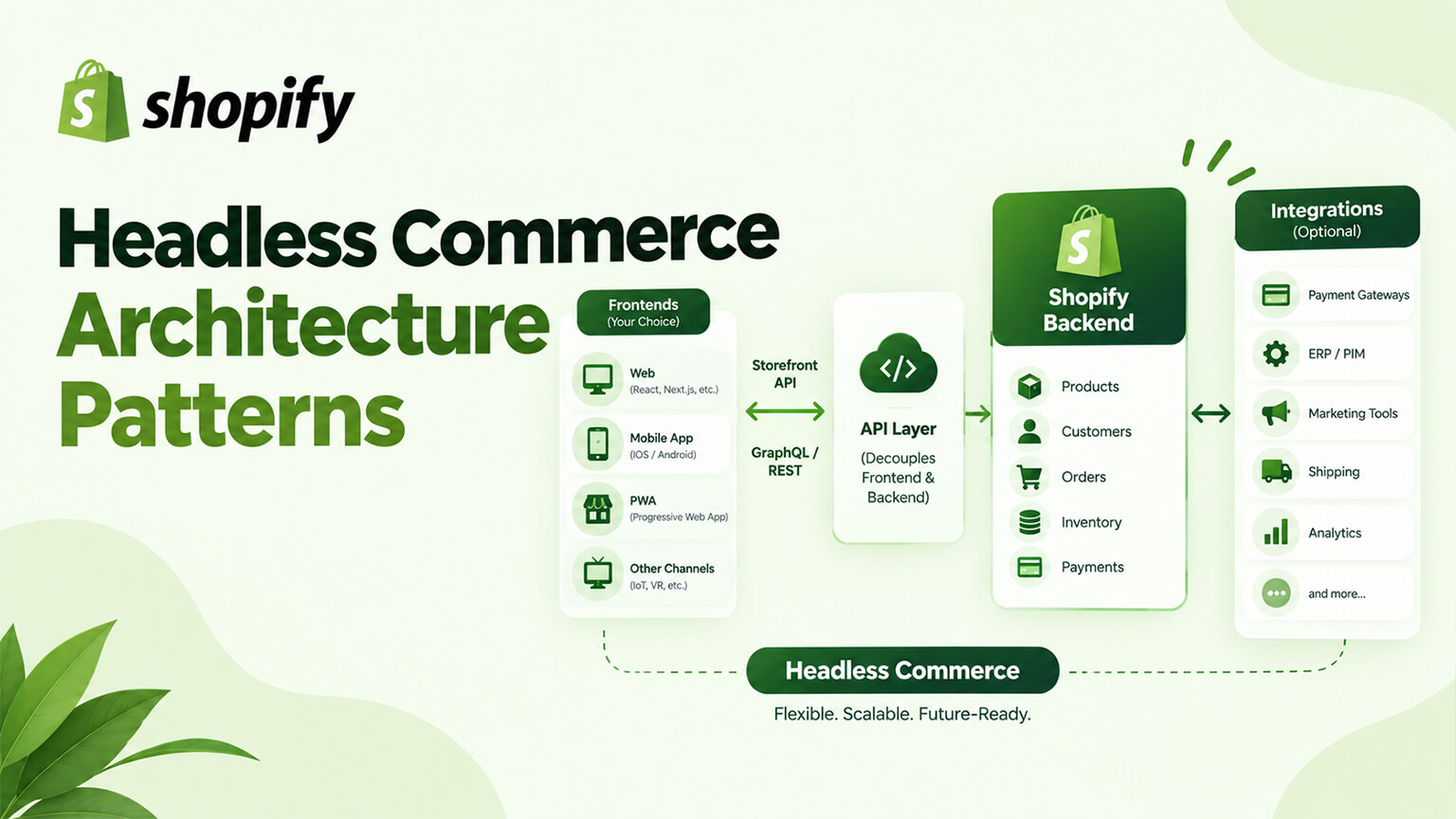
“Headless” is often talked about as a single thing, but headless commerce actually encompasses a range of architecture patterns — different ways of structuring a headless (or partly-headless) commerce setup, with different scopes, trade-offs, and use cases. Understanding these patterns helps you see that headless isn’t all-or-nothing: there’s full headless (a completely custom front-end replacing the theme), hybrid approaches (headless for parts while keeping Shopify’s theme/checkout for others), and various architectural choices within a headless build. Choosing the right pattern for your situation — matching the architecture to your needs, resources, and goals — is part of doing headless well (and part of the headless decision, as the is-headless-worth-it discussion covers). This piece provides an overview of the main headless commerce architecture patterns and their trade-offs, so you can understand the options beyond the binary “headless or not.” (This connects to the is-headless-worth-it and hybrid-headless discussions; this focuses on the architecture patterns. Note: this is a somewhat technical, architectural overview at a conceptual level.)
This piece covers why there are multiple headless patterns (not one), the main patterns (full headless, hybrid, and others), the architectural choices within headless, and how to choose the right pattern. Because headless isn’t one architecture but a range of patterns, and understanding them helps you choose the right approach. Let me walk through it.
Why there are multiple headless patterns (not one)
Headless isn’t a single architecture because there are different ways and degrees of decoupling. Headless is a spectrum, not binary — headless means decoupling the front-end from the back-end (as the what-is-headless discussion covers), but this can be done fully (a completely custom front-end) or partially (headless for some parts, Shopify’s theme for others) — so headless is a spectrum of decoupling, not a single binary state. Different scopes — you can go headless for the whole storefront, or just parts (a headless section, a headless app, headless for specific pages) while keeping the rest on Shopify’s theme — different scopes of headless. Different architectural choices — within a headless build, there are architectural choices (rendering strategies, how much is headless, how checkout is handled, how it integrates, as the caching/ISR, keeping-checkout, and other discussions cover) — so headless builds vary architecturally. Trade-offs drive patterns — the trade-offs of headless (complexity, cost, benefits, as the is-headless-worth-it discussion covers) drive different patterns: full headless (maximum control/benefit but maximum complexity/cost) vs. hybrid (some benefit with less complexity) vs. minimal headless — patterns balancing the trade-offs differently. Different needs and situations — different stores have different needs, resources, and goals, suiting different patterns (full headless for those needing and resourcing it, hybrid for those wanting some benefit with less commitment, etc.) — so patterns match different situations. And it’s not all-or-nothing — crucially, headless isn’t all-or-nothing (as the hybrid-headless discussion covers): you can adopt headless partially (hybrid), getting some benefits with less cost/complexity than full headless — an important realisation (patterns beyond the binary). So there are multiple headless patterns because headless is a spectrum of decoupling (not binary), with different scopes (whole storefront or parts), architectural choices (rendering, checkout, integration), trade-offs driving patterns (full vs. hybrid vs. minimal), and different needs suiting different patterns — so headless isn’t all-or-nothing but a range of patterns. So understand headless as a range of patterns (not one architecture), which the next sections detail. So recognise the patterns beyond “headless or not,” matching the pattern to your situation.
The main patterns: full headless, hybrid, and others
Let’s outline the main headless architecture patterns. Full headless — a completely custom front-end (built with a framework like Next.js or Hydrogen, as those discussions cover) replacing Shopify’s theme entirely, connected to Shopify’s backend via the Storefront API (as that discussion covers), with checkout typically staying on Shopify (as the keeping-checkout discussion covers). This is “full” headless: maximum front-end control and performance potential, but maximum complexity, cost, and responsibility (as the is-headless-worth-it and headless-TCO discussions cover) — for stores needing and resourcing full headless. Hybrid headless — a hybrid approach (as the hybrid-headless discussion covers): headless for some parts (specific pages, sections, or experiences built headless — e.g., a headless landing page or section) while keeping Shopify’s theme for the rest — getting some headless benefits (for the headless parts) with less complexity/cost than full headless (keeping most on the theme). A middle-ground pattern balancing benefit and cost. Headless for specific applications — using headless (the Storefront API) for specific applications or contexts (a mobile app, a specific tool, embedding commerce in a content site, as the Storefront-API discussion covers) while the main store stays on Shopify’s theme — headless for a specific purpose, not the whole store. Progressive/incremental headless — adopting headless progressively (as the headless-roadmap discussion touches on): starting with some headless (a section, a page) and expanding over time, or migrating incrementally — a phased pattern (versus a big-bang full headless). Micro-frontends or composable — more advanced patterns (micro-frontends, composable architectures, as the composable discussion covers) composing the storefront from multiple pieces/services — sophisticated patterns for complex needs (larger, more complex operations). And Shopify’s own headless options — Shopify’s headless offerings (Hydrogen/Oxygen, as those discussions cover, and Shopify’s headless/custom storefront support) provide patterns for building headless within Shopify’s ecosystem. So the main patterns are full headless (complete custom front-end — maximum control/complexity), hybrid headless (headless for some parts, theme for the rest — balancing benefit and cost), headless for specific applications (a specific purpose, not the whole store), progressive/incremental headless (phased adoption), micro-frontends/composable (advanced, for complex needs), and Shopify’s own headless options (Hydrogen/Oxygen). So there’s a range of patterns from full headless to hybrid to specific/progressive approaches — matching different scopes and situations. So consider which pattern fits your needs (not just “full headless or not”). The next section covers the architectural choices within headless.
The architectural choices within headless
Within any headless build, there are architectural choices that shape the specific architecture. Framework — which framework (Next.js, Hydrogen, others, as the Hydrogen-vs-Next discussion covers) — a foundational choice affecting the build. Rendering strategy — the rendering strategies (SSR, SSG, ISR, edge rendering, as the caching/ISR and edge-rendering discussions cover) used for different pages/content — shaping performance and freshness (a key architectural choice, as those discussions cover). Hosting — where and how the front-end is hosted (Oxygen for Hydrogen, Vercel, Cloudflare, other platforms, as the edge-rendering discussion covers) — an infrastructure choice. Data-fetching and API usage — how the front-end fetches data from Shopify (Storefront API usage, caching, as the Storefront-API and caching discussions cover) — shaping data-fetching and performance. Checkout handling — how checkout is handled (typically staying on Shopify, as the keeping-checkout discussion covers) — a key choice (usually keep Shopify’s checkout). CMS integration — whether/how a headless CMS is integrated (for content, as the headless-CMS discussion covers) — a content-architecture choice. State and cart management — how state and the cart are managed (client-side, as the cart discussions touch on) — an application-architecture choice. Integration architecture — how the headless front-end integrates with Shopify and other systems (APIs, webhooks, as those discussions cover) — the integration architecture. And component architecture (RSC etc.) — the component architecture (server/client components with RSC, as that discussion covers, and how the front-end is structured) — shaping the application. So within headless, architectural choices include the framework, rendering strategy, hosting, data-fetching/API usage, checkout handling, CMS integration, state/cart management, integration architecture, and component architecture (RSC) — all shaping the specific headless architecture. These choices (developer/architect decisions, as the headless-team discussion covers) shape how the headless build works and performs. So a headless build involves these architectural choices (beyond the pattern), shaping the specific architecture — decisions your headless team/architect makes (as the headless-team discussion covers). So understand that headless architecture involves these choices, made by your team, shaping the build. The next section covers choosing the right pattern.
How to choose the right pattern
Choosing the right headless pattern (and architecture) for your situation involves matching to your needs, resources, and goals. Assess your needs and goals — assess what you need from headless (front-end control, performance, specific experiences, as the is-headless-worth-it discussion covers) and your goals — since the right pattern depends on what you’re trying to achieve. Assess your resources — assess your resources (development capability, budget, as the headless-team and headless-TCO discussions cover), since patterns vary in resource needs (full headless needs the most; hybrid less) — matching the pattern to what you can resource. Consider full vs. hybrid vs. minimal — consider whether you need full headless (genuine need for full front-end control/performance, and the resources), or whether a hybrid or specific/progressive pattern gets you the benefits you need with less complexity/cost (as the hybrid-headless discussion covers) — often, a hybrid or partial pattern is the better fit (less commitment for the benefit needed) than full headless. Don’t default to full headless — don’t assume headless means full headless: consider the hybrid and partial patterns, which may serve your needs with less cost/complexity (as the hybrid-headless discussion covers) — a key point (patterns beyond full headless). Match the architecture to your needs — within the pattern, make the architectural choices (framework, rendering, hosting, etc.) to fit your needs (performance, content, integration), with your team/architect (as the headless-team discussion covers) — the right architecture for your situation. Consider phasing — consider a phased/progressive approach (starting partial, expanding, as the headless-roadmap discussion touches on), reducing risk and commitment versus a big-bang full headless — often sensible. Get expert architectural input — the pattern and architecture choices benefit from expert input (a headless architect/team, as the headless-team discussion covers), given the technical and consequential nature — helping you choose and build the right architecture. And weigh in the headless decision — the pattern choice is part of the broader headless decision (whether and how to go headless, as the is-headless-worth-it discussion covers) — choosing the pattern that delivers the benefits you need for the cost/complexity you can justify (which might be hybrid, not full). So choose the right pattern by assessing your needs and goals, assessing your resources, considering full vs. hybrid vs. minimal (not defaulting to full headless — hybrid/partial often fits better), matching the architecture to your needs, considering phasing, getting expert architectural input, and weighing it in the headless decision. The keys are matching the pattern to your needs and resources (not defaulting to full headless), considering hybrid/partial patterns (often the better fit), and getting expert architectural input. So choose the headless pattern and architecture that fit your situation — often a hybrid or partial pattern rather than full headless, matched to your needs and resources with expert input. So the right headless pattern is the one matching your needs, resources, and goals — recognising the range of patterns (not just full headless) and choosing accordingly.
A worked example: choosing a pattern instead of defaulting to full headless
Picture a brand attracted to headless for one specific reason: it wants a couple of high-impact, highly-custom landing experiences (a flagship product launch page and an interactive lookbook) that its theme can’t deliver well, and it cares about their performance. The instinct, fed by how headless is usually discussed, is “let’s go headless” — meaning a full rebuild of the entire storefront as a custom front-end. But that would be a huge, expensive, risky undertaking (a full headless build with all its complexity, cost, ongoing maintenance, and SEO risk) to solve what is really a narrow need. Recognising headless as a range of patterns changes the decision. Instead of full headless, the brand adopts a hybrid pattern: it builds just those specific experiences headless (custom, high-performance pages via the Storefront API) while the rest of the store — collections, product pages, cart, checkout — stays on its perfectly-good Shopify theme. It gets exactly the benefit it wanted (custom, fast flagship experiences) at a fraction of the cost, complexity, and risk of full headless, and it keeps all the conveniences of the theme for everything else.
Contrast that with a different brand that needs full front-end control and top performance across its entire storefront, has the development team to build and maintain it, and has weighed the trade-offs — for that brand, full headless may be the right pattern. And a third brand, unsure and wanting to reduce risk, adopts a progressive approach: starting with one headless section and expanding over time only if it proves worthwhile. Three brands, three different correct patterns — full, hybrid, and progressive — each matched to the brand’s actual needs and resources. The lesson is the one that runs through this whole topic: don’t treat “headless” as a single all-or-nothing decision. Identify what you actually need, assess what you can resource, and choose the pattern (often hybrid or partial rather than full) that delivers those benefits at a cost and complexity you can justify. Getting expert architectural input helps, but the mindset shift — from “headless or not” to “which headless pattern” — is what prevents the common, expensive mistake of committing to full headless when a lighter pattern would have served better.
The bottom line
“Headless” is often talked about as a single thing, but headless commerce actually encompasses a range of architecture patterns — different ways and degrees of decoupling the front-end from the back-end, with different scopes, trade-offs, and use cases. Headless is a spectrum, not a binary: you can go fully headless (a completely custom front-end) or partially (headless for some parts while keeping Shopify’s theme for others), with different scopes, architectural choices, and trade-offs driving different patterns — so headless isn’t all-or-nothing. The main patterns are: full headless (a completely custom front-end replacing the theme entirely, connected to Shopify’s backend via the Storefront API with checkout typically staying on Shopify — maximum front-end control and performance potential, but maximum complexity, cost, and responsibility); hybrid headless (headless for some parts, like specific pages or sections, while keeping Shopify’s theme for the rest — getting some headless benefits with less complexity and cost than full headless, a middle-ground); headless for specific applications (using the Storefront API for a specific purpose like a mobile app or embedded commerce, while the main store stays on the theme); progressive/incremental headless (adopting headless in phases rather than a big-bang); micro-frontends or composable architectures (advanced patterns for complex needs); and Shopify’s own headless options (Hydrogen/Oxygen). Within any headless build, architectural choices — the framework, rendering strategy (SSR, SSG, ISR, edge), hosting, data-fetching and API usage, checkout handling (usually keeping Shopify’s), CMS integration, state and cart management, integration architecture, and component architecture (RSC) — shape the specific architecture, and are decisions your headless team or architect makes. Choose the right pattern by assessing your needs and goals (what you need from headless), your resources (development capability, budget — patterns vary in resource needs), and considering full vs. hybrid vs. minimal — crucially, not defaulting to full headless, since a hybrid or partial pattern often serves your needs with less complexity and cost (an important realisation beyond the binary). Match the architecture to your needs within the pattern, consider a phased/progressive approach (reducing risk versus a big-bang), get expert architectural input (given the technical, consequential nature), and weigh the pattern choice as part of the broader headless decision (choosing the pattern delivering the benefits you need for the cost you can justify — which might be hybrid, not full). The keys are matching the pattern to your needs and resources, considering hybrid/partial patterns (often the better fit than full headless), and getting expert architectural input. So understand headless as a range of architecture patterns (not one thing), and choose the pattern and architecture that fit your situation — recognising that for many stores, a hybrid or partial pattern, rather than full headless, is the right way to get the headless benefits they need at a cost and complexity they can justify.
Frequently asked questions
Is headless commerce all-or-nothing?
No — this is a key point. Headless is often talked about as a single, all-or-nothing thing (a completely custom front-end replacing your theme), but it’s actually a spectrum of architecture patterns with different scopes and degrees of decoupling. You can go fully headless (a completely custom front-end), or partially — using headless for some parts (specific pages, sections, or experiences) while keeping Shopify’s theme for the rest (a hybrid approach), or using the Storefront API for a specific application (like a mobile app) while your main store stays on the theme. You can also adopt headless progressively (in phases) rather than all at once. So headless isn’t binary — there’s a range of patterns from full headless to hybrid to specific or partial approaches, each balancing the benefits and the complexity/cost differently. Recognising this matters because for many stores, a hybrid or partial pattern gets them the headless benefits they need with far less complexity and cost than full headless.
What are the main headless architecture patterns?
Several. Full headless is a completely custom front-end (built with a framework like Next.js or Hydrogen) replacing Shopify’s theme entirely, connected to Shopify’s backend via the Storefront API, with checkout typically staying on Shopify — maximum front-end control and performance potential, but maximum complexity, cost, and responsibility. Hybrid headless uses headless for some parts (specific pages or sections) while keeping Shopify’s theme for the rest — getting some benefits with less complexity than full headless, a middle-ground. Headless for specific applications uses the Storefront API for a specific purpose (a mobile app, embedded commerce in a content site) while the main store stays on the theme. Progressive or incremental headless adopts it in phases rather than a big-bang. More advanced patterns include micro-frontends and composable architectures for complex needs. And Shopify’s own options (Hydrogen with Oxygen hosting) provide patterns within its ecosystem. The range means you can match the pattern to your needs rather than defaulting to full headless.
How do I choose the right headless pattern?
Match it to your needs, resources, and goals. Assess what you actually need from headless (front-end control, performance, specific experiences) and your goals, since the right pattern depends on what you’re trying to achieve. Assess your resources (development capability, budget), since patterns vary in what they require — full headless needs the most, hybrid and partial patterns less. Then consider full versus hybrid versus minimal, and crucially don’t default to full headless: a hybrid or partial pattern often serves your needs with far less complexity and cost, so it’s frequently the better fit. Within your chosen pattern, make the architectural choices (framework, rendering strategy, hosting, integration) to suit your needs, consider a phased/progressive approach to reduce risk versus a big-bang, and get expert architectural input given the technical and consequential nature of these decisions. Weigh the pattern choice as part of the broader headless decision — choosing the pattern that delivers the benefits you need at a cost and complexity you can justify.
Is full headless always the best option?
No — full headless is the most powerful pattern (maximum front-end control and performance potential) but also the most complex, costly, and demanding, so it’s the best option only for stores that need that full control and performance and can resource it. For many stores, a hybrid or partial pattern is a better fit: it delivers the specific headless benefits they need (for the parts that benefit from headless) with far less complexity, cost, and risk than a full headless rebuild. For example, a store might build a specific high-performance landing page or section headless while keeping the rest on its theme, or use the Storefront API for a mobile app while the main store stays on the theme — getting targeted benefits without full commitment. So rather than assuming headless means full headless, consider the hybrid and partial patterns, which often serve stores’ needs more sensibly. The right choice is the pattern that delivers the benefits you need at a cost and complexity you can justify — which, for many stores, is not full headless.