
Entity SEO for Ecommerce Brands
On this page
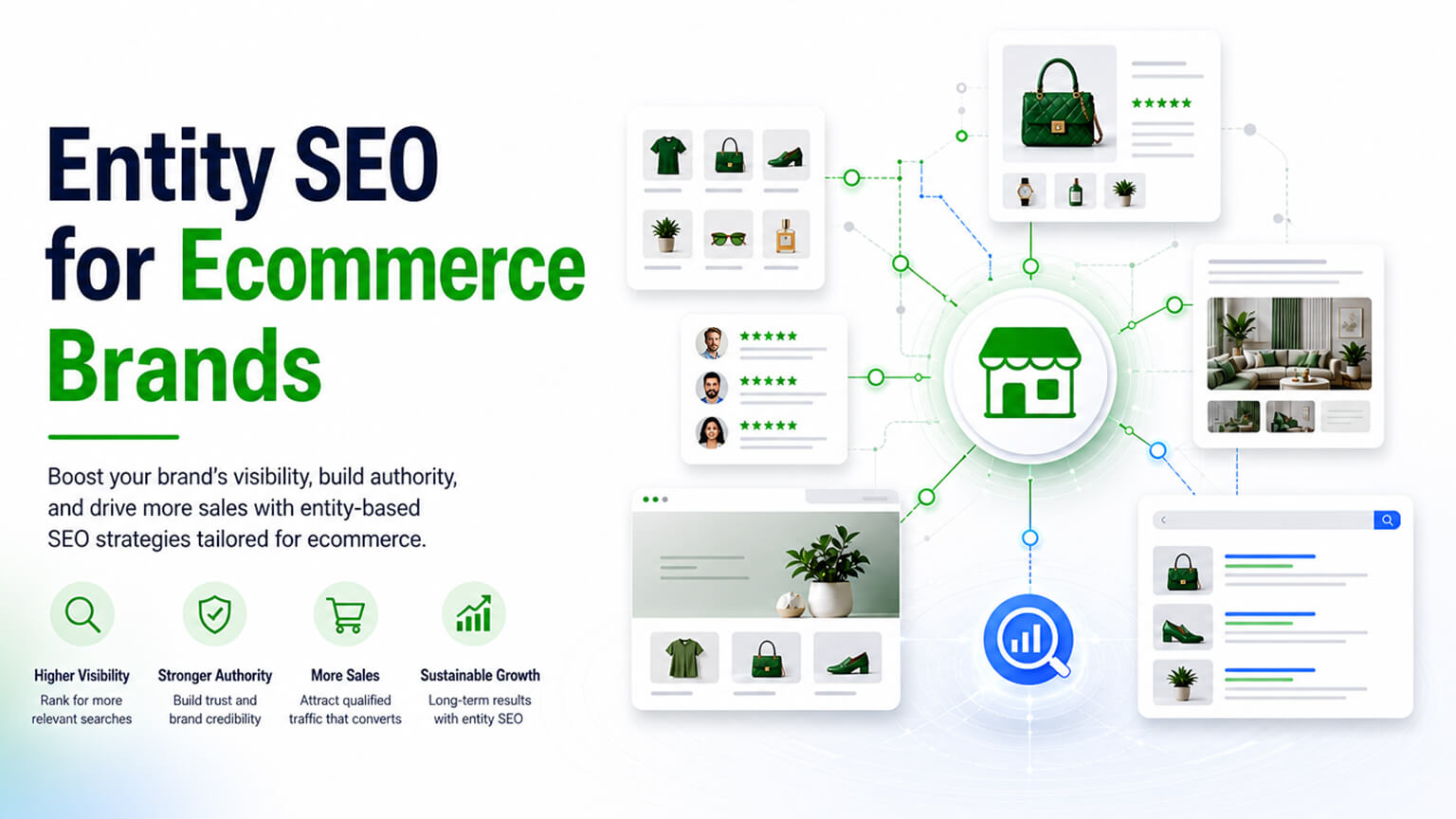
Search has evolved from matching keywords to understanding entities — the real-world things (brands, products, people, places, concepts) that content is about, and how they relate. Modern search engines (and AI engines) increasingly work with a knowledge graph: a map of entities and their relationships, so they understand not just the words on a page but what real-world things it’s about and how those connect. Entity SEO is the practice of helping search and AI engines understand your brand (and your products, and the topics you’re authoritative on) as recognised entities — so you’re understood, trusted, and surfaced as the entity you are, not just as a bag of keywords. For ecommerce brands, entity SEO means building your brand into a recognised, understood entity in the knowledge graph — which supports being surfaced for your brand and topics, being trusted (entity recognition aligns with authority and EEAT, as that discussion covers), and being understood by AI engines (which rely heavily on entities, as the GEO discussion covers). It’s a somewhat advanced, forward-looking SEO concept, but increasingly important as search and AI become entity- and knowledge-graph-driven. This piece explains entity SEO for ecommerce brands and how to build entity recognition. (This connects to the EEAT and GEO discussions, which overlap; this focuses on entity SEO.)
This piece covers what entity SEO is (and the shift from keywords to entities), why it matters for ecommerce brands, how to build entity recognition, and how it connects to EEAT and AI/GEO. Because search and AI are increasingly entity-driven, and building your brand as a recognised entity supports being understood, trusted, and surfaced. Let me walk through it.
What entity SEO is (the shift from keywords to entities)
Let’s understand the shift and the concept. The old model: keywords — traditional SEO focused heavily on keywords: matching the words in queries to the words on pages, optimising for keyword relevance. Search engines matched query words to content words. The new model: entities — modern search (and AI) increasingly works with entities: real-world things (a brand, a product, a person, a place, a concept) that are recognised, understood, and related in a knowledge graph. Search engines aim to understand what a page is about (which entities) and how entities relate, not just match keywords. The knowledge graph — search engines maintain a knowledge graph (Google’s Knowledge Graph is the famous example): a vast map of entities (things) and their relationships (this brand makes these products, this person founded this company, this concept relates to these topics). Being in and understood in this graph is being a recognised entity. What entity SEO is — entity SEO is the practice of helping search and AI engines understand and recognise your brand (and products, topics) as entities in the knowledge graph — so you’re understood as the real-world entity you are (a specific brand, making specific products, authoritative on specific topics), recognised and related correctly, not just matched on keywords. Being understood, not just matched — the goal is being understood (search knows what your brand is, what you do, what you’re authoritative on, how you relate to other entities) rather than merely keyword-matched — a deeper, more robust kind of relevance. So entity SEO is about the shift from keyword-matching to entity-understanding: helping search and AI engines recognise and understand your brand (and products, topics) as entities in the knowledge graph, so you’re understood as the real-world entity you are. It’s a more sophisticated model of relevance (understanding vs. matching), increasingly central as search and AI become entity-driven. So understand entity SEO as building recognised, understood entity presence — which the next sections show why it matters and how to build.
Why it matters for ecommerce brands
Entity SEO matters for ecommerce brands for several forward-looking reasons. Being understood as a brand — when search engines understand your brand as a recognised entity (what you are, what you sell, what you’re known for), they can surface you appropriately for brand and related searches, and present your brand correctly (potentially in knowledge panels, brand results), so entity recognition supports brand visibility and correct representation. Robust relevance — entity understanding is more robust than keyword-matching: if search understands your brand and topics as entities, you’re relevant for related searches and concepts (not just exact keywords), a deeper, more durable relevance as search evolves. Aligns with authority and EEAT — entity SEO aligns with authority and EEAT (as that discussion covers): being a recognised, understood entity (a real, authoritative brand) supports being trusted and surfaced, since search increasingly favours recognised, authoritative entities over anonymous keyword-matchers. Central to AI engines — AI engines rely heavily on entities and knowledge (they understand and reason about entities), so being a recognised, understood entity supports being surfaced and cited by AI (as the GEO discussion covers) — increasingly important as AI search grows. Topical authority — entity SEO connects to topical authority (as that discussion covers): being understood as authoritative on your topics (an entity known for your domain) supports ranking and being surfaced for those topics. And future-proofing — as search and AI become more entity- and knowledge-driven, entity recognition future-proofs your SEO (building durable, understanding-based relevance) versus keyword-only optimisation (more fragile as search evolves). So entity SEO matters because it supports being understood and correctly represented as a brand, provides robust relevance (understanding vs. brittle keyword-matching), aligns with authority and EEAT, is central to being surfaced by AI engines, connects to topical authority, and future-proofs your SEO as search and AI become entity-driven. These are forward-looking but increasingly important benefits. So building entity recognition is worthwhile for ecommerce brands, especially as search and AI evolve toward entity understanding. The next section covers how to build it.
How to build entity recognition
Building entity recognition for your brand involves several practices. Consistent, clear brand information — provide consistent, clear information about your brand across the web (your site, and off-site — consistent NAP, brand details, descriptions), so search engines can understand and recognise your brand consistently (inconsistency confuses entity recognition). Structured data — use structured data (schema, as that discussion covers): Organization schema (describing your brand as an entity — name, logo, description, social profiles, etc.), Product schema, and other relevant schema, explicitly telling search engines about your brand and products as entities. Structured data is a direct way to feed entity understanding. Wikipedia/Wikidata and authoritative references — being referenced in authoritative entity sources (Wikipedia, Wikidata, and other authoritative databases/references, where applicable and legitimate) strongly supports entity recognition (these feed knowledge graphs) — for brands notable enough. Consistent brand presence — build a consistent, authoritative brand presence across the web (your site, social profiles, mentions, references, directories), so your brand is well-represented and recognised as an entity. Being mentioned and cited — being mentioned, referenced, and cited across the web (by other sites, publications, in your industry) builds your brand’s entity presence and authority (entities are recognised partly through their web presence and connections). Clear “about” and brand content — clear about pages, brand information, and content that establishes what your brand is and what you’re authoritative on (as the EEAT discussion covers), helping search understand your brand and expertise. Topical authority content — building topical authority (comprehensive, authoritative content on your topics, as that discussion covers) establishes your brand as an entity authoritative on those topics. And linking your entity presence — connecting your brand’s presence (linking your social profiles, using consistent identifiers, sameAs in schema), helping search connect and consolidate your entity presence. So build entity recognition through consistent clear brand information, structured data (Organization and Product schema — a direct entity signal), authoritative references (Wikipedia/Wikidata where applicable), a consistent authoritative brand presence across the web, being mentioned and cited, clear about/brand content, topical-authority content, and linking your entity presence. These practices help search and AI engines recognise, understand, and trust your brand as an entity. So invest in these — especially structured data (a direct entity signal), a consistent authoritative brand presence, and topical authority — building your brand into a recognised, understood entity. It’s a longer-term, foundational effort (entity recognition builds over time), but increasingly worthwhile. So work on entity recognition as part of your SEO, building durable entity-based relevance.
How it connects to EEAT and AI/GEO
Entity SEO connects closely to EEAT and AI/GEO, reinforcing why it matters. Connection to EEAT — entity SEO and EEAT (Experience, Expertise, Authoritativeness, Trust, as that discussion covers) are deeply connected: being a recognised, understood, authoritative entity is much of what EEAT is about (a trusted, authoritative brand/entity), and the practices overlap (authoritative brand presence, clear brand and expertise information, being referenced/cited, topical authority). So entity SEO and EEAT reinforce each other — building entity recognition builds EEAT, and vice versa. They’re two lenses on the same goal: being a recognised, trusted, authoritative entity. Connection to AI/GEO — entity SEO is central to AI/GEO (being found and cited by AI engines, as that discussion covers): AI engines rely heavily on entities and knowledge (they understand and reason about entities and their relationships), so being a recognised, understood entity is much of what makes you surfaceable and citable by AI. Entity recognition and GEO strongly overlap — building your brand as a recognised entity supports being understood and cited by AI engines. The unified goal — entity SEO, EEAT, and GEO all point to the same underlying goal: being a recognised, understood, trusted, authoritative entity (brand) that search and AI engines understand and favour. They’re interconnected facets of modern, forward-looking SEO — building your brand’s recognised, authoritative entity presence supports traditional SEO (understanding, authority), EEAT (trust, authority), and AI/GEO (being understood and cited by AI) together. So invest in the unified goal — building a recognised, authoritative brand entity — which serves entity SEO, EEAT, and GEO simultaneously. So entity SEO connects to and reinforces EEAT and AI/GEO — all pointing to being a recognised, understood, trusted, authoritative entity — so building entity recognition is a foundational, forward-looking investment serving traditional SEO, EEAT, and AI discoverability together. This interconnection is why entity SEO, though somewhat advanced, is increasingly important: it’s part of the unified modern approach to being understood, trusted, and surfaced across search and AI. So treat entity recognition as part of building your brand’s authority and understanding across search and AI, capturing the compounding benefits.
A worked example: turning a brand into a recognised entity
Picture a mid-sized specialty brand — say, a coffee company — that ranks fine for some product keywords but isn’t really “understood” by search or AI: no knowledge panel, AI engines describe it vaguely or not at all, and it competes purely on keywords against bigger players. An entity-SEO effort changes that over time. They start with the direct signals: Organization schema on the site describing the brand as an entity (name, logo, description, founding, social profiles via sameAs), Product schema on products, and consistent brand information (NAP, description, positioning) everywhere the brand appears online, so the picture is coherent rather than contradictory across sources. They tighten their about and brand content to clearly state what the brand is, what it’s known for, and its expertise (single-origin roasting, say), feeding both entity understanding and EEAT.
Then they build the connective tissue that entities are recognised through: authoritative mentions and references (industry publications, legitimate directories, press), consistent linked social presence, and — as the brand grows notable enough — presence in authoritative entity sources. Alongside, they build topical authority with comprehensive, authoritative content on their domain (brewing, origins, roasting), which establishes the brand as an entity known for those topics. Over months, the effect compounds: search increasingly understands the brand as a specific, authoritative entity (better brand representation, more robust relevance for related searches, and eventually knowledge-panel-style recognition), and AI engines — which lean heavily on entities — start describing and citing the brand accurately when users ask about coffee in its niche. Notice this isn’t a keyword trick; it’s building a coherent, well-referenced, authoritative identity that machines can recognise and trust. And notice that the same work paid off three ways at once — traditional SEO understanding, EEAT/authority, and AI/GEO citability — which is exactly why entity recognition, though slow to build, is such a high-leverage foundation. The lesson: you build an entity by being consistently, verifiably, authoritatively who you say you are, across the web, in ways both humans and machines can parse.
Why this is increasingly urgent with AI
Entity SEO has always mattered somewhat, but the rise of AI search makes it more urgent, which is worth understanding as you decide how much to invest. Traditional search could and did fall back on keyword matching to some degree, so a brand weak on entity recognition could still rank on keywords. AI engines work differently: they understand and reason about entities and their relationships, and when a user asks an AI assistant to recommend or describe products or brands in a category, the AI draws on what it understands as recognised, authoritative entities. A brand the AI doesn’t clearly recognise as a distinct, trustworthy entity in its space is much less likely to be surfaced or cited — it simply isn’t part of the AI’s understood map of who matters in that category. So as more discovery shifts toward AI answers (as the AI-overviews and GEO discussions cover), entity recognition shifts from a nice-to-have toward a prerequisite for being included in AI’s recommendations.
This is why the earlier framing — that entity SEO, EEAT, and GEO all point to the same goal — is so practically important right now. The work of becoming a recognised, authoritative entity is exactly the work that positions a brand to be understood and cited by AI engines, not just ranked by traditional search. For an ecommerce brand, that means entity SEO is no longer only a forward-looking refinement; it’s increasingly part of staying discoverable as the discovery landscape changes. The brands that invest now in coherent brand information, structured data, authoritative presence, and topical authority are building the entity recognition that both traditional search rewards and AI engines depend on. The brands that rely on keyword optimisation alone risk being understood by neither as clearly as they need to be. So treat entity recognition as an increasingly urgent foundation — not because keywords stopped mattering, but because being a recognised, trusted entity is what earns you a place in the entity- and knowledge-driven systems that more and more of search and AI now are.
The bottom line
Search has evolved from matching keywords to understanding entities — the real-world things (brands, products, people, places, concepts) that content is about, mapped with their relationships in a knowledge graph — so modern search and AI engines increasingly understand what content is about (which entities) and how entities relate, not just match query words to page words. Entity SEO is the practice of helping search and AI engines recognise and understand your brand (and products, and the topics you’re authoritative on) as entities in the knowledge graph — so you’re understood as the real-world entity you are, recognised and related correctly, not just keyword-matched. For ecommerce brands, it matters because it supports being understood and correctly represented as a brand (potentially in knowledge panels and brand results), provides more robust relevance than brittle keyword-matching (you’re relevant for related searches and concepts), aligns with authority and EEAT (search favours recognised, authoritative entities), is central to being surfaced and cited by AI engines (which rely heavily on entities, as the GEO discussion covers), connects to topical authority, and future-proofs your SEO as search and AI become entity-driven. Build entity recognition through consistent, clear brand information across the web; structured data (especially Organization and Product schema — a direct entity signal); authoritative references (Wikipedia/Wikidata where applicable and legitimate); a consistent, authoritative brand presence across the web; being mentioned and cited; clear about/brand content establishing what your brand is and what you’re authoritative on; topical-authority content; and linking your entity presence (sameAs, consistent identifiers). It’s a longer-term, foundational effort that builds over time. Crucially, entity SEO connects to and reinforces EEAT and AI/GEO — all three point to the same underlying goal of being a recognised, understood, trusted, authoritative entity that search and AI engines understand and favour — so building entity recognition is a unified, forward-looking investment serving traditional SEO, EEAT, and AI discoverability together. So invest in building your brand into a recognised, authoritative entity — through structured data, consistent authoritative brand presence, topical authority, and the other practices — capturing the compounding benefits across search and AI. As search and AI become increasingly entity- and knowledge-driven, entity recognition is an increasingly important foundation for being understood, trusted, and surfaced.
Frequently asked questions
What is entity SEO?
Entity SEO is the practice of helping search and AI engines recognise and understand your brand — and your products and the topics you’re authoritative on — as entities in the knowledge graph, rather than just matching keywords. It reflects how search has evolved: modern search engines (and AI engines) increasingly work with a knowledge graph, a map of real-world things (entities) and their relationships, so they aim to understand what a page is about (which entities) and how those entities relate, not just match query words to page words. Entity SEO is about being understood as the real-world entity you are — a specific brand, making specific products, authoritative on specific topics, recognised and related correctly — which is a deeper, more robust form of relevance than keyword-matching alone.
Why does entity SEO matter for ecommerce brands?
Because search and AI are increasingly entity-driven, and being a recognised entity supports several important things. It helps search engines understand and correctly represent your brand (potentially in knowledge panels and brand results). It provides more robust relevance than brittle keyword-matching — if search understands your brand and topics as entities, you’re relevant for related searches and concepts, not just exact keywords. It aligns with authority and EEAT, since search favours recognised, authoritative entities over anonymous keyword-matchers. It’s central to being surfaced and cited by AI engines, which rely heavily on entities and knowledge. And it future-proofs your SEO as search and AI continue moving toward entity and knowledge-graph understanding. These are forward-looking but increasingly important benefits for building durable, understanding-based visibility.
How do I build entity recognition for my brand?
Through several practices that help search and AI engines recognise, understand, and trust your brand as an entity. Provide consistent, clear brand information across the web (consistent NAP, brand details, descriptions), since inconsistency confuses entity recognition. Use structured data — especially Organization schema (describing your brand as an entity: name, logo, description, social profiles) and Product schema — which is a direct way to feed entity understanding. Build a consistent, authoritative brand presence across the web (site, social profiles, mentions, references), and be mentioned and cited by other sites and publications. Create clear about and brand content establishing what your brand is and what you’re authoritative on, and build topical authority (comprehensive, authoritative content on your topics). Where applicable and legitimate, being referenced in authoritative entity sources (Wikipedia, Wikidata) strongly supports recognition. And link your entity presence (sameAs in schema, consistent identifiers). It’s a longer-term effort that builds over time.
How does entity SEO relate to EEAT and AI search?
They’re deeply connected — all three point to the same underlying goal of being a recognised, understood, trusted, authoritative entity. Entity SEO and EEAT (Experience, Expertise, Authoritativeness, Trust) overlap heavily: being a recognised, authoritative entity is much of what EEAT is about, and the practices (authoritative brand presence, clear brand and expertise information, being cited, topical authority) reinforce each other. Entity SEO is also central to AI search and GEO (being found and cited by AI engines), because AI engines rely heavily on entities and knowledge — they understand and reason about entities and their relationships — so being a recognised, understood entity is much of what makes you surfaceable and citable by AI. So building entity recognition simultaneously serves traditional SEO (understanding, authority), EEAT (trust, authority), and AI/GEO (being understood and cited by AI) — a unified, forward-looking investment.