
How AI Is Changing Keyword and Content Strategy for Ecommerce
On this page
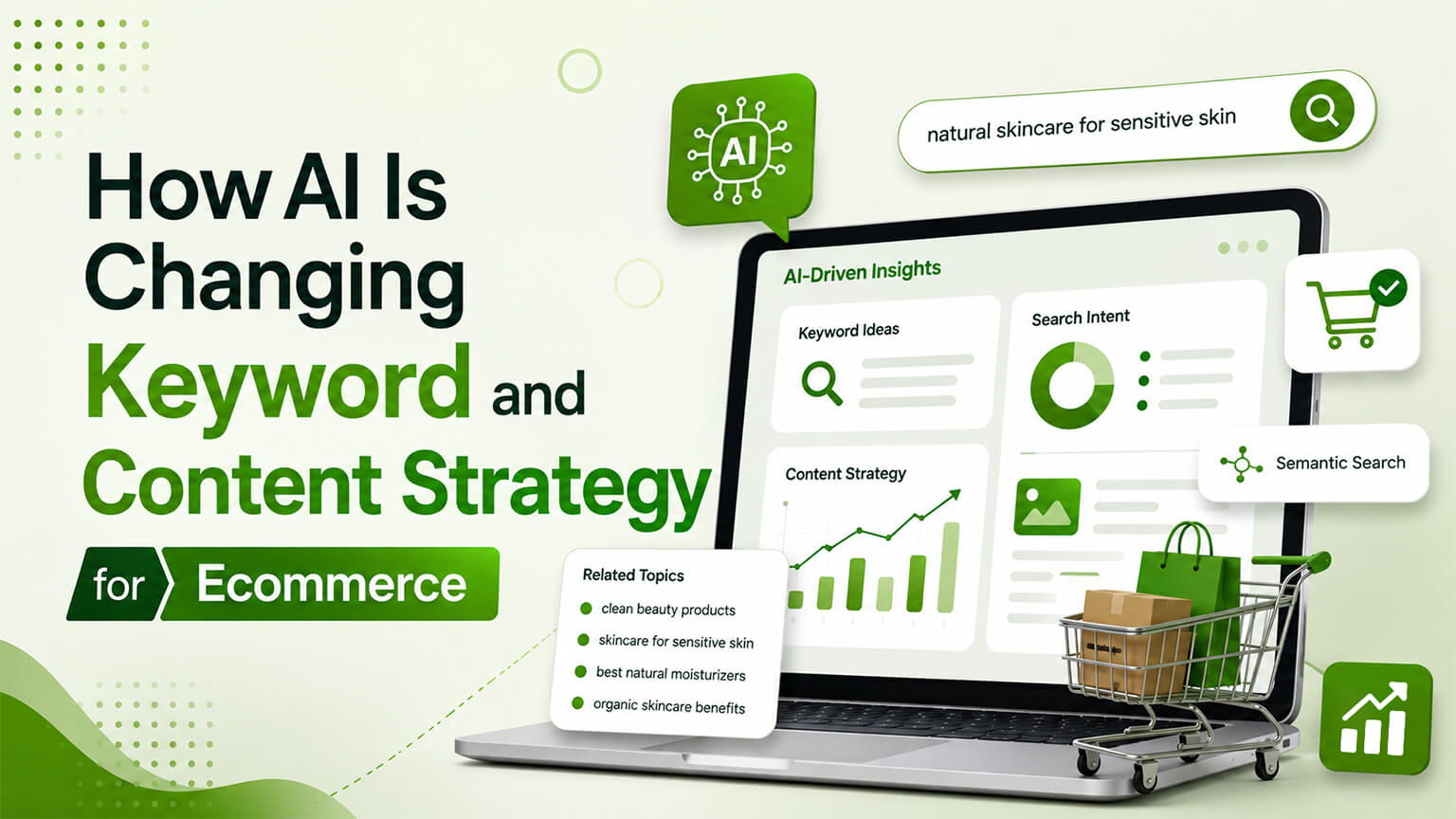
There are two AI revolutions happening to content at the same time, and they pull in opposite directions, which is why this moment feels so confusing for anyone responsible for an ecommerce brand’s content. On one side, AI is changing how content gets discovered — people increasingly find answers through AI tools that summarize and cite rather than through ten blue links. On the other, AI is changing how content gets made — anyone can now generate endless articles in seconds, flooding the web with more content than ever. The first shift raises the bar for what gets surfaced; the second floods the zone with mediocrity. Understanding how these two forces interact is the key to a content strategy that works now rather than one built for 2019.
Let me untangle both shifts and, more importantly, get to what you should actually do, because a lot of the advice flying around is either panic or hype.
Shift one: how content gets discovered
The discovery side is the more consequential change for strategy. For years, the model was: person searches, gets a list of links, clicks one. Increasingly, the model is: person asks a question (often in natural language, sometimes of an AI assistant directly), and gets a synthesized answer that draws from and cites a handful of sources. Google’s own results now often lead with an AI-generated summary; tools like ChatGPT and Perplexity answer directly with citations; and a growing share of research happens in these conversational interfaces rather than traditional search.
The strategic implication is significant. It’s no longer enough to rank in a list — you increasingly need to be one of the sources an AI draws on to build its answer, and there are usually only a few cited sources rather than ten ranked links. This doesn’t kill traditional search overnight (plenty of searching still works the old way, and the AI answers often cite the same authoritative content that ranks well), but it shifts the emphasis. You’re optimizing not just to be found in a list, but to be the clear, trustworthy, citable source an AI reaches for. That changes how you think about keywords and content in concrete ways.
From keywords to questions, intent, and entities
The old keyword model — find the exact phrases people type, optimize pages around those exact strings — was already evolving, and AI accelerates the shift. People increasingly search in natural language and ask full questions, especially when interacting with AI tools, rather than typing terse keyword fragments. So content strategy moves from “rank for this exact phrase” toward “thoroughly answer the questions and intents around this topic, in the language real people use.”
This means a few practical shifts. Think in terms of questions and intent, not just keywords — what does someone actually want to know or do, and how would they phrase it conversationally? Build content that comprehensively addresses topics rather than thin pages each targeting one keyword string. And pay attention to entities — the specific named things in your space (products, brands, materials, standards, techniques) — because AI systems understand the world partly through entities and their relationships, and content that uses the right vocabulary consistently signals genuine authority on a subject. Keyword research doesn’t disappear; it broadens into question research, intent mapping, and topic-and-entity coverage. The brands that adapt think about owning topics and answering questions thoroughly, not chasing exact-match phrases.
Topical authority matters more, not less
A theme that runs through this: AI discovery rewards genuine topical authority — being a thorough, trustworthy source on a subject — even more than the old model did. When an AI is deciding which sources to synthesize and cite, it favors sources that demonstrably cover a topic well and read as credible. A brand with deep, connected, authoritative content on its subject is more likely to be drawn from than one with thin, scattered pages.
So the topic-cluster approach — building a connected body of content that thoroughly covers your area, with a strong cornerstone piece supported by focused articles, all interlinked — becomes more valuable, not less, in an AI world. It signals comprehensive authority to both traditional search and AI systems, and it provides the substantive, well-organized content that AI tools prefer to cite. If anything, AI raises the reward for owning your topic and lowers the payoff for scattered, shallow content chasing individual keywords. The strategic move is depth and authority on the topics that matter to your customers, organized coherently — which, conveniently, is also just good content strategy.
Shift two: how content gets made (and the flood it creates)
Now the other revolution. AI writing tools mean anyone can generate articles, product descriptions, and blog posts at near-zero cost and enormous speed. The predictable result is a flood: more content than ever, much of it generic, fluent, and hollow — the recognizable texture of unedited AI output. The web is filling up with competent-sounding, substanceless content because producing it became almost free.
This matters for your strategy in a counterintuitive way. You might think the response is to use AI to produce content at the same scale, to keep up with the flood. That’s usually a mistake, because you’d just be adding to the ocean of mediocrity that AI discovery is increasingly able to see past. When everyone can generate generic content instantly, generic content becomes worthless — there’s infinite supply and no reason for an AI or a reader to prefer yours. The flood doesn’t reward joining it; it rewards rising above it.
Why authentically human, expert content stands out more now
Here’s the optimistic flip side, and it’s the most important strategic point in this whole piece. As generic AI content floods the web, the value of content that’s clearly the opposite — expert, experience-based, specific, original, trustworthy — goes up, because it’s increasingly rare and increasingly distinguishable from the mass of fluff. Both human readers and AI systems are getting better at telling the difference, and both increasingly favor the substantive over the generic.
This connects to what Google has long emphasized with E-E-A-T — experience, expertise, authoritativeness, trustworthiness — qualities that generic AI content conspicuously lacks. Content that demonstrates real experience (“here’s what actually happened when we did this”), genuine expertise, original insight, specific concrete detail, and credible authorship is exactly what stands out in a sea of AI sameness. So the winning move in the AI era isn’t to out-produce the flood; it’s to make content the flood can’t replicate — drawing on real experience, real data, real opinions, real expertise that an AI generating from training data simply doesn’t have. The bar for “worth surfacing” rises, and clearing it requires the human, expert qualities that became scarcer as generic content became infinite.
So what should you actually do?
Pulling the two shifts together into a strategy: lean into depth, authority, and genuine human value, organized for discoverability. Concretely:
Build genuine topical authority on the subjects your customers care about, through connected, comprehensive content rather than scattered thin pages. Write content that thoroughly answers real questions and intents in natural language, not just targets keyword strings. Make your content unmistakably valuable in the ways AI can’t fake — real experience, specific detail, original insight, credible expertise, accurate information. Structure it so it’s easy for both readers and AI to extract and cite — clear questions answered clearly, good headings, scannable formats, accurate structured data. And use AI as a tool to assist your content creation (research, drafting, editing) while keeping the human expertise, judgment, and originality that make it worth surfacing — not as a machine to mass-produce filler.
This is, notably, not a radical departure from good content strategy. It’s good content strategy with the dials turned toward depth, authority, genuine value, and clean structure — and away from the keyword-chasing, thin-content, volume-over-quality approach that AI has rendered worthless. The fundamentals didn’t change; their relative importance did.
What not to do
Equally important, the traps to avoid. Don’t mass-produce AI content to chase volume — you’ll add to the flood and the flood is worthless. Don’t publish unedited AI output, which is generic, sometimes wrong, and increasingly recognizable as exactly the low-value content that gets passed over. Don’t abandon content entirely out of “AI killed SEO” panic — discovery is shifting, not vanishing, and the brands producing valuable content are positioned to win in both traditional and AI search. Don’t chase exact-match keywords with thin pages, an approach AI discovery sees right through. And don’t believe vendors promising to “rank you in AI” through some trick — the systems reward genuine authority and value, not gaming. The losing strategies are mostly variations on “produce more, cheaper, thinner,” which is precisely what the AI flood has made pointless.
Measuring in an AI world
A practical note on measurement, since it’s harder now. Some AI-driven discovery is hard to attribute — an AI answer that mentions you might drive a branded search or a direct visit later rather than a trackable click. So watch a broader set of signals: traditional organic performance in Search Console, yes, but also branded search growth (people seeking you out after encountering you), referral traffic from AI tools where it’s visible, and overall trends rather than just keyword rankings. And periodically ask the AI tools the questions your customers ask, to see whether your content surfaces. Attribution is messier than the clean keyword-ranking world, so judge your content strategy on broad trajectory and authority signals rather than expecting the tidy metrics of the past. The measurement got fuzzier; the underlying goal — be a valuable, authoritative source — got clearer.
A content workflow that works in this environment
If all this feels abstract, here’s a workflow that puts it into practice. Start with your customers’ real questions and intents — the things they actually want to know before, during, and after buying in your category. Gather these from your support tickets, your sales conversations, the questions people ask in your space, and yes, by asking AI tools the kinds of questions your customers ask and seeing what comes back. That’s your content roadmap: real questions worth answering thoroughly.
Then, for each piece, lead with genuine substance only you can provide — your experience, your data, your specific point of view, the things you’ve actually learned — and use AI as an assistant for the parts it’s good at: research, structuring, drafting sections you then heavily edit, tightening. The human contributes the expertise and originality; the AI contributes speed on the mechanical parts. Edit ruthlessly so the final piece reads as the expert, specific, trustworthy content that stands out, not the generic fluent filler that gets passed over. Structure it cleanly — clear questions answered clearly, good headings, accurate structured data — so both readers and AI can use it. And organize the whole body of content into coherent topic clusters that build authority on your subject.
This workflow scales reasonably without sacrificing the quality that matters, because it uses AI where AI helps and humans where humans are irreplaceable. It’s slower than mass-generating filler and far more valuable, which is exactly the trade the AI era rewards. The brands that win aren’t producing the most content; they’re producing the content most worth surfacing, efficiently enough to keep it up.
The trust dimension: who’s behind the content
A factor that grows in importance as AI floods the web with anonymous, generic content: visible trust and authorship. When anyone can generate plausible-sounding articles, signals that real, credible humans stand behind your content become more valuable — for readers deciding whether to believe you, for Google’s E-E-A-T assessment, and increasingly for AI systems weighing source credibility. That means real author attribution with genuine expertise, an “about” presence that establishes who you are and why you’re credible on your subject, accurate and verifiable information, and the broader trust signals (reviews, transparency, a real business behind the content) that distinguish a legitimate, authoritative source from anonymous AI sludge.
This is why faceless content farms, even sophisticated AI-powered ones, are a weaker bet than they used to be: they lack the trust signals that increasingly determine what gets surfaced and believed. A brand with genuine expertise, credible authorship, and visible trustworthiness has an advantage precisely because those things can’t be conjured from nothing by a content generator. In an environment where content is infinite and trust is scarce, being demonstrably trustworthy is a durable edge — invest in the signals that show real, credible humans stand behind what you publish.
Don’t forget commercial content, not just blog posts
One last strategic point: the AI content shift applies to your commercial pages too, not just your blog. Your product and collection pages — covered in depth elsewhere — are content, and the same principles apply. Generic, duplicated product descriptions are exactly the kind of thin, replicable content that AI discovery passes over and that gives search engines no reason to prefer you. Unique, specific, informative product and category content is what both ranks and gets surfaced by AI product research.
So when you think about content strategy in the AI era, don’t silo it as “the blog.” Your highest-value content opportunities are often your commercial pages, where unique, substantive information serves shoppers, ranks in search, and positions you to be surfaced as AI-driven product discovery grows. The blog builds topical authority and answers questions; the commercial pages capture the buyers — and both reward the same shift toward genuine, specific, trustworthy content over thin or duplicated filler. A complete AI-era content strategy treats the commercial pages as content worth the same care as the blog, because increasingly they’re evaluated by the same systems against the same rising bar.
Quality over cadence
A last reframe worth internalizing, because it overturns an old content-marketing habit. For years the advice was to publish frequently — feed the machine, post weekly, keep the cadence up. In an environment flooded with cheap AI content, that advice has inverted: cadence for its own sake is worthless, and quality is everything. Ten mediocre posts a month add nothing surfaceable; one excellent, authoritative, experience-rich piece that thoroughly owns a topic can do more than all ten combined, for both traditional and AI discovery.
So if you take a practical scheduling lesson from all this, it’s to stop measuring your content program by volume and start measuring it by whether each piece is worth surfacing. Publish less, but make each thing substantially better — deeper, more expert, more specific, more useful than what’s already out there. The brands winning at content in the AI era aren’t the ones publishing the most; they’re the ones publishing things that are actually the best answer available, which is a higher bar that fewer pieces can clear but that pays off far more when they do. Resist the pressure to keep a cadence with filler. A slower stream of excellent, authoritative content beats a firehose of competent mediocrity, now more than ever, because the firehose is exactly what AI has made infinite and worthless.
The bottom line
AI is reshaping content from two directions at once: changing how content is discovered (toward AI answers that synthesize and cite a few trusted sources rather than listing ten links) and how it’s made (flooding the web with cheap, generic, AI-generated filler). The two shifts point to the same strategy. On discovery, move from chasing exact keywords toward thoroughly answering questions and intents, building genuine topical authority, and using the right entities and vocabulary, structured so AI can extract and cite you. On creation, resist the temptation to join the flood with mass-produced AI content; instead, make content the flood can’t replicate — grounded in real experience, expertise, specificity, and trustworthiness, the E-E-A-T qualities that grow more valuable as generic content grows infinite. Use AI to assist, not to author. The fundamentals of good content didn’t change; AI just raised the reward for depth, authority, and genuine human value, and reduced the payoff for thin, generic, keyword-chasing volume to roughly zero. Make things worth surfacing, and you’ll be surfaced — by Google, by AI, and by the humans both are trying to serve.
Frequently asked questions
Is SEO dead because of AI?
No, but it’s shifting. Discovery increasingly happens through AI answers that synthesize and cite a few trusted sources rather than listing ten links, so the emphasis moves from “rank in a list” to “be a clear, authoritative, citable source.” Traditional search still matters, and the content that wins in AI discovery is largely the same authoritative, valuable content that ranks well. The fundamentals didn’t die; their relative importance changed.
Should I use AI to produce more content faster?
Be careful. Mass-producing generic AI content just adds to the flood of cheap, hollow content that AI discovery increasingly sees past — there’s infinite supply of generic content and no reason to prefer yours. Use AI to assist (research, drafting, editing) while keeping the human expertise, experience, and originality that make content worth surfacing. Out-producing the flood is a losing game; rising above it isn’t.
How is keyword strategy changing with AI?
It’s broadening from exact-match phrases toward questions, intent, and topics. People increasingly search in natural language and full questions, especially with AI tools, so the move is to thoroughly answer real questions in the language people use, build genuine topical authority, and use the right entities and vocabulary consistently — rather than optimizing thin pages around individual keyword strings.
Does human-written content still matter in the AI era?
More than ever. As generic AI content floods the web, expert, experience-based, specific, original, trustworthy content becomes rarer and more distinguishable — and both readers and AI systems increasingly favor it. The E-E-A-T qualities (experience, expertise, authoritativeness, trustworthiness) that generic AI output lacks are exactly what stands out and gets surfaced now.