
When NOT to Go Headless
On this page
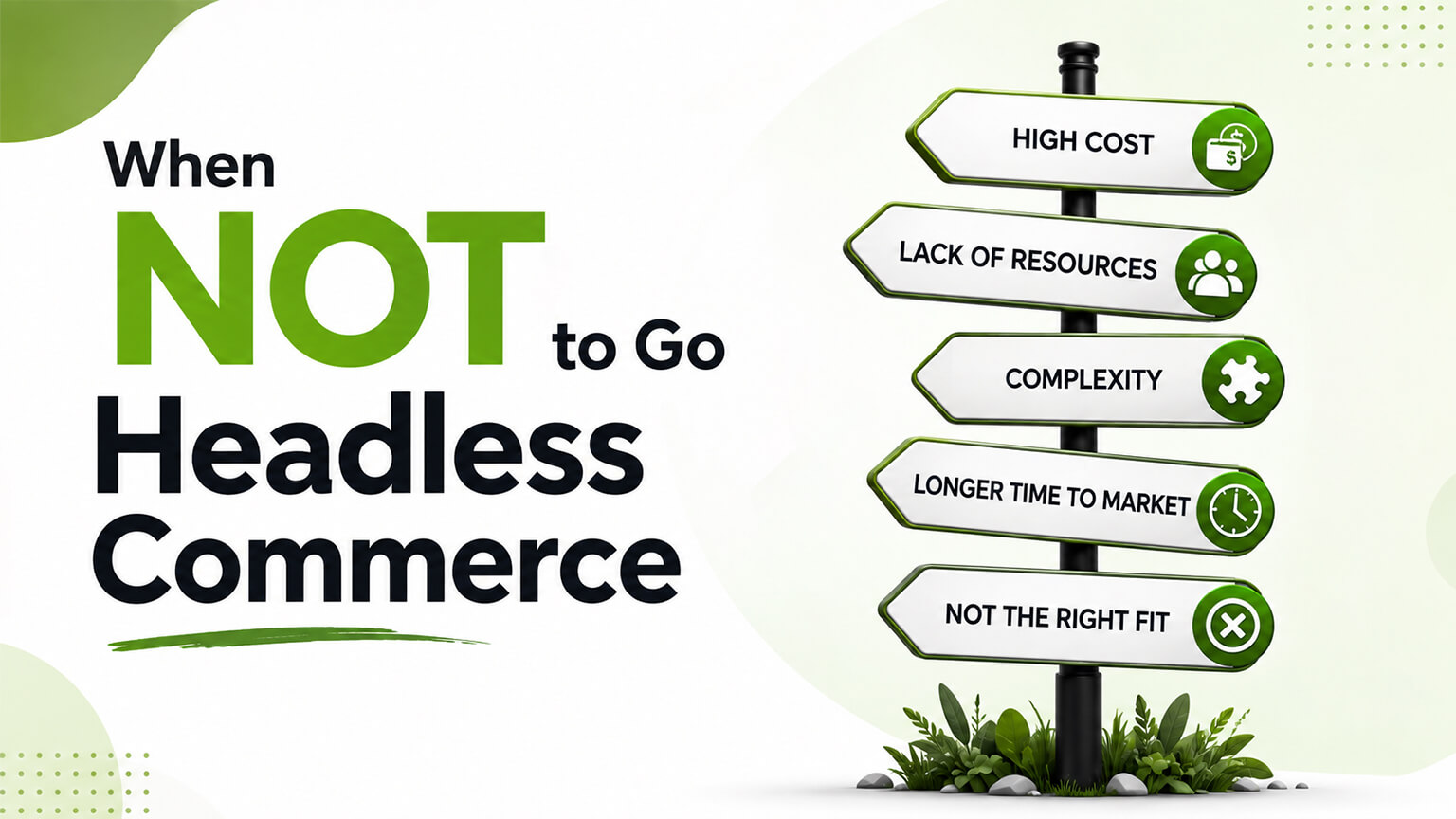
Most articles about headless commerce are written to sell you on headless commerce, which makes sense, because the people who write about it most are the people who build it. This one goes the other way. I think headless is the right choice for a specific, fairly narrow set of stores, and the wrong choice for most of the brands that end up considering it. So instead of “here’s why headless is amazing,” this is “here are the honest signs you shouldn’t, and the bad reasons people talk themselves into it anyway.”
I’m not anti-headless. When it fits, it’s powerful, and I’ve seen it work beautifully. But I’ve also watched brands spend a fortune going headless for reasons that don’t hold up, end up with an expensive, hard-to-maintain storefront, and quietly wish they’d just built a great theme. That outcome is common enough, and avoidable enough, that a contrarian piece feels worth writing.
A quick reminder of what headless is
Briefly, so we’re on the same page. Headless means separating your storefront — the part customers see — from Shopify’s built-in theme layer, and building that front end yourself with a framework like Hydrogen or Next.js, pulling data from Shopify through an API. You keep Shopify’s commerce engine and checkout; you replace the storefront. It can deliver excellent performance and total design flexibility. It also costs a lot more upfront and, crucially, requires ongoing maintenance forever, because you’ve built a custom web application rather than configured a theme.
That last point — the perpetual maintenance — is the thread running through most of the reasons not to do it, so keep it in mind. Headless isn’t a one-time purchase; it’s the adoption of a long-term responsibility. Most of the “don’t” cases come down to taking on that responsibility without the need or the means to carry it.
The bad reasons people go headless
Let me start with the motivations that should give you pause, because recognizing your own reasoning here is the most useful thing this article can do.
“It’s the future / we don’t want to be left behind.” This is fear of missing out dressed up as strategy. Headless being more advanced doesn’t mean it’s right for you, any more than a commercial kitchen’s equipment is right for your home cooking. Plenty of large, successful, sophisticated brands run on themes very deliberately. There’s no prize for being headless, and “everyone’s moving to it” is both not quite true and not a reason. Technology choices should follow needs, not trends.
“We want to be cutting-edge.” Cutting-edge is a cost, not a benefit, unless the edge does something for your customers or your business. A storefront isn’t impressive to shoppers because it’s headless; it’s impressive because it’s fast, beautiful, and easy to use — all of which a great theme can also be. Choosing headless to feel advanced is choosing to pay more and take on maintenance for a feeling.
“We need it to be fast.” This is the most understandable bad reason, because headless can be fast. But here’s the catch: a well-built theme can also be fast, and most stores that “need headless for speed” have never actually optimized a good theme. They’re slow because of app bloat, unoptimized images, and a heavy theme — all fixable without headless. Going headless to fix a speed problem you could fix on a theme is using a sledgehammer to hang a picture, and an expensive sledgehammer you then have to maintain.
“A vendor or agency recommended it.” Consider the incentive. An agency that specializes in headless builds will tend to see headless as the answer, the same way a developer eyeing an interesting project leans toward building. That doesn’t make them dishonest, but it means their recommendation isn’t neutral. A good partner will sometimes tell you that you don’t need headless; be a little wary of one whose recommendation happens to align perfectly with their most lucrative service.
“To future-proof.” Future-proofing is often a way to justify spending now for hypothetical needs later. You can move to headless when you actually have a need that requires it. Building a complex, costly, maintenance-heavy storefront today for requirements you might have someday is usually a worse bet than building well for your real needs now and revisiting if and when those future needs materialize.
The scenarios where you should not go headless
Now the concrete situations. If you recognize your store in these, headless is probably the wrong call, and choosing a great theme instead is good judgment, not settling.
You don’t have ongoing development capacity. This is the big one. If you don’t have an in-house engineering team or a committed agency relationship to maintain a custom storefront indefinitely, do not go headless. A headless build without maintenance capacity decays — dependencies go stale, things break, performance drifts — until you’re facing a costly rescue. The maintenance isn’t optional, and if you can’t sustain it, the whole thing is a mistake from day one.
Your store is small or your needs are simple. If you sell a manageable catalog in a fairly standard way, a theme does everything you need. The flexibility headless offers is flexibility you won’t use, and you’d be paying for and maintaining capability that’s irrelevant to your business. Headless’s benefits scale with complexity and ambition; a simple store gets the costs without the benefits.
Your budget is better spent on growth. For most growing brands, the money a headless build would consume does more good spent on acquiring customers, improving products, and building inventory. A fast, beautiful theme frees that budget up. Sinking it into a custom storefront when you’re still figuring out growth is a misallocation, however nice the storefront would be.
You need to move fast. Headless builds take longer — months for anything substantial — versus weeks to get a great theme live. If time-to-market matters, that delay is a real cost, and a theme gets you selling sooner.
You haven’t actually maxed out a great theme. This deserves its own emphasis below, because it’s the single most common mistake.
You mainly want speed, and your real problem is a neglected theme. As covered above, fix the theme first; you’ll usually find you didn’t need headless at all.
The “you haven’t actually tried a good theme yet” problem
Here’s the pattern I see most, and it’s worth dwelling on. A brand has a slow, cluttered, dated store on a theme that was never properly built or maintained. They conclude the theme model is the problem and that headless is the solution. But they’ve never actually had a great theme — a clean, fast, well-built, properly optimized one. They’re comparing their neglected theme against an idealized headless build, which is not a fair comparison.
In a huge number of these cases, a well-built theme would deliver the performance and experience they think they need headless for, at a fraction of the cost and with none of the ongoing maintenance burden. The honest move, before committing to headless, is to find out what a solid theme can do for you — because the gap between a bad theme and headless is enormous, but the gap between a great theme and headless is much smaller, and often not worth the cost and complexity. Don’t judge the theme model by the worst version of it. Most brands considering headless have never seen the best version of a theme, and seeing it would change their decision.
The maintenance reality, stated plainly
I keep returning to maintenance because it’s the cost that sinks more headless projects than the upfront price ever does, and it’s the one most underweighted in the decision. When you go headless, you own a custom web application. Forever. Frameworks update, dependencies need attention, Shopify’s APIs evolve, things break in ways a managed theme simply doesn’t. Someone has to keep it healthy, indefinitely.
With a theme, a great deal of this is handled for you — the platform updates, the theme framework is maintained, your store keeps working through changes you never see. That managed convenience is worth a lot, and headless trades it away. If you go in thinking of headless as a one-time build, you’ve mispriced it badly. The true cost is the build plus years of upkeep, and the true requirement is the capacity to do that upkeep. A brand that can’t or won’t sustain it ends up with an expensive, slowly-decaying storefront — strictly worse than the maintained theme they left. This single factor disqualifies a lot of the brands that consider headless, and honestly facing it is the most important part of the decision.
The opportunity cost nobody calculates
Beyond the direct cost and maintenance, there’s an opportunity cost that rarely makes it into the decision. The money, time, and engineering attention a headless build consumes are resources not spent elsewhere. The months your team spends building and then maintaining a custom storefront are months not spent on marketing, product, merchandising, customer experience, or the dozens of other things that grow a business.
For most brands, those other things would generate more return than a headless storefront. A modestly better storefront experience (which is often all headless delivers over a great theme) rarely beats the growth you’d get from putting the same resources into acquisition and product. So even when headless would be a marginal improvement on a great theme, the opportunity cost can make it the wrong call — you’re spending heavily on a small storefront gain while neglecting bigger levers. The question isn’t just “would headless be better?” but “is headless the best use of these resources versus everything else I could do with them?” For most stores, it isn’t.
How to tell you’re rationalizing
A gut-check, since the pull toward headless is often emotional. If you find yourself reaching for justifications — “it’s more modern,” “it’ll future-proof us,” “the best brands use it,” “we want the flexibility” (flexibility for what, exactly?) — that vagueness is a tell. Solid reasons to go headless are specific and concrete: “our content strategy requires a separate CMS our theme can’t accommodate,” “performance is a measurable competitive advantage in our category and we’ve maxed out a great theme,” “our multi-brand, multi-region complexity is something a theme can’t handle.” If your reasons sound like the first list (aspirational, vague, trend-following) rather than the second (specific, concrete, need-driven), you’re probably rationalizing a decision you want to make for reasons that won’t survive contact with the maintenance bill. Be honest with yourself about which list your reasons belong to.
The honest minority who should go headless
To be fair, since this is contrarian rather than anti-headless: there is a real set of brands for whom headless is right. Those with genuine, specific needs a theme can’t meet — a content architecture requiring a powerful separate CMS, performance as a true competitive edge already maxed out on a theme, complex multi-brand or international requirements. And, non-negotiably, the budget and the ongoing development capacity to build and maintain it properly. When those conditions hold — and note they usually hold together, in larger and more sophisticated operations — headless is a powerful, justified choice, and done well it’s excellent.
The point of this article isn’t that headless is bad. It’s that the conditions which justify it are more demanding and less common than the hype suggests, and that a lot of brands consider headless for reasons that don’t hold up. If you’re in the genuine minority, go forth and build something great. If you’re being honest and you’re not, a great theme will serve you better, cheaper, and with far less ongoing burden — and choosing it is wisdom, not timidity.
What “a great theme” actually looks like
Since I keep urging you to try a great theme before considering headless, it’s worth being concrete about what that means, because “great theme” is doing a lot of work in this argument and most people picture something far short of it. A great theme isn’t a flashy multipurpose theme loaded with sliders and effects — those are usually slow. It’s a clean, well-built theme (often a quality base, sometimes custom) that’s been properly optimized: images served in modern formats at the right sizes with lazy loading, minimal and deferred third-party scripts, a lean app stack, fast fonts, and a layout that loads its main content quickly and stays stable. It’s built on Shopify’s modern section system so your team can compose pages without a developer. And it’s been performance-tuned to actually hit strong Core Web Vitals on real devices, not just look fine on a fast connection.
A theme like that is fast, flexible, on-brand, and easy to maintain — and most brands have never had one, because their theme was bought cheaply, stuffed with apps, and never optimized. The reason this matters for the headless decision is that the honest comparison isn’t “my current theme versus headless”; it’s “a truly great theme versus headless.” Against a great theme, headless’s advantages shrink to a narrow band that only specific brands need. So before you conclude you need to leave the theme model, make sure you’ve actually experienced the best version of it. Get a great theme built first; you may discover the problem you were trying to solve with headless was really just a neglected theme all along.
Starting on a theme keeps your options open
One more argument for not rushing to headless: starting on (or staying on) a great theme is the more reversible decision, and reversibility is valuable when you’re unsure. If you build a great theme and later develop a genuine, specific need for headless — your content strategy outgrows what the theme can do, your scale and complexity demands it — you can make that move then, from a position of knowledge, with a real need driving it and revenue to fund it. You’ve lost nothing; you got a fast, effective store in the meantime and you go headless when it’s actually justified.
Go headless prematurely, though, and you’ve committed to the cost and the perpetual maintenance before you knew you needed it, and unwinding that is far harder than the other direction. So when you’re unsure whether you need headless — and uncertainty is itself a strong sign you don’t yet — the lower-risk path is the theme. It meets your needs now, keeps your money working on growth, and leaves the headless option open for the day a concrete need appears. Decisions you can reverse cheaply should be made sooner and more freely; decisions that are expensive to reverse, like adopting a maintenance-heavy custom storefront, deserve more caution. Headless is firmly in the second category, which is one more reason to default to the theme until the need for headless is undeniable rather than merely appealing.
The bottom line
Headless is the right call for a narrow set of brands: those with specific needs a theme can’t meet, plus the budget and ongoing development capacity to build and maintain a custom storefront forever. For most brands considering it, it’s the wrong call, and the reasons they’re considering it — it’s the future, we want to be cutting-edge, we need speed, an agency suggested it, to future-proof — don’t survive scrutiny. The most common mistake is judging the theme model by a neglected theme rather than a great one; in a huge share of cases, a well-built, properly optimized theme delivers what brands think they need headless for, without the cost, the delay, or the perpetual maintenance. Before going headless, be honest about whether you have the capacity to maintain it, whether your reasons are specific or aspirational, whether you’ve actually tried a great theme, and whether the resources wouldn’t do more good spent on growth. If after all that headless still fits, do it properly. If you’re rationalizing, a great theme is the smarter, cheaper, more sustainable answer — and there’s no prize for being headless.
Frequently asked questions
Should most stores go headless?
No. Headless suits a narrow set of brands with specific needs a theme can’t meet and the budget and ongoing development capacity to maintain a custom storefront indefinitely. For most stores, a well-built theme delivers what they need at a fraction of the cost and without the perpetual maintenance, and choosing it is good judgment rather than settling.
Isn’t headless necessary for a fast store?
Usually not. A well-built, properly optimized theme can be fast too. Most stores that think they “need headless for speed” are slow because of app bloat, unoptimized images, and a heavy theme — all fixable without headless. Fix the theme first, and run it through PageSpeed Insights before and after; you’ll often find the optimized theme hits the performance you wanted and you didn’t need headless at all, having saved yourself the build cost and the years of maintenance in the process.
What’s the biggest reason not to go headless?
Lack of ongoing development capacity. A headless build is a custom application you must maintain forever — frameworks and dependencies update, APIs evolve, things break. Without an in-house team or committed agency to sustain that upkeep, a headless store decays into an expensive liability that’s worse than the maintained theme you left.
How do I know if I’m going headless for the wrong reasons?
Check whether your reasons are specific and concrete (“our content strategy needs a separate CMS our theme can’t accommodate,” “performance is a measured competitive edge and we’ve maxed out a great theme”) or vague and aspirational (“it’s more modern,” “to future-proof,” “the best brands use it,” “we want flexibility”). Vague, trend-following reasons usually mean you’re rationalizing a decision that won’t survive the maintenance bill.