
Using AI for Fraud Detection on Shopify
On this page
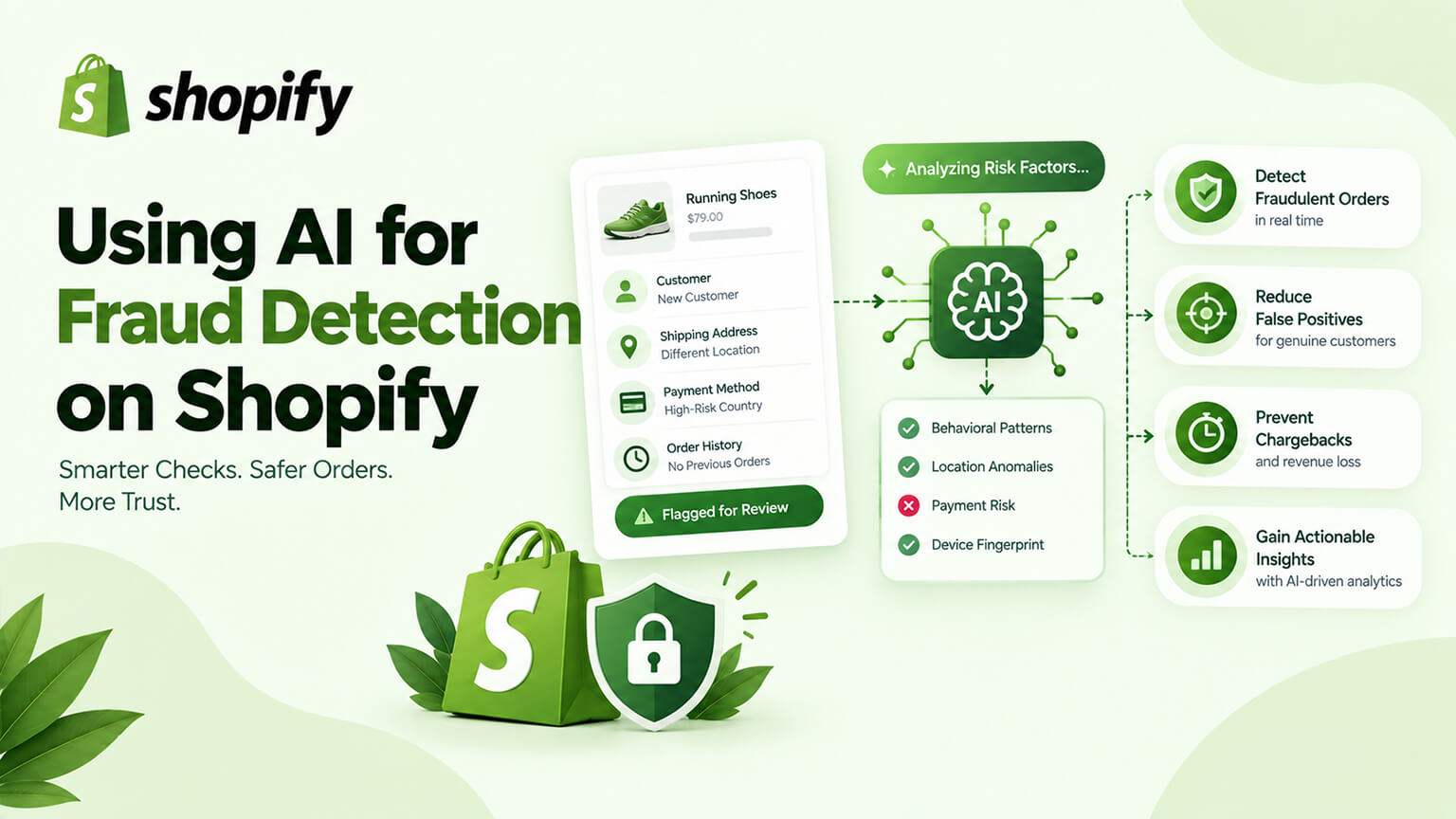
Fraud is a real and costly problem in ecommerce: fraudulent orders (using stolen payment details), chargebacks (where a cardholder disputes a charge, and the merchant often loses the money and the goods, plus fees), and other fraudulent activity cost merchants real money and cause operational headaches. Detecting and preventing fraud — distinguishing legitimate orders from fraudulent ones — is important but hard to do manually at scale (reviewing every order is impractical, and spotting fraud isn’t obvious). This is a strong use case for AI: AI-powered fraud detection analyses orders and signals (payment details, order patterns, behavior, and many data points) to assess fraud risk and flag suspicious orders — at a scale and sophistication that manual review can’t match. Shopify provides fraud analysis (built-in fraud risk assessment, and fraud-related apps/tools, often AI-powered), so Shopify merchants have access to AI-powered fraud detection. Understanding how it works and how to use it sensibly helps you reduce fraud losses while avoiding the pitfalls (like wrongly flagging legitimate orders). This piece covers using AI for fraud detection on Shopify: the fraud problem, how AI fraud detection works, Shopify’s fraud tools, and how to use it sensibly. (This connects to the checkout and AI-for-ecommerce discussions; this focuses on AI fraud detection. Note: Shopify’s fraud features evolve; verify current specifics.)
This piece covers the fraud problem and why it matters, how AI fraud detection works, Shopify’s fraud detection tools, and how to use AI fraud detection sensibly. Because fraud costs real money, AI is well-suited to detecting it, and using it sensibly reduces losses while avoiding pitfalls. Let me walk through it.
The fraud problem and why it matters
Fraud is a real, costly problem in ecommerce worth understanding. Fraudulent orders — fraudsters place orders using stolen payment details (stolen credit cards, compromised accounts), obtaining goods they didn’t pay for legitimately — a direct loss (the goods, and often the money via chargeback). Chargebacks — when a cardholder disputes a charge (including fraud), a chargeback occurs, and the merchant often loses: the money is reversed, the goods are usually gone, and there are chargeback fees — so chargebacks (especially from fraud) are costly (money, goods, fees) and a major fraud impact. Real financial cost — fraud and chargebacks cost merchants real money (lost goods, reversed payments, fees), a significant cost for many ecommerce businesses (fraud is a persistent ecommerce problem). Operational burden — dealing with fraud and chargebacks (reviewing orders, disputing chargebacks, managing the process) is an operational burden, taking time and effort. Hard to detect manually — distinguishing fraudulent from legitimate orders isn’t obvious (fraud can look legitimate), and reviewing every order manually is impractical at scale — so manual fraud detection is hard, limited, and doesn’t scale. Balancing fraud prevention and legitimate orders — there’s a balance: being too lax lets fraud through (losses), while being too strict (flagging/blocking legitimate orders) loses legitimate sales and frustrates good customers (false positives) — so fraud detection must balance catching fraud with not blocking legitimate orders, a real challenge. And it’s a growing/persistent problem — fraud is a persistent and evolving problem (fraudsters adapt), so ongoing fraud detection is needed. So the fraud problem matters because fraudulent orders and chargebacks cost real money (lost goods, reversed payments, fees), impose an operational burden, are hard to detect manually (fraud isn’t obvious, manual review doesn’t scale), require balancing fraud prevention with not blocking legitimate orders, and are persistent and evolving. So fraud detection is important but hard, making AI (which can detect fraud at scale) valuable — which the next section covers. So reducing fraud losses (while not blocking legitimate orders) is a real, valuable goal that AI can help with.
How AI fraud detection works
AI-powered fraud detection analyses data to assess fraud risk, at a scale and sophistication manual review can’t match. Analyses many signals — AI fraud detection analyses many data points and signals about an order: payment details (card, billing), the order (items, value, patterns), the customer (behavior, history, account), the context (IP, location, device, velocity — many orders quickly), address mismatches, and other signals — assessing fraud risk from the combination of signals (far more than a human could weigh). Learns fraud patterns — AI learns patterns associated with fraud (from data on fraudulent vs. legitimate orders), so it can recognise fraud-indicative patterns (combinations of signals that indicate risk) that aren’t obvious, improving detection — learning what fraud looks like from data. Assesses risk and flags — AI assesses each order’s fraud risk (a risk score/level) based on the signals and patterns, flagging suspicious/high-risk orders for review or action (while passing low-risk ones) — so it triages orders by fraud risk, focusing attention on the risky ones. Scale and speed — AI does this at scale and speed (assessing every order automatically, instantly), which manual review can’t (reviewing every order is impractical) — so AI enables fraud assessment on all orders (versus manual review of few). Sophistication — AI’s analysis is more sophisticated than simple rules (weighing many signals, learning patterns), so it detects fraud better than basic rules or manual checks — the sophistication advantage. And it improves over time — AI fraud detection can improve over time (learning from more data, adapting to evolving fraud), staying effective as fraud evolves. So AI fraud detection works by analysing many signals (payment, order, customer, context) to assess fraud risk, learning fraud patterns (recognising non-obvious fraud indicators), assessing and flagging risky orders (triaging by risk), at scale and speed (all orders, instantly), with sophistication (better than simple rules), improving over time. So AI is well-suited to fraud detection (analysing many signals at scale to detect fraud better than manual/rules) — a strong AI use case. So AI fraud detection assesses fraud risk on all orders sophisticatedly, flagging risky ones — the core of AI-powered fraud protection. The next section covers Shopify’s fraud tools.
Shopify’s fraud detection tools
Shopify provides fraud detection tools for merchants (built-in and via apps). Built-in fraud analysis — Shopify includes built-in fraud analysis: for orders, Shopify provides a fraud risk assessment (indicators and a risk level — low/medium/high — based on Shopify’s fraud analysis of the order’s signals), helping you assess order fraud risk (as part of Shopify’s order management) — a built-in AI-informed fraud assessment. Fraud indicators — Shopify’s fraud analysis shows indicators (signals like address mismatches, high-risk characteristics) and a risk level, so you can see why an order is flagged and its risk — informing your review/decision. Shopify Protect (where available) — Shopify offers Shopify Protect (in eligible cases/regions): chargeback protection for eligible orders (Shopify covers eligible fraudulent chargebacks), reducing your fraud/chargeback risk on covered orders — a valuable protection (verify availability/eligibility). Fraud apps — fraud-prevention apps (often AI-powered, from third parties) provide additional/advanced fraud detection and prevention (more sophisticated analysis, automation, chargeback protection), for merchants wanting more than the built-in (weighing the app, as the app discussions cover) — options for enhanced fraud protection. Payment provider fraud tools — payment providers (Shopify Payments, etc.) include fraud tools/analysis (fraud screening at the payment level), adding fraud protection — part of the fraud-detection stack. And integration and automation — fraud tools can integrate with your order management and automate actions (flagging, holding, or cancelling high-risk orders, as the Flow discussion touches on for automation) — enabling automated fraud handling. So Shopify’s fraud detection tools include built-in fraud analysis (risk assessment and indicators per order), Shopify Protect (chargeback protection where available), fraud-prevention apps (advanced AI-powered detection/protection), payment provider fraud tools, and integration/automation — providing merchants AI-powered fraud detection (built-in and enhanced via apps). So Shopify merchants have access to fraud detection (built-in, plus apps and Protect where applicable) — the tools to detect and reduce fraud. So use Shopify’s built-in fraud analysis (and Protect, apps as needed) for fraud detection. The next section covers using it sensibly.
How to use AI fraud detection sensibly
Using AI fraud detection sensibly means reducing fraud while avoiding pitfalls (like blocking legitimate orders). Use the fraud risk assessment — use Shopify’s fraud risk assessment (and any fraud tools) to inform your handling of orders: reviewing or scrutinising high-risk orders (before fulfilling), while processing low-risk ones normally — using the risk assessment to focus attention on risky orders. Don’t blindly auto-reject — don’t blindly auto-reject flagged orders (a high-risk flag isn’t certainty of fraud — some flagged orders are legitimate, false positives): review high-risk orders (the indicators, the order) before deciding, avoiding wrongly rejecting legitimate orders (which loses sales and frustrates good customers) — human judgment on flagged orders. Balance fraud prevention and false positives — balance catching fraud (not fulfilling fraudulent orders) with not blocking legitimate orders (false positives lose sales) — the key balance: use the risk assessment to catch likely fraud while not over-rejecting (which harms legitimate customers and sales) — avoiding both fraud losses and false-positive losses. Review high-risk orders with judgment — review high-risk orders with human judgment (assessing the indicators, the order, sometimes verifying with the customer), deciding based on the evidence (not just the flag) — applying judgment to flagged orders. Use protection where available — use Shopify Protect (chargeback protection) where available/eligible, reducing your fraud/chargeback risk on covered orders — leveraging available protection. Consider apps for more protection — for higher fraud exposure or wanting more, consider fraud-prevention apps (advanced detection, automation, protection), weighing the benefit against cost/complexity — enhancing protection where warranted. Automate sensibly — automate fraud handling sensibly (e.g., auto-holding high-risk orders for review, as the Flow discussion touches on) — but with human review of flagged orders (not auto-rejecting), balancing efficiency and judgment. Keep humans in the loop — keep human judgment in the loop for flagged orders and decisions (AI flags, humans decide, especially for uncertain cases), as with other AI applications (AI assists, humans judge) — avoiding both under- and over-blocking. And monitor and adjust — monitor your fraud and chargebacks and adjust your approach (tools, thresholds, review process) to keep the balance right (catching fraud, not over-blocking) as fraud evolves — ongoing adjustment. So use AI fraud detection sensibly by using the fraud risk assessment to focus on risky orders, not blindly auto-rejecting flagged orders (reviewing them — some are legitimate), balancing fraud prevention with false positives (catching fraud without over-blocking legitimate orders — the key balance), reviewing high-risk orders with human judgment, using protection (Shopify Protect) where available, considering apps for more protection, automating sensibly (with human review), keeping humans in the loop for decisions, and monitoring and adjusting. The keys are using the risk assessment to focus attention, balancing fraud prevention with not blocking legitimate orders (the crucial balance), keeping human judgment on flagged orders, and leveraging available protection. So use AI fraud detection to reduce fraud losses while keeping human judgment on flagged orders and balancing against false positives — reducing fraud without harming legitimate customers and sales. So AI fraud detection, used sensibly (informing human judgment, balancing fraud and false positives, leveraging protection), reduces fraud losses while avoiding the pitfall of blocking legitimate orders.
A worked example: the balance in practice
Picture a store working through a morning’s orders with Shopify’s fraud analysis in hand, and how the sensible balance plays out. Most orders come back low-risk and are fulfilled normally — no reason to slow them down. A handful are flagged medium or high risk, and here the store applies judgment rather than a reflex. One high-risk order shows the classic pattern: billing and shipping addresses in different countries, a rushed high-value order, and a mismatch between the card’s country and the IP location. The store reaches out to verify or, given the strong indicators, declines to fulfil — likely genuine fraud avoided. But another flagged order, on inspection, has an innocent explanation: a customer buying a gift to ship to a friend in another city (address mismatch), with an otherwise clean history and a plausible order. Auto-rejecting that order would have lost a legitimate sale and annoyed a good customer; reviewed with judgment, it’s fulfilled. That’s the crucial balance — using the risk flags to focus attention, but deciding with human judgment rather than blindly blocking everything flagged.
Over time, the store gets the balance right by watching both sides of the ledger: its fraud and chargeback rate (is fraud getting through?) and signs of over-blocking (are legitimate customers complaining about rejected orders?). If chargebacks tick up, it scrutinises more or adds a fraud-prevention app; if it’s rejecting too many legitimate orders, it eases up and reviews more carefully. Where available, it uses Shopify Protect to cover eligible chargebacks, reducing its exposure on covered orders. The result is meaningfully lower fraud losses without a wall that turns away good customers — AI doing the heavy lifting of assessing every order at scale, humans making the judgment calls on the flagged few, and available protection backstopping the rest. That combination — AI triage, human judgment on the balance, and protection where offered — is exactly how to use fraud detection sensibly: it reduces the real cost of fraud while protecting the legitimate customer experience and sales that over-aggressive blocking would sacrifice.
The bottom line
Fraud is a real, costly problem in ecommerce — fraudulent orders (using stolen payment details), chargebacks (where a cardholder disputes a charge and the merchant often loses the money, the goods, and fees), and other fraudulent activity cost merchants real money and impose operational burdens. Detecting and preventing fraud (distinguishing legitimate from fraudulent orders) is important but hard to do manually at scale (fraud isn’t obvious, and reviewing every order is impractical), and it requires balancing catching fraud with not blocking legitimate orders (false positives lose sales and frustrate good customers). This is a strong use case for AI: AI-powered fraud detection analyses many signals about each order (payment details, order patterns, customer behavior, context like IP, location, device, and velocity, address mismatches, and more) to assess fraud risk and flag suspicious orders — learning fraud patterns (recognising non-obvious indicators), triaging orders by risk, at a scale, speed, and sophistication manual review can’t match, and improving over time. Shopify provides fraud detection tools: built-in fraud analysis (a fraud risk assessment with indicators and a risk level per order), Shopify Protect (chargeback protection for eligible orders where available, reducing your fraud/chargeback risk on covered orders), fraud-prevention apps (advanced AI-powered detection and protection for merchants wanting more), payment-provider fraud tools, and integration/automation — giving merchants access to AI-powered fraud detection. Use it sensibly to reduce fraud while avoiding pitfalls: use the fraud risk assessment to focus attention on high-risk orders (reviewing them before fulfilling, processing low-risk ones normally), don’t blindly auto-reject flagged orders (a high-risk flag isn’t certainty — some flagged orders are legitimate, so review them with human judgment before deciding, to avoid wrongly rejecting legitimate orders), balance fraud prevention with false positives (the crucial balance — catch likely fraud without over-blocking legitimate orders, since both fraud losses and false-positive losses hurt), review high-risk orders with judgment (the indicators, the order, sometimes verifying with the customer), use Shopify Protect where available/eligible, consider fraud-prevention apps for higher exposure or more protection, automate sensibly (auto-holding high-risk orders for review, but not auto-rejecting), keep human judgment in the loop for flagged orders and decisions (AI flags, humans decide), and monitor your fraud and chargebacks and adjust your approach as fraud evolves. The keys are using the risk assessment to focus attention, balancing fraud prevention with not blocking legitimate orders, keeping human judgment on flagged orders, and leveraging available protection. Done this way, AI fraud detection reduces your fraud losses while avoiding the pitfall of blocking legitimate orders — using AI’s ability to detect fraud at scale to protect your business, with human judgment ensuring you catch fraud without harming legitimate customers and sales. So leverage Shopify’s AI-powered fraud detection (built-in, plus Protect and apps as warranted) sensibly, balancing fraud prevention with legitimate orders, to reduce the real cost of ecommerce fraud.
Frequently asked questions
How does AI fraud detection work?
AI-powered fraud detection analyses many data points and signals about each order to assess its fraud risk — far more than a human could weigh. It looks at payment details (card, billing), the order itself (items, value, patterns), the customer (behavior, history, account), and the context (IP address, location, device, velocity of orders, address mismatches, and more), assessing fraud risk from the combination of signals. It learns patterns associated with fraud (from data on fraudulent versus legitimate orders), so it recognises fraud-indicative combinations of signals that aren’t obvious to a human. It then assesses each order’s fraud risk (a risk score or level) and flags suspicious, high-risk orders for review or action while passing low-risk ones — triaging orders by risk. Crucially, it does this at scale and speed (assessing every order automatically and instantly), which manual review can’t, and with more sophistication than simple rules, improving over time as it learns from more data and adapts to evolving fraud. This makes AI well-suited to detecting fraud that manual review and basic rules would miss.
What fraud protection does Shopify provide?
Several tools. Shopify includes built-in fraud analysis: for each order, it provides a fraud risk assessment with indicators (signals like address mismatches or high-risk characteristics) and a risk level (typically low, medium, or high), helping you assess order fraud risk as part of order management. Shopify also offers Shopify Protect in eligible cases and regions — chargeback protection for eligible orders, where Shopify covers eligible fraudulent chargebacks, reducing your fraud and chargeback risk on covered orders (verify availability and eligibility). Beyond the built-in tools, third-party fraud-prevention apps (often AI-powered) provide more advanced fraud detection, automation, and protection for merchants wanting more than the built-in analysis, and payment providers (like Shopify Payments) include their own fraud screening. These tools can integrate with your order management and automate actions (like holding high-risk orders for review). Together they give Shopify merchants access to AI-powered fraud detection, from the built-in analysis to enhanced protection via Protect and apps.
Should I automatically reject orders flagged as high-risk?
No — this is an important pitfall to avoid. A high-risk flag indicates elevated fraud risk, but it’s not certainty of fraud: some flagged orders are legitimate (false positives), and automatically rejecting them loses real sales and frustrates good customers. Instead, review high-risk orders with human judgment before deciding — examine the fraud indicators and the order details, and sometimes verify with the customer — then decide based on the evidence rather than the flag alone. The key is balancing fraud prevention (not fulfilling fraudulent orders) with not blocking legitimate orders (false positives), since both fraud losses and false-positive losses hurt your business. So use the risk assessment to focus your attention on the orders that warrant scrutiny, apply human judgment to those flagged orders, and avoid both blindly fulfilling everything (letting fraud through) and blindly rejecting everything flagged (losing legitimate sales). AI flags; humans should make the final call on uncertain cases.
How do I use AI fraud detection without blocking legitimate customers?
Balance is the key. Use the fraud risk assessment to triage — focus your scrutiny on high-risk orders while processing low-risk ones normally — rather than treating every order the same or auto-rejecting flagged ones. Review high-risk orders with human judgment (assessing the indicators and order, sometimes verifying with the customer) before deciding, so you don’t wrongly reject legitimate orders. Aim to catch likely fraud without over-blocking, since being too strict loses legitimate sales and frustrates good customers just as being too lax lets fraud through. Automate sensibly — for example, auto-holding high-risk orders for review rather than auto-rejecting them — keeping human judgment in the loop for the decisions. Use protection like Shopify Protect where available to reduce your chargeback risk, and consider fraud-prevention apps if you have higher exposure. Then monitor your fraud and chargeback rates (and any complaints about wrongly-blocked orders) and adjust your thresholds and process to keep the balance right as fraud evolves. This way, you reduce fraud losses while protecting the legitimate customer experience and sales.