
The AI Tools Worth Using in an Ecommerce Workflow (and the Ones to Skip)
On this page
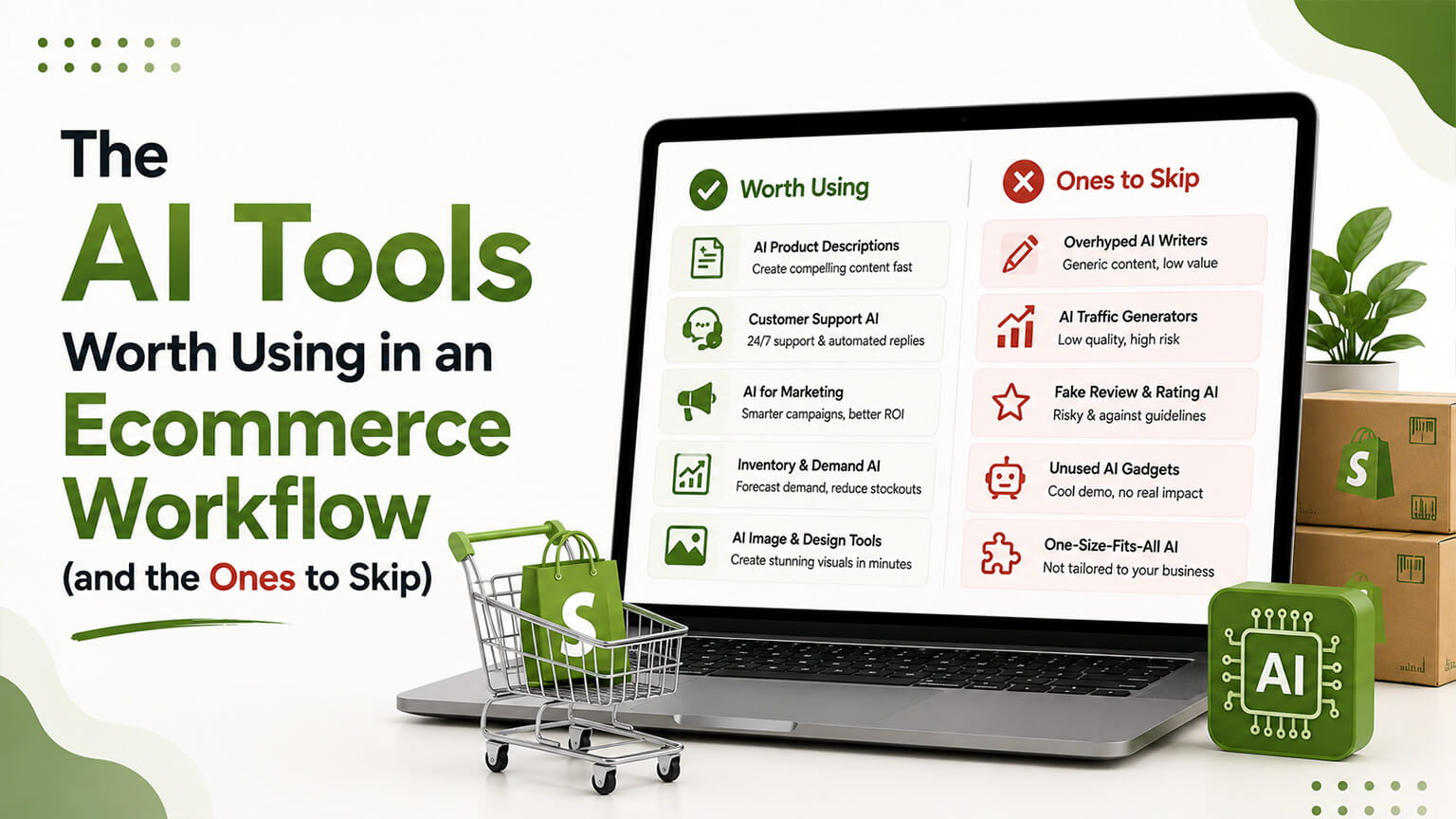
If you run an ecommerce store, you’re being sold AI from every direction — AI for your copy, your support, your personalization, your forecasting, your ads, your everything. Some of it helps. Some of it is the same old functionality with “AI” stapled on for the marketing. And some of it is a tempting trap that wastes money or actively hurts you. After covering specific AI applications across this cluster, this piece pulls it together into a practical, honest guide: which AI tools and applications actually earn their place in an ecommerce workflow, which to skip, and — most usefully — the principles for telling the difference yourself, since the specific tools change constantly but the principles don’t.
I’ll organize this around what’s worth using, what’s overhyped or worth skipping, and the cross-cutting principles that should guide any AI decision. The goal is to leave you able to evaluate the next AI tool you’re pitched, rather than just a snapshot of today’s landscape.
The principle that cuts through the hype
Start with the frame that makes everything else clearer: judge an AI tool by whether it solves a real problem and delivers real value for your business, not by the fact that it’s AI. “AI-powered” is a marketing label, not a benefit — what matters is whether the tool does something useful that improves your outcomes enough to justify its cost and effort. This sounds obvious, but the AI hype constantly tempts people to adopt tools because they’re AI rather than because they solve a real problem, which is how money gets wasted on impressive-sounding tools that don’t move anything.
So for any AI tool, ask: what specific problem does this solve, does it solve it better than the alternative (including not using it), is the value real and ideally measurable, and does it justify the cost and complexity? Tools that pass this test earn their place; tools that don’t — however advanced they sound — should be skipped. Hold this principle and the rest is application: the useful AI tools solve real ecommerce problems with real value, and the skippable ones are AI for AI’s sake, hype with the label doing the work. Let me apply it to the landscape.
What’s worth using
These are the AI applications that consistently earn their place, drawn from across this cluster.
Email and SMS personalization and lifecycle marketing. The most reliable AI-adjacent value, through platforms like Klaviyo, where behavior-based personalization and automated flows drive real repeat revenue. This works because it solves a real problem (engaging customers relevantly at scale) with measurable value, grounded in your first-party data.
AI-assisted content creation — as an assistant, not an author. Using AI to draft and edit content (product descriptions, articles) faster, while humans supply the expertise, voice, and accuracy. Valuable when it accelerates a human process; harmful when used to mass-produce generic filler. The line is assist-not-replace.
Customer support automation — for the routine, with human escalation. AI handling repetitive, factual questions (order status, policies) instantly while routing complex and emotional issues to humans, via tools like Gorgias. Real value (faster answers, less support load) when done with easy human escalation; harmful when it traps customers.
AI-powered search and discovery — for stores with the catalog and traffic to benefit. Smart search that understands intent, and relevant recommendations, for larger catalogs where finding products is a real challenge. Valuable when your shoppers struggle to find things; a gimmick for small catalogs.
CRO research and analysis assistance. Using AI to help analyze data, surface insights, and accelerate conversion research, augmenting human analysis. Useful as a research aid within a disciplined CRO process.
Demand forecasting and inventory — for data-rich stores. AI sharpening demand forecasting from your sales history, for stores with enough data and inventory complexity to benefit, with human judgment layered on. Real value where the data and stakes support it.
AI image generation — used carefully. Generating or assisting with product and lifestyle imagery, where it saves real effort, used carefully and honestly (not misrepresenting products). Useful for supporting imagery and iteration; requires care for accuracy and authenticity.
The thread through all of these: they solve real ecommerce problems with real, often measurable value, they work best grounded in good data, and they keep humans in the loop where judgment matters. That’s the profile of AI worth using.
What’s overhyped or worth skipping
Equally important, the AI applications and pitches to be skeptical of or skip.
Magical “1:1 personalization” platforms for stores without the data. The vision of AI perfectly personalizing for each individual is oversold, and sophisticated personalization platforms deliver little for stores without the data volume to feed them. Skip the expensive magical-personalization promises until you have the data and have proven the basics.
Mass-producing generic AI content. Using AI to churn out volumes of generic content (product descriptions, articles) to chase scale. This adds to the flood of worthless content AI discovery sees past, and can hurt your SEO. Skip the mass-generation; use AI to assist quality content instead.
“AI will rank you in search/AI” guarantees. Vendors promising to game search or AI rankings through some AI trick. The systems reward genuine quality and authority, not gaming; skip the promises of AI-driven ranking shortcuts.
Sophisticated AI tools a small store can’t feed. Advanced AI (personalization, forecasting) sold to small stores that lack the data volume to benefit. The tool needs data to deliver value; without it, you’re paying for capability you can’t use. Skip until you have the data and scale.
AI for AI’s sake. Any tool adopted because it’s AI rather than because it solves a real problem with real value. The most common waste — impressive-sounding tools that don’t move anything. Skip anything that can’t pass the “real problem, real value” test.
The pattern in what to skip: AI that’s oversold (magical promises), AI misapplied (sophisticated tools without the data to feed them), AI used badly (mass-generation), AI as a gaming shortcut (ranking guarantees), and AI for its own sake. None of these delivers real value proportionate to its cost, which is exactly why the “real problem, real value” principle flags them.
The cross-cutting principles
Beyond the specific landscape, a few principles recur across every AI decision in ecommerce, and internalizing them is more durable than any tool list.
AI’s value depends on your data. Most AI applications need good data to deliver value, so data quality and quantity gate what AI can do for you, and small or data-poor stores benefit less from data-hungry AI. Build your data foundation (first-party data, clean and integrated) to make AI useful.
Keep humans in the loop. The best AI applications augment human judgment, not replace it — AI does the data-processing and the routine, humans handle judgment, context, creativity, and what AI can’t see. Over-trusting AI and removing human judgment causes errors; the human-in-the-loop pattern recurs across content, support, personalization, and forecasting.
Start small and prove value. Rather than buying ambitious AI on faith, start with the proven basics, measure real value, and expand from there. This protects against over-buying and reveals what actually works for you. The disciplined path is incremental and evidence-based.
Measure by real value, not by being AI. Hold AI tools to demonstrable improvement on the metrics that matter, not to sounding advanced. If it doesn’t measurably help, it’s not worth it however impressive it is.
These principles — data-dependent, human-in-the-loop, start-small, measure-by-value — are the durable guide. The specific AI tools and capabilities will keep changing, but these principles will keep telling you which to use and which to skip, which is why they matter more than any snapshot of today’s tools.
Building an AI-augmented workflow
Pulling it into practice: the goal is an ecommerce workflow where AI augments your team and automates the routine, freeing humans for the judgment, creativity, and relationship work that matters, without AI overreaching into things it does badly. That means using AI to assist content creation (humans author and edit), automate routine support (humans handle the complex), personalize and market with your data (via your email platform and good data), inform decisions (forecasting, analysis, with human judgment), and handle repetitive tasks (operational automation) — while keeping humans firmly in charge of strategy, judgment, creativity, brand, and the customer relationship.
This balanced, augmented workflow — AI handling the data-processing and the routine, humans handling the judgment and the human — is where AI improves ecommerce operations. It’s neither the AI-skeptic stance of ignoring useful tools, nor the AI-hype stance of replacing humans with AI that does important things badly. It’s the pragmatic middle: use AI where it helps, keep humans where they’re essential, ground it in good data, and measure real value. Built this way, AI is a real and growing advantage in an ecommerce workflow; chased as hype, it’s wasted money and degraded quality.
How to evaluate any AI tool
Finally, a practical checklist for the next AI tool you’re pitched, since new ones appear constantly. What specific, real problem does it solve for my business? Does it solve it better than the alternatives, including not using it? Is the value real and ideally measurable, or just impressive-sounding? Do I have the data and scale for it to deliver value? Does it keep appropriate human oversight, or does it overreach into judgment it can’t handle? Can I start small and prove the value before committing big? And does the value justify the cost and complexity? Run any AI tool through these questions and you’ll separate the ones worth using from the ones to skip, regardless of how the AI landscape evolves. The questions are durable even as the tools change, which is exactly why learning to evaluate AI tools yourself is more valuable than any list of which tools are good today.
A worked example: same tool, opposite outcomes
To show why the “real problem, real value, your data” framing matters, consider the same AI tool adopted by two different stores. A sophisticated AI personalization or forecasting tool is pitched to both. Store A is a large, established brand with years of clean data, high traffic, many SKUs, and a real problem the tool addresses — they have the data to feed it, the scale where its improvements are meaningful, and the team to apply judgment on top. For Store A, the tool delivers genuine, measurable value: better personalization or sharper forecasts that improve real outcomes. It was worth adopting.
Store B is a small, newer brand with little data, modest traffic, and a simple operation. The same tool is sold to them with the same impressive pitch. But Store B lacks the data to feed it, the scale where its improvements would matter, and a real problem it solves — their situation is manageable without it. For Store B, the tool delivers little, costs money and complexity they can’t justify, and solves a problem they don’t really have. The same “AI-powered” tool that was a smart investment for Store A is a waste for Store B, and the difference is entirely whether the store had the real problem, the data, and the scale for the tool to deliver value.
This is the whole point of evaluating AI by real value rather than by the label. The tool’s marketing is identical for both stores; its actual value is opposite, depending on the store’s situation. A buyer dazzled by the “AI-powered” pitch can’t tell the difference; a buyer applying the “real problem, real value, my data and scale” test can immediately. So the same AI tool is worth using or worth skipping depending on your specific situation — which is exactly why the durable skill is evaluating tools against your own reality, not trusting that “AI” means “good for me.” Store A and Store B both got pitched the same thing; only one should have bought it, and the framework is what tells you which one you are.
Don’t let either AI fear or AI hype decide for you
Two opposite emotional reactions distort AI decisions, and both should be resisted in favor of the clear-eyed evaluation this article argues for. AI hype — the breathless sense that AI is transformative and you’ll be left behind without it — drives over-adoption: buying tools because they’re AI, chasing every new capability, replacing humans with AI that does important things badly, all from a fear of missing out rather than a real assessment of value. AI fear or skepticism — the reflexive dismissal of AI as overhyped nonsense — drives the opposite error: ignoring useful tools that would help, out of cynicism rather than evaluation.
Both reactions substitute emotion for analysis, and both lead to worse decisions than the pragmatic middle. The hype-driven over-adopter wastes money on AI that doesn’t help and degrades quality by over-trusting it; the fear-driven skeptic misses real advantages competitors capture. The clear-eyed approach — judging each AI application by whether it solves a real problem with real value for your specific situation, keeping humans in the loop, grounding it in your data, starting small and measuring — avoids both errors. It uses the useful AI (so you don’t fall behind) while skipping the hype (so you don’t waste money or degrade quality). So don’t let either the excitement or the cynicism decide for you; evaluate. The brands that get the most from AI are neither the breathless adopters nor the reflexive skeptics, but the pragmatists who soberly assess each application against real value and adopt accordingly. That sober assessment, not enthusiasm or dismissal, is what turns AI from hype or threat into the real, bounded advantage it actually is for ecommerce.
The bottom line
AI is everywhere in ecommerce, much of it useful and much of it hype, and the durable skill is telling them apart by judging tools on whether they solve a real problem with real value — not on being AI. The worthwhile applications solve real problems with measurable value, grounded in good data, with humans in the loop: email/SMS personalization and lifecycle marketing, AI-assisted (not AI-authored) content, support automation for the routine with human escalation, search and discovery for large catalogs, CRO research assistance, demand forecasting for data-rich stores, and careful AI image generation. The applications to skip are the overhyped (magical 1:1 personalization promises), the misapplied (data-hungry AI sold to stores without the data), the harmful (mass-produced generic content), the gaming shortcuts (AI ranking guarantees), and anything adopted for its own sake. Across all of it, the cross-cutting principles hold: AI’s value depends on your data, keep humans in the loop, start small and prove value, and measure by real outcomes not by sounding advanced. Build an AI-augmented workflow where AI handles the data-processing and the routine while humans keep charge of judgment, creativity, and relationships — the pragmatic middle between ignoring useful AI and over-trusting it. And evaluate every new AI tool against whether it solves a real problem with real value you can justify, because the tools will keep changing but those questions won’t. Use AI where it helps, skip it where it’s hype, and you’ll get the real advantage AI offers ecommerce without the wasted money and degraded quality that chasing the hype produces.
Frequently asked questions
How do I tell which AI tools are actually worth using?
Judge them by whether they solve a real problem and deliver real, ideally measurable value for your business — not by the fact that they’re AI. For any tool, ask what specific problem it solves, whether it solves it better than the alternatives (including not using it), whether the value is real or just impressive-sounding, whether you have the data and scale for it to work, and whether the value justifies the cost. Tools that pass earn their place; those that don’t, however advanced they sound, should be skipped.
What AI applications help ecommerce stores?
The ones solving real problems with real value, grounded in good data, with humans in the loop: email and SMS personalization and lifecycle marketing (via platforms like Klaviyo), AI-assisted content creation (as an assistant, not an author), support automation for routine questions with easy human escalation, search and discovery for large catalogs, CRO research assistance, demand forecasting for data-rich stores, and careful AI image generation. These augment human work rather than replacing judgment, and deliver measurable value where the data and scale support them.
What AI tools should I be skeptical of?
Magical “1:1 personalization” promises for stores without the data to feed them, mass-production of generic AI content (which adds to worthless content and can hurt SEO), “AI will rank you” guarantees (the systems reward genuine quality, not gaming), sophisticated data-hungry tools sold to small stores that can’t feed them, and anything adopted because it’s AI rather than because it solves a real problem. The common thread is AI that’s oversold, misapplied, used badly, or adopted for its own sake — none delivering real value proportionate to its cost.
What principles should guide my AI decisions?
Four durable ones: AI’s value depends on your data (so data quality and quantity gate what AI can do, and a strong first-party data foundation makes AI useful); keep humans in the loop (AI augments judgment, it doesn’t replace it); start small and prove value before expanding (rather than buying ambitious AI on faith); and measure by real outcomes, not by sounding advanced. These principles outlast any specific tool, so they’re more valuable than a snapshot of which tools are good today — they’ll keep telling you which AI to use and which to skip as the landscape changes. That durability matters because the AI landscape changes fast: the specific tools, capabilities, and pitches you’ll face in a year will differ from today’s, but a tool that doesn’t solve a real problem, that you lack the data to feed, that overreaches past human judgment, or that you can’t measure real value from will still be one to skip, whatever it’s called. Learn to evaluate, not just to recognize today’s good tools, and you’re equipped for whatever the next wave of AI products brings.