
Shopify vs Salesforce Commerce Cloud
On this page
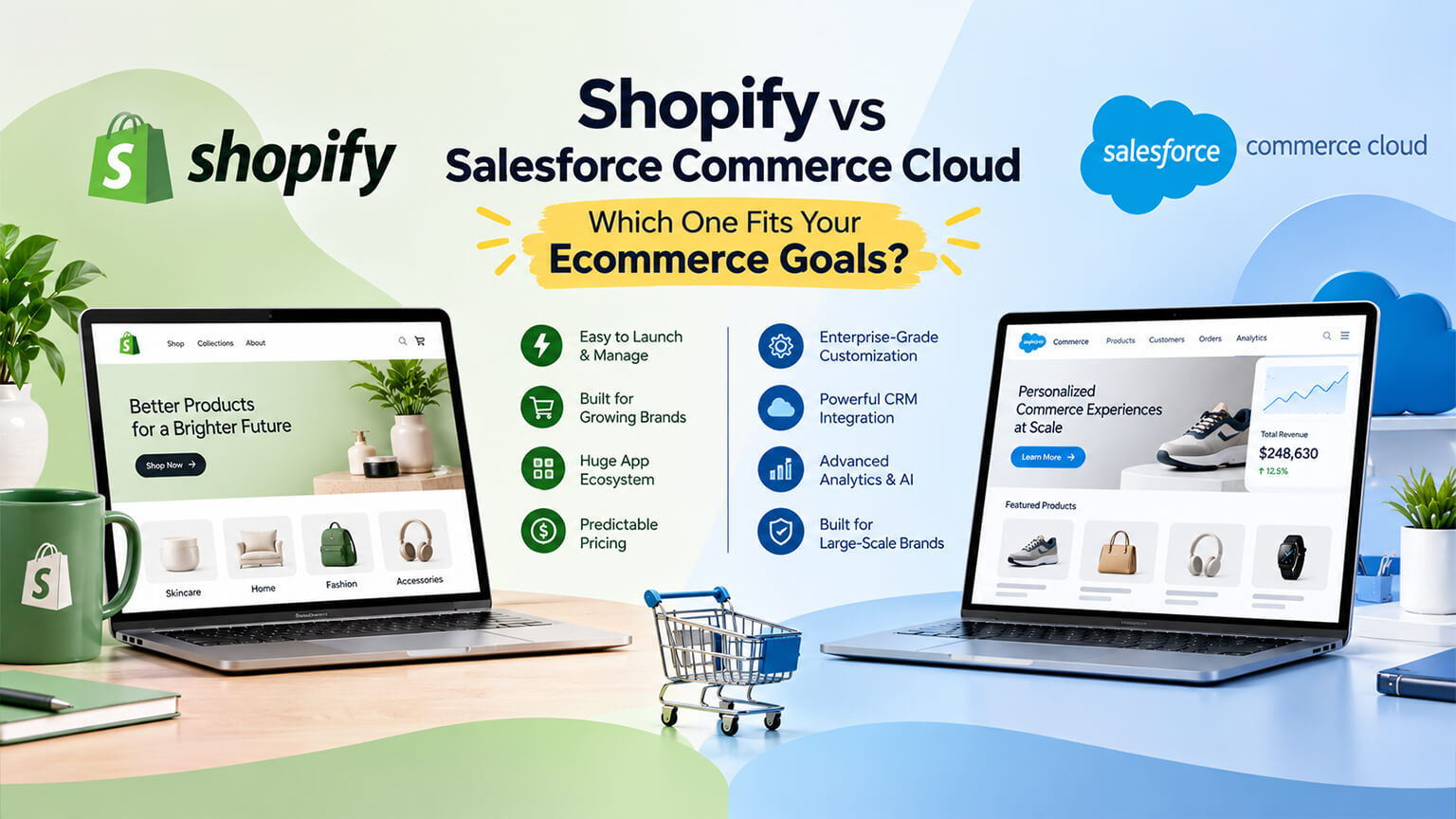
This comparison comes up in a specific situation: you are an established retailer, probably running Salesforce Commerce Cloud already, and somebody has asked whether Shopify Plus could do the job for considerably less money. Or you are choosing an enterprise platform for the first time and these two are on the shortlist.
Either way, the honest answer is that these platforms are aimed at different kinds of enterprise, and the number of retailers for whom Commerce Cloud is clearly correct is smaller than it was five years ago — while remaining real.
What each one actually is
Salesforce Commerce Cloud — still widely called Demandware, its name before Salesforce acquired it — is an enterprise commerce platform built for large, complex retail operations. Its heritage is traditional retail: multi-brand, multi-region, deep merchandising, sophisticated promotions, and integration into a wider Salesforce estate covering CRM, service, and marketing. It is sold on enterprise contracts, typically with revenue-share pricing, and implemented by specialist partners over long engagements.
Shopify Plus is Shopify’s enterprise tier. The same hosted platform most of the internet’s DTC brands run on, with checkout customisation, Shopify Functions, native B2B, expansion stores, higher API limits, and enterprise support layered on top.
The philosophical difference matters. Commerce Cloud assumes you have a large team and complex requirements, and gives you a deep, configurable system to express them. Shopify Plus assumes you want to move fast with a smaller team, and gives you a constrained but highly polished platform that handles the hard parts for you.
Where Commerce Cloud wins
Let me be fair before the economics, because there are real reasons it exists.
Deep merchandising and promotions. Commerce Cloud’s merchandising tooling is more sophisticated than Shopify’s out of the box — complex campaign logic, sophisticated product sorting and ranking rules, extensive A/B infrastructure, and promotion structures that would require Functions or apps on Shopify.
Multi-brand, multi-region complexity at depth. If you operate many storefronts across many markets with shared catalogues, differing assortments, and localised merchandising, Commerce Cloud’s architecture was designed for exactly that. Shopify handles it with expansion stores and Markets, which works well but is a different model.
The Salesforce ecosystem. This is the strongest structural argument. If you already run Salesforce CRM, Service Cloud, and Marketing Cloud, Commerce Cloud sits inside that estate with shared data and unified customer records. That integration is real and it is hard to replicate by connecting separate systems.
Enterprise procurement comfort. Large organisations with established vendor relationships, security review processes, and contractual expectations often find Salesforce a smoother institutional fit than a platform whose core market is DTC brands.
B2B and complex commerce models. Commerce Cloud’s B2B capability is mature, and for the most elaborate account hierarchies and approval workflows it remains strong.
Where Shopify Plus wins
Total cost of ownership, and it is not close. This is the main reason retailers move. Commerce Cloud’s licensing typically involves revenue share, and implementation is a major specialist project — frequently a seven-figure programme when you count the partner engagement. Ongoing change requires specialist developers who are scarce and expensive. Shopify Plus costs a subscription with predictable scaling, and implementation is measured in months rather than years at a fraction of the cost.
Speed of change. This is the difference retailers notice most after moving. On Shopify, a merchandiser can build a landing page and launch a campaign without a development cycle. On Commerce Cloud, more of that work routes through specialists and release processes. Over a year, a team shipping weekly outlearns a team shipping quarterly.
Implementation timeline. Commerce Cloud programmes commonly run a year or more. Shopify Plus migrations of comparable scope typically run four to nine months, and the difference is not just cost — it is a year of market responsiveness you get back.
The checkout. Shopify’s checkout is among the highest-converting on the internet, maintained and optimised continuously by Shopify. On Commerce Cloud the checkout is yours to build and optimise, which means it is as good as your investment in it.
Talent availability. Shopify developers are abundant and competitively priced. Commerce Cloud specialists are scarce, expensive, and concentrated in a handful of partner firms — which affects your bargaining position as well as your budget.
Operational simplicity. Fewer specialists required to run day-to-day operations, and a platform your merchandising team can actually use.
The cost picture, honestly
This deserves specifics because it is usually decisive.
Commerce Cloud’s commercial model is typically a percentage of gross merchandise value, with minimums. That means your platform cost scales directly with your success, and at high volume it becomes a significant line. Add implementation — a specialist partner programme that is substantial by any measure — plus ongoing development at specialist rates, plus the internal team to manage it.
Shopify Plus charges a subscription with a revenue-linked component above certain thresholds, which is generally more predictable and materially lower at comparable volumes. Implementation costs a fraction of a Commerce Cloud programme. Ongoing development uses a talent pool that is deep and competitively priced.
For most retailers in the range where this comparison is live, the total cost difference over three years is large enough to fund a meaningful amount of marketing or product work. That is the argument, and it is why the traffic flows one way.
The honest counterweight: if you are deeply embedded in Salesforce across CRM, service, and marketing, unpicking Commerce Cloud means losing integration value that is difficult to quantify and expensive to rebuild with custom integrations.
A worked example: the retailer that moved, and why
A multi-brand apparel retailer, several hundred million in revenue, three brands across two regions, running Commerce Cloud for six years.
Their complaints were consistent with what we hear. Campaign changes took weeks because everything routed through a specialist partner. Their annual platform and development spend was substantial and rising. Their checkout conversion lagged benchmarks and improving it meant a project nobody could schedule. And their last platform upgrade had consumed most of a year.
The evaluation hinged on three questions. Could Shopify Plus express their promotion logic? Mostly yes, through Functions, with two edge cases they decided to simplify rather than rebuild. Could expansion stores model their brand and region structure? Yes, and more simply than they expected. Could they keep their Salesforce CRM and Marketing Cloud? Yes, through integration work — which was real cost but far less than the licensing difference.
They moved over about eight months. The outcomes that mattered: platform cost fell sharply, campaign turnaround went from weeks to days, and checkout conversion improved without bespoke engineering.
The instructive part is the two promotion mechanics they chose to simplify rather than rebuild. Both turned out to be legacy complexity nobody could justify when asked directly. That happens often in these migrations — a chunk of what looks like essential complexity is accumulated history, and the evaluation is a useful excuse to question it.
How to decide
Are you deeply embedded in the Salesforce estate? If CRM, Service Cloud, and Marketing Cloud are core to your operation and the shared data model is delivering real value, that is the strongest case for staying. Weigh it properly rather than dismissing it.
How complex is your merchandising, actually? Not how complex it could theoretically be — how complex it is. Many retailers discover their essential rules fit comfortably within Shopify Functions once someone writes them down.
What is your appetite for operating cost? If platform spend is under scrutiny, the gap here is large and hard to argue with.
How fast do you need to move? If campaign velocity is a competitive factor, Shopify’s model is structurally faster.
Can you hire? Commerce Cloud talent scarcity is a genuine strategic risk that rarely appears in evaluations.
Implementation: what the projects actually look like
The delivery model differs enough to affect your planning, your staffing, and your risk.
Commerce Cloud implementations are specialist partner programmes. The pool of firms capable of delivering one is small, engagements are long, and the methodology is typically waterfall-ish with extended discovery, design, build, and testing phases. You will have a dedicated programme team, formal governance, and a plan measured in quarters. That structure suits organisations comfortable with large IT programmes, and it is slow and expensive by the standards of anyone used to shipping monthly.
Shopify Plus implementations are shorter and more iterative. A capable agency can have a staging store you can click through within weeks, and the working pattern is closer to continuous delivery than to a programme with phase gates. Shopify’s own Launch Engineers support enterprise migrations, and the partner ecosystem is deep enough that you have genuine choice of supplier.
The practical consequence beyond cost is risk profile. A long programme concentrates risk at the end, when everything integrates for the first time. A shorter, more iterative build surfaces problems earlier when they are cheaper to fix. For organisations that have been burned by a large platform programme, this difference tends to land harder than the price comparison.
Data, reporting, and the analytics layer
Enterprise buyers ask about this late and should ask early.
Commerce Cloud sits inside the Salesforce reporting and analytics estate, which is a genuine advantage if you use it. Customer data, service interactions, marketing engagement, and commerce behaviour in one place supports analysis that is awkward to assemble from separate systems. Einstein’s recommendation and analytics tooling is part of that picture.
Shopify Plus gives you solid native analytics plus clean API access, and most enterprises pipe that into their own warehouse — BigQuery, Snowflake, or similar — alongside data from other sources. That is a perfectly good pattern and arguably more flexible, since you are not confined to one vendor’s analytical model. It does mean owning the pipeline, which is integration work with ongoing maintenance attached.
The question to ask is whether your analytics strategy is “one vendor’s unified estate” or “our own warehouse, fed from everywhere.” If it is the second — which is increasingly common — Commerce Cloud’s unified-data argument weakens considerably, because you were going to extract it all anyway.
Side by side
| Factor | Salesforce Commerce Cloud | Shopify Plus |
|---|---|---|
| Built for | Large, complex, multi-brand global retail | Fast-moving brands wanting low operating cost |
| Pricing model | Typically revenue share with minimums | Subscription with revenue-linked component |
| Implementation | Specialist programme, often a year or more | Months, iterative, wide partner choice |
| Merchandising depth | Exceptional, highly configurable | Strong; complex rules via Functions |
| Checkout | Yours to build and optimise | Among the highest-converting available |
| Multi-brand / multi-region | Native, deep architecture | Expansion stores and Markets |
| Salesforce estate integration | Native and unified | Via integration work |
| Campaign turnaround | Development cycle | Often same-week, merchandiser-led |
| Talent pool | Scarce, expensive, concentrated | Deep and competitive |
| Upgrades & maintenance | Your programme to run | Handled by the platform |
| Suits | Salesforce-embedded enterprises | Most retailers in this bracket |
The questions that actually settle it
How much of the Salesforce estate do you actually run, and is it delivering?
Owning licences is not the same as extracting value. If the unified data model drives service and marketing outcomes, that is a real reason to stay. If Commerce Cloud sits alongside Salesforce products you use lightly, the integration argument is weaker than it appears on a slide.
Write down your five hardest merchandising rules.
Not categories of complexity — actual rules, in sentences. Then have each assessed against Functions and the Shopify data model. In our experience three or four fit comfortably, one needs rethinking, and one turns out to be legacy nobody can justify.
What is your platform cost as a percentage of revenue, and where does it go at scale?
Revenue-share pricing means growth increases platform cost automatically. Model your three-year plan under both commercial structures.
How many people do you need to change a campaign?
Count the actual handoffs. If a promotion needs a developer, a release, and a QA cycle, you have found a strategic constraint rather than an inconvenience.
Could you hire three specialists this quarter if you had to?
For Shopify, yes. For Commerce Cloud, probably not quickly or cheaply. That is a risk worth pricing.
Risk, and what procurement will ask
Enterprise decisions rarely turn on features alone, so it helps to anticipate the objections.
“Is Shopify enterprise-grade?” The honest answer is that this question is dated. Shopify handles some of the largest traffic events in ecommerce, maintains PCI compliance, and runs infrastructure your team does not have to provision. The reputational hesitation among enterprise buyers is a lag rather than a technical assessment, and it is fading quickly.
“What about vendor lock-in?” Both are proprietary platforms, so neither offers escape in the open-source sense. In practice Shopify is easier to leave: data exports cleanly, the structures are widely understood, and a large ecosystem exists specifically to move stores in and out. Leaving a Commerce Cloud implementation means unwinding a bespoke build that fewer firms can work on.
“Will we lose capability we depend on?” Possibly some, which is why the five-requirements exercise matters. What tends to surprise retailers is how much of the capability they were protecting was never used.
“Can we get support at our scale?” Plus includes a Merchant Success Manager, launch engineering support for migrations, and higher priority handling. It is a different model from an enterprise account team but it is not thin.
“What happens at peak?” This tends to favour Shopify decisively. Traffic spikes are absorbed by the platform rather than provisioned by your team, which removes an annual source of anxiety and an occasional source of disaster.
The bottom line
For the majority of retailers weighing this, Shopify Plus is the better economic answer, and the gap in total cost of ownership is wide enough that it usually decides the matter on its own. You give up some merchandising depth and some configurability; you gain a dramatically lower cost base, faster implementation, faster campaign execution, a better checkout, and a talent pool you can actually hire from.
Salesforce Commerce Cloud remains the right answer for a real minority: retailers deeply integrated into the Salesforce estate where that unified data is core to operations, organisations with exceptional merchandising or multi-brand complexity, and enterprises whose procurement and institutional preferences favour an established enterprise vendor.
The way to decide is not a feature comparison — both will tick nearly every box. Write down the five things your merchandising and commerce logic must do that are unusual, and get each assessed against Shopify Plus specifically. Our Plus team does exactly this kind of evaluation, and we will tell you plainly when the Salesforce integration value means you should stay.
Frequently asked questions
Which is better for multi-brand, multi-region retail?
Commerce Cloud was architected for exactly this and handles deep multi-brand, multi-region complexity natively, with shared catalogues and extensive per-storefront overrides. Shopify Plus approaches it differently, using expansion stores for separate brands or regions and Markets for currency, pricing, and tax localisation. For most multi-brand retailers the Shopify model works well and is simpler to operate, though it is a different architecture rather than a like-for-like replacement. Where Commerce Cloud keeps an edge is very large storefront counts with intricate shared-catalogue relationships. Map your actual brand and region structure against the expansion-store model before assuming either way.
Is Shopify Plus capable enough to replace Salesforce Commerce Cloud?
For most retailers, yes — and the number who have made the move demonstrates it. Checkout Extensibility handles checkout customisation, Shopify Functions express custom discount, shipping, and validation logic, expansion stores handle multi-brand and multi-region structures, and native B2B covers company accounts and contract pricing. Where Commerce Cloud retains an edge is the depth of its merchandising and promotion tooling, and the unified data model if you run the wider Salesforce estate. The honest test is specific: write down your five most unusual requirements and have each assessed technically rather than assuming either way.
How much cheaper is Shopify Plus than Commerce Cloud?
Materially, though the exact gap depends on your volume and contract. Commerce Cloud typically prices as a percentage of gross merchandise value with minimums, so platform cost scales directly with revenue, and implementation is a specialist partner programme that is substantial by any measure. Shopify Plus is a subscription with a revenue-linked component above certain thresholds, implementation costs a fraction as much, and ongoing development draws on a far deeper and cheaper talent pool. Over three years the difference is usually large enough to fund significant marketing or product investment. Model it against your actual numbers rather than trusting general figures.
Can I keep Salesforce CRM if I move to Shopify Plus?
Yes, and many retailers do. Salesforce CRM, Service Cloud, and Marketing Cloud all integrate with Shopify through APIs and established connectors, so you can keep the customer, service, and marketing layers while changing the commerce platform underneath. What you lose is the out-of-the-box unified data model that comes from everything being Salesforce natively — you are replacing that with integration work you own and maintain. Budget for it properly, because it is real, but it is usually far smaller than the licensing difference it saves.
How long does a Commerce Cloud to Shopify Plus migration take? Typically four to nine months for a serious enterprise retailer, depending on catalogue complexity, integration count, and how much custom merchandising logic needs rebuilding. That compares favourably with Commerce Cloud implementations, which commonly run a year or more. The hard work is rarely the data — it is re-expressing promotion and merchandising logic inside Shopify Functions, rebuilding integrations with ERP, OMS, and the Salesforce estate, and planning a careful staged cutover. Expect to discover that some inherited complexity is legacy rather than essential, which often simplifies the project once someone questions it.