
Shopify Partner vs Shopify Plus Partner: What the Badges Mean
On this page
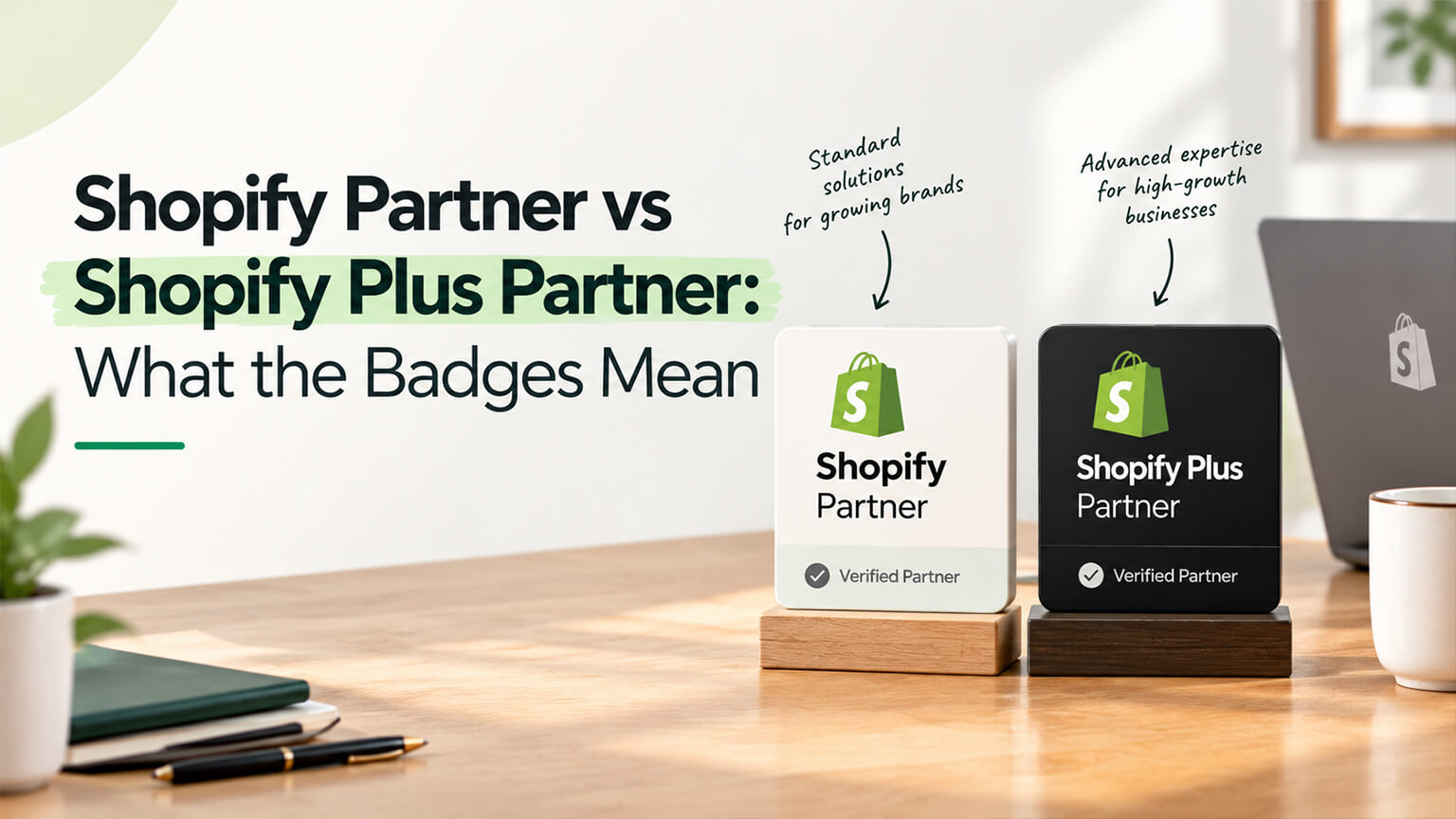
Agency websites display partner badges prominently, and clients reasonably assume they mean something specific about quality. They mean something — just not quite what most people assume.
Understanding what each badge actually certifies helps you weight it correctly: as one data point among several rather than as a quality guarantee or, at the other extreme, as meaningless marketing.
Shopify Partner: what it actually is
What it means. Signing up to Shopify’s partner programme. It is open, free, and has no meaningful barrier to entry. Anyone who intends to build on Shopify, or thinks they might, can become a Shopify Partner today.
What it gives the agency. Development stores for building and testing, access to partner documentation and resources, a referral arrangement, and the ability to use the badge.
What it tells you about them. That they work with Shopify, or intend to at some point. That is all it certifies.
How much weight to give it. Almost none as a quality signal. Its absence is mildly informative — an agency doing serious Shopify work without partner access would be unusual, since development stores are basic infrastructure — but its presence tells you nothing about capability.
This is not a criticism of the programme, which exists to enable development rather than to certify quality. It is a correction of a common misreading, and one that some agencies are content to let stand.
Shopify Plus Partner: what it actually is
What it means. A distinct and selective tier. Shopify assesses agencies against criteria that have historically included Plus project experience, demonstrated technical capability, client references and satisfaction, business stability, and ongoing performance. Numbers are limited and the status must be maintained.
What it tells you about them. Considerably more than the base badge. Specifically: they have delivered real Shopify Plus projects, they passed a vetting process involving client outcomes, and Shopify judges them capable enough to associate with its enterprise tier. For Plus work, that is a meaningful filter.
What it still does not tell you. Whether they are right for your project. Plus Partners vary widely in size, specialism, and quality. Some are large enterprise consultancies, some are boutique teams. Some are excellent at migrations and weak at subscriptions. Some are strong technically and poor at communication. The badge establishes a floor, not a ranking.
How much weight to give it. Substantial for genuine Plus projects, because the experience requirement is real and Plus work has specific demands — Functions, Checkout Extensibility, B2B configuration — that fewer developers have done. Much less for a standard Shopify build, where you may be paying enterprise overhead for a project that does not need it.

The other things you will see
Agencies display various other credentials, and their value varies.
Shopify App Store presence. An agency with published apps has shipped software that passed Shopify’s review and is maintained in public. This is a genuine signal about engineering discipline, particularly relevant if you want custom app work. Check the app’s reviews and whether it is actively updated.
Shopify certifications and credentials for individuals. Shopify has offered various certification programmes over time. These demonstrate that someone studied the material and passed an assessment. Mildly positive; not a substitute for evidence of shipped work.
“Featured” or award listings in Shopify’s partner directory or its various recognition programmes. Some are substantive, some are closer to marketing. Worth understanding what a specific recognition required before weighting it.
Case studies on Shopify’s own site. More meaningful than self-published ones, since there is an editorial filter.
Other platform badges — Google Partner, Meta Partner, Klaviyo Partner, and similar. Requirements vary from substantive to nominal, and the visual similarity between them hides that variation entirely. Some tiers are tied to demonstrable client volume, certified staff numbers, or retained spend; others require little more than filling in a registration form. Check what the specific programme actually requires rather than assuming any badge implies vetting, because a wall of logos is designed to be read as cumulative endorsement when it may represent nothing more than a set of completed sign-up pages.
What no badge tells you
The things that determine your project’s outcome are not certified by anyone.
Whether they will tell you your brief is wrong. The most valuable thing you can buy from an agency, and no programme assesses it.
Communication quality. Whether problems get raised early, whether updates arrive, whether bad news travels.
Who will actually work on your project. Badges attach to firms; outcomes attach to people. A Plus Partner can staff your project with juniors.
Whether they are right for your size. A large Plus Partner may treat a modest project as a minor account, which is rational for them and poor for you.
SEO competence. Nothing in any partner programme assesses whether they will preserve your organic traffic through a migration, which is the single largest risk in that project type.
Domain experience relevant to you. Plus experience is not subscription experience, which is not B2B experience, which is not marketplace integration experience.
How they behave when a project goes wrong. The only way to learn this is asking a reference directly.
How to weight badges in a decision
A practical hierarchy, most to least informative.
Most informative: live stores they built, that you can inspect. Open them, test on a phone, check speed and structured data. This is evidence rather than credential.
Then: a reference for a comparable project. Ask what went wrong and how it was handled.
Then: how they respond to your brief. Do they challenge it, do they identify the risky part, do they ask awkward questions.
Then: Plus Partner status, if you have a Plus project. A genuine filter for that specific work.
Then: App Store presence, if you need custom development. Real evidence of engineering discipline.
Least informative: base Partner status, certifications, and most other badges. Not worthless, not decisive.
The general rule: prefer evidence you can verify yourself over credentials awarded by someone else. A store you can load in a browser tells you more than any badge, and it is available in thirty seconds.
A worked example: two Plus Partners, one bad fit
A skincare brand at around £4m revenue needed a Plus build with subscription functionality. They shortlisted two Plus Partners, reasoning correctly that the badge was relevant for Plus work.
One was a large agency with enterprise clients, an impressive portfolio, and a formal process. The other was a twelve-person team with a narrower portfolio that included three subscription-heavy brands.
The large agency’s proposal was polished and expensive. In conversation it became clear the brand would be among their smaller accounts, their subscription experience was limited to two projects, and the named senior people would be involved at a supervisory level with delivery by a team the brand had not met.
The smaller team’s proposal was less polished and engaged directly with the subscription mechanics. They flagged that the brand’s proposed portal design would make skipping harder than cancelling, which they said would increase churn. They named the two developers who would do the work and offered a reference at a brand with a similar subscription model.
The brand hired the smaller team. The project went well, and the portal point turned out to be correct — they redesigned it before build and their skip rate ran well above what they had projected.
Both agencies held the same badge. The badge was a useful filter that got both onto the shortlist, and it did not distinguish between them at all. Everything that mattered came from the conversation.
If an agency has no badges
Not automatically a concern, and worth thinking about properly.
A freelancer or small team may have base Partner status and nothing else. Entirely normal, and irrelevant if their work is good and relevant.
Plus Partner status requires sustained Plus project volume, which a small excellent team may not have even if they are capable of the work. If they have delivered Plus projects as a subcontractor or in a previous role, ask about it.
No partner status at all is worth a question, since development store access is basic. It may indicate someone very new, or someone who primarily works on other platforms.
Judge the work. A small team with three excellent live stores relevant to your project is a better bet than a badge-rich agency with nothing comparable to show you.
How to verify a badge claim
Badges are images on a website, and images can be placed on a website by anyone. A few minutes of checking is worthwhile, particularly for the claims that carry weight.
Search Shopify’s own partner directory. Plus Partners are listed in Shopify’s directory, so the claim is verifiable at source rather than from the agency’s footer. If a firm claims the status and you cannot find them listed, ask about it — there may be a legitimate explanation involving a recent change or a regional listing, and there may not.
Check whether the badge is current. Partner tiers require maintenance, and an agency that qualified three years ago may not qualify now. A badge is a claim about the present.
Look at the actual App Store listing if they claim published apps. Check the developer name matches, read the reviews, and check when it was last updated. An app published four years ago and never updated says something different from one actively maintained.
Ask which specific projects earned the status. A Plus Partner should be able to name Plus builds they delivered. If the answer is vague, or the examples are older than the badge, that is worth probing.
Distinguish the firm from the individual. Sometimes a badge belongs to a parent company, a network, or a former employer. Ask whose status it is.
Check the programme’s actual requirements on Shopify’s own site rather than trusting a description of them. Programmes change, requirements get restructured, and a badge that meant something specific two years ago may mean something different now.
Be alert to badge-adjacent language. “Shopify Plus experts”, “Plus specialists”, and “certified Shopify developers” are marketing phrases rather than programme statuses. They may be accurate descriptions of real capability; they are not credentials, and the distinction is easy to blur visually.
What to look for instead
Since the badges are weak signals, here is what to substitute — all verifiable in under an hour.
Three live stores relevant to your project. Not their most impressive work; their most similar work. Open them on a phone, place something in the cart, run a product page through PageSpeed Insights, and check the structured data. You will learn more in fifteen minutes than from any portfolio page.
One reference from a comparable project, with a real conversation rather than a written quote. Ask what went wrong, how fast they heard about it, and whether they would hire them again for a bigger project.
Their response to your brief in writing. Send it and see what comes back. Questions are good. Challenges are better. A quote with no questions is a warning.
Named people with named experience. Who writes the code, what have they built, who reviews it.
Evidence of SEO ownership if you are migrating. Ask how they handle the redirect map and what post-launch monitoring looks like. This single question sorts a shortlist faster than any credential.
A willingness to start small. Anyone confident in their work is comfortable proving it on a contained piece first.
Something they will not do. Every good agency declines some work. An agency that claims to handle everything for everyone has either no focus or no candour, and neither is what you want on a project you cannot easily assess yourself.
Why the badge question comes up at all
It is worth understanding why clients reach for badges, because the underlying need is real even if the badges answer it poorly.
You are being asked to assess something you cannot see. Development quality is hard to evaluate without technical knowledge. You cannot read the code, you cannot judge the architecture, and you will not know whether it was built well until something goes wrong eighteen months later. In that situation a credential from a recognised authority is enormously appealing, because it appears to transfer the assessment to someone qualified.
The market is crowded and undifferentiated. Hundreds of agencies describe themselves in near-identical language: experienced, results-driven, conversion-focused, partners in your growth. When the copy is interchangeable, a badge is one of the few visible differences.
Agencies encourage it, reasonably enough, because it is one of the few third-party signals available to them.
The alternative feels like more work, and it is. Opening three stores, calling a reference, and reading a proposal critically takes an hour or two. A badge takes a second.
But the hour is the better investment, and the reason is that badges assess the firm’s history while your project depends on the firm’s behaviour. Past Plus project volume is a fact about last year. Whether someone tells you your subscription portal design will increase churn is a fact about next month, and it is the one that determines your outcome.
The practical resolution: use badges to narrow, then spend the hour. If you only have time for one thing, send your brief and read what comes back. The response to a brief reveals more about how an agency thinks than any credential it displays, and it costs you nothing but the wait.
The bottom line
Shopify Partner is registration, not certification — open to anyone, and close to meaningless as a quality signal. Shopify Plus Partner is a genuine, selective tier that establishes real Plus project experience and is worth weighting for Plus work, while telling you nothing about fit, communication, or who will actually build your store.
Use badges as filters, not decisions. They can shorten a list; they cannot rank it.
What actually predicts your outcome is unbadgeable: live work you can inspect, a reference for a comparable project, and whether the agency will tell you something you do not want to hear. Those three cost you an hour to check and are worth more than every logo on an agency’s footer — including, for what it is worth, on a development page like ours.
Frequently asked questions
What is the difference between a Shopify Partner and a Shopify Plus Partner?
Shopify Partner is open registration — free, no meaningful barrier, available to anyone who works with Shopify or intends to. It provides development stores and documentation access, and as a quality signal it tells you almost nothing. Shopify Plus Partner is a selective tier that Shopify assesses against criteria historically including demonstrated Plus project experience, technical capability, client references and satisfaction, and business stability, with the status needing to be maintained. For genuine Plus work the second is a meaningful filter; for a standard build it may just mean enterprise overhead.
Should I only hire a Shopify Plus Partner?
Only if you actually have a Plus project, where the badge’s experience requirement is directly relevant — Functions, Checkout Extensibility, and B2B configuration have specific demands that fewer developers have met. For a standard Shopify build, restricting yourself to Plus Partners narrows your options to agencies geared toward larger projects, where you may be a minor account paying for process you do not need. And bear in mind the badge establishes a floor rather than a ranking: Plus Partners vary enormously in size, specialism, and how well they would suit your particular project.
Does a Shopify Partner badge mean an agency is certified or vetted?
No. It means they signed up to a free, open programme to get development stores and documentation. There is no assessment, no quality threshold, and no vetting involved. Some agencies display it in a way that implies endorsement, which is worth knowing when you are evaluating a website. Its absence is mildly unusual for anyone doing serious Shopify work, since development store access is basic infrastructure — but its presence carries no information about capability, process, or whether they will deliver your project well.
How much should partner badges influence my choice of agency?
Treat them as filters rather than as decision criteria. Plus Partner status is worth weighting for Plus projects; App Store presence is genuine evidence of engineering discipline if you need custom development. Everything else is weak signal. The things that actually determine your outcome are not certified by anyone: whether they challenge your brief, who will really write the code, how they communicate when something goes wrong, and whether they have SEO competence on a migration. Prefer evidence you can verify yourself — live stores, a relevant reference — over credentials awarded elsewhere.
Is it risky to hire an agency without Plus Partner status for a Plus project?
It adds risk you should manage rather than a reason to rule them out. What you actually need is evidence of real Plus work: Functions they have written, checkout extensions they have shipped, B2B configurations they have delivered. A small capable team may have done all of that as a subcontractor or in previous roles without accumulating the volume the badge requires. Ask directly which Plus features they have built, ask to see a live example, and ask for a reference from a Plus client. If those answers are solid, the missing badge matters much less than the demonstrated work.