
Shopify for Fashion & Apparel Brands: A Complete Playbook
On this page

Apparel is the category where a store can grow revenue and lose money at the same time, and most playbooks ignore why.
The reason is that apparel profitability is decided by two things that have almost nothing to do with your storefront: your returns rate and your size curve. A brand converting well, growing fast, and returning 40% of units with a broken size distribution is in worse shape than a slower brand returning 18% and selling through cleanly.
So this playbook is about the operation. The theme and product page side is covered separately in our guide to the best Shopify themes for fashion and apparel — this is everything around it.
The economics you are actually running
Returns are the defining cost. Apparel return rates are the highest in mainstream ecommerce, and every returned unit carries outbound shipping, return shipping, handling, inspection, repackaging, and sometimes markdown. A return is not a neutral reversal; it is a sale that cost you money.
The implication is counterintuitive. Reducing returns by a few percentage points is frequently worth more than the same effort spent raising conversion, because returns attack margin directly while conversion gains arrive with the same return rate attached. Yet almost all optimisation attention goes to conversion.
Size curve determines sell-through. You buy or make a distribution of sizes, and you sell a different distribution. The gap becomes end-of-season markdown. Brands that track actual demand by size and buy to it carry far less terminal stock than brands buying to a standard curve.
Seasonality compresses everything. You have narrow windows to sell at full price, and whatever remains sells at a discount that may be below cost. Full-price sell-through percentage is the number that matters, not revenue.
Customer acquisition cost against a volatile repeat rate. Some apparel categories repeat well; others are effectively one-purchase businesses. Know which you are before modelling anything.
Catalogue and data architecture
This is the unglamorous foundation that makes everything else possible, and apparel brands under-invest in it consistently.
Structure size and fit data per product, in metafields. Actual garment measurements — chest, length, sleeve, waist, inseam — not a generic chart. Plus model reference details and fit notes. Every brand says sizing is hard; almost none hold the data structurally.
Hold fabric composition, care, and provenance as structured fields, not as prose in the description. It makes filtering possible and survives any redesign.
Decide your option architecture early. Colour, size, and sometimes fit or length. Apparel hits Shopify’s option limits faster than any other category, so check your most complex intended product against current limits before you build a range around an architecture that will not fit.
Use consistent colour naming and map it to filterable colour families. Customers filter by “blue”, not by “Marine Heather”.
Tag for occasion, season, and collection so merchandising can be automated rather than manual.
Barcode and SKU discipline. Dull, and it is what makes multi-channel, wholesale, and 3PL integration possible later without a data cleanup project.
The operational core: returns
If you do one thing from this playbook, do this.
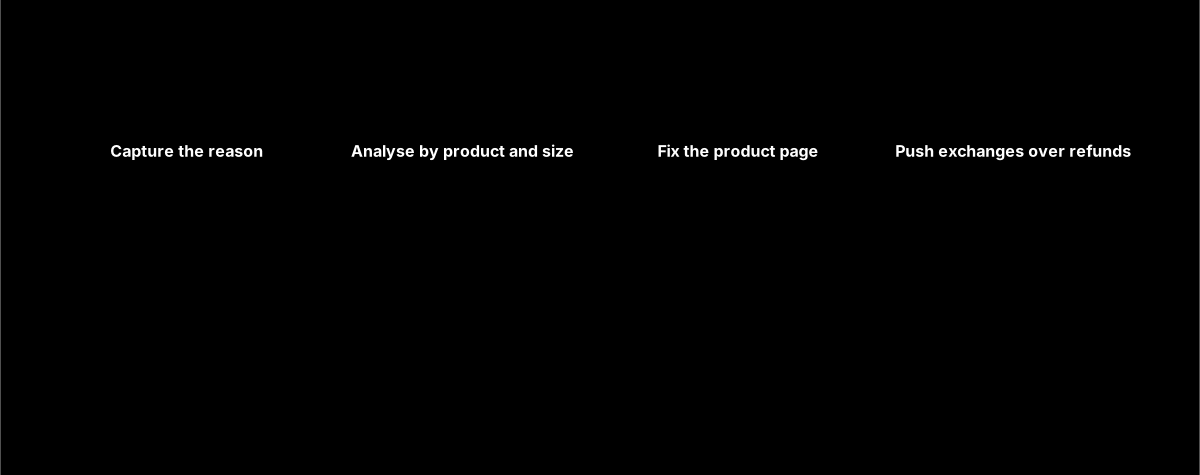
Capture a return reason on every return, structured and mandatory. Too small, too large, not as pictured, quality, changed mind, arrived late. Without this you cannot diagnose anything.
Analyse reasons by product and by size. A garment returning heavily for “too small” needs its size guide corrected or its fit noted, not a discount. One product driving a disproportionate share of returns is usually a fixable information problem.
Feed the findings back into the product page. Fit notes drawn from your own returns data are the most credible content you can put on a listing, and they reduce the next return.
Make the returns process efficient, not difficult. Friction reduces returns slightly and reduces repeat purchase considerably. The better lever is accuracy before purchase, not obstruction after it.
Encourage exchanges over refunds. An exchange retains the revenue and the customer. A returns portal that offers size exchange prominently converts a meaningful share of refunds.
Track returns as a product-level metric, visible alongside revenue. A product with high revenue and a high return rate may be unprofitable, and nobody notices while looking only at sales.
Watch serial returners. A small number of customers return most units in many apparel brands. You need the data to decide what, if anything, to do about it.
Merchandising and seasonality
Plan the merchandising calendar in advance, with collection launches, campaign pages, and markdown phases mapped. Apparel runs on a calendar and stores that improvise lose full-price selling days.
Build for self-service merchandising. Your team will create landing pages, lookbooks, and seasonal collections constantly. If each requires a developer, you lose the window. This is the strongest argument for investing in flexible sections.
Automate collections where you can. Rules-based collections driven by tags reduce manual work during the busiest periods.
Manage markdown deliberately rather than reactively. Phased reductions on a schedule protect margin better than panic discounting in week eleven.
Plan for restocks and back-in-stock demand. Capturing size-level back-in-stock requests tells you what to remake and gives you a warm list when you do.
Acquisition and retention
Paid acquisition dominates early and gets expensive. Apparel is competitive, and creative quality matters more than targeting sophistication in most accounts.
Organic search is underused. Category and collection pages can rank for commercially valuable terms if they carry real content, and most apparel brands publish bare product grids. Buying guides, fit guides, and material explainers all attract qualified traffic earlier in the decision. This is where sustained organic work compounds.
Email is your margin channel. New collection launches, restocks, back-in-stock alerts, and post-purchase sequences. Apparel suits email unusually well because there is always something new to say.
Retention depends on fit confidence. A customer whose first order fitted will reorder; one whose first order was returned usually will not. Which connects retention directly back to the returns work above.
Know your repeat rate honestly, by cohort. It determines how much you can afford to pay for a customer, and apparel brands frequently model on a repeat rate they do not actually have.
The tech stack
Keep it lean. Specifics on app selection are in our app roundups; the categories that matter here:
Reviews with fit feedback. Reviewers reporting whether an item ran small is the highest-value review data in apparel.
Search and filtering. Essential past a few hundred SKUs, with size, colour, fit, and fabric as filters.
Returns and exchange portal. Covered above, and the highest-return app category for this vertical.
Back-in-stock notifications, at variant level.
Email and SMS on one platform.
Inventory management once you pass a single location or add wholesale.
A 3PL or warehouse integration when fulfilment moves out of house.
What to resist: urgency widgets, multiple upsell tools, and anything that adds weight to already-heavy product pages.
A worked example: growth that was losing money
A womenswear brand doubled revenue in eighteen months and ran out of cash.
The audit found what the revenue figure hid. Their return rate was 41%, and 62% of returns were sizing. Their returns portal defaulted to refund rather than exchange. They captured no structured return reason, so nobody could see which products were responsible. And they were buying to a standard size curve while their actual demand skewed two sizes larger, leaving them with unsold small sizes every season.
The work was operational, not storefront. Mandatory structured return reasons. Per-garment measurements in metafields, displayed on every product page, with fit notes added for the twelve worst offenders. A returns portal rebuilt to offer size exchange as the primary option. Back-in-stock capture at variant level. And a monthly report of return rate by product and size, reviewed by the buying team.
Over the following two seasons: return rate fell to 29%, exchanges rose from 11% to 34% of returns, and their size buying shifted to match demand. Revenue grew more slowly. Gross margin improved enough to fund the business from operations.
The uncomfortable lesson: their conversion rate work had been fine all along. The thing destroying them was a metric nobody owned.
What to build, in what order
First: structured product data. Measurements, fabric, care, colour families, occasion tags. Everything else depends on it.
Second: returns infrastructure. Reason capture, exchange-first portal, product-level reporting.
Third: the product page. Measurements displayed, fit notes, strong imagery, swatches. Covered in the theme guide.
Fourth: search and filtering, once your catalogue warrants it.
Fifth: back-in-stock and restock capture.
Sixth: merchandising self-service, so your team can run the calendar without help.
Seventh: email programme properly built — launches, restocks, post-purchase, win-back.
Eighth: organic content around fit, materials, and category guidance.
Ninth: operational integration — inventory, 3PL, wholesale if relevant.
Most apparel brands do this list roughly backwards, starting with paid acquisition and a redesign.
The metrics that matter
Full-price sell-through percentage. The single most important number in apparel and the one most brands do not track.
Return rate, by product and by size.
Exchange rate as a share of returns.
Contribution margin per product after returns, not gross revenue.
Repeat rate by cohort, honestly measured.
Size curve variance — what you bought against what you sold.
Terminal stock as a percentage of buy.
Revenue and conversion rate are both on most apparel dashboards and neither tells you whether the business works.
The size curve problem, properly
This is the apparel issue least discussed and most expensive, so it deserves working through.
What it is. You buy or manufacture a distribution of sizes — say 10% XS, 20% S, 30% M, 25% L, 15% XL. Your customers want a different distribution. The difference becomes stock you cannot sell at full price, and it recurs every season until someone notices.
Why it persists. Standard curves are inherited from suppliers, from industry convention, or from whatever was ordered last time. Few brands compare what they bought against what actually sold, by size, by product type, at the end of each season. Without that comparison the error repeats indefinitely.
How to measure it. For each product, record the buy distribution and the full-price sell-through distribution. The gap is your curve error. Do it by product type as well as overall, because the right curve for knitwear may differ from the right curve for outerwear.
Where the demand signal hides. Sold-out sizes understate demand, because once a size sells out it stops selling and the data looks like it reached its natural level. Back-in-stock requests at variant level are the correction — they tell you what you would have sold. This is why variant-level back-in-stock capture matters commercially rather than just as a nicety.
Returns distort it too. A size that sells well and returns heavily is not demand, it is a fit problem presenting as demand. Net of returns is the only meaningful sell-through figure.
Adjust gradually and watch. Shifting a curve by a few points per season and measuring beats a dramatic correction based on one season’s data, which may reflect a single product’s fit rather than your customer base.
The payoff. Brands that get this right carry materially less terminal stock, which means less markdown, which flows directly to margin. It is unglamorous analysis with a larger effect than most storefront work.
Fit consistency across your range
A related issue that quietly drives returns and that brands rarely audit.
If a size M is cut differently across your range — because different manufacturers, different patterns, or different years are involved — customers cannot learn their size with you. A customer who buys an M that fits and then an M that does not has learned that your sizing is unreliable, and they either stop ordering or start ordering two sizes and returning one.
What to do about it. Measure your actual garments rather than trusting the tech pack. Record the measurements per product in metafields, which you should be doing anyway. Then look across the range for inconsistency within the same nominal size.
Where you find it, you have two options: correct the production so sizes are consistent, which is the right long-term answer, or disclose it honestly on the product page with fit notes. The second is cheap and effective — “runs slightly small, consider sizing up” prevents more returns than any policy change.
Be particularly careful across manufacturers. Brands that scale frequently add a second supplier and discover six months later that their sizing has diverged, usually from returns data rather than from a check.
And audit after any production change. A new factory, a new pattern, or a fabric change can shift fit without anyone updating the size guide.
Where apparel brands get into trouble
Patterns we see repeatedly, roughly in order of how much damage they cause.
Nobody owns the return rate. It sits between operations, buying, and marketing, and consequently belongs to no one. Revenue has an owner; returns usually do not, which is why the metric that decides profitability goes unmanaged for years.
Scaling paid acquisition before fixing returns. Spending more to acquire customers who return 40% of what they buy multiplies a loss rather than a profit. The sequence matters: fix the leak, then open the tap.
Discounting to clear stock that should not have been bought. Markdown is a symptom. Treating it as a demand-generation tool rather than as evidence of a buying error means the error repeats.
Adding SKUs faster than the operation can carry them. Every new style adds photography, data entry, inventory complexity, and size-curve risk. Brands frequently find that a modest share of styles produce most of the margin while the long tail consumes working capital.
Launching collections without a merchandising plan. Full-price selling days are finite and a launch that is not supported loses them.
Treating photography as a cost rather than the product. In apparel, images are what customers are buying from. It is consistently the highest-return spend available and consistently squeezed.
Ignoring the second purchase. Apparel retention is largely determined by whether the first order fitted, which means the returns work is also the retention work. Brands that separate the two miss the connection entirely.
Building a wholesale channel on the retail store without thinking about pricing visibility, minimums, or terms, and then discovering the architecture does not support it.
Growing out of the storage and fulfilment arrangement without planning the transition, so peak season arrives with a fulfilment problem.
A realistic view of channel mix
Worth being honest here, because apparel brands are often advised as though direct-to-consumer is the only model.
Your own store gives you the best margin, the customer relationship, and full control. It also means you carry the entire cost of acquisition, which in a competitive category is substantial and rising.
Marketplaces give you volume and discovery at the cost of margin, customer data, and brand control. They also distort your returns picture, since marketplace return behaviour differs from your own. Useful for clearing terminal stock, risky as a primary channel.
Wholesale moves inventory in bulk at lower margin with far lower acquisition cost, and gives you cash flow predictability. It requires different pricing architecture, minimums, and terms, and it is covered properly in the B2B playbook in this batch.
Physical retail, including pop-ups and markets. Higher conversion, almost no return problem, immediate feedback on fit and product. Operationally demanding and often where small apparel brands learn most about their own range.
The practical point. A brand depending entirely on paid acquisition into its own store is exposed to acquisition cost inflation it cannot control. Most apparel brands that get durable eventually run two or three channels, and the architecture decisions — pricing visibility, inventory allocation, data structure — are much cheaper to make early than to retrofit.
The bottom line
Apparel profitability is decided by returns and size curve, not by conversion rate, and the operational work is where the money is.
Build structured size and fit data first, then returns infrastructure that captures reasons and pushes exchanges over refunds, then feed what you learn back onto the product page. That loop — measure returns, fix the information, reduce the next return — is the highest-return optimisation work available in this category and almost nobody runs it.
Then invest in self-service merchandising so your team can work the seasonal calendar, and in organic content so you are not wholly dependent on paid acquisition. Get the foundations right in that order and the storefront work compounds. Do it backwards and you grow revenue while margin quietly disappears.
Frequently asked questions
What is the most important metric for a Shopify fashion brand?
Full-price sell-through percentage, with return rate by product and size close behind — and both are missing from most apparel dashboards, which tend to show revenue and conversion rate instead. Revenue tells you nothing about whether you sold at full price or cleared stock at a loss, and conversion rate improvements arrive with the same return rate attached. Track contribution margin per product after returns rather than gross revenue, because a high-revenue product with a 45% return rate can be losing money while appearing near the top of your sales report.
How do I reduce returns on a Shopify clothing store?
Capture a structured, mandatory return reason on every return, then analyse by product and by size — without that data you cannot diagnose anything. Most apparel returns are sizing, and the fix is information rather than policy: per-garment measurements held in metafields and displayed on the product page, model reference details, and fit notes drawn from your own returns data. Then rebuild your returns portal to offer size exchange as the primary option rather than defaulting to refund, which retains both the revenue and the customer.
Should I make returns harder to reduce my return rate?
No. Friction reduces returns slightly and reduces repeat purchase considerably, and in a category where retention depends on customers trusting that they can order confidently, that trade is usually negative. The better lever is accuracy before purchase — better measurements, honest fit notes, clearer imagery with scale reference — which reduces returns without penalising customers. Where you want to protect margin, push exchanges over refunds and make the exchange path the easiest option in the portal.
How important is SEO for a fashion brand on Shopify?
More than most apparel brands treat it, because collection and category pages can rank for commercially valuable terms and most publish bare product grids with no content at all. Buying guides, fit guides, fabric and material explainers, and category introductions attract qualified traffic earlier in the decision than product searches do, and that traffic is considerably cheaper than paid. It also reduces dependence on paid acquisition, which in apparel is competitive and tends to get more expensive over time rather than less.
What apps does a Shopify fashion store actually need?
Keep it lean, because apparel product pages are already heavy. The categories that earn their place: reviews that capture fit feedback, search and filtering once you pass a few hundred SKUs, a returns and exchange portal, variant-level back-in-stock notifications, and email with SMS on one platform. Add inventory management when you move beyond a single location and a 3PL integration when fulfilment leaves the building. Resist urgency widgets, multiple overlapping upsell tools, and anything decorative that adds load time.