
Navigation and Merchandising: Helping Shoppers Find What They Want
On this page
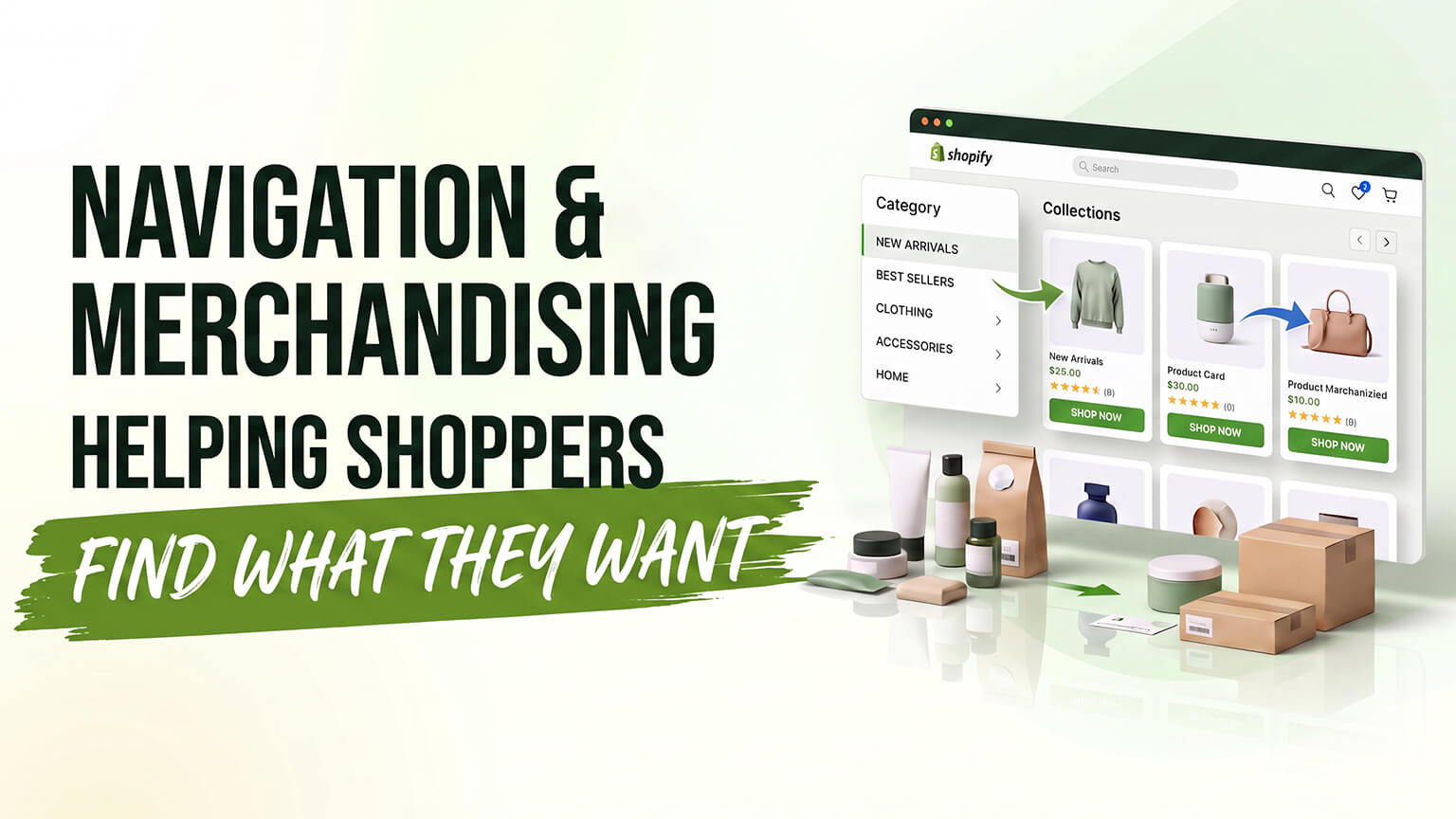
A shopper who can’t find what they want doesn’t buy it. That simple truth makes navigation and merchandising — how your store guides shoppers to products and presents those products — a core conversion lever, and an underrated one. While much conversion attention goes to product pages and checkout, the earlier step of helping shoppers find and discover the right products is just as important: if they can’t navigate to what they want, or aren’t shown relevant products, they never reach the product page where the rest of your conversion work happens. Navigation (how shoppers move through and find their way around your store) and merchandising (how you organize, present, and surface products) together determine whether shoppers find products they’ll buy — or leave because they couldn’t.
This piece covers why navigation and merchandising matter for conversion, what good navigation looks like (logical structure, intuitive menus, search), what good merchandising looks like (deliberate organization and presentation of products, guiding discovery), the mobile dimension, and how they connect to other topics. Because helping shoppers find and discover the right products is foundational to conversion — the work before the product page that determines whether shoppers reach the right products at all. Let me walk through it.
Why navigation and merchandising matter for conversion
The core reason is that finding and discovering products is a prerequisite for buying them — a shopper has to reach the right product before they can convert on it, and navigation and merchandising are what get them there. If your navigation is confusing or your category structure illogical, shoppers struggle to find what they want and leave. If your merchandising is poor — products presented in an unconsidered order, relevant products not surfaced, no help discovering what they’d want — shoppers don’t find the products they’d buy. So navigation and merchandising sit upstream of the product page and checkout in the conversion journey, determining whether shoppers reach the right products at all, and poor navigation/merchandising loses shoppers before they ever get to the product page where the rest of conversion happens.
This makes navigation and merchandising a foundational conversion lever, and an underrated one — much conversion attention goes to the product page and checkout (the later steps), while the earlier finding-and-discovering step gets less, even though shoppers who can’t find or discover the right products never reach those later steps. So helping shoppers find what they want (navigation) and surfacing the products they’d buy (merchandising) is core conversion work, addressing the upstream step that determines whether shoppers reach the products to convert on. A store with great product pages but confusing navigation and poor merchandising loses shoppers before the product page; a store that helps shoppers find and discover the right products well gets them to the products where conversion happens. So recognize navigation and merchandising as the foundational, upstream conversion lever they are — helping shoppers find and discover products, the prerequisite for the product-page and checkout conversion that follows. Let me cover each.
Good navigation: clear, logical, intuitive
Navigation is how shoppers move through your store and find their way to what they want, and good navigation is clear, logical, and intuitive — letting shoppers reach what they want easily, in a few clicks, without confusion. The core of navigation is your category and collection structure (how your products are organized into categories shoppers browse) and your menus (how that structure is presented for navigation). Good navigation organizes products into a logical, intuitive structure that matches how shoppers think about and look for products, with clear menus that let shoppers find their way to the right category easily.
This connects to the collection-page discussion: organizing your collections around how shoppers actually shop (by category, use case, attribute — how they look for products) makes navigation intuitive, while organizing around your internal logic (rather than the shopper’s) makes it confusing. So good navigation starts with a logical, shopper-oriented category structure, presented through clear, intuitive menus, letting shoppers navigate to what they want easily. A shopper should be able to reach the category or products they want in a few clicks, through navigation that matches how they think — not struggle through a confusing structure or unclear menus. Poor navigation (confusing structure, unclear menus, products hard to find) loses shoppers; good navigation (logical, intuitive, shopper-oriented structure and clear menus) guides them to what they want. So invest in clear, logical, intuitive navigation — a shopper-oriented category structure and clear menus — as the foundation of helping shoppers find products. And remember search as part of finding: for shoppers who know what they want, good site search (covered in the AI search and discovery discussion) is part of navigation, letting them search directly to products, so good search complements good browse navigation in helping shoppers find what they want.
Good merchandising: deliberate organization and presentation
Merchandising is how you organize, present, and surface products — and good merchandising is deliberate, surfacing the right products to shoppers rather than leaving it to default or chance. Within a collection, merchandising includes how products are ordered (which products show first), which are featured, and how the collection is curated — and doing this deliberately (featuring your best, most relevant, or strategic products, ordering thoughtfully) rather than accepting an unconsidered default surfaces the products most likely to convert or that you want to move. Beyond collection ordering, merchandising includes guiding discovery — helping shoppers discover relevant products through recommendations, related products, featured selections, and curation — surfacing products shoppers would want but might not find on their own.
So good merchandising is the deliberate surfacing and presentation of products — ordering and featuring within collections thoughtfully, guiding discovery through recommendations and curation — to surface the products shoppers will buy and that serve your goals. This is often under-attended: stores accept default collection ordering and do little deliberate merchandising, missing the chance to surface the products most likely to convert or that they want to move. Deliberate merchandising — featuring and ordering products thoughtfully, guiding discovery — surfaces better products to shoppers, improving the chance they find something they’ll buy. So merchandise deliberately: order and feature products within collections thoughtfully (surfacing your best/relevant/strategic products), and guide discovery (recommendations, related products, curation) to surface products shoppers would want. This connects to the recommendations and personalization discussions — relevant recommendations and discovery are part of good merchandising — and to the broader theme of helping shoppers find products they’ll buy. Deliberate merchandising surfaces the right products; unconsidered default merchandising leaves it to chance. So attend to merchandising as the deliberate surfacing of products it should be, surfacing what converts and what you want to move, rather than accepting defaults.
The mobile dimension and putting it together
Navigation and merchandising on mobile deserve specific attention, since most traffic is mobile and navigation especially is harder on a small screen (as the mobile conversion discussion covers). Mobile navigation (the menu, search, finding one’s way) must work well on the small screen — a cramped or confusing mobile menu, or hard-to-use mobile search, loses the mobile majority. So ensure your navigation and search work well on mobile, where most shoppers are finding their way — clear mobile menus, easy mobile search, navigable on a small screen. Mobile merchandising matters too (how products are surfaced and presented on mobile). So apply the navigation and merchandising principles with mobile front of mind, since that’s where most shoppers are navigating and discovering.
Putting it together: helping shoppers find and discover the products they’ll buy — through clear, logical, intuitive navigation (shopper-oriented structure, clear menus, good search) and deliberate merchandising (thoughtful ordering and featuring, guided discovery) — is foundational conversion work, getting shoppers to the right products so the product-page and checkout conversion can happen. It’s underrated relative to product-page and checkout optimization, but it’s the upstream step that determines whether shoppers reach the right products at all. So invest in navigation and merchandising as the foundational conversion lever they are: clear navigation helping shoppers find their way, deliberate merchandising surfacing the right products, good search for those who know what they want, all working on mobile where most shoppers are. And, where you have the traffic, test navigation and merchandising changes (as the testing discussion covers), since improvements here — helping more shoppers find products they’ll buy — lift conversion at a foundational, upstream point in the journey. Helping shoppers find what they want is, after all, a prerequisite for selling it to them.
A worked example: the store nobody could navigate
To see the stakes, picture a store with good products and good product pages but navigation organized around the brand’s internal logic rather than how shoppers think. The categories are named in the brand’s internal terms, the structure groups things in ways that make sense to the team but not to shoppers, the menus are cluttered or unclear, and the search is weak. A shopper arrives wanting a specific kind of product, can’t figure out where it would be in the confusing structure, the search doesn’t help, and they leave — never reaching the good product page that would have converted them. The store’s good product pages and products are undermined by navigation shoppers can’t use, losing shoppers upstream of where the conversion work was done.
Now the store fixes its navigation and merchandising. The categories are reorganized around how shoppers actually shop (the terms and groupings shoppers think in), the menus are clarified, the search is improved, and the collections are merchandised deliberately (featuring relevant products, guiding discovery). Now shoppers find their way to the right products easily — browsing intuitive categories or searching effectively — and reach the good product pages, where they convert. The same products and product pages now perform far better, because shoppers can actually find and discover the products to buy. The store didn’t change its products or product pages; it fixed the navigation and merchandising that were losing shoppers before they reached them.
This captures the foundational, upstream nature of navigation and merchandising: a store can have great products and product pages, but if shoppers can’t find and discover the products (poor navigation and merchandising), they’re lost before the product page, undermining all the downstream conversion work. Fixing navigation and merchandising (shopper-oriented structure, clear menus, good search, deliberate merchandising) lets shoppers reach the products, unlocking the conversion the good product pages can then deliver. The before-and-after — good products and pages undermined by poor navigation, versus the same products and pages reached easily through good navigation and merchandising — shows why this upstream lever matters, and why it’s worth attending to alongside the product-page and checkout work that gets more attention.
Faceted filtering and large catalogs
For stores with large catalogs, navigation and merchandising include faceted filtering — letting shoppers narrow a large collection by attributes (size, color, price, type, etc.) to find what they want. For a large catalog, good filtering is essential to navigation: a shopper facing hundreds of products in a collection needs to filter down to the relevant ones, and good faceted filtering (clear, useful filters that narrow effectively) is how they do it, while poor or absent filtering leaves them overwhelmed and unable to find what they want. So for large catalogs especially, invest in good faceted filtering as part of navigation — clear, useful filters that let shoppers narrow large collections to the relevant products.
There’s an SEO consideration with filtering too (as the duplicate-content discussion noted — faceted filtering can generate many URL variations needing proper handling), so good filtering serves shoppers (finding products in large catalogs) while being handled properly for SEO. For large-catalog stores, filtering is a key part of navigation, so ensure it’s good (useful filters, effective narrowing, well-handled for SEO) — it’s how shoppers find products in a large catalog, and poor filtering loses them in the volume. Smaller catalogs need filtering less (shoppers can browse the smaller selection), but large catalogs depend on it for navigability. So if you have a large catalog, treat faceted filtering as essential navigation infrastructure, investing in good, useful filtering that lets shoppers narrow to the relevant products, handled properly for SEO. Good filtering turns an overwhelming large catalog into a navigable one where shoppers find what they want; poor filtering leaves them lost in the volume.
Merchandising for your goals, not just relevance
A strategic dimension of merchandising worth noting: merchandising surfaces products not just for relevance to the shopper but for your business goals — and good merchandising balances both. You can merchandise to surface your highest-margin products, your products you want to move (overstock, new launches), your best sellers, or strategically important products — using merchandising to advance your business goals, not just to show relevant products. The balance is to merchandise in a way that serves both the shopper (surfacing relevant products they’ll want) and your goals (surfacing products that benefit you), since merchandising purely for your goals at the expense of relevance (pushing products shoppers don’t want) backfires, while merchandising purely for relevance ignores the chance to advance your goals.
So good merchandising is strategic as well as shopper-serving: surface products that are both relevant to shoppers and good for your business (high-margin, to-move, strategic), balancing the shopper’s interest (relevant products) with yours (strategic products). This makes merchandising a lever for your business goals (moving the products you want to move, surfacing the profitable ones) as well as for helping shoppers, when balanced well. Merchandising deliberately for both — relevance and your goals — is more sophisticated and valuable than either default merchandising (no strategic intent) or purely self-serving merchandising (pushing products regardless of relevance, which backfires). So merchandise with both the shopper and your goals in mind: surface products that are relevant and that advance your business goals, using merchandising strategically while keeping it shopper-serving. This strategic dimension — merchandising for your goals, balanced with relevance — adds to merchandising’s value as a lever, letting you advance your business goals (margin, moving products, strategic priorities) through how you surface products, as long as it stays balanced with surfacing what shoppers actually want.
The bottom line
A shopper who can’t find what they want doesn’t buy it, which makes navigation (how shoppers move through and find their way around your store) and merchandising (how you organize, present, and surface products) a core, underrated conversion lever — the upstream step that determines whether shoppers reach the right products at all, before the product-page and checkout conversion that gets more attention. Good navigation is clear, logical, and intuitive: a shopper-oriented category and collection structure (organized around how shoppers actually shop, as the collection discussion covers) presented through clear menus, letting shoppers reach what they want in a few clicks, complemented by good site search for those who know what they want. Good merchandising is deliberate: thoughtfully ordering and featuring products within collections (surfacing your best, relevant, or strategic products rather than accepting defaults), and guiding discovery through recommendations, related products, and curation — surfacing the products shoppers will buy and that serve your goals, rather than leaving it to chance. Attend to the mobile dimension, since most shoppers navigate and discover on mobile, where navigation especially is harder and must work well. Together, clear navigation and deliberate merchandising help shoppers find and discover the right products — the foundational, upstream conversion work that gets shoppers to the products where the rest of conversion happens. It’s underrated relative to product-page and checkout optimization, but a store where shoppers can’t find or aren’t shown the right products loses them before the product page, so helping shoppers find what they want is a prerequisite for selling it to them — and worth the investment as a foundational conversion lever.
Frequently asked questions
Why do navigation and merchandising matter for conversion?
Because finding and discovering products is a prerequisite for buying them — a shopper has to reach the right product before they can convert, and navigation (how they find their way) and merchandising (how you surface products) are what get them there. They sit upstream of the product page and checkout, determining whether shoppers reach the right products at all. Poor navigation or merchandising loses shoppers before the product page where the rest of conversion happens, making this a foundational, if underrated, conversion lever.
What makes navigation good?
Clarity, logic, and intuitiveness — a category and collection structure organized around how shoppers actually shop (by category, use case, attribute, how they look for products), presented through clear menus, letting shoppers reach what they want in a few clicks without confusion. It’s complemented by good site search for shoppers who know what they want. Poor navigation (confusing structure, unclear menus, hard-to-find products) loses shoppers; good navigation guides them to what they want, matching how they think about and look for products.
What is good merchandising?
The deliberate organization, presentation, and surfacing of products — thoughtfully ordering and featuring products within collections (surfacing your best, relevant, or strategic products rather than accepting an unconsidered default), and guiding discovery through recommendations, related products, and curation. It surfaces the products shoppers will buy and that serve your goals, rather than leaving it to chance. Many stores accept default collection ordering and do little deliberate merchandising, missing the chance to surface the products most likely to convert or that they want to move.
Does navigation matter more on mobile?
It matters everywhere, but mobile deserves specific attention because most traffic is mobile and navigation is harder on a small screen — a cramped or confusing mobile menu, or hard-to-use mobile search, loses the mobile majority. So ensure your navigation and search work well on mobile (clear menus, easy search, navigable on a small screen), since that’s where most shoppers are finding their way. Apply the navigation and merchandising principles with mobile front of mind, given that mobile is where most shoppers navigate and discover.