
Hiring and Structuring a Team for a Headless Shopify Project
On this page
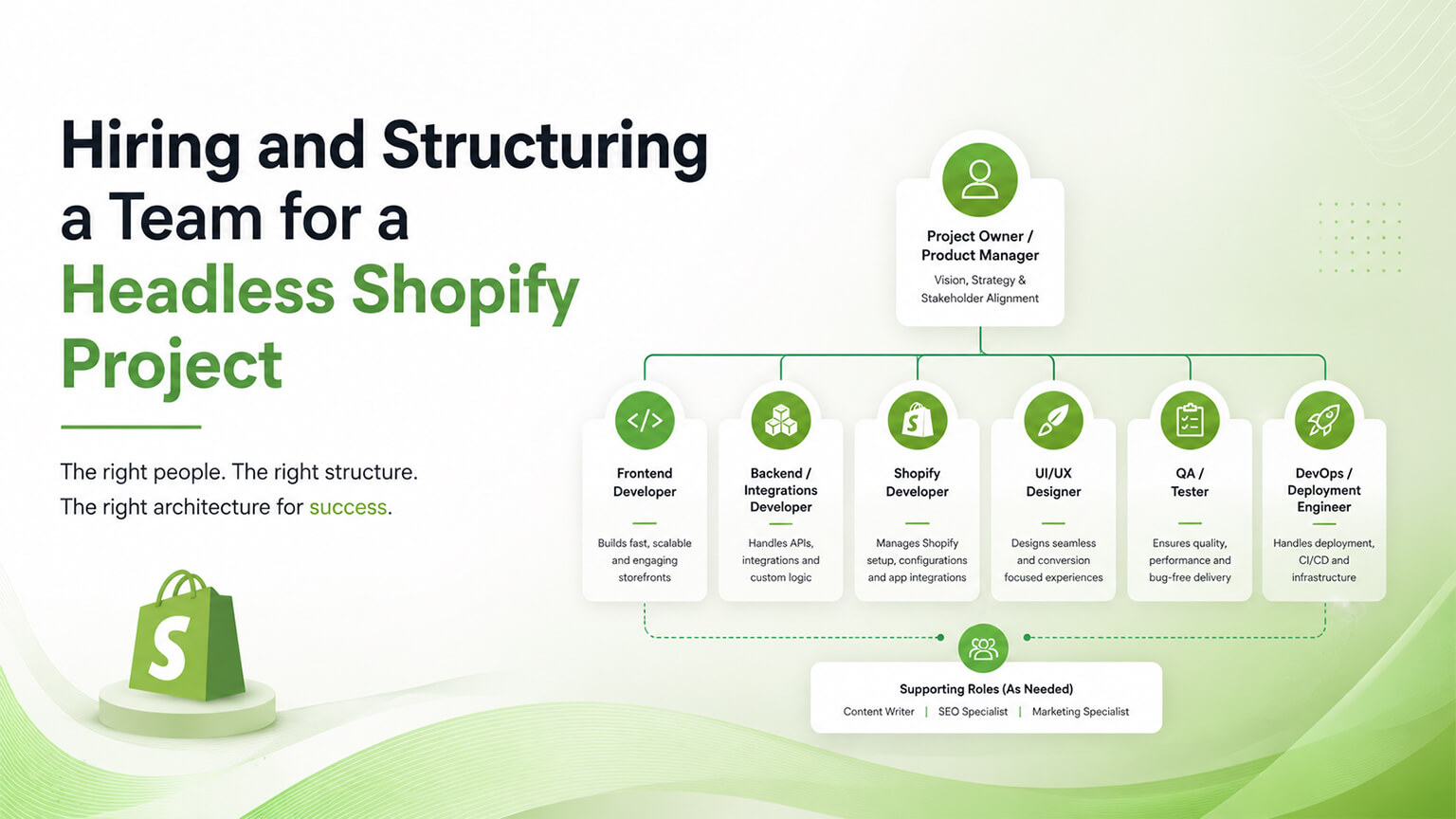
One of the most underappreciated aspects of going headless is that it’s fundamentally a bigger, more demanding engineering undertaking than a standard Shopify theme — and its success depends heavily on having the right team and skills. A standard Shopify theme can be built and maintained by a Shopify developer or agency with theme expertise; a headless storefront is a custom application (front-end, integrations, hosting, performance, SEO, and ongoing maintenance) that requires broader and deeper engineering capability. Many headless projects disappoint or fail not because headless is wrong for the store, but because the store underestimated the team and skills required — attempting it without the right capability, or with a team lacking key skills like headless SEO. So a crucial part of the headless decision and the total cost of ownership is the team: what skills a headless project needs, whether to build an in-house team or use an agency, and how to structure it for success.
This piece covers why the team matters so much for headless, the skills a headless project needs, the in-house vs. agency decision, and how to structure the team and ensure success.
Why the team matters so much for headless
The team matters enormously for headless because headless is a demanding engineering undertaking whose success depends on capability. Headless is a custom application — a headless storefront is a custom front-end application built with a framework like Next.js or Hydrogen, integrated with Shopify via APIs, hosted, and optimised — which is fundamentally more complex than a Shopify theme. Building and running it requires real, ongoing engineering capability rather than just theme expertise.
Success depends on execution. Headless can be excellent or a disaster depending on how well it is implemented. Good execution can deliver performance and control, while poor execution can cause SEO problems, poor performance, and technical issues. Since execution depends on the team’s capability, the team largely determines whether headless succeeds.
Broad skills are needed. Headless requires front-end development, integration, performance, SEO, hosting and DevOps, and ongoing maintenance. A team needs to cover these areas, because missing key skills can cause serious problems, including SEO issues when headless SEO expertise is lacking.
Ongoing capability is essential. Headless needs continuous engineering, development, maintenance, and updates rather than a one-time build. The team is therefore an ongoing requirement, not simply a project resource that can be dismissed after launch.
Underestimating the team is a common failure. Many headless projects disappoint because stores underestimate the skills and resources required. The team is also a major part of headless’s cost and viability, making it central to the decision about whether headless is right for the business.
The team is one of the most crucial factors in headless success. Getting the right skills, adequate capability, and ongoing support in place is essential.
The skills a headless project needs
A headless Shopify project needs a broad set of skills, and understanding them helps you assess the team required.
Front-end development — Strong front-end development skills are needed to work with a framework such as React, Next.js, or Hydrogen and build the custom storefront application. This is the core of building a headless front end.
Shopify and Storefront API integration — Knowledge of Shopify and its Storefront API is essential for connecting the front end with Shopify’s commerce functionality, including product data, cart, and checkout. Experience with Shopify API integration can help businesses connect their storefront with the systems and data they need.
Performance engineering — Performance skills are needed to optimise the front end, implement caching and rendering strategies, and improve Core Web Vitals. Performance is a major potential benefit of headless, but achieving it requires skilled engineering.
Headless SEO — The team needs expertise in rendering for indexability, implementing SEO fundamentals, and handling technical SEO. This is a crucial and often-overlooked skill because poor implementation can prevent content from being indexed correctly and undermine organic search performance.
Hosting and DevOps — Hosting and DevOps skills are needed to deploy and run the front-end application, manage infrastructure, and maintain reliable releases. The team must understand how the application will be hosted and monitored after launch.
Backend and integration — Backend and integration skills are important for connecting Shopify’s Admin API, external systems, webhooks, and other services. Depending on the business, custom Shopify integrations may be needed to connect the storefront with existing business processes.
Design and UX — Design and UX skills help the team take advantage of the freedom headless provides for creating custom shopping experiences. A technically sound storefront still needs to be intuitive, accessible, and easy for customers to use.
Ongoing maintenance and support — The team must be able to maintain and support the storefront over time, including updates, fixes, monitoring, and further development. Unlike a one-time theme project, a headless application requires continuing engineering support.
Technical leadership and architecture — A significant headless project needs technical leadership to design the architecture, guide implementation, and make sound decisions about frameworks, integrations, performance, and maintainability.
A headless project therefore needs front-end development, Shopify and Storefront API integration, performance engineering, headless SEO, hosting and DevOps, backend integration, design and UX, ongoing maintenance, and technical leadership. The breadth is the point: headless needs more and broader engineering skills than a theme, and gaps — especially in SEO or performance — can cause serious problems. Assess whether your in-house team or agency covers these skills before committing to the project.

The in-house vs. agency decision
A key decision is whether to build an in-house team or use an agency for your headless project.
In-house team — Building an in-house engineering team with the necessary skills gives you dedicated, ongoing capability and control. This can suit stores committed to headless long-term that have the resources to hire and retain talent across front-end development, performance, SEO, and DevOps. However, it requires a significant investment in recruitment, salaries, retention, and team management. Not every business can attract and retain the necessary engineering talent.
Agency or specialist — Using an agency or specialist with headless expertise gives you access to the required skills without building a complete in-house team. This can suit stores that want headless capability without hiring multiple engineers. An experienced agency can bring knowledge of common pitfalls, established workflows, and experience delivering headless projects. When evaluating a potential partner, review its experience with Shopify store optimization and the technical requirements of custom storefronts, rather than relying on design examples alone.
Hybrid approach — A hybrid model combines some in-house capability with agency support for specialist work or the more demanding parts of the build. This can balance internal control with external expertise.
Assess your resources and commitment — The decision depends on your resources, long-term commitment, and business needs. Larger stores committed to headless may have the resources to build in-house, while other businesses may be better served by an agency or a hybrid model.
Consider experience as well as capability — An agency that has delivered headless projects may already understand common risks, including SEO and performance problems. This experience can reduce the risk of mistakes that an inexperienced team might make.
Plan for ongoing support — The required capability does not end at launch. Headless needs ongoing maintenance and development, so the decision should account for long-term support, whether that comes from an internal team or an agency relationship.
Whichever route you choose, ensure the team has the necessary skills and genuine headless experience. An in-house team, an agency, or a hybrid arrangement can all work, but inadequate capability remains a risk regardless of the model.
How to structure the team and ensure success
Structuring the team and ensuring headless success involves covering the skills, leadership, and ongoing capability. Cover the full skill set — ensure the team, however structured, covers the full headless skill set (front-end, integration, performance, headless SEO, DevOps, design/UX, maintenance, and leadership) with no critical gaps, especially in headless SEO and performance, since gaps can cause serious problems. This is the crucial thing to get right. Include technical leadership — include technical leadership and architecture, with someone responsible for designing the architecture and guiding the build to ensure the project is built soundly. Ensure SEO capability — specifically ensure the team has headless SEO expertise, including rendering, indexability, and technical SEO, because this is a crucial skill that is often missing. Plan for ongoing capability — arrange maintenance, development, and support after the build, with an ongoing internal team or agency relationship rather than a one-time project team. Right-size the team — match the team’s resources to the project’s complexity and ensure the build is adequately staffed. Coordinate and communicate — maintain good coordination within the team and between the team and the business so the project stays well-managed and aligned with business needs. Vet capability and experience — assess the team’s or agency’s portfolio, previous headless projects, specific skills, and references to ensure it can execute the project well. And treat it as central to the headless decision — if you cannot resource an adequate team internally or through an agency, reconsider whether headless is the right choice. So structure the team and ensure success by covering the full skill set, providing technical leadership, ensuring SEO expertise, planning for ongoing support, right-sizing the team, maintaining good communication, vetting capability and experience, and treating team resourcing as central to the headless decision. The key is to cover the full skill set, ensure the crucial often-overlooked skills are available, plan for ongoing support, and verify real experience. Getting the team right is crucial to headless success, so treat adequate skills, experience, and ongoing capability as prerequisites for going headless, not afterthoughts.
The bottom line
One of the most underappreciated aspects of going headless is that it is a bigger, more demanding engineering undertaking than a standard Shopify theme, and its success depends heavily on having the right team and skills. Many headless projects disappoint not because headless was wrong for the store, but because the store underestimated the capability required.
A headless project needs front-end development, Shopify and Storefront API integration, performance engineering, headless SEO, hosting and DevOps, backend integration, design and UX, ongoing maintenance, and technical leadership. This is a broader skill set than a standard theme typically requires, and gaps in areas such as SEO or performance can undermine the project.
The in-house versus agency decision depends on your resources, commitment, and needs. An in-house team provides dedicated capability and control but requires a significant investment in hiring and retention. An agency provides specialist skills and experience without requiring you to build a complete engineering team, while a hybrid approach can combine both advantages.
Whatever model you choose, cover the full skill set, provide technical leadership, plan for ongoing support, and verify the team’s experience. Resourcing the right team — with the right skills, real experience, and continuing capability — is a prerequisite for headless success, not an afterthought.
Frequently asked questions
Why does the team matter so much for a headless project?
Because headless is a demanding engineering undertaking whose success depends heavily on execution, and execution depends on the team’s capability. A headless storefront is a custom front-end application that requires broad, ongoing engineering skills to build and run well. Skill gaps can lead to SEO problems, poor performance, and technical issues. The capability is ongoing rather than limited to the initial build, so underestimating the team can put the entire project at risk.
What skills does a headless Shopify project need?
A headless Shopify project needs front-end development, Shopify and Storefront API integration, performance engineering, headless SEO, hosting and DevOps, backend and integration skills, design and UX, ongoing maintenance, and technical leadership. The breadth of these requirements is one of the main differences between headless and a standard Shopify theme. SEO and performance expertise are particularly important because mistakes in either area can undermine the storefront.
Should I build an in-house team or use an agency for headless?
It depends on your resources, long-term commitment, and business needs. An in-house team offers dedicated capability and control but requires the resources to hire and retain experienced engineers. An agency provides specialist skills and headless experience without requiring you to build a complete team internally. A hybrid model can combine internal knowledge with agency expertise. Whichever option you choose, ensure that the team has the necessary skills and can provide ongoing support.
How do I make sure my headless project succeeds?
Ensure the team covers the full range of technical skills, including headless SEO and performance. Provide technical leadership, establish clear communication, allocate realistic resources, and plan for maintenance and development after launch. Evaluate the team’s previous headless work and its ability to handle integrations, deployment, and ongoing support. Most importantly, make sure you have the capability to execute and maintain the project before committing to headless.