
Custom Shopify Theme vs. Premium Template: How to Actually Decide
On this page
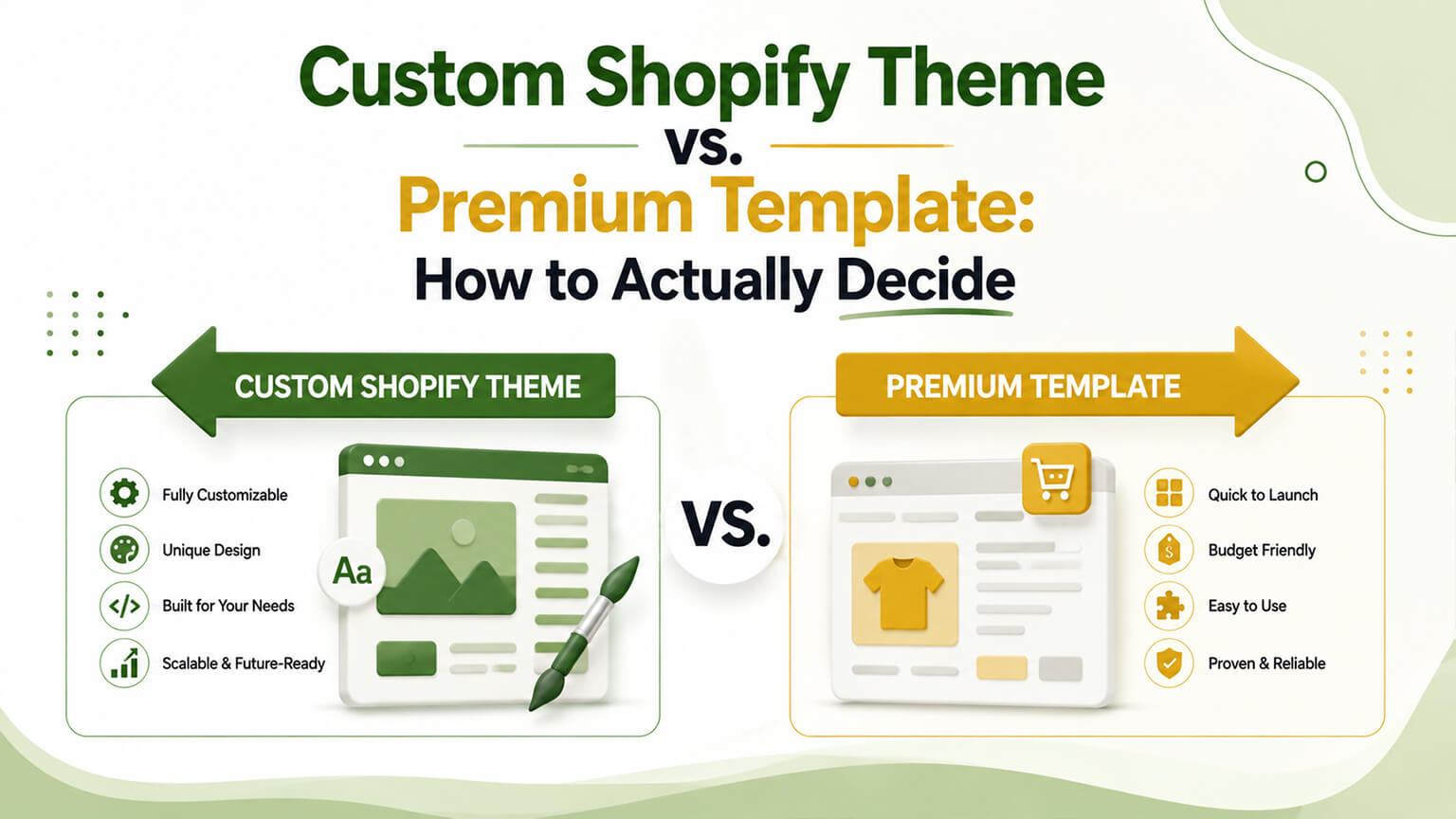
There’s a quiet assumption in a lot of ecommerce advice that custom is always better. Custom theme, custom design, custom everything — as if buying a template is something to be slightly embarrassed about. It isn’t. A well-chosen premium theme has launched countless successful brands, and a custom theme commissioned for the wrong reasons has drained plenty of budgets that should have gone to ads or inventory.
The real question isn’t which is better in the abstract. It’s which is better for you, right now, given what you’re trying to do. This article gives you a way to answer that without a salesperson’s thumb on the scale.
What you’re actually comparing
A premium template is a paid theme — from the Shopify Theme Store or a marketplace — that you configure to your brand. You get a polished, tested starting point with documentation and support, usually for a one-time fee in the low hundreds of dollars. You change settings, swap content, pick from the layouts it offers, and you’re live.
A custom theme is built for your store specifically. A designer and developer create the layouts, sections, and behavior you need, implemented in Liquid (or as a headless front end, though that’s a separate decision). You’re not picking from preset options; you’re defining them. The cost is in the thousands to tens of thousands, and the timeline is weeks rather than an afternoon.
There’s also a middle path that often gets ignored: heavily customizing a premium theme. You start from a clean, fast base like Shopify’s free Dawn theme or a quality paid theme, then have a developer build the custom sections and behavior you need on top. For a lot of brands this is the smartest option, and we’ll come back to it.
The honest case for a premium template
Templates get unfairly dismissed, so let’s give them their due.
They’re cheap and fast. You can launch this week for a few hundred dollars. When you’re testing whether a product even has demand, that speed and frugality is exactly right — pouring money into a custom build before you’ve validated the business is a classic way to run out of runway.
They’re tested. A popular theme has been installed thousands of times across every browser and device. The bugs have been found and fixed by other people. Your brand-new custom code has not had that trial by fire.
They’re maintained. The theme vendor ships updates, fixes compatibility issues, and supports you. With a custom theme, that responsibility is yours (or your agency’s).
And modern themes are flexible. Thanks to Shopify’s section system, today’s premium themes let you build quite distinctive pages without code. The ceiling is higher than it used to be.
The catch is that you’re working within someone else’s decisions. You can rearrange the furniture, but you can’t move the walls. When your needs exceed what the theme’s settings allow, you hit a wall — and how soon you hit it depends entirely on how unusual your requirements are.
The honest case for a custom theme
Custom themes earn their cost in specific situations, not as a default flex.
You get a store that’s truly yours. Not “this looks a bit like that other brand’s store” — truly distinctive, which matters more in crowded, design-led categories like fashion, beauty, and jewelry where the storefront is part of the product.
You get exactly the features you need, built the way you need them, rather than bending your business to fit a theme’s assumptions. If your selling model is unusual — complex bundles, configurators, a particular merchandising logic — custom is often the only way to do it cleanly.
You get control over performance. This surprises people: custom is frequently faster than a premium template, because templates ship code to support every feature any customer might use, most of which you don’t. A custom theme includes only what you need. Built well, that’s a real Core Web Vitals advantage.
And you get a section library tailored to how your team works, so marketers can build campaigns and landing pages without a developer for each one.
The cost isn’t only money. A custom build takes weeks, demands your time in reviews and feedback, and hands you the maintenance responsibility. Done badly — by someone who writes tangled, undocumented code — a custom theme can be worse than a template, because now you own a mess only one person understands.
A decision framework that doesn’t require a developer
Run your situation through these questions. The answers point pretty clearly one way or the other.
How validated is your business? Pre-revenue or testing a concept? Template. You need to prove demand before investing in bespoke anything. Established with steady sales and a clear trajectory? Custom starts to make sense.
How unusual are your requirements? If you sell normal products in a normal way, a good theme handles it. If your selling model is distinctive, you’ll hit a template’s limits fast, and paying to fight those limits is worse than building for them from the start.
How much does brand differentiation matter in your category? In commodity categories, customers care about price and reviews more than whether your store looks unique. In premium and design-led categories, a templated look can actively undercut your positioning.
What’s your budget, honestly? Not just for the build, but for everything — ads, inventory, the rest. If a custom theme would consume the budget you need to actually acquire customers, it’s the wrong priority no matter how nice it’d be.
Who’ll maintain it? If you have no developer relationship and no plan for upkeep, a maintained template removes a burden. If you have an agency or in-house developer, custom is more sustainable.
Why the middle path wins more often than people expect
Here’s the option that gets lost in the binary framing: take a clean, fast premium (or free) theme and customize the specific parts that matter.
Maybe your product page needs to be special because it’s where you win or lose the sale — so you invest there, and leave the rest of the store on solid, standard foundations. Maybe you need three custom sections for your homepage and a particular collection layout, but everything else the theme already does well. You spend a fraction of a full custom build, you get the distinctiveness where it counts, and you keep the tested reliability of a real theme underneath.
For a large share of growing brands, this is the right answer and nobody offered it, because “custom theme” sounds more impressive in a pitch and “template” sounds cheap. Ignore the framing and look at the outcome: the parts that drive revenue should get attention, and the parts that don’t can stay standard.
Common mistakes in both directions
Brands over-invest by commissioning a full custom build to “look professional” before they have the traffic to justify it, then can’t afford marketing. They also under-invest by clinging to a cluttered, slow template stuffed with apps long after they’ve outgrown it, leaving real money on the table because the store can’t keep up with the brand.
A subtler mistake: buying a flashy, feature-heavy “multipurpose” theme loaded with sliders, animations, and effects. These look great in the demo and load like treacle in the real world. A clean, fast theme with fewer bells beats a heavy one every time, because speed converts and animations rarely do.
How to choose a premium theme if you go that route
If a template is the right call, choose well. Prioritize speed — check the theme’s demo in PageSpeed Insights before you buy, not after. Favor themes with a strong section system so you can build pages without code. Read recent reviews for how responsive the vendor’s support is. And resist the temptation to pick the theme with the most features; pick the one that does the few things you need cleanly and loads fast.
What “outgrowing a template” actually feels like
Brands rarely wake up one day needing custom. They drift toward it, and the signs are worth recognizing so you neither jump early nor cling too long. The clearest tell is fighting the theme — when you and your developer keep saying “the theme won’t let us do X without a hacky workaround.” A workaround or two is normal; a pattern of them means the theme is now costing you more in friction than a custom build would in money.
Another tell is performance you can’t fix. If your store is slow and you’ve removed the apps, optimized the images, and done the housekeeping, but a bloated multipurpose theme is still dragging you down, that’s a foundation problem a clean custom (or heavily customized) theme solves. A third is brand drift — your brand has matured past what the template can express, and the gap between how the brand looks everywhere else and how the store looks has become embarrassing. A fourth is operational: your marketing team is blocked on a developer for routine page changes because the theme’s section system is too rigid, and that bottleneck is slowing your whole calendar.
None of these alone forces a custom build. Together, or persistently, they’re the business telling you the foundation no longer fits.
A cost-of-ownership lens most people skip
The sticker price gets all the attention, but the smarter comparison is total cost of ownership over a couple of years. A template costs little upfront but can cost you in conversion and speed if you outgrow it and don’t act, plus the recurring drag of apps bolted on to fill its gaps. A custom theme costs more upfront but, built well, can cost less over time — fewer apps needed, better performance, faster page-building for your team, and no theme-vendor lock-in.
The crucial words are “built well.” A custom theme built by someone who writes clean, documented, sectioned code is an asset that lowers your ongoing costs. A custom theme built as a tangle only its author understands is a liability that raises them, because every future change is slow and risky. This is why who builds your custom theme matters as much as the decision to go custom at all — and why the cheapest custom quote can be the most expensive choice over two years. When you run the cost-of-ownership math, factor in maintenance, app subscriptions, page-building speed, and the likelihood you’ll need to redo it if it’s built badly.
How the decision shifts by category and stage
The template-versus-custom question doesn’t have one answer because it changes shape depending on what you sell and how far along you are. A few category patterns make the framework concrete.
In design-led categories — fashion, beauty, jewelry, premium home goods — the storefront is part of the product. Customers in these spaces read a templated, generic-looking store as a signal about the brand itself, and a distinctive experience can justify its cost. Here, custom (or heavy customization) tips into worthwhile earlier than the raw revenue numbers alone would suggest, because differentiation is doing real work.
In commodity and price-driven categories — supplements, basics, replacement parts, anything where shoppers compare on price and reviews — a distinctive storefront earns far less. Customers care that the page is fast, clear, and trustworthy, not that it’s unique. A clean template does that job well, and money that would have gone to a custom design is almost always better spent on acquisition, price competitiveness, or inventory.
B2B and unusual selling models are the category most likely to force custom regardless of aesthetics, because the requirement is functional rather than visual. Custom pricing per account, quantity breaks, purchase-order workflows, gated catalogs — when a template simply can’t express how you sell, you build for it, and the decision is made for you.
Stage cuts across all of this. A pre-revenue brand in any category should almost always start with a template, because the priority is proving demand cheaply before investing in bespoke anything — even a fashion brand is better off validating on a good template than spending its runway on a custom build nobody’s visited yet. An established brand with steady sales and a clear trajectory has both the justification and the data to invest, and can do so knowing what actually needs to be custom rather than guessing.
The honest synthesis: let category tell you how much differentiation is worth, and let stage tell you whether now is the time to pay for it. A design-led brand with real traction is the clearest case for custom; a commodity brand still validating is the clearest case for a clean template; and most brands, in between those poles, are best served by the middle path — a strong, fast theme with the revenue-critical parts customized.
Don’t forget the maintenance question
Whichever way you lean, ask one question before you commit: who keeps this working over the next two years? It’s the part that decides whether your choice ages well or badly. A premium template answers it for you — the vendor ships updates and fixes compatibility as browsers and Shopify evolve, so upkeep is largely handled. A custom theme puts that responsibility on you or whoever built it, which is fine if you have a developer relationship and a plan, and a slow-building problem if you don’t.
This is why the maintenance answer should inform the build decision rather than being an afterthought once the store is live. If you have no developer and no appetite to manage upkeep, the maintained template removes a real burden and that weighs in its favor. If you have an agency or in-house help, custom becomes sustainable and the burden is a non-issue. Deciding template-versus-custom without answering the maintenance question is how brands end up with a beautiful custom store nobody can safely change six months later — an asset that quietly turned into a dependency.
Frequently asked questions
How does my industry affect the decision?
A lot. In design-led categories like fashion, beauty, and jewelry, the storefront is part of the product, so differentiation is worth more and custom tips into worthwhile earlier. In commodity, price-driven categories, customers care about speed, clarity, and trust more than a unique look, so a clean template is usually the smarter spend. B2B and unusual selling models often force custom regardless of aesthetics, because a template simply can’t express how you sell. Let your category tell you how much differentiation is worth, and let your stage tell you whether now is the time to pay for it.
Is a custom Shopify theme always better than a template?
No. A custom theme is better when you have a validated business, distinctive requirements, a brand-led category, and the budget and maintenance plan to support it. For early-stage brands, normal requirements, or tight budgets, a well-chosen premium theme is often the smarter call — and sometimes the best option is a premium theme with a few targeted customizations.
Will a custom theme make my store faster or slower?
Built well, usually faster. Premium themes ship code to support every feature any customer might want, most of which you don’t use; a custom theme includes only what you need. The caveat is “built well” — a poorly coded custom theme can be slower than a clean template, so who builds it matters.
How long does a custom Shopify theme take to build?
Typically several weeks to a few months depending on the number of templates, custom features, and design rounds. A heavily customized premium theme is faster than a fully bespoke build, which is part of why the middle path appeals to brands that want distinctiveness without the full timeline.
What is the “middle path” between template and custom?
Starting from a clean, fast premium or free theme and customizing only the parts that matter — say, a custom product page and a few homepage sections — while leaving the rest standard. You get distinctiveness where it drives revenue and tested reliability everywhere else, usually for a fraction of a full custom build.
A quick self-assessment
If you want to translate all this into a yes-or-no lean, run through a short self-assessment and count which way the answers point. Has your business validated demand with real, steady sales? Are your selling requirements unusual enough that a theme would fight you? Does brand differentiation matter in your category? Do you have budget beyond what you need for marketing and inventory? And do you have a developer relationship or plan for ongoing maintenance?
If most of those are yes, custom (or substantial customization) is likely worth it for you, and you’d probably feel the limits of a template before long. If most are no — especially if you’re early, your requirements are normal, or budget is tight — a clean premium theme is almost certainly the smarter use of money right now, and choosing it is good judgment rather than settling.
And if you’re split down the middle, that’s precisely the signal to look hard at the middle path: a strong, fast theme with targeted customization of the parts that drive revenue. It captures most of the upside of custom for a fraction of the cost and commitment, and it’s the answer that suits more growing brands than either extreme. The decision isn’t really template versus custom — it’s matching the level of investment to where your business actually is, and being honest about that rather than buying for the brand you imagine being someday.
The takeaway
Template versus custom isn’t a status question, it’s a fit question. Early, validating, normal requirements, tight budget? A clean premium theme — possibly with a few targeted customizations — is almost always right. Established, distinctive, brand-led, with the budget and a maintenance plan? Custom earns its keep.
And whenever you’re unsure, look hard at the middle path. The smartest spending often isn’t “template or custom” but “standard where it doesn’t matter, custom where it does.” That’s not a compromise. It’s just good allocation of money you’d rather spend growing the business.