
Composable Commerce vs. All-in-One: What the Hype Misses
On this page
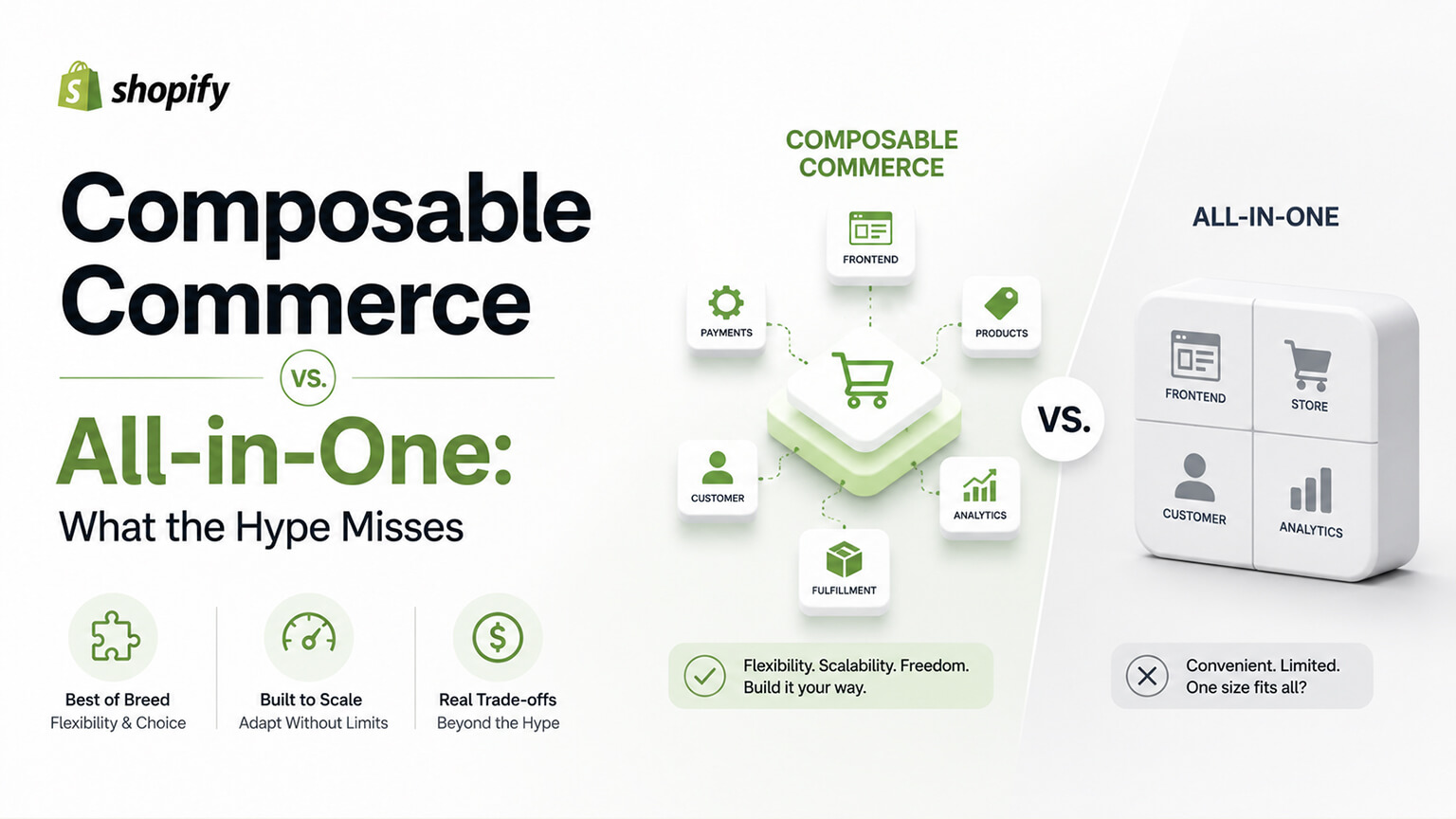
“Composable commerce” is having a moment. It shows up in vendor decks, analyst reports, and conference talks, usually framed as the inevitable future that smart brands are racing toward while everyone else gets left behind. Some of that is real. A lot of it is the enterprise-software industry doing what it always does — turning a reasonable idea into a buzzword you’re made to feel behind for not adopting.
Let me try to give you the grounded version: what composable commerce actually is, what the trade-offs really are, and who really benefits versus who’s being sold a more complicated, expensive setup than they need.
What the term actually means
Strip away the jargon and composable commerce is a philosophy about how you assemble your tech stack. The “all-in-one” approach is a single platform that does most things — your store, your checkout, your content, your basic marketing tools, all under one roof. Shopify, at its core, is largely an all-in-one: a lot of what you need is built in or tightly integrated.
The composable approach says: instead of one platform doing everything (and inevitably doing some things only okay), assemble your stack from best-of-breed pieces. A dedicated commerce engine here, a specialized content management system there, a separate search provider, a separate this and that — each chosen for being excellent at its one job, connected together through APIs. You “compose” your ideal stack from specialized parts rather than accepting one vendor’s bundle.
It’s closely related to headless, because going composable usually means decoupling your storefront from any single platform so you can plug those pieces together. The two ideas travel together: composable is the philosophy, headless is often the architecture that enables it.
The genuine appeal
There’s a real case here, and it’s worth stating fairly. When you assemble best-of-breed components, each part can be excellent rather than “good enough.” If content is central to your brand, a dedicated content management system runs circles around the content features bundled into a commerce platform. If search and discovery are critical, a specialized search provider does things a built-in search never will. You’re not stuck with one vendor’s weakest features.
You also get flexibility. Want to swap your search provider in two years because something better came along? In a composable setup, you replace that one piece without ripping out everything. You’re not married to a single vendor’s roadmap and decisions. For large, sophisticated operations with specific, demanding needs across many areas, that flexibility and that best-of-breed quality can be a real competitive advantage.
The part the hype skips: cost and complexity
Here’s what the glossy decks gloss over. Every piece you add to a composable stack is a piece you have to integrate, maintain, and keep working with all the other pieces. Five best-of-breed components connected by APIs means five vendors, five sets of updates, five things that can break, and a lot of integration glue holding it together — glue that you own and maintain.
An all-in-one platform handles a huge amount of this for you. The pieces are already integrated; the vendor makes sure they work together; updates don’t break the seams because there are fewer seams. You trade some best-of-breed excellence for enormous simplicity and lower total cost of ownership. That trade is invisible in a vendor pitch that’s only showing you the upside of specialization, but it’s the whole ballgame for most brands.
Composable done well needs real technical capacity — to build the integrations, maintain them, and manage the complexity indefinitely. It needs budget, not just for the build but for the ongoing operation. For a brand without that capacity, going composable doesn’t get you a best-of-breed dream stack; it gets you a fragile, expensive, hard-to-maintain mess that underperforms the all-in-one you left.
Where Shopify sits in all this
Worth clarifying, because it confuses people. Shopify is fundamentally strong as an all-in-one — that’s a big part of its appeal, and for most brands it’s exactly the right model. But Shopify also supports composable and headless approaches: you can keep Shopify as your commerce engine (the part it’s best at — catalog, cart, checkout) while composing other best-of-breed pieces around it, like a dedicated CMS, connected through its APIs.
So it’s not “Shopify all-in-one versus composable” as an either/or. A common and sensible middle path is Shopify-as-commerce-core in an otherwise composable stack — you get Shopify’s rock-solid, high-converting checkout and commerce backend, plus the freedom to plug in specialized tools where they really matter. That hybrid is often far more sensible than going fully composable with a separate commerce engine, because it keeps the riskiest, most critical piece (commerce and checkout) on something reliable while letting you specialize elsewhere.
Who should actually consider it
So who’s it for? Large, sophisticated brands with specific, demanding needs that an all-in-one can’t meet, and the technical capacity and budget to build and maintain a composable stack properly. Content-heavy operations where a dedicated CMS is a real competitive edge. Businesses with complexity — multiple brands, regions, channels — where the flexibility pays off. Brands that have honestly outgrown what a bundled platform can do and have the team to handle the alternative.
And who’s being oversold? Most everyone else. If an all-in-one (or Shopify-as-core with a couple of best-of-breed additions) meets your needs — and for the large majority of brands it does — going fully composable adds cost and complexity for benefits you won’t fully use and maintenance you’re not staffed for. There’s no prize for having a fashionably composable stack. The prize is a store that performs, converts, and is sustainable to run, and for most brands that’s a simpler setup, not a more complicated one.
The bottom line
Composable commerce is a real, sometimes powerful approach — assembling best-of-breed pieces instead of accepting one vendor’s bundle — with genuine benefits in quality and flexibility for the brands that need it and can support it. But the hype conveniently omits the cost: complexity, integration burden, and maintenance that demand real technical capacity. For most brands, an all-in-one like Shopify, possibly with a few specialized additions around a Shopify commerce core, delivers what they need at a fraction of the complexity. Don’t adopt composable because it’s the buzzword of the moment. Adopt it if, and only if, you have a specific need it solves and the team to run it. Otherwise, simpler wins.
The maintenance and team reality that decides it
The composable-versus-all-in-one debate usually gets argued on features and flexibility, but the factor that actually decides whether composable is a good idea for you is far more mundane: who’s going to build and maintain the thing, because a composable stack is several systems you’ve chosen to stitch together, and someone has to keep those seams working indefinitely. This is the part the hype consistently skips, and it’s the part that sinks most composable projects.
An all-in-one platform like standard Shopify is, by design, integrated — the pieces are built to work together, updates are coordinated, and a lot of the maintenance is the platform’s problem rather than yours. You give up some flexibility in exchange for the pieces cohering without your effort. A composable stack inverts that trade: you assemble best-of-breed pieces — commerce here, a separate CMS there, a dedicated search provider, other specialized tools — each excellent at its job, but now the integration between them, and the ongoing health of that integration, is your responsibility. When one piece updates, you have to make sure it still plays nicely with the others. When something breaks at a seam, it’s yours to diagnose across multiple systems. That’s real, permanent work.
Which means the honest question isn’t “is composable more powerful?” — it usually is, in the abstract — but “do we have the engineering capacity to build and maintain a multi-system architecture indefinitely?” A brand with a capable in-house engineering team or a committed agency relationship can absolutely take this on and reap the benefits of best-of-breed flexibility. A brand without that capacity will find a composable stack slowly decaying: seams that break and stay broken, pieces that drift out of sync, an architecture that becomes a liability rather than an asset. The flexibility is real, but so is the ongoing burden, and the burden is what the pitches understate.
So the deciding lens is your team and your maintenance reality, not the feature comparison. If you have the engineering capacity and a genuine need that best-of-breed pieces solve — a content operation that a dedicated CMS serves far better, a search requirement a specialized provider handles, scale or complexity that justifies the architecture — composable can be excellent. If you don’t have that capacity, or your needs are well served by an integrated platform, the all-in-one approach isn’t a compromise; it’s the sensible choice that keeps your effort on growing the business rather than maintaining plumbing. Match the architecture to your capacity to run it, and the composable-versus-all-in-one question mostly answers itself — which is a far more useful test than tallying features neither approach will let you use if you can’t maintain them.
What “best-of-breed” really buys you, and what it costs
The seductive phrase in composable pitches is “best-of-breed” — the promise that instead of accepting an all-in-one’s compromises, you assemble the single best tool for each job. It’s a real benefit, but it’s worth being precise about what it buys and what it quietly costs, because the phrase does a lot of persuasive work while glossing over the trade.
What it buys is depth in each area. A dedicated headless CMS is usually a far more powerful content tool than an all-in-one platform’s built-in content features, so a content-heavy brand — one whose editorial, storytelling, and guides are central — can get a meaningfully better content operation by pairing that CMS with commerce. A specialized search-and-discovery provider can outperform a general platform’s built-in search for a large catalog where findability really matters. A best-of-breed piece is, by definition, better at its one job than the equivalent module in an integrated suite that has to be decent at everything. For a brand with a specific area where that extra depth is a real competitive need, the benefit is concrete rather than theoretical.
What it costs is the integration and the coherence you gave up. An all-in-one platform’s modules are built to work together — the content, the commerce, the checkout, the data all cohere because one vendor made them cohere. When you assemble best-of-breed pieces, that coherence becomes your job: connecting the CMS to the commerce, keeping the search index in sync with the catalog, ensuring the pieces share data correctly, and maintaining all of that as each piece independently evolves. You’ve traded “decent at everything, integrated for free” for “excellent at each thing, integrated at your expense.” That expense is real, ongoing, and paid in engineering effort.
So the honest way to evaluate best-of-breed is per area, against your actual needs. Is there a specific area — content, search, something else — where an all-in-one’s built-in capability is holding you back, badly enough that a specialized tool’s extra depth justifies owning the integration? If yes, composable earns its cost in that area. If your needs in each area are well served by an integrated platform’s modules, then best-of-breed is buying depth you don’t need at a coherence cost you’d rather not pay. The phrase makes composable sound unambiguously superior, but it’s only superior where you have a real need for the depth and the capacity to pay for the integration — which, for most stores in most areas, is a narrower situation than the pitch implies.
Where Shopify fits, and the middle ground people miss
The composable-versus-all-in-one framing is often presented as a stark binary, but the more useful truth is that there’s a spectrum, and Shopify occupies an interesting spot on it that dissolves a lot of the supposed dilemma. Understanding that spectrum keeps you from thinking you have to choose between a rigid all-in-one and a fully composable stack you can’t maintain.
At one end sits the pure all-in-one: an integrated platform where everything is built together and you accept its compromises in exchange for coherence and low maintenance. At the other end sits fully composable: a stack of best-of-breed pieces you assemble and integrate yourself, maximally flexible and maximally your responsibility to maintain. The pitches tend to present these as the only two options, so you feel forced to choose between rigidity and complexity.
Shopify muddies that binary in a useful way, because it’s an integrated commerce platform that also supports composable approaches when you want them. You can run it as a coherent all-in-one — commerce, content, checkout, apps all working together with the platform handling the integration — which suits most stores well. But you can also go headless with it, keeping Shopify’s commerce engine and checkout while building a custom storefront and plugging in a separate CMS or other best-of-breed pieces where you have a real need. And in between, you can extend an integrated Shopify store with specialized apps and tools for specific jobs without going fully composable at all. So rather than a binary, Shopify offers a dial you can turn toward composability exactly as far as your needs and capacity justify, keeping the integrated coherence everywhere else.
This middle ground is what the hype misses, and it’s where most brands are best served. You don’t have to choose between an all-in-one that constrains you and a fully composable stack that overwhelms your maintenance capacity. You can run a coherent, low-maintenance integrated store for the large majority of what you do, and selectively adopt best-of-breed pieces — a powerful CMS, a specialized search provider, a headless storefront — only in the specific areas where you have a genuine need and the capacity to maintain the integration. That selective, needs-driven composability captures the benefit where it matters without taking on the full cost everywhere. So when someone frames it as composable versus all-in-one, the sharper question is: in which specific areas, if any, do I have a real need that best-of-breed depth solves and the capacity to maintain — and can I keep everything else integrated and simple? For most stores, the answer is a mostly-integrated setup with composability applied surgically, which is neither pole the pitches argue for, and usually the wisest place to land.
Frequently asked questions
Is composable commerce better than an all-in-one platform?
Not inherently — it’s better only where you have a real need for best-of-breed depth and the capacity to maintain the integration. Composable lets you assemble the single best tool for each job (a powerful CMS, a specialized search provider) and can outperform an all-in-one in a specific area, but you take on permanent responsibility for keeping those pieces connected as each evolves. An all-in-one trades some depth for coherence and low maintenance. The deciding factors are your engineering capacity and whether a specific area is holding you back. For most stores, a mostly-integrated platform with composability applied surgically — only where a real need justifies it — beats both extremes.
Does choosing Shopify mean choosing all-in-one over composable?
Not at all — Shopify sits on a spectrum rather than at one pole, which dissolves much of the supposed dilemma. You can run it as a coherent, low-maintenance all-in-one (commerce, content, checkout, and apps working together with the platform handling integration), which suits most stores. But you can also go headless with it — keeping Shopify’s commerce engine and checkout while building a custom storefront and plugging in a best-of-breed CMS or search provider where you have a real need — or simply extend an integrated store with specialized apps for specific jobs. So rather than choosing between a rigid all-in-one and an unmaintainable fully composable stack, you can turn the dial toward composability exactly as far as your needs and capacity justify, keeping everything else integrated and simple.
How do I decide between composable and all-in-one?
Judge it on your team and maintenance capacity, not on which is more powerful in the abstract. A composable stack means assembling best-of-breed pieces (commerce, a separate CMS, a dedicated search provider, other tools) and taking permanent responsibility for the integration between them — keeping the seams working as each piece updates. That flexibility is real, but so is the ongoing engineering burden. If you have a capable in-house team or committed agency and a genuine need best-of-breed pieces solve, composable can be excellent. If you don’t, an integrated all-in-one platform isn’t a compromise — it’s the sensible choice that keeps your effort on growth rather than maintaining plumbing.
What is composable commerce in simple terms?
It’s building your tech stack from best-of-breed specialized pieces — a commerce engine, a dedicated CMS, a separate search provider, and so on — connected through APIs, instead of using one all-in-one platform that does most things. The idea is that each piece can be excellent at its one job, at the cost of more integration and maintenance.
Is composable commerce better than an all-in-one platform?
Not universally — it’s a trade-off. Composable offers best-of-breed quality and flexibility but adds significant cost, complexity, and maintenance that require real technical capacity. All-in-one platforms trade some specialization for simplicity, integration, and lower total cost of ownership. For most brands, the all-in-one (or a hybrid) wins.
Can I use Shopify in a composable setup?
Yes. A common, sensible approach is keeping Shopify as your commerce core — for the catalog, cart, and reliable checkout it does best — while composing best-of-breed tools like a dedicated CMS around it via its APIs. That hybrid keeps the most critical piece reliable while letting you specialize where it matters.
Who actually needs composable commerce?
Large, sophisticated brands with specific needs an all-in-one can’t meet, plus the budget and technical team to build and maintain the stack. Content-heavy or multi-brand/multi-region operations are common fits. Most other brands are better served by an all-in-one or a light hybrid, and going fully composable would add complexity they don’t need.