
Best Shopify Subscription Apps Compared
On this page
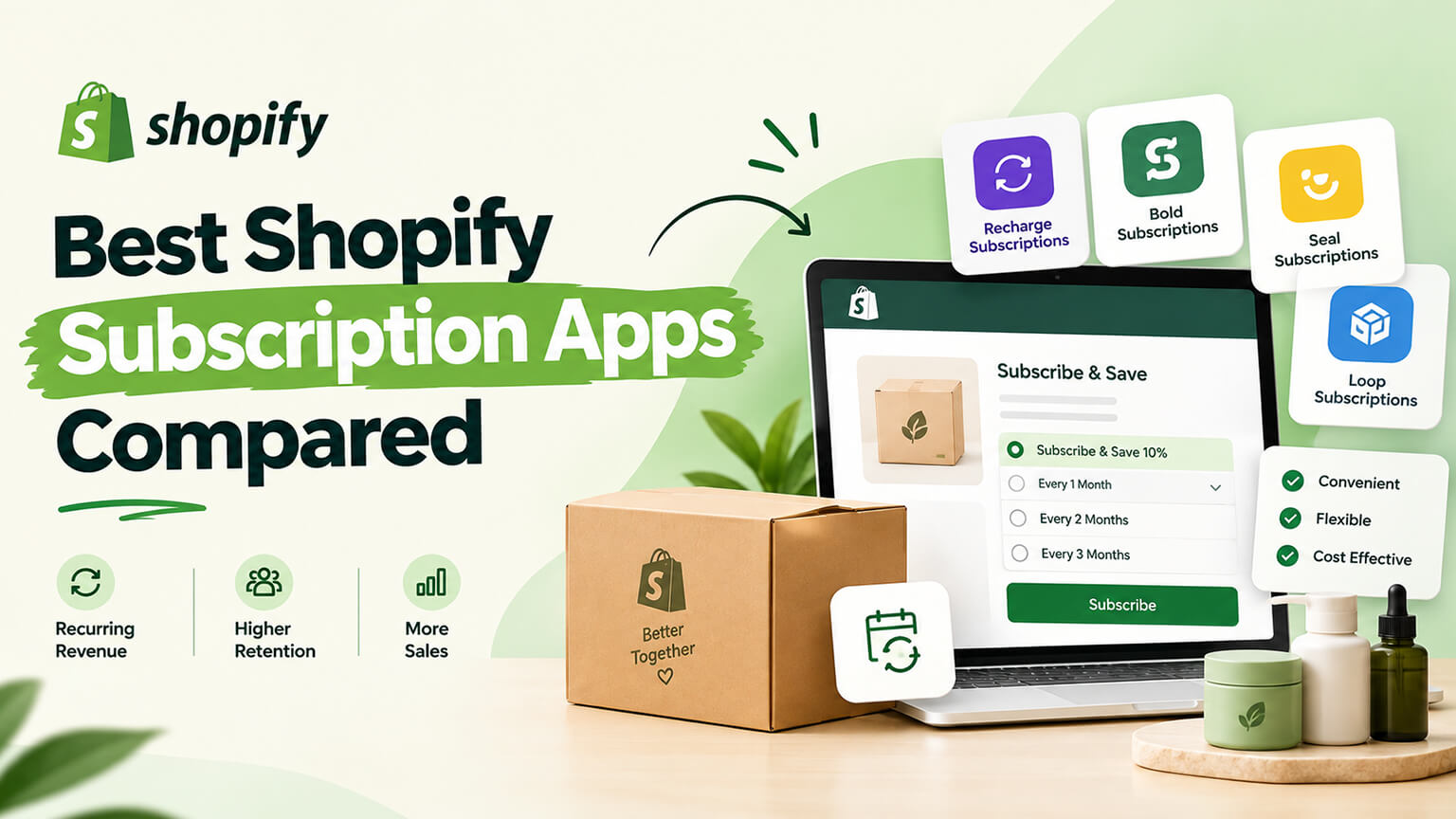
Subscription apps are the single stickiest decision in your app stack. Swap your review app and you lose some display formatting. Swap your subscription app and you are migrating live billing relationships, stored payment tokens, and recurring schedules for every subscriber you have — while none of them notice. That is a hard project, and it is why choosing well the first time matters more here than anywhere else.
So this is less a ranking than a way to think about the decision. The right app depends on how you sell, what your margins look like, and how much custom behaviour your model needs.
What a subscription app actually has to do
It is worth separating the obvious job from the hard one.
The obvious job is taking recurring payments on a schedule. Every app in this category does that, and none of them differentiate on it.
The hard job is everything around it. Storing payment methods securely and handling their expiry. Retrying failed payments intelligently without annoying the customer or burning through retry limits. Giving subscribers a portal where they can skip, swap, pause, reschedule, or cancel without emailing you. Handling proration when someone changes plan mid-cycle. Managing dunning when a card fails. Passing clean data to your email platform so you can run winback and churn-prevention flows. Reporting on the metrics that matter — churn rate, subscriber lifetime value, monthly recurring revenue.
That second list is where apps separate, and it is where the money is. A subscription business lives or dies on churn, and most churn is not a decision — it is a failed payment nobody rescued, or a customer who wanted to pause and could only find a cancel button.
How to evaluate, in order of importance
Migration path in and out. Ask first, not last. Can it import existing subscribers with their payment tokens intact, and can it export them if you leave? An app that traps your subscribers is a permanent decision disguised as a monthly subscription. Get the answer in writing before you commit.
The customer portal. This is the part subscribers actually touch, and it drives your churn rate more than anything else in the app. Can they skip a delivery, change frequency, swap products, update an address, and pause — all without contacting you? Is it on your domain, styled like your store, and usable on a phone? A clunky portal is a churn engine, and portal quality varies enormously between apps.
Dunning and failed-payment recovery. Ask specifically how it handles declines: how many retries, on what schedule, with what customer communication, and does it use any intelligence about when a retry is likely to succeed. Failed payments are the largest single source of involuntary churn, and better recovery here is usually worth more than any other feature.
Fee structure. Most charge a platform fee plus a percentage of subscription revenue, sometimes on top of payment processing. At low volume the percentage is irrelevant. At scale it becomes one of your larger line items, and the app that looked cheapest at fifty subscribers may be the most expensive at five thousand. Model it at your projected volume, not today’s.
Flexibility for your model. Straightforward subscribe-and-save is universally supported. Build-a-box, curated rotating boxes, prepaid terms, gifting, tiered membership pricing, and bundles-within-subscriptions are where apps diverge sharply. Write your model down precisely and check it against each candidate.
Your stack. Klaviyo integration depth matters if email drives your retention. Check how subscription events flow through, whether you can segment on subscription status, and how your accounting system will see the recurring revenue.
Where the main options sit
Rather than rank them, here is the shape of the market — verify current specifics before publishing.
Recharge is the established default and the one most agencies know best. It has the deepest ecosystem, the most integrations, the most mature tooling, and the largest pool of developers who have worked with it. Its customer portal is customisable, which matters, and our Recharge development work is largely about building portals that look and behave like the rest of the store rather than an obvious bolt-on. The trade is cost at scale and a certain amount of complexity you inherit from its maturity.
Shopify’s own subscription tooling deserves consideration precisely because it is native. Subscriptions built on Shopify’s APIs keep the data inside Shopify, avoid a third-party layer, and integrate cleanly with the rest of the platform. Several apps are built on this foundation. For straightforward subscribe-and-save it is increasingly the sensible default, and the native path tends to get better over time in a way third-party layers do not.
Newer, developer-oriented apps — Skio being the most prominent — have competed by focusing on migration from Recharge, a cleaner portal experience, and pricing pitched against the incumbent. For brands whose main complaint is portal quality or fees, they are worth a serious look.
Bold Subscriptions has been in the market a long time and remains a viable option, particularly for merchants already using other Bold products.
Lighter, cheaper apps exist and serve small catalogues well. The caution is to check the migration and portal questions especially carefully, because that is where budget options tend to be thin.
When to build instead of buy
Not often, but it does happen, and it is worth knowing the shape of it.
The case for custom is not usually “we want to own the billing.” Building subscription billing from scratch means taking on PCI scope, payment tokenisation, retry logic, and compliance — a serious undertaking with real risk that no sensible brand takes on lightly.
The realistic middle path is using a subscription app as the billing engine while building the customer experience around it yourself. A custom portal on your own domain, in your own design, with exactly the options you want to offer — backed by the app’s API. That gets you the churn benefits of a great portal without rebuilding billing, and it is the approach most sophisticated subscription brands end up taking.
The other genuine custom case is unusual logic: a subscription model that no app anticipated, pricing that varies by more dimensions than any portal supports, or deep integration with an internal system.
A worked example: the migration that paid for itself
A coffee brand with several thousand active subscribers came to us with a churn problem. Their numbers were not catastrophic, but they were losing more subscribers each month than the model could sustain.
The diagnosis was unglamorous. Two things dominated. First, failed payments: their app’s dunning was a single retry followed by a cancellation, and a meaningful share of “churned” subscribers had simply had a card expire. Second, the portal: skipping a delivery took four clicks through a poorly-styled page that did not work well on mobile, so customers who wanted to pause for a month cancelled instead.
Neither problem needed a different app in principle. Better dunning configuration recovered a large share of the involuntary churn. A rebuilt portal on their own domain, with skip and pause as prominent single-click actions, converted a lot of would-be cancellations into pauses.
The reason I tell this story is that they came in asking which app they should switch to. The answer was that the app was not really the problem — the configuration and the customer experience were. Switching apps would have been an expensive migration that fixed neither. Check that first before you assume the tool is at fault.
The metrics your app should be showing you
A subscription app that cannot tell you these numbers is making you fly blind, so check the reporting before you commit.
Churn rate, split by type. The single most important distinction in subscription commerce is voluntary churn (someone chose to leave) versus involuntary churn (a payment failed and nobody rescued it). These have completely different fixes — one is a product and experience problem, the other is a dunning configuration problem — and an app that reports a single blended churn number is hiding the difference.
Subscriber lifetime value. How much an average subscriber is worth across their whole relationship, which is the number that tells you what you can afford to spend acquiring one.
Monthly recurring revenue, with its components. Not just the total, but new subscribers, expansion, contraction, and churn broken out. A flat MRR line can hide heavy churn masked by heavy acquisition, which is an expensive way to stand still.
Retention by cohort. How subscribers who joined in January are doing compared to those who joined in June. Cohort views reveal whether changes you made actually improved retention, which a blended average will obscure for months.
Failed payment recovery rate. What share of declines eventually succeed. If your app cannot tell you this, you cannot tell whether your dunning is working.
Skip and pause usage. Counterintuitively, high skip rates are usually good news — those are customers who would otherwise have cancelled. If nobody skips, check whether the option is actually findable.
Where subscription revenue quietly leaks
Beyond the app itself, a few recurring problems cost subscription brands more than any feature gap.
Cancel flows with no alternatives. A cancel button that cancels is leaving money on the table. Offering a pause, a frequency change, a product swap, or a discount at the moment of cancellation converts a meaningful share of departures into retained subscribers. This is a configuration and design decision, not a software limitation, and most brands never set it up.
No pre-billing notification. Charging someone unexpectedly is a fast route to a cancellation and sometimes a chargeback. A reminder email a few days before the next charge, with a one-click skip option, reduces both — and the skips it generates are cheaper than the cancellations it prevents.
Poor first-delivery experience. A large share of subscription churn happens after the first or second delivery. If onboarding, packaging, and early communication are weak, no retention tooling later will rescue the relationship.
Treating subscribers like one-time buyers in email. Subscription customers need different messaging — upcoming charges, delivery timing, how to manage their plan. Sending them the same acquisition-focused campaigns as everyone else wastes the channel and occasionally irritates people into leaving.
No segmentation by subscription status. If your email platform cannot distinguish active subscribers from lapsed ones from one-time buyers, you cannot run winback properly. Check that the integration passes this cleanly — it is a common gap and it undermines your whole retention program.
Questions to ask every vendor before you sign
Take this list into each demo. The answers separate the apps far better than their marketing pages do.
“Can you import our existing subscribers including payment tokens, and what exactly transfers?” Listen for specifics about your gateway. Vague reassurance here is a warning sign.
“If we leave in two years, what can we export?” A vendor comfortable answering this is a vendor confident in their product. Evasion tells you what you need to know.
“Walk me through what happens when a card declines.” You want to hear about retry counts, retry timing, whether the schedule adapts, what the customer receives, and how long before the subscription is cancelled. “We retry it” is not an answer.
“Show me the customer portal on a phone.” Not a desktop screenshot — an actual phone. Then try to skip a delivery and change a frequency yourself, counting the taps.
“What does this cost us at [your projected volume] in eighteen months?” Platform fee plus percentage plus any transaction fees, calculated on realistic numbers rather than today’s.
“How does subscription status reach our email platform?” Specifically whether you can segment on active, paused, cancelled, and next-charge-date.
“Can customers subscribe to [your exact model]?” Describe your model precisely — build-a-box, prepaid terms, rotating curation, whatever it is — rather than accepting a general yes.
“Who else our size and in our category uses this?” Then talk to one of them, ideally about something that went wrong rather than a testimonial.
Matching the app to your model
A rough guide to which situations point where.
Straightforward subscribe-and-save on consumables — coffee, supplements, pet food, household goods. The most common model and the best supported. Shopify’s native foundation or any mainstream app will handle it; decide on portal quality and fees rather than capability.
Curated or rotating boxes where contents change each cycle. Needs an app comfortable with variable contents and good customer communication about what is coming. Check this specifically, because plenty of apps assume a fixed product.
Build-your-own-box where the customer assembles their selection. More demanding, and the portal experience matters enormously since customers will return to adjust their box. Often where custom portal work pays for itself.
Prepaid and term commitments — three months paid upfront, annual plans. Check proration handling and what happens at renewal, which is where these models get messy.
Membership and access rather than physical delivery. Different enough that some subscription apps are a poor fit; verify carefully.
Mixed carts where subscription and one-time items are purchased together. Sounds trivial and is a common source of friction. Test it properly before committing.
What it costs beyond the subscription fee
Budget for these, because they catch people out.
The portal build. Most brands eventually want a portal that looks like their store rather than a generic one, and that is design and development work on top of the app fee. Worth doing — the churn improvement usually pays for it — but plan for it rather than discovering it later.
Integration work. Connecting subscription data properly to your email platform, your analytics, and your accounting system is rarely as turnkey as the marketing suggests. Expect some integration work to get clean data flowing, particularly into accounting where recurring revenue recognition has its own rules.
Ongoing optimisation. Dunning schedules, cancel flows, and portal options all reward tuning. This is not a set-and-forget system; the brands with the best retention are the ones reviewing these numbers monthly.
Support load. Subscriptions generate support tickets — address changes, delivery timing, plan adjustments. A good portal reduces these substantially, which is another way portal quality pays back.
The bottom line
Choose a subscription app on migration path, portal quality, dunning intelligence, fee structure at your projected scale, and whether it supports your actual model. Those five things matter far more than the feature grid.
Recharge remains the safe, well-supported default with the deepest ecosystem. Shopify’s native subscription foundation is increasingly compelling for straightforward models and keeps your data in one place. The newer challengers compete meaningfully on portal experience and pricing, and are worth evaluating if those are your pain points.
The mistake to avoid is treating this as a reversible decision. It is the hardest app in your stack to change, so spend a week evaluating properly rather than an afternoon — and ask every vendor the migration question in both directions before you sign up.
If you are weighing a switch, or suspect your churn problem is configuration rather than software, we are happy to look at the numbers before you commit to a migration you may not need.
Frequently asked questions
Which Shopify subscription app is best?
There is no universal answer, because the right choice depends on your model and scale. Recharge is the safe default with the deepest ecosystem and the most agency familiarity. Shopify’s native subscription foundation is increasingly sensible for straightforward subscribe-and-save, keeping data inside the platform. Newer apps like Skio compete on portal quality and pricing. Evaluate on five things: can it import and export subscribers with payment tokens, how good is the customer portal, how intelligent is failed-payment recovery, what does the fee structure cost at your projected volume, and does it support your specific model. Those decide it far more than feature counts.
How hard is it to switch subscription apps?
Harder than any other app migration, which is why the choice deserves real evaluation upfront. You are moving live billing relationships — stored payment tokens, next-charge dates, plan configurations, discount arrangements — without disrupting subscribers or double-charging anyone. Payment tokens in particular are the sticking point; how portable they are depends on your gateway and the apps involved. It is routinely done and several vendors specialise in migrating away from competitors, but it is a project requiring careful planning and thorough testing, not a weekend swap.
Do subscription apps hurt site speed?
Less than you might expect, because most of the work happens in the billing layer rather than the storefront. The storefront footprint is typically a widget on the product page offering subscribe-and-save options, plus the customer portal. That widget does add weight, so check it loads efficiently and does not shift the layout as it renders. The bigger performance consideration is usually the portal, which is often a separate page carrying its own scripts. A custom-built portal can be considerably lighter than a stock one, which is a side benefit of building your own.
Should we build a custom subscription system?
Almost never build the billing itself — that means taking on PCI scope, payment tokenisation, retry logic, and compliance, which is serious risk for little reward. The sensible custom approach is different: use an established app as the billing engine, then build the customer-facing portal yourself against its API. That gives you a portal on your own domain, in your own design, with exactly the options you want to present — which is where churn is actually won or lost. The other genuine case for custom work is a subscription model no existing app supports, or deep integration with an internal system.