
Best Shopify Helpdesk Apps: Gorgias and the Alternatives
On this page
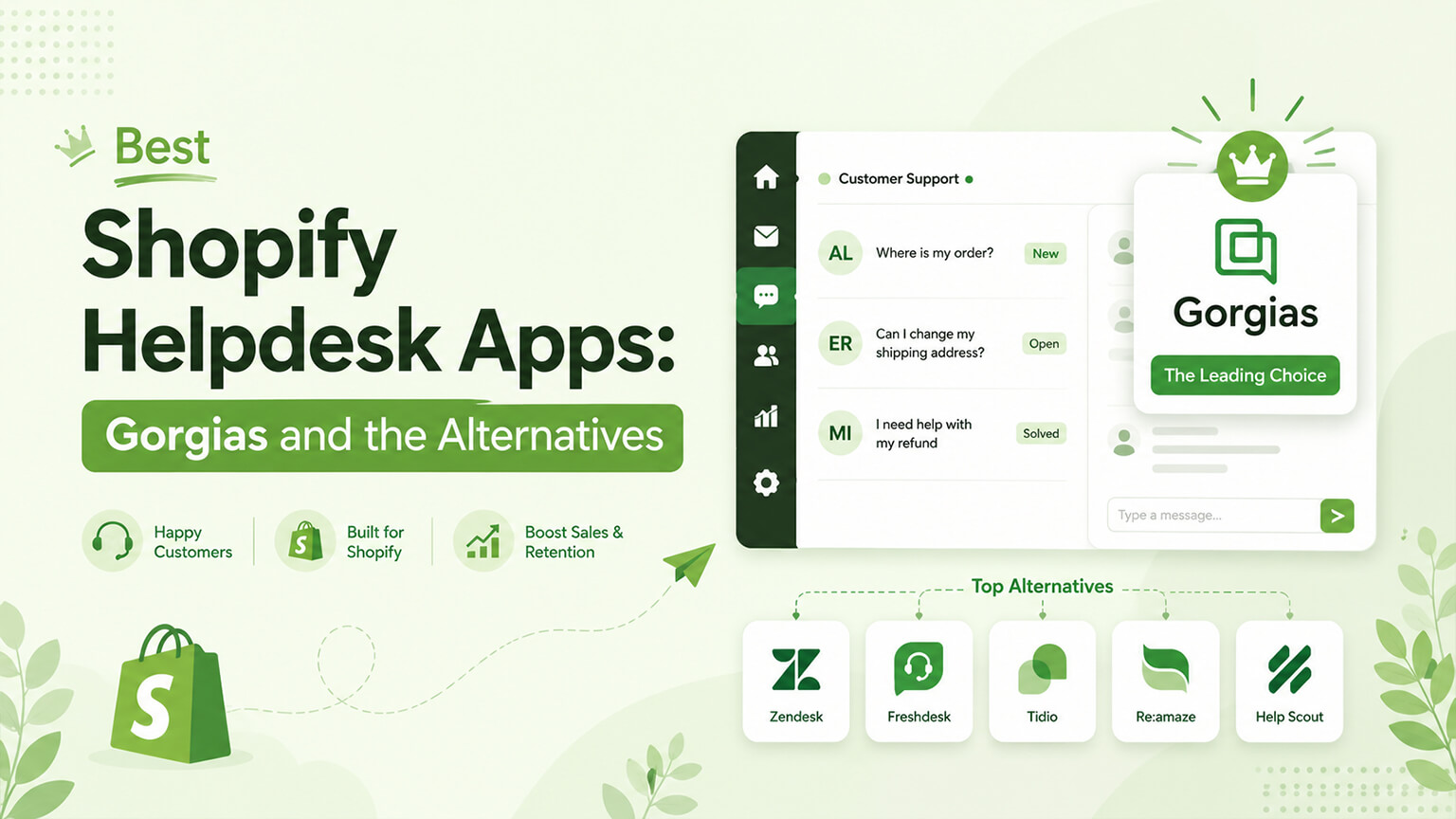
Customer support is a bigger lever than many stores realise: good support drives satisfaction, retention, and reviews (as the retention and reviews discussions cover), while poor or slow support frustrates customers and costs sales and loyalty. As a store grows, handling support through a personal inbox stops working — you need a proper helpdesk: a system that centralises customer conversations across channels (email, chat, social, SMS), integrates with your store (so agents see order and customer context), and helps your team respond efficiently and consistently. For Shopify, Gorgias is the best-known helpdesk (built specifically for ecommerce, with deep Shopify integration, as the AI-support discussion covers), but it’s not the only option — there are alternatives, each with strengths, and the right choice depends on your needs, size, and budget. This piece covers how to think about Shopify helpdesk apps: what a helpdesk does and why it matters, Gorgias and its strengths, the alternatives, and how to choose. (This connects to the AI-customer-support and returns discussions; this focuses on helpdesk apps and choosing among them. Note: specific apps, features, and pricing evolve, so verify current details; this covers how to think about the category.)
This piece covers what a helpdesk does and why it matters, Gorgias (the ecommerce-focused leader) and its strengths, the alternatives and their positioning, and how to choose the right helpdesk for your store. Because a good helpdesk turns support into a strength, and choosing well matters. Let me walk through it.
What a helpdesk does and why it matters
A helpdesk is the system that runs your customer support, and it matters more than many realise. Centralises conversations — a helpdesk centralises customer conversations across channels (email, live chat, social media, SMS, phone) into one place, so your team manages all support from one system (rather than scattered inboxes and channels), a foundation for efficient, organised support. Integrates store context — a good ecommerce helpdesk integrates with your store (Shopify), so agents see customer and order context (order history, customer details, order status) alongside the conversation — letting them help efficiently and knowledgeably (versus looking up info separately), which speeds and improves responses. Enables efficiency — helpdesks provide efficiency features: ticket management, assignment, macros/templates (canned responses), automation (as the AI-support discussion covers), and workflows, so your team handles support faster and more consistently (versus manual, ad-hoc handling) — important as support volume grows. Enables consistency and quality — a helpdesk supports consistent, quality support (templates, shared processes, oversight), so customers get consistent, good responses. Scales support — as support volume grows (with the store), a helpdesk lets you scale support (efficiently handling more volume, with a team), which a personal inbox can’t — so a helpdesk is essential for scaling support. Why it matters — support matters because it drives satisfaction, retention, reviews, and loyalty (good support) or costs sales and loyalty (poor support), as the retention and reviews discussions cover — so the helpdesk (which enables good, efficient, scalable support) is an important investment in a real lever. And support is a differentiator — good support can differentiate a brand (a reason customers choose and stay), so investing in it (via a good helpdesk) supports competitive advantage. So a helpdesk centralises conversations, integrates store context (for efficient, knowledgeable responses), enables efficiency (ticketing, macros, automation) and consistency/quality, and scales support — and it matters because support is an important lever (satisfaction, retention, reviews, loyalty) and differentiator, which a good helpdesk enables. So a helpdesk is a worthwhile investment as you scale, turning support into an efficient strength. The next sections cover Gorgias and the alternatives.
Gorgias (the ecommerce-focused leader) and its strengths
Gorgias is the best-known Shopify helpdesk, built specifically for ecommerce. Ecommerce-focused — Gorgias is built specifically for ecommerce (versus general helpdesks), so it’s designed around ecommerce support needs (order-related queries, ecommerce workflows), fitting ecommerce stores well. Deep Shopify integration — Gorgias’s key strength is deep Shopify (and ecommerce platform) integration: agents see order and customer data (and can often take actions like refunds/edits) directly in the helpdesk, so they handle order-related support (the bulk of ecommerce support) efficiently with full context — a major efficiency benefit. Multichannel — Gorgias centralises support across channels (email, chat, social, SMS), managing all ecommerce support in one place. Automation and AI — Gorgias offers automation and AI features (auto-responding to common queries, AI assistance, as the AI-support discussion covers), helping handle volume efficiently (automating routine queries, assisting agents). Ecommerce workflows — Gorgias supports ecommerce support workflows (handling common ecommerce queries — where’s my order, returns, product questions — efficiently), fitting how ecommerce support works. Popular and proven — Gorgias is widely used in ecommerce (popular, proven, with a large user base and ecosystem), so it’s a well-supported, established choice. And its positioning — Gorgias positions as the ecommerce helpdesk (purpose-built, deeply integrated), which is its main appeal (versus general helpdesks not built for ecommerce). Considerations — Gorgias’s considerations include cost (its pricing, which can be significant especially at volume — worth evaluating for your size/volume) and that it’s one option among alternatives (not automatically right for everyone). So Gorgias is the ecommerce-focused helpdesk leader, with strengths in deep Shopify/ecommerce integration (agents handling order-related support with full context and actions — a major efficiency benefit), ecommerce focus, multichannel support, automation/AI, ecommerce workflows, and being popular and proven — making it a strong, purpose-built choice for ecommerce support, with cost being a consideration. So Gorgias is often a strong choice for Shopify stores (especially given its ecommerce integration), worth considering, while weighing its cost and the alternatives. The next section covers the alternatives.
The alternatives and their positioning
Gorgias isn’t the only option; alternatives suit different needs. General helpdesks (Zendesk, Freshdesk, Help Scout, etc.) — established general-purpose helpdesks (Zendesk, Freshdesk, Help Scout, and others) offer robust helpdesk functionality (ticketing, multichannel, automation), with Shopify integrations available (though often less deep/ecommerce-native than Gorgias) — suiting stores wanting a proven general helpdesk (perhaps already used, or for broader/non-ecommerce support needs), though the ecommerce integration may be less seamless than Gorgias. Other ecommerce-focused helpdesks — there are other ecommerce-focused helpdesk options (some newer or competing with Gorgias on ecommerce integration), which may offer similar ecommerce focus/integration, sometimes at different price points or with different features — worth considering as Gorgias alternatives for ecommerce. Live-chat-focused tools — some tools focus on live chat/messaging (with support features), suiting stores prioritising chat-based support. Simpler/cheaper options — simpler or cheaper helpdesk tools (or Shopify’s own inbox/chat for basic needs) suit smaller stores with modest support volume, where a full-featured (and pricier) helpdesk like Gorgias may be more than needed. All-in-one or CRM-adjacent tools — some tools combine helpdesk with other functions (CRM, marketing), suiting stores wanting an integrated suite. And Shopify Inbox — Shopify’s own Inbox (free, basic chat/messaging) can handle basic support for smaller stores, a starting point (though not a full helpdesk). So the alternatives to Gorgias include general helpdesks (Zendesk, Freshdesk, Help Scout — robust but often less ecommerce-native), other ecommerce-focused helpdesks (competing on ecommerce integration/price), live-chat-focused tools, simpler/cheaper options (for smaller stores), all-in-one/CRM-adjacent tools, and Shopify’s own Inbox (basic, free) — each positioned for different needs (ecommerce focus, general robustness, chat focus, simplicity/cost, integration). So there’s a range of helpdesk options beyond Gorgias, suiting different needs and budgets. So consider the alternatives against your needs (ecommerce integration, features, size, budget), since the right choice depends on your situation. The next section covers how to choose.
How to choose the right helpdesk
Choosing the right helpdesk depends on your needs, and involves weighing several factors. Assess your support needs — assess your support: volume (how much support you handle), channels (email, chat, social, SMS — which you need), complexity, and team size — since your needs determine what helpdesk fits (a high-volume multichannel operation needs more than a small email-only one). Prioritise ecommerce integration — for a Shopify store, prioritise good ecommerce/Shopify integration (agents seeing order/customer context and taking actions), since order-related support is the bulk of ecommerce support and the integration drives efficiency — a key reason Gorgias (and ecommerce-focused options) appeal. Consider the channels you need — ensure the helpdesk covers the channels you use (email, chat, social, SMS), matching your multichannel needs. Weigh features vs. needs — weigh the features (automation, AI, workflows, reporting) against your needs, choosing a helpdesk with the features you’ll use (not over-paying for features you won’t, or under-serving your needs). Consider cost vs. size/volume — consider cost against your size and volume: full-featured ecommerce helpdesks (like Gorgias) cost more (worth it at volume for the efficiency, potentially more than needed for a small store), while simpler/cheaper options (or Shopify Inbox) suit smaller stores — so match the cost to your scale (as the app-cost discussions cover). Match to your stage — match the choice to your stage: a small store might start with Shopify Inbox or a simpler/cheaper tool, upgrading to a full helpdesk (Gorgias or an alternative) as support volume grows and justifies it — scaling the helpdesk with the store. Consider the ecosystem and fit — consider integration with your other tools, ease of use for your team, and overall fit. And trial before committing — trial helpdesks (many offer trials) to assess fit (features, integration, usability) before committing, since fit matters and you can evaluate it. So choose the right helpdesk by assessing your support needs (volume, channels, complexity, team), prioritising good ecommerce/Shopify integration (key for ecommerce efficiency), covering your channels, weighing features against needs, considering cost against your size/volume, matching to your stage (starting simple, upgrading as you scale), considering ecosystem/fit, and trialling before committing. The keys are matching the helpdesk to your needs and scale, prioritising ecommerce integration, and not over- or under-buying for your situation. So Gorgias is often a strong choice for Shopify stores (especially for its ecommerce integration) once support volume justifies a full helpdesk, but evaluate it against the alternatives and your specific needs, size, and budget — choosing the helpdesk that best fits. So choose based on your situation, and the right helpdesk turns support into an efficient strength.

A worked example: choosing as you scale
Picture a store’s support journey as it grows, because the right helpdesk answer changes with scale. Early on, the founder handles support personally through a shared email inbox, and Shopify’s free Inbox covers the occasional live chat — perfectly adequate for a handful of tickets a day, and buying a full helpdesk here would be over-buying. As the store grows to dozens of tickets daily across email, chat, and Instagram DMs, the inbox starts breaking down: messages get missed, there’s no order context at hand (the founder keeps switching to the Shopify admin to look up orders), and responses are slow and inconsistent. This is the point where a proper helpdesk earns its cost. The store evaluates options against its needs — meaningful volume, multichannel, and heavily order-related queries — and the ecommerce integration becomes the deciding factor: it wants agents to see order history and status and issue refunds without leaving the helpdesk. That points strongly toward an ecommerce-focused helpdesk like Gorgias, and after trialling it (and an alternative), the store adopts it, immediately gaining efficiency (full order context in every conversation, canned responses, automation for “where’s my order” queries) and consistency.
Later, at higher volume with a support team, the store leans further into the helpdesk’s automation and AI to deflect routine queries and assist agents, and the per-seat cost — significant but justified by the efficiency and the support quality driving retention and reviews — is clearly worth it. The lesson across the journey is that there’s no single right helpdesk, only the right one for your stage and needs: Shopify Inbox or a simple tool when volume is tiny, a full ecommerce-focused helpdesk (Gorgias or a comparable alternative) once volume and multichannel, order-heavy support justify it, with the ecommerce integration as the key selection criterion for a Shopify store and cost matched to scale. Trialling before committing and upgrading as you grow (rather than over-buying early or clinging to an inbox too long) is how you land on the choice that turns support into an efficient strength at each stage.
The bottom line
Customer support is a bigger lever than many stores realise — good support drives satisfaction, retention, reviews, and loyalty, while poor support costs sales and loyalty — and as a store grows, a personal inbox stops working: you need a proper helpdesk that centralises customer conversations across channels (email, chat, social, SMS), integrates with your store so agents see order and customer context (handling the order-related queries that dominate ecommerce support efficiently and knowledgeably), and provides efficiency features (ticketing, macros, automation, workflows) to handle volume consistently and at scale. A helpdesk matters because it enables the good, efficient, scalable support that’s an important lever and differentiator. For Shopify, Gorgias is the best-known helpdesk — built specifically for ecommerce, with its key strength being deep Shopify integration (agents seeing order and customer data and often taking actions like refunds directly in the helpdesk, a major efficiency benefit), plus ecommerce focus, multichannel support, automation and AI, ecommerce workflows, and being popular and proven — making it a strong, purpose-built choice, with cost (significant especially at volume) being a consideration. But it’s not the only option: alternatives include general helpdesks (Zendesk, Freshdesk, Help Scout — robust but often less ecommerce-native), other ecommerce-focused helpdesks (competing on integration and price), live-chat-focused tools, simpler or cheaper options for smaller stores, all-in-one/CRM-adjacent tools, and Shopify’s own free Inbox (basic, a starting point) — each positioned for different needs and budgets. Choose the right helpdesk by assessing your support needs (volume, channels, complexity, team size), prioritising good ecommerce/Shopify integration (key for ecommerce support efficiency), covering the channels you use, weighing features against your actual needs, considering cost against your size and volume (matching the investment to your scale — a full-featured helpdesk is worth it at volume but may exceed a small store’s needs), matching to your stage (starting simpler and upgrading to a full helpdesk as support volume justifies it), considering ecosystem and team fit, and trialling before committing. The keys are matching the helpdesk to your needs and scale, prioritising ecommerce integration, and not over- or under-buying. Gorgias is often a strong choice for Shopify stores once volume justifies a full helpdesk, especially for its ecommerce integration — but evaluate it against the alternatives and your specific situation. Whichever you choose, a good helpdesk turns customer support from an overwhelmed inbox into an efficient, consistent, scalable strength — which, given how much support drives satisfaction, retention, and loyalty, is a worthwhile investment as you grow.
Frequently asked questions
Why do I need a helpdesk app for my Shopify store?
Because as your store grows, handling customer support through a personal inbox stops working, and support is a bigger lever than many realise — good support drives satisfaction, retention, reviews, and loyalty, while poor or slow support costs sales and loyalty. A helpdesk centralises customer conversations across channels (email, chat, social, SMS) into one place, integrates with your store so agents see order and customer context (handling the order-related queries that dominate ecommerce support efficiently and knowledgeably), and provides efficiency features (ticketing, assignment, canned responses, automation, workflows) that let your team respond faster and more consistently. Crucially, it lets you scale support as volume grows, which a personal inbox can’t. So a helpdesk turns support from an overwhelmed, ad-hoc inbox into an efficient, consistent, scalable strength — a worthwhile investment in an important lever and differentiator as you grow.
What makes Gorgias popular for Shopify?
Gorgias is built specifically for ecommerce (rather than being a general-purpose helpdesk), and its standout strength is deep Shopify integration: agents see order and customer data — order history, details, status — directly in the helpdesk alongside the conversation, and can often take actions (like refunds or order edits) without leaving it. Since order-related queries make up the bulk of ecommerce support, this integration is a major efficiency benefit, letting agents handle support quickly with full context. Gorgias also centralises support across channels (email, chat, social, SMS), offers automation and AI features to handle routine queries and assist agents, supports ecommerce-specific workflows, and is widely used and proven in ecommerce. Its main consideration is cost, which can be significant especially at higher volume, so it’s worth evaluating against your size and the alternatives — but its purpose-built ecommerce integration is why it’s a popular, strong choice for Shopify stores.
What are the alternatives to Gorgias?
Several, positioned for different needs. General-purpose helpdesks like Zendesk, Freshdesk, and Help Scout offer robust, proven helpdesk functionality with Shopify integrations available, though the ecommerce integration is often less deep and native than Gorgias — suiting stores wanting a general helpdesk or with broader support needs. Other ecommerce-focused helpdesks compete with Gorgias on ecommerce integration, sometimes at different price points. Live-chat-focused tools suit stores prioritising chat-based support. Simpler or cheaper options (including Shopify’s own free Inbox for basic chat and messaging) suit smaller stores with modest support volume, where a full-featured, pricier helpdesk would be more than needed. And some all-in-one or CRM-adjacent tools combine helpdesk with other functions. The right alternative depends on your needs, size, and budget — so evaluate options against your ecommerce integration needs, channels, features, and scale rather than assuming any one is universally best.
How do I choose the right helpdesk for my store?
Match it to your needs and scale. Assess your support: volume, the channels you use (email, chat, social, SMS), complexity, and team size — since a high-volume multichannel operation needs more than a small email-only one. For a Shopify store, prioritise good ecommerce/Shopify integration (agents seeing order and customer context and taking actions), since that drives efficiency for the order-related queries that dominate ecommerce support. Ensure the helpdesk covers your channels, weigh its features (automation, AI, workflows, reporting) against what you’ll actually use, and consider cost against your size and volume — a full-featured helpdesk like Gorgias is worth it at volume but may exceed a small store’s needs, where a simpler or cheaper option (or Shopify Inbox) fits better. Match the choice to your stage (start simpler, upgrade as volume justifies it), consider team fit and integrations, and trial options before committing. The keys are prioritising ecommerce integration, matching the helpdesk to your needs and scale, and not over- or under-buying.