
AI Translation and Localization for International Stores
On this page
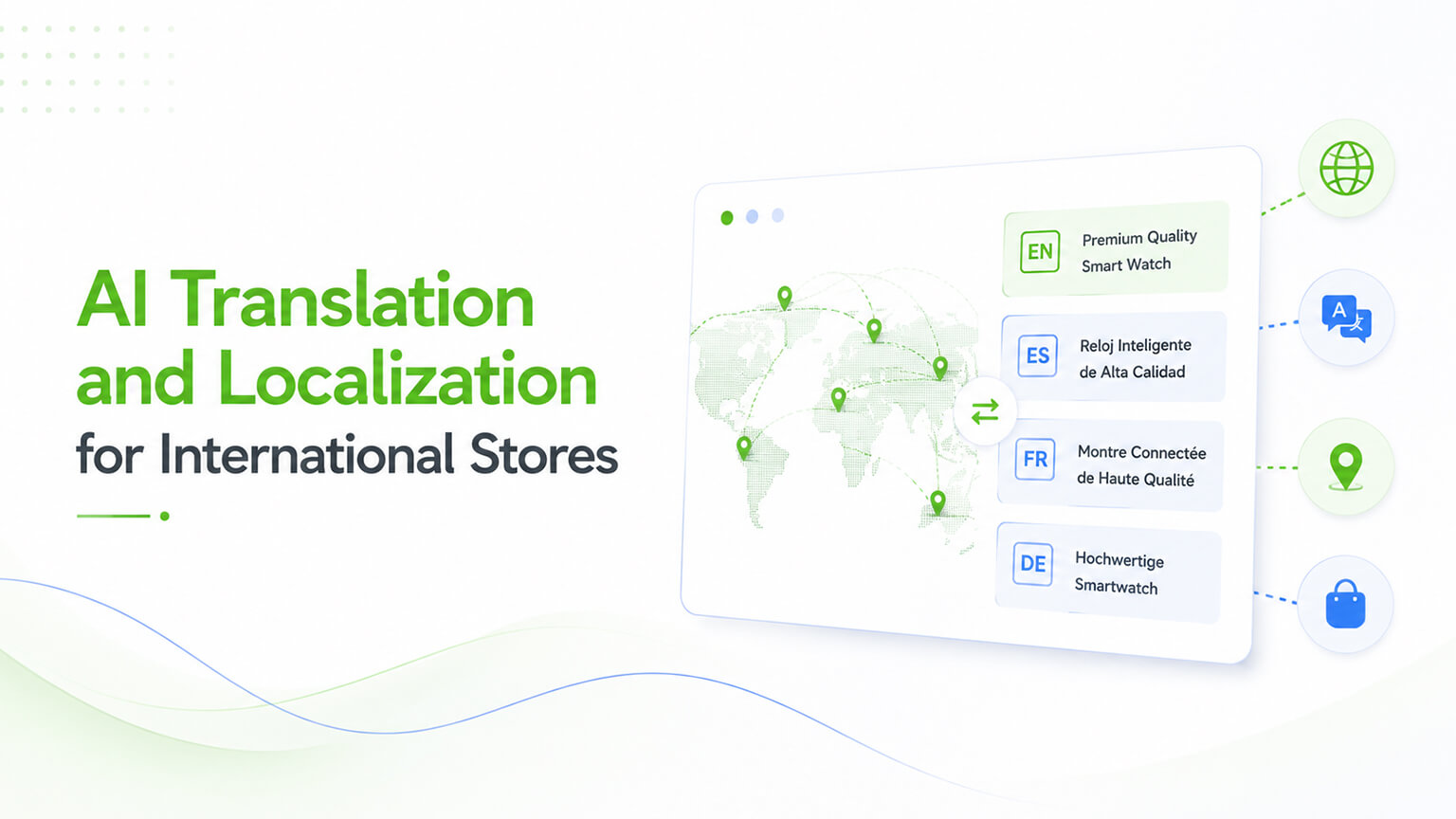
Going international means making your store work in other languages and markets, and one of the biggest historical barriers was the cost and effort of translation. AI translation has changed that calculus — it’s now fast, cheap, and increasingly good, making it viable to translate your store into many languages affordably. But AI translation also has real limits, and translation is only one part of the broader localization that international success actually requires (as discussed in the international and multi-store context). So the question isn’t whether to use AI translation — it’s useful — but how to use it well: where it suffices, where it needs human quality, and how it fits into the broader, human-led localization effort that going international properly demands.
This piece covers what AI translation does well, its limits, the crucial distinction between translation and localization, and how to use AI translation effectively within a proper localization strategy. Because the brands that succeed internationally use AI translation as a capable tool within a broader localization effort, while the brands that fail treat machine translation as the whole of localization. Let me walk through it.
What AI translation does well
Start with the genuine value, because it’s substantial. AI translation has become fast, inexpensive, and increasingly high-quality, which transforms the economics of going international. Translating a store into multiple languages used to be expensive and slow (requiring human translators for everything) or simply not done (leaving international customers with an English-only store). AI translation makes it viable to translate your store’s content into many languages quickly and affordably, dramatically lowering the barrier to making your store accessible in customers’ languages.
This is a real enabler — for many brands, AI translation is the difference between offering a localized-language experience to international customers and not. Making your content available in customers’ languages improves their experience and your international viability, and AI translation makes doing so affordable at scale. So AI translation’s genuine value is lowering the cost and effort barrier to multi-language content, making international language accessibility viable for brands that couldn’t afford full human translation of everything. Used well (with the cautions below), it lets you offer international customers content in their language, which is a meaningful improvement over an English-only store or no international presence. The economics AI translation enables — affordable, scalable, increasingly good translation — are a genuine boon for international expansion, which is why it belongs in any international strategy as a capable tool.
The quality reality and its limits
But be clear-eyed about the limits, because pure machine translation has real quality issues. AI translation, while increasingly good, isn’t perfect — it can produce awkward or unnatural phrasing, miss nuance and idiom, get context wrong, and lack the cultural sensitivity that makes content feel native rather than translated. The result of pure, unreviewed machine translation can be content that’s understandable but obviously translated — slightly off, awkward in places, not quite how a native speaker would phrase it — which undermines the native feel that good localization aims for and can subtly erode trust and professionalism in that market.
This matters because international customers can tell when content is awkwardly machine-translated, and it signals a lack of genuine investment in their market, undermining the trust and native experience that international success needs. So while AI translation is capable, pure unreviewed machine translation has a quality ceiling that falls short of the native-quality content important markets and content deserve. The limit isn’t that AI translation is bad (it’s increasingly good) but that it’s not perfect, and the imperfections (awkwardness, missed nuance, cultural gaps) matter for the content and markets where quality and native feel are important. Recognizing this limit — AI translation is capable but imperfect, and the imperfections matter where quality counts — is what leads to using it well (with human review where it matters) rather than badly (pure machine translation everywhere). Don’t treat AI translation as flawless; treat it as a capable tool whose output needs human quality where quality matters.
The hybrid approach: AI translation plus human review
The practical answer to AI translation’s quality limits is a hybrid approach: use AI translation for speed and scale, with human review and editing where quality matters. AI translation produces the translation quickly and affordably; human review (by someone fluent, ideally native) catches the awkwardness, fixes the nuance and cultural gaps, and brings the content to native quality. This combines AI’s speed and cost advantages with human quality, getting you affordable, scalable translation that’s also good where it needs to be.
The key is prioritizing human review where it matters most, rather than either reviewing everything (expensive, defeating AI’s cost advantage) or reviewing nothing (pure machine translation, with its quality issues). Prioritize human quality for your important markets, your key pages (homepage, key product and category pages, important marketing content), your brand voice content, and anything where native quality matters for trust and conversion. Accept AI-quality (lightly or unreviewed) for lower-stakes content (perhaps less-important pages, or markets you’re testing) where the cost of full human review isn’t justified. This prioritization gets you native quality where it counts (important markets and content) and affordable AI translation where it’s acceptable (lower-stakes content), balancing quality and cost. So the hybrid approach — AI translation plus prioritized human review — is how to use AI translation well: capturing its speed and cost benefits while ensuring human quality for the content and markets that warrant it. Don’t choose between AI translation and human translation; combine them, with human review prioritized where quality matters most.
Translation is not localization
A crucial distinction, emphasized in the international discussion and worth restating: translation is not localization. Translation converts your words to another language; localization adapts your store to the market — cultural norms, local expectations, conventions (date formats, sizing, units), culturally appropriate imagery and messaging, locally-preferred payment methods, and an experience that feels native to that market, not just translated into its language. Translation is one part of localization, but localization is much broader, and a store that’s translated but not localized still feels foreign in ways beyond language.
This matters for the AI discussion because AI translation handles (part of) the translation, but localization — the broader cultural and experiential adaptation — is a human-led effort that AI translation doesn’t accomplish. So even with great AI-assisted translation, you still need the broader localization work (cultural adaptation, local conventions, appropriate imagery and payment, native-feeling experience) to truly succeed in a market. AI translation is a tool for one part (translation) of the larger localization effort; it’s not a substitute for localization. The mistake is treating machine translation as localization — translating the words and assuming the store is now “localized” — when real localization requires the broader human-led adaptation to the market. So use AI translation for the translation part, but understand it’s one component of a broader localization effort that requires human judgment and cultural understanding for the rest. Don’t conflate translating your store with localizing it; AI helps with the former, while the latter is a broader, human-led undertaking.
The SEO and maintenance dimensions
Two practical considerations. SEO: translated/multi-language content connects to international SEO (hreflang and proper multi-region setup, as discussed in the international context), and machine-translated thin content carries the same SEO risks as any thin content — so your translated content should be quality (hybrid-approach quality where it matters) and properly handled for international SEO (signaling which version serves which market). Pure machine-translated content that’s awkward and thin can underperform in search as well as undermining the customer experience, so quality and proper international SEO setup both matter for your translated content. Maintenance: your content changes over time, and your translations need updating to match — AI translation helps here too, making it affordable to keep translations current as your content evolves, but the same quality considerations apply (human review for important updated content). So factor in keeping translations current (AI helps make this affordable) and handling the international SEO of your translated content properly, as part of using AI translation within a real international strategy.
The practical approach
Pulling it together, the practical way to use AI translation for going international: use AI translation to make multi-language content viable and affordable (its genuine value, lowering the barrier to international language accessibility), apply the hybrid approach (human review prioritized for important markets, key pages, brand content, and where quality matters; AI-quality acceptable for lower-stakes content), understand it’s one part of a broader human-led localization effort (cultural adaptation, local conventions, imagery, payment, native experience), handle the international SEO of your translated content properly, and keep translations current as content changes. This gets you the affordability and scale AI translation offers while maintaining the quality and broader localization that international success requires.
This balanced approach — AI translation as a capable, affordable tool used with prioritized human quality, within a broader localization effort — is how brands succeed internationally with AI translation. The brands that fail either avoid translation (leaving international customers underserved) or rely on pure machine translation as the whole of localization (awkward content, no real localization, underwhelming international results). The brands that succeed use AI translation’s affordability to make international viable, apply human quality where it matters, and do the broader localization work, treating AI translation as a valuable tool within a real international strategy rather than as the strategy itself. So use AI translation for what it’s good at (affordable, scalable, capable translation), with human quality where it counts, within a proper localization effort — and it’s a genuine enabler of international expansion.
A worked example: the awkwardly-translated store
To see why pure machine translation falls short, picture a brand that expands into a new-language market by running its entire store through machine translation, unreviewed, and calling it localized. The content is understandable but subtly off throughout — phrasing a native speaker wouldn’t use, idioms translated literally and landing awkwardly, occasional outright errors, a general feel of “this was machine-translated.” To a native speaker in that market, it reads as a foreign brand that didn’t bother to do it properly, which undermines trust and the sense that the brand is present in their market. The store technically speaks their language but doesn’t feel native, and conversion suffers accordingly.
Now picture the brand doing it with the hybrid approach. They machine-translate for speed and scale, but have a native speaker review and polish the important content — the homepage, key product and category pages, marketing copy, brand voice content — bringing it to native quality, while accepting machine quality for lower-stakes pages. The important content now reads as if written by a native speaker, the store feels present in the market, and trust and conversion are far better. They captured AI translation’s affordability (machine-translating the bulk, polishing what matters) while ensuring native quality where it counts. The difference from the pure-machine-translation version is stark, and it came from prioritized human review of the important content, not from translating everything by hand (which would have been prohibitively expensive).
This captures the AI translation lesson: pure unreviewed machine translation produces an awkward, foreign-feeling store that undermines international success, while the hybrid approach (machine translation plus prioritized human review) produces a native-feeling experience affordably. The brands that machine-translate everything and call it done get the awkward version; the brands that use AI translation with human quality where it matters get the native-feeling version. And note that even the well-translated store still needs the broader localization (cultural adaptation, local payment, conventions) to fully succeed — translation quality is necessary but not sufficient. The worked example shows both the importance of translation quality (hybrid over pure machine) and that translation is one part of the broader localization the brand also needs.
Match translation quality to market priority
A useful principle for allocating your translation effort: match the translation quality (and thus the human-review investment) to the market’s priority. Your most important international markets — the ones you’re seriously investing in, where you expect significant business — warrant the most human review and the highest translation quality, because native quality matters most where you’re most committed. Markets you’re testing or that are lower-priority can accept more machine-translation quality, since the cost of full human review isn’t justified for an uncertain or minor market.
This prioritization lets you allocate your translation-quality investment sensibly — high quality (more human review) for priority markets where it matters, more machine-quality for lower-priority or test markets where it’s acceptable — rather than either over-investing in human review everywhere or under-investing with pure machine translation everywhere. It mirrors the broader principle of matching effort to importance: your priority markets get the quality treatment, your test or minor markets get the affordable AI treatment, and you scale up the quality investment in a market as it proves important. So as you expand internationally, match your translation quality and human-review investment to each market’s priority, investing in native quality where you’re committed and accepting AI quality where you’re testing or the market is minor. This sensible allocation gets you quality where it matters without over-spending on review for markets that don’t yet warrant it, and it scales naturally — a market that grows in importance gets more translation-quality investment as it does. Match the quality to the priority, and your translation investment tracks your market priorities.
The bottom line
AI translation has transformed the economics of going international — it’s fast, cheap, and increasingly good, making multi-language content viable and affordable where it used to be expensive or undone, which is a genuine enabler of international expansion. But it has real limits: it’s capable but not perfect, and pure unreviewed machine translation can produce awkward, obviously-translated content that misses nuance and cultural context, undermining the native feel and trust that international success needs. So use the hybrid approach — AI translation for speed and scale, with human review prioritized where quality matters (important markets, key pages, brand content) and AI-quality accepted for lower-stakes content — combining AI’s affordability with human quality where it counts. Crucially, understand that translation is not localization: AI translation handles part of the translation, but localization (cultural adaptation, local conventions, imagery, payment, native experience) is a broader, human-led effort that AI translation doesn’t accomplish, so don’t treat machine translation as the whole of localization. Handle the international SEO of your translated content properly, keep translations current as content changes (AI helps make this affordable), and treat AI translation as a valuable tool within a real, broader localization strategy rather than as the strategy itself. Used this way, AI translation makes international expansion more affordable and viable while you maintain the quality and localization that international success actually requires — a capable tool in service of a human-led international strategy. The brands that succeed internationally with AI translation use it as the affordable, capable tool it is — machine-translating at scale, applying human quality where it matters, and doing the broader localization work — while the brands that struggle either avoid translation entirely or treat raw machine translation as the whole of localization. Match your translation-quality investment to each market’s priority, keep your translations current, handle the international SEO properly, and remember throughout that translation is one part of localization, not the whole of it. Do that, and AI translation is a genuine enabler that makes serving international customers in their language affordable while you maintain the quality and cultural adaptation that actually wins those markets.
Frequently asked questions
Is AI translation good enough for my international store?
It’s capable and increasingly good, and it’s transformed the economics of going international by making multi-language content affordable and viable. But it’s not perfect — pure unreviewed machine translation can produce awkward, obviously-translated content that misses nuance and cultural context, undermining the native feel and trust international markets need. So it’s good enough as a tool used well (with human review where quality matters), but not good enough as pure machine translation for important markets and content. Use the hybrid approach rather than relying on raw machine translation everywhere.
What’s the difference between translation and localization?
Translation converts your words to another language; localization adapts your whole store to the market — cultural norms, local conventions (date formats, sizing, units), culturally appropriate imagery and messaging, locally-preferred payment methods, and an experience that feels native rather than just translated. Translation is one part of localization. AI translation handles (part of) the translation, but localization is a broader, human-led effort AI translation doesn’t accomplish. Don’t treat machine translation as the whole of localization — a translated-but-not-localized store still feels foreign beyond language.
How should I use AI translation effectively?
With a hybrid approach: use AI translation for speed and scale (its affordability is the genuine value), but prioritize human review where quality matters most — important markets, key pages (homepage, key products and categories), brand voice content, and anywhere native quality affects trust and conversion — while accepting AI-quality for lower-stakes content. This combines AI’s cost and scale advantages with human quality where it counts, rather than either reviewing everything (expensive) or reviewing nothing (awkward machine translation). And use it within a broader localization effort, not as a substitute for localization.
Does machine-translated content affect SEO?
It can. Translated multi-language content connects to international SEO (hreflang and proper multi-region setup to signal which version serves which market), and pure machine-translated content that’s awkward and thin carries the same SEO risks as any thin content, potentially underperforming in search as well as undermining the customer experience. So ensure your translated content is quality (hybrid-approach quality where it matters) and that your international SEO is set up properly. Quality translation and correct international SEO both matter for your translated content’s performance.