
AI Image Generation for Product and Lifestyle Photos
On this page
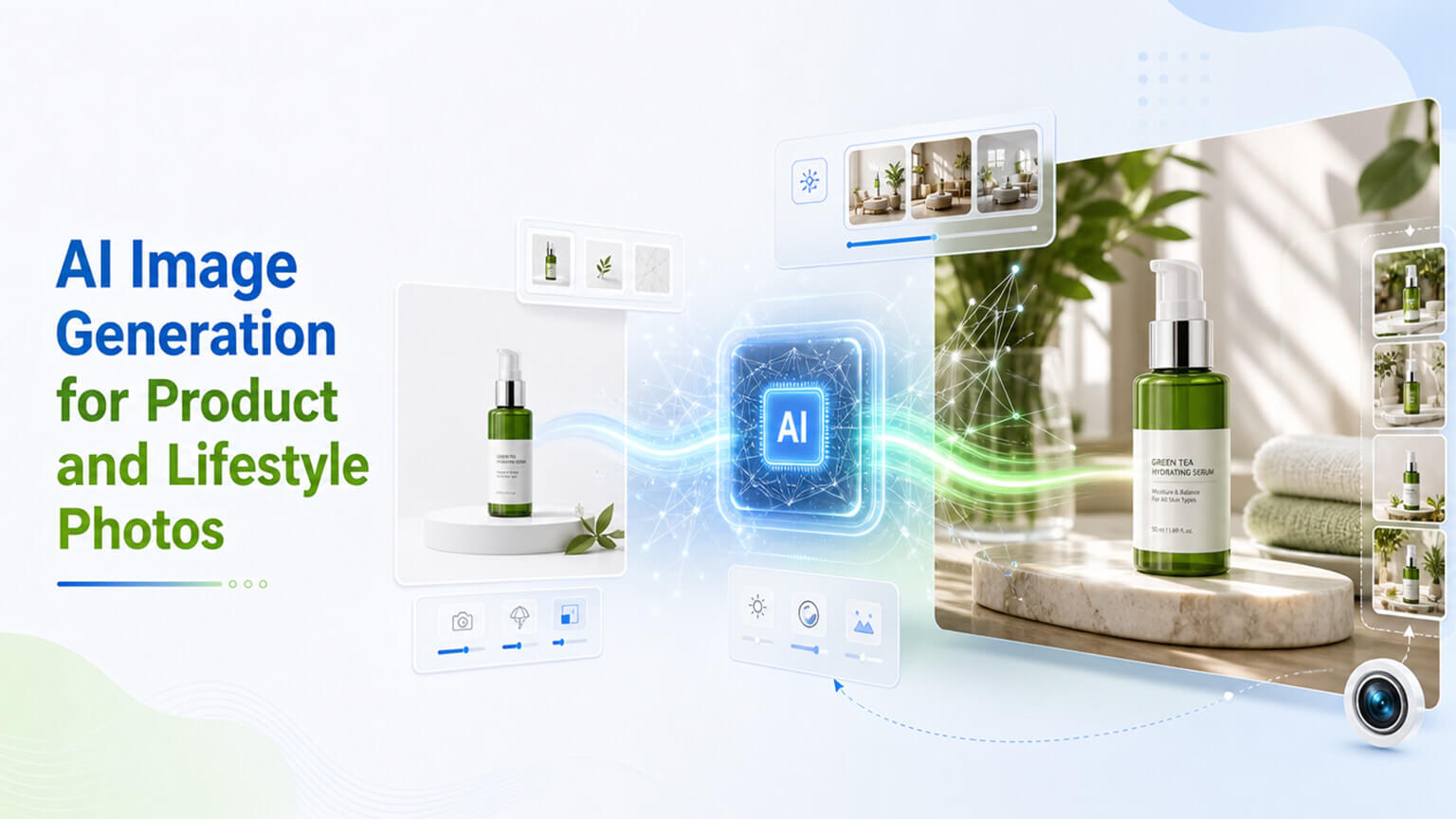
AI image generation has become capable enough to produce and assist with ecommerce imagery — generating lifestyle scenes, backgrounds, and supporting visuals, editing and enhancing photos, and creating variations faster and cheaper than traditional photography for some purposes. For ecommerce, where imagery is central and producing it is a real cost and effort, this is useful in places. But it comes with a critical caveat specific to ecommerce: product imagery must accurately represent the actual product, and AI-generated or heavily-AI-edited images that misrepresent what the customer will receive cross a line — misleading customers, causing returns, and eroding trust. So AI image generation in ecommerce is a tool to use thoughtfully, valuable for supporting and lifestyle imagery and assistance, but bounded by the imperative that the product itself be honestly represented.
This piece covers where AI image generation helps in ecommerce, the crucial accuracy-and-honesty line around product representation, and how to use it well. Because the value (faster, cheaper supporting imagery and editing assistance) is real, but the risk (misrepresenting the product) is serious, so using it well means capturing the value while staying firmly on the right side of the honesty line. Let me walk through it.
Where AI image generation helps
AI image generation is useful for several ecommerce imagery purposes. Lifestyle and contextual imagery — generating scenes, backgrounds, and contexts (a product in a setting, a lifestyle scene) faster and cheaper than staging and shooting them, useful for showing products in context. Backgrounds and scenes — placing products in generated backgrounds or scenes, or generating contextual settings. Editing and enhancement — AI-assisted editing, cleanup, and enhancement of photos (a capable, faster way to do post-production tasks). Variations — generating variations of imagery (different backgrounds, contexts, formats) for testing and different uses (ad creative variations, social, as the ad creative discussion covers). And concepts and mockups — generating concepts and mockups quickly.
So AI image generation helps with the supporting, contextual, and assistive imagery work — lifestyle scenes, backgrounds, editing/enhancement, variations, concepts — producing this imagery faster and cheaper than traditional methods for these purposes. This is valuable for ecommerce, where this kind of imagery (lifestyle, contextual, supporting, varied) is needed and producing it traditionally is costly and slow. So AI image generation can relieve the cost and effort of producing supporting and lifestyle imagery and assist with editing, which is a real benefit. The key is that these uses — lifestyle/contextual scenes, backgrounds, editing assistance, variations, concepts — are largely about supporting and contextual imagery and post-production assistance, not about misrepresenting the actual product, which is where the honesty line comes in. So for supporting and lifestyle imagery, backgrounds, editing, and variations, AI image generation is useful, capturing real value in producing this imagery faster and cheaper. Used for these purposes, it’s a valuable tool relieving the cost and effort of ecommerce’s substantial supporting-imagery needs.
The crucial accuracy-and-honesty line
Here’s the critical caveat specific to ecommerce: product imagery must accurately represent the actual product, and this is the line AI image generation must not cross. The whole point of product imagery is to show the customer what they’ll actually receive, so they can make an informed buying decision — so product images that misrepresent the actual product (AI-generated or heavily-AI-edited images showing a product that differs from what the customer will get) mislead the customer, who buys based on a false impression. This causes returns (the product isn’t what the images showed, as the returns discussion covers — misrepresentation creating an expectation gap), erodes trust (the customer feels misled), and crosses into misleading-advertising territory (legally and ethically problematic). So the line is clear: the actual product must be honestly represented in your product imagery, and AI must not be used to misrepresent it.
This is the crucial boundary for AI image generation in ecommerce: it’s fine for supporting and lifestyle imagery and legitimate editing, but the product itself must be shown honestly — what the images convey about the product’s actual appearance must be accurate to what the customer receives. So AI-generated lifestyle scenes, backgrounds, and contexts are fine (they’re supporting/contextual, not misrepresenting the product), and legitimate editing/enhancement is fine (cleaning up a real product photo, as traditional post-production does), but generating or AI-editing images that misrepresent the product’s actual appearance (making it look different, better, or other than it is) crosses the line. The test is whether the imagery honestly represents what the customer will receive: supporting/lifestyle/contextual imagery and honest editing pass; misrepresenting the product’s actual appearance fails. So use AI image generation freely for supporting and lifestyle imagery and legitimate editing, but never to misrepresent the actual product — the product must be honestly shown, because misrepresenting it misleads customers, causes returns, erodes trust, and crosses ethical and legal lines. This accuracy-and-honesty line is the crucial boundary, and respecting it is what separates legitimate, valuable use of AI imagery from misleading misuse.
Quality, brand consistency, and human judgment
Beyond the honesty line, the familiar AI cautions apply. Quality: AI-generated images can look generic, off, or have the tell-tale artifacts of AI generation, so they need human judgment and selection — using the good ones, rejecting the off ones, ensuring quality — rather than using raw AI output uncritically. Brand consistency: your imagery represents your brand, so AI-generated imagery needs to be on-brand (matching your aesthetic and brand), not generic AI imagery that doesn’t fit your brand — requiring human direction and selection for brand consistency. So as with AI content and ad creative, AI image generation needs human judgment, selection, and direction to ensure quality and brand consistency, rather than using raw output.
So the human role with AI image generation is providing direction (for brand-consistent, quality imagery), selecting the good outputs (rejecting the generic or off ones), and ensuring quality and brand fit — the familiar pattern of AI accelerating production while humans direct, select, and ensure quality and brand consistency. AI-generated imagery used with human judgment and selection (quality, on-brand, well-chosen) is valuable; raw AI imagery used uncritically (generic, off-brand, variable quality) is not. So apply human judgment to AI imagery as to AI content and creative — direct it, select from it, ensure quality and brand consistency — capturing the production benefit while maintaining the quality and brand fit your imagery needs. This, combined with the honesty line (honest product representation), is how to use AI image generation well: for supporting and lifestyle imagery and legitimate editing, with human judgment for quality and brand consistency, and never misrepresenting the actual product.
How to use it well
Pulling it together, using AI image generation well in ecommerce means: use it for the useful purposes — lifestyle and contextual imagery, backgrounds and scenes, editing and enhancement, variations (for ads, social, testing), and concepts — capturing the value of faster, cheaper supporting imagery and editing assistance. Respect the accuracy-and-honesty line absolutely — the actual product must be honestly represented, so use AI for supporting/lifestyle/contextual imagery and legitimate editing, but never to misrepresent the product’s actual appearance. Apply human judgment and selection — directing for quality and brand consistency, selecting the good outputs, ensuring brand fit — rather than using raw AI output. And keep it on-brand and quality.
So the practical approach is to use AI image generation for supporting and lifestyle imagery, backgrounds, editing, and variations (where it adds genuine value), with human judgment for quality and brand consistency, while honestly representing the actual product (the honesty line). Used this way, AI image generation is a valuable tool relieving the cost and effort of ecommerce’s supporting-imagery needs and assisting with editing, while maintaining the honesty (accurate product representation), quality, and brand consistency that matter. The brands that use it well capture the production value for supporting/lifestyle imagery and editing, with human judgment and honest product representation; the brands that misuse it (misrepresenting products, using generic raw output, off-brand) cause returns, distrust, and quality/brand problems. So use AI image generation for its useful purposes, with human judgment and absolute honesty about the actual product — capturing the value while staying firmly on the right side of the accuracy line and maintaining quality and brand. That’s how AI image generation is a valuable, legitimate tool in ecommerce rather than a source of misleading imagery or generic, off-brand visuals.
A worked example: a homeware brand’s imagery workflow
Picture a mid-sized homeware brand selling ceramics, textiles, and small furniture. Before AI, their imagery process looked like this: a half-day studio shoot per collection for clean product shots on white, then a separate (expensive) location shoot for lifestyle imagery — a styled living room, a set table, a sunlit shelf — and weeks of back-and-forth with a photographer and retoucher. Lifestyle imagery was the bottleneck: it was costly enough that they only shot it for hero products, leaving most of the catalogue with bare product-on-white shots and nothing showing the item in a real setting.
Here’s how a sensible AI-assisted workflow changes that without crossing the honesty line. The clean product shots stay real — actual photography of the actual product, because those are the images the customer relies on to know what they’re buying. Nothing AI-generated replaces the true product photo. But the lifestyle layer changes: the brand photographs the real product, then uses AI to place that real product into generated contextual scenes (a styled shelf, a cosy room), or generates supporting lifestyle and mood imagery for collection pages, social, and ads. Now every product can have contextual imagery, not just the heroes, and the cost and time of the location shoot largely disappears. A human art director still reviews every output — rejecting the scenes that look “off” or generic, keeping the ones that match the brand’s warm, natural aesthetic, and making sure the product as shown in any composite still matches the real thing.
The result is more and better contextual imagery across the whole catalogue, produced faster and cheaper, while the actual product is always honestly represented by real photography and human-checked composites. That’s the pattern to copy: keep true product representation real and honest, use AI to expand the supporting and lifestyle layer that was previously too expensive to do at scale, and keep a human directing for brand and quality. The brand captures the genuine production value exactly where it’s safe to capture it.
Practical guardrails to put in place
If you’re rolling AI imagery into your store, a few guardrails keep you on the right side of the line and protect quality. First, write down a simple rule your team understands: the actual product must be represented honestly, and AI is for supporting/lifestyle/contextual imagery and legitimate editing only — never for changing how the product itself looks. That single rule prevents most problems.
Second, treat colour, texture, scale, and detail as sacred on product imagery. These are the attributes customers buy on and the ones that drive returns when they’re wrong, so any editing (AI or traditional) must keep them true to the real product. If a generated or edited image makes the fabric look smoother, the colour richer, or the item larger than it is, that’s the line being crossed — pull it.
Third, keep a human in the loop for selection and brand fit. AI output is variable; someone who knows the brand should approve what ships, rejecting generic or off-brand results. Fourth, consider disclosure where appropriate — if imagery is clearly illustrative/contextual rather than a literal product shot, presenting it in a way that doesn’t imply it’s the product protects trust. And fifth, watch your returns and customer-feedback data after introducing AI imagery; if returns tied to “not as pictured” tick up, that’s a signal something in the imagery has drifted from honest representation, and you investigate. These guardrails are lightweight, but they’re what let you use AI imagery aggressively for its legitimate purposes while keeping the honesty, quality, and brand consistency that protect your customers and your reputation.
What about fully synthetic product images?
A question that comes up often: can you ever show a product image that’s entirely AI-generated, with no underlying photograph of the real item? The honest answer is — only when the synthetic image still accurately represents the real product, and even then, with caution. If you have a product that matches the generated depiction (for instance, a simple item whose appearance the AI can render faithfully, or a 3D-rendered image built from the actual product’s true specifications, materials, and dimensions, as many furniture and electronics brands already do with CAD renders), a synthetic image can be legitimate because it accurately represents what the customer receives. The technology used to make the image matters less than whether the image is true.
But the risk rises sharply with fully synthetic imagery, because it’s much easier for a generated image to drift from reality — inventing a finish, a proportion, or a detail the real product doesn’t have. So the safer default for most brands is: real photography (or accurate, spec-based renders) for product representation, and AI generation reserved for the supporting and lifestyle layer where it can’t mislead anyone about the product itself. If you do use synthetic product imagery, treat it like a render in a regulated catalogue — verify it against the physical product, lock the true attributes, and have a human confirm it matches before it ships. The principle never changes: honest representation of the actual product, whatever tools produce the picture.
The bottom line
AI image generation has become capable enough to help with ecommerce imagery — generating lifestyle scenes, backgrounds, and supporting visuals, editing and enhancing photos, and creating variations faster and cheaper than traditional methods for these purposes — which is valuable given how central and costly imagery is in ecommerce. But it comes with a critical, ecommerce-specific caveat: product imagery must accurately represent the actual product, so AI must not be used to misrepresent what the customer will receive, since that misleads customers, causes returns, erodes trust, and crosses ethical and legal lines. So the line is clear — use AI freely for supporting and lifestyle imagery, backgrounds, contexts, editing, and variations (where it adds value), but never to misrepresent the product’s actual appearance, which must be honestly shown. Apply the familiar human judgment — directing for quality and brand consistency, selecting the good outputs, ensuring brand fit — rather than using raw AI output, which can be generic, off, or off-brand. Used well — for its useful supporting and lifestyle imagery and editing purposes, with human judgment for quality and brand, and absolute honesty about the actual product — AI image generation is a valuable tool relieving the cost and effort of ecommerce’s substantial imagery needs while maintaining the honesty, quality, and brand consistency that matter. Used badly (misrepresenting products, generic raw output, off-brand), it causes returns, distrust, and quality problems. So capture the production value for supporting imagery and editing, with human judgment, while staying firmly on the right side of the accuracy-and-honesty line — which is the boundary that makes AI image generation a legitimate, valuable ecommerce tool rather than a source of misleading or generic imagery.
Frequently asked questions
What can AI image generation do for an ecommerce store?
It can help with supporting and contextual imagery — generating lifestyle scenes, backgrounds, and settings (showing products in context), assisting with photo editing and enhancement, creating variations for ads, social, and testing, and producing concepts and mockups — faster and cheaper than traditional methods for these purposes. This is valuable given how central and costly imagery is in ecommerce. The key is that these are supporting, contextual, and assistive uses, not misrepresenting the actual product, which is where the honesty line comes in.
What’s the line AI image generation must not cross in ecommerce?
Misrepresenting the actual product. Product imagery must honestly represent what the customer will receive, so AI-generated or heavily-AI-edited images that make the product look different, better, or other than it actually is cross the line — misleading customers (who buy on a false impression), causing returns (the product isn’t what the images showed), eroding trust, and crossing into misleading-advertising territory. Use AI for supporting/lifestyle imagery and legitimate editing, but the actual product must always be shown honestly.
Is it okay to use AI for lifestyle and background images?
Yes — that’s a useful, legitimate use. Generating lifestyle scenes, contextual settings, and backgrounds (showing products in context) is supporting/contextual imagery, not misrepresenting the product, so it’s on the right side of the honesty line and can save real cost and effort versus staging and shooting. Just apply human judgment for quality and brand consistency (AI images can look generic or off-brand), and ensure that where the actual product appears, it’s represented honestly.
Do AI-generated images need human oversight?
Yes. AI-generated images can look generic, off, or carry tell-tale AI artifacts, and they need to be on-brand, so they require human judgment and selection — directing for quality and brand consistency, selecting the good outputs and rejecting the off ones — rather than using raw AI output uncritically. As with AI content and ad creative, the pattern is AI accelerating production while humans direct, select, and ensure quality and brand fit. Combined with honest product representation, this is how to use AI imagery well.
How do I know if an AI-edited image has crossed the line?
Ask one question: would a customer who received the real product feel the image was accurate, or misled? If the editing kept colour, texture, scale, proportion, and material true to the actual item — and only cleaned up, lit, or contextualised it — you’re fine. If it made the product look like something the customer won’t actually receive (a richer colour, a smoother finish, a different size or detail), the line is crossed. Watch your “not as pictured” returns and customer feedback after introducing AI imagery; an uptick there is the clearest signal that some image has drifted from honest representation.