
AI for Demand Forecasting and Inventory
On this page
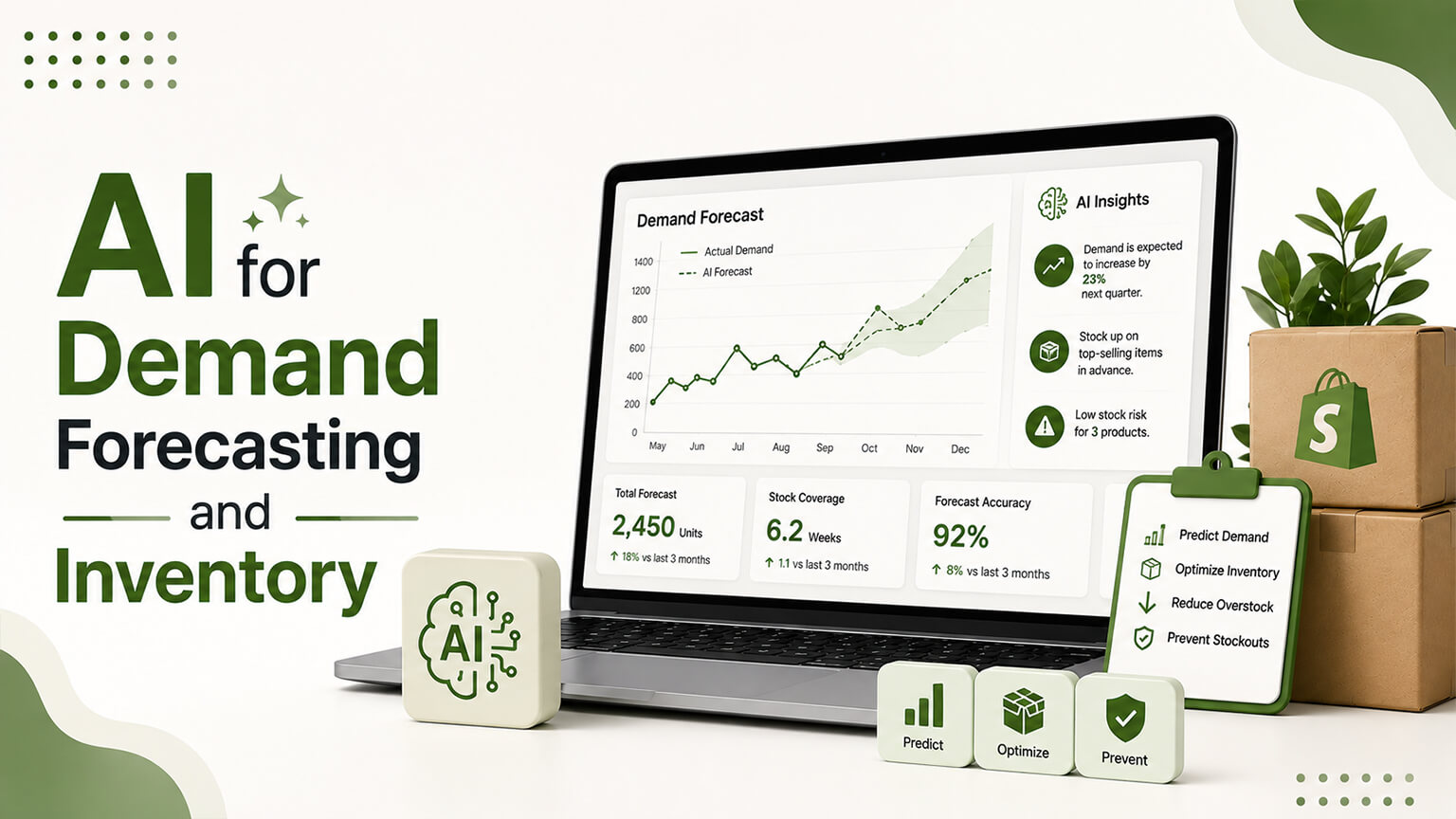
Inventory is the unglamorous discipline that quietly makes or breaks ecommerce profitability. Order too much and you’ve got cash tied up in stock that isn’t selling, storage costs, and eventual markdowns to clear it. Order too little and you stock out, losing sales you can’t recover and disappointing customers who go elsewhere. Getting it right — having the right products in the right quantities at the right time — is hard, because it depends on forecasting demand, and demand is influenced by seasonality, trends, promotions, and a dozen factors that are tricky to predict. This is exactly the kind of complex, data-driven prediction problem AI is supposed to be good at, which is why “AI for demand forecasting” has become a real and growing application.
But as with all things AI, the reality sits between the hype and the dismissal. AI can sharpen demand forecasting and inventory decisions, within real limits, and it’s worth understanding what it can actually do, what it can’t, and whether it’s worth it for your store. Let me lay it out honestly, because inventory is too important and too expensive to get wrong based on either inflated promises or reflexive skepticism.
The inventory problem AI addresses
To understand what AI brings, start with why inventory is hard. You’re trying to predict future demand — how much of each product you’ll sell over coming periods — so you can stock appropriately. That prediction has to account for a lot: historical sales patterns, seasonality (demand varies by time of year), trends (rising or falling popularity), promotions and their effects, the introduction of new products, external factors, and the interactions among all of these. Humans forecasting this, often in spreadsheets, do their best but are limited in how much data and how many factors they can process, and they’re prone to bias and oversimplification.
The consequences of getting it wrong are expensive in both directions. Overstock ties up cash, incurs storage costs, and often ends in margin-eroding markdowns. Stockouts lose sales (customers buy elsewhere) and damage customer experience and loyalty. And the right answer is a moving target as demand shifts. So inventory forecasting is a hard, high-stakes, data-rich prediction problem — precisely the profile where AI’s ability to find patterns across lots of data can add value over human spreadsheet-based forecasting. That’s the opportunity AI demand forecasting addresses: doing the complex, multi-factor demand prediction more accurately and at more scale than manual methods.
What AI can do
Here’s where AI delivers real value, when applied well. AI can analyze large amounts of historical and contextual data — sales history, seasonality, trends, promotions, and other signals — and find patterns and relationships that inform more accurate demand forecasts than manual methods. It can process more data and more factors than a human in a spreadsheet, account for complex seasonal and trend patterns, and update forecasts as new data comes in. This translates into concrete benefits: more accurate demand forecasts, better reorder timing (knowing when and how much to reorder), reduced stockouts (forecasting demand well enough to stock appropriately), and reduced overstock (not over-ordering products that won’t sell). For a store with enough sales history and complexity, this can meaningfully improve inventory efficiency — less cash tied up in the wrong stock, fewer lost sales to stockouts, better-tuned ordering.
AI can also help with related inventory tasks: identifying demand trends early (spotting rising or falling products), informing replenishment decisions, flagging slow-moving or dead stock that should be cleared, and optimizing inventory across locations if you have multiple. The common thread is using AI’s pattern-recognition across your data to make better, more informed, more timely inventory decisions than manual forecasting allows. When you have the data to feed it and the volume to benefit, this is genuine, quantifiable value — inventory efficiency directly affects cash flow and profitability, so improving it matters.
What AI can’t do (and the data dependency)
Now the honest limits, because the hype oversells AI forecasting and the limits are real. AI forecasting depends heavily on data — it learns from your historical sales and patterns, so it needs sufficient, quality historical data to forecast well. A new store with little history, or a store with sparse or messy data, gives AI little to learn from, so the sophisticated forecasting that works for an established, data-rich store may deliver little for a new or small one. This is the recurring AI-data dependency: forecasting power scales with the quantity and quality of your data, which the vendor pitches rarely emphasize when selling to smaller stores.
AI also can’t predict the unpredictable. A viral moment, a sudden trend, a black-swan event, a competitor’s action, a supply-chain shock — these aren’t in the historical patterns, so AI can’t forecast them. AI forecasts based on patterns in past data; it doesn’t have a crystal ball for the unprecedented. New products with no sales history are similarly hard — there’s no pattern to learn from, so forecasting a brand-new product’s demand is uncertain regardless of AI. And AI forecasts are probabilistic estimates, not certainties — better than guessing, but not perfect, and treating them as perfect leads to its own errors.
So set expectations at “more accurate forecasting from your data,” not “perfect prediction of the future.” AI improves demand forecasting where there’s data and pattern to work with; it can’t conjure forecasts from no data or predict the unforeseeable. The realistic value is better, data-informed forecasts that reduce (not eliminate) the costly errors of overstock and stockout — meaningful, but bounded by data and by the inherent unpredictability of some demand.
Keep humans in the loop
A crucial principle: AI forecasting should inform human decisions, not replace human judgment entirely, especially for the things AI can’t see. The pattern is AI doing the heavy data-processing to produce informed forecasts, and humans applying judgment — accounting for the things AI doesn’t know (an upcoming campaign AI isn’t aware of, market knowledge, a planned product launch, awareness of an external factor), sanity-checking the forecasts, and making the final inventory decisions. AI handles the data-driven pattern analysis; humans handle the context, judgment, and the unpredictable that data alone misses.
This matters because over-trusting AI forecasts — treating them as gospel and removing human judgment — leads to errors when the AI misses something it couldn’t know from the data. The best inventory operations use AI to produce better-informed forecasts and then apply human expertise on top, combining AI’s data-processing strength with human knowledge of context and the unforeseeable. So don’t position AI forecasting as replacing your inventory decision-makers; position it as giving them better information to decide with. The combination — AI-informed, human-judged — outperforms either alone, and it guards against the over-reliance that AI forecasting’s confident outputs can tempt.
Whom it’s worth it for
As with all AI applications, demand forecasting AI is worth it for some stores and not others, and the deciding factors are data and complexity. It’s most valuable when you have enough sales history and data for AI to learn from, and enough inventory volume and complexity that better forecasting meaningfully improves efficiency and profitability. A store with substantial sales history, many SKUs, real seasonality, and significant inventory investment stands to gain real value from sharper forecasting — the improvements in cash efficiency and reduced stockouts/overstock are quantifiable and meaningful at that scale.
It’s least valuable for new stores (little data to learn from), very small or simple inventory situations (where the forecasting problem is manageable manually and the stakes are low), or stores whose data is too sparse or messy to support good forecasting. For these, sophisticated AI forecasting may be solving a problem that doesn’t yet warrant it, or lacking the data to do it well. So assess honestly: do you have the data and the inventory complexity for AI forecasting to add real value? If yes, it can meaningfully improve a high-stakes, expensive part of your business. If no, your inventory effort is better spent on getting the basics right and accumulating clean data, revisiting AI forecasting when you have the volume and history to benefit.
The tools and integration
AI demand forecasting comes via inventory and forecasting tools (some apps, some features of inventory management systems or ERPs) that apply AI to your sales and inventory data. For this to work, the tool needs access to your data — your Shopify sales history and inventory data, and potentially data from other systems (your ERP, your purchasing). So integration matters: connecting the forecasting tool to your Shopify data (and other relevant systems) so it has the full picture to forecast from. For larger operations, demand forecasting is often part of a broader inventory or ERP system, integrated with the rest of the operation. The quality of the forecasting depends partly on the quality and completeness of the data it can access, which is why clean, well-integrated data is a prerequisite for good AI forecasting — another reason the data foundation matters. As with any integration, connecting these systems reliably is real work, and the forecasting is only as good as the data feeding it.
Common mistakes
A few traps with AI demand forecasting. Over-trusting the forecasts and removing human judgment, so you’re blindsided when AI misses what it couldn’t know. Feeding it poor data and expecting good forecasts — garbage in, garbage out applies fully. Expecting perfect prediction rather than improved, probabilistic forecasts, and being disappointed or making errors when reality deviates. Adopting sophisticated forecasting AI before you have the data and volume to benefit. And neglecting the integration and data foundation that good forecasting depends on. Avoid these by keeping humans in the loop, ensuring clean and well-integrated data, setting realistic expectations (better, not perfect), matching adoption to your data and scale, and treating AI forecasting as a tool that informs rather than replaces inventory decision-making.
A worked example: the overstock and the stockout
To make the value tangible, consider the two inventory failures AI forecasting helps prevent, in a brand with real seasonality and history. Without good forecasting, the brand over-orders a product ahead of a season based on a rough guess, demand comes in lower than hoped, and they’re left with excess stock — cash tied up, storage costs, and eventually a markdown that erodes margin to clear it. Meanwhile, on another product, they under-order because they underestimated demand, sell out mid-season, and lose weeks of sales they can’t recover while customers buy from competitors. Both errors are expensive, and both stem from forecasting demand poorly.
With AI forecasting fed good historical data, the picture improves. The AI, having learned the brand’s seasonal patterns, trends, and sales history, produces sharper forecasts for each product — flagging that the first product’s demand is likely lower than the human guess (preventing the overstock) and the second’s higher (preventing the stockout). The brand’s inventory team takes those forecasts, applies their own judgment (they know about an upcoming campaign the AI doesn’t, so they adjust one number up), and orders more accurately. The overstock and the stockout are both reduced, improving cash efficiency and capturing sales that would have been lost.
This is the everyday value of AI forecasting on a data-rich store: not magic, but meaningfully better demand prediction that reduces the costly errors in both directions, with human judgment layered on for what the data can’t capture. Note the conditions that made it work — real history for the AI to learn from, real seasonality and complexity making forecasting hard, and human judgment applied on top. Those are exactly the conditions under which AI forecasting earns its keep, and the worked example shows both the value (fewer expensive inventory mistakes) and the prerequisites (data, complexity, human judgment) in action.
Clean data first, fancy AI second
A practical priority worth stating plainly: before investing in sophisticated AI forecasting, invest in clean, well-organized, well-integrated data, because the AI is only as good as the data feeding it. Many stores would benefit more from getting their inventory and sales data clean, accurate, and properly connected across their systems than from layering AI on top of messy data. Garbage in, garbage out applies completely — AI forecasting on poor data produces poor forecasts, confidently presented, which can be worse than honest manual estimates because the false precision invites over-trust.
So the sensible sequence is to get your data foundation right first — accurate sales history, clean inventory data, proper integration across Shopify and your other systems — and then apply AI forecasting on that solid foundation, where it can actually deliver value. This also means that the work of building good data and integration (covered in the integrations context) is a prerequisite for, not a competitor to, AI forecasting. A store with clean, well-integrated data is positioned to benefit from AI forecasting; a store with messy, siloed data should fix that first, and may find that clean data plus sensible human forecasting already solves much of the problem. Don’t reach for fancy AI as a shortcut around a poor data foundation — build the foundation, then the AI has something good to work with.
The compounding value of fewer inventory mistakes
It’s worth appreciating why getting inventory forecasting right matters so much, because the value compounds in ways that aren’t always obvious. Inventory mistakes are expensive in both directions and they happen continuously — every ordering decision is a chance to over- or under-order, and the costs (tied-up cash, storage, markdowns, lost sales) accumulate across every product and every period. So even modest improvements in forecasting accuracy, applied across your whole catalog over time, add up to meaningful money: less capital trapped in the wrong stock, fewer margin-eroding clearances, fewer sales lost to stockouts. The improvement on any single decision might be small, but multiplied across your entire inventory operation, continuously, it compounds into a real impact on cash flow and profitability.
This is what makes better forecasting worth pursuing for stores with the data and scale to benefit: it’s not a one-time win but an ongoing improvement to a high-frequency, high-stakes part of the business. A store that forecasts even somewhat better, consistently, frees up cash and captures sales that a store guessing in spreadsheets leaves on the table, period after period. That said, the compounding cuts both ways — over-trusting flawed AI forecasts, or feeding them bad data, compounds errors just as steadily. So the value comes specifically from better forecasting applied judiciously (AI-informed, human-judged, fed clean data), which compounds into improved efficiency, while careless application compounds into accumulated mistakes. Getting it right is worth the effort precisely because inventory decisions are so frequent and so consequential that improvements (or errors) compound across the whole operation.
The bottom line
AI can sharpen demand forecasting and inventory decisions — analyzing your sales history, seasonality, trends, and other signals to produce more accurate forecasts than manual spreadsheet methods, leading to better reorder timing and reduced stockouts and overstock, which directly improves the cash efficiency and profitability that inventory drives. But the value is bounded by real limits: AI forecasting depends heavily on sufficient, quality historical data (so it’s far more valuable for established, data-rich stores than new or small ones), it can’t predict the unpredictable (viral moments, black swans, new products with no history), and it produces probabilistic estimates, not perfect predictions. So keep humans in the loop — AI handles the data-driven pattern analysis, humans apply judgment, context, and awareness of what AI can’t see, and the combination outperforms either alone. It’s worth it for stores with enough data and inventory complexity that better forecasting meaningfully improves efficiency, and less so for new or simple-inventory stores that lack the data or stakes. Ensure clean, well-integrated data, set realistic expectations, and treat AI forecasting as a tool that informs better inventory decisions rather than replacing the judgment that handles what data can’t predict. Used that way, on a store with the data to support it, AI demand forecasting improves a hard, expensive, high-stakes part of the business.
Frequently asked questions
Can AI actually improve demand forecasting?
Yes, within limits. AI can analyze your sales history, seasonality, trends, and other signals to find patterns and produce more accurate demand forecasts than manual spreadsheet methods, leading to better reorder timing and reduced stockouts and overstock. The value is real for stores with enough quality historical data and inventory complexity, since inventory efficiency directly affects cash flow and profitability — but it’s bounded by your data and by demand’s inherent unpredictability.
What can’t AI demand forecasting do?
It can’t predict the unpredictable — viral moments, sudden trends, black-swan events, competitor actions, supply shocks — because those aren’t in the historical patterns it learns from. It also struggles with new products that have no sales history, and it needs sufficient quality data to work, so it delivers little for new or data-sparse stores. And it produces probabilistic estimates, not perfect predictions, so treating its forecasts as certainties causes its own errors.
Should AI replace human inventory decisions?
No — AI should inform human decisions, not replace judgment. The best approach has AI doing the heavy data-processing to produce informed forecasts, and humans applying context and judgment AI lacks (an upcoming campaign, market knowledge, a planned launch, awareness of external factors) and making the final calls. Over-trusting AI forecasts and removing human judgment leads to errors when the AI misses what it couldn’t know from data. AI-informed, human-judged outperforms either alone.
Is AI demand forecasting worth it for my store?
It depends on your data and inventory complexity. It’s worth it when you have substantial sales history and enough inventory volume and complexity (many SKUs, real seasonality, significant inventory investment) that better forecasting meaningfully improves efficiency and profitability. It’s less worth it for new stores (little data to learn from), very small or simple inventory situations (low stakes, manageable manually), or stores with sparse or messy data. Match adoption to whether you have the data and scale to benefit.