
Measuring Referral Traffic From AI Engines
On this page
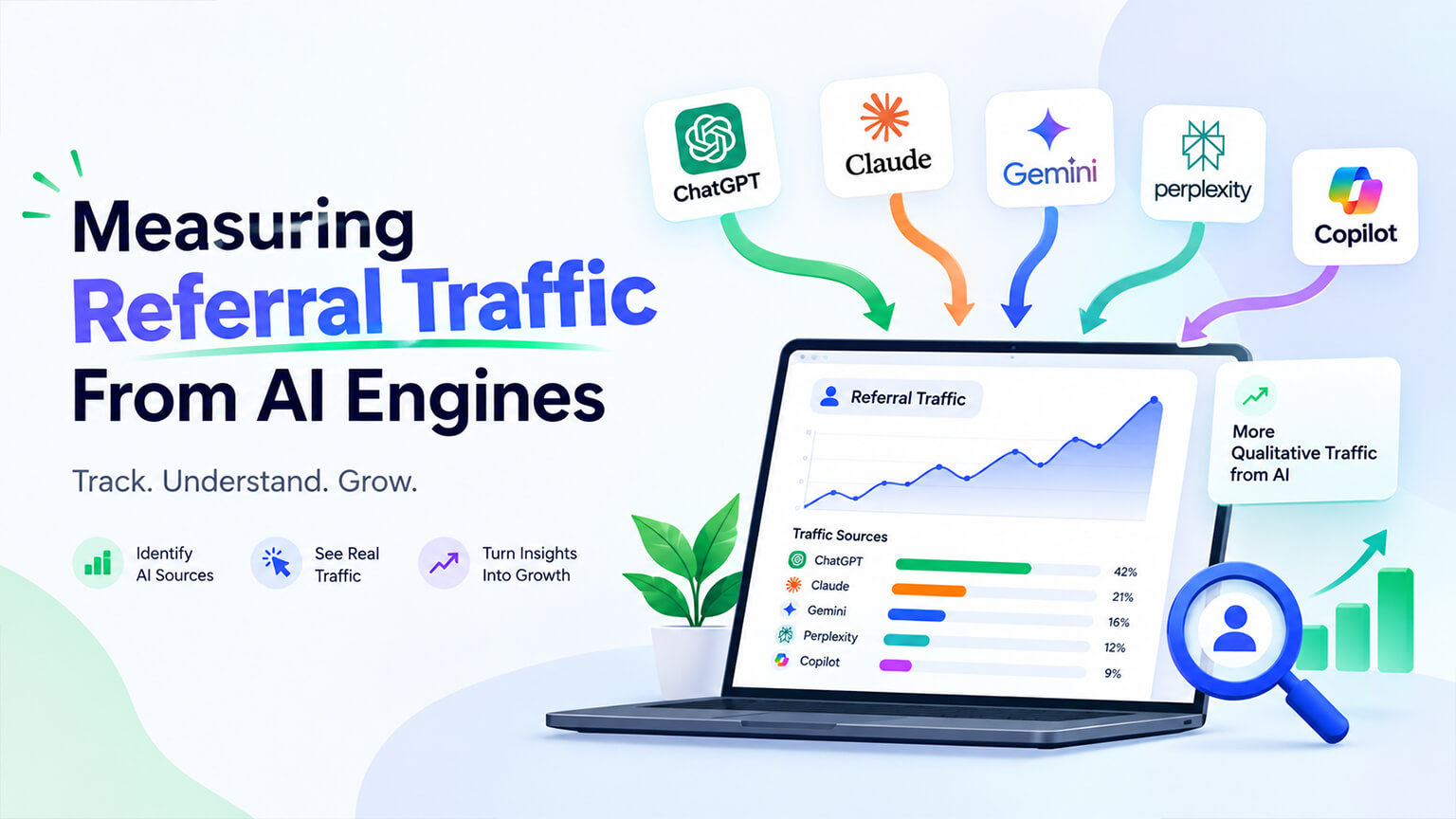
As AI engines (ChatGPT, Perplexity, Google’s AI features, and others) increasingly answer questions and cite sources, they’ve started sending referral traffic — users clicking through from an AI engine’s answer to your site (when you’re cited as a source, as the GEO discussion covers). This is a new, growing traffic channel, and measuring it — how much traffic AI engines send, from which engines, to which pages, and how it behaves and converts — helps you understand your AI-driven discovery, gauge your GEO efforts (whether you’re being found and cited by AI), and inform your strategy. Measuring AI referral traffic is a newer, evolving area (AI-referral tracking is still developing, and the data has limitations), but it’s increasingly worth doing as AI-driven discovery grows (as the AI-Overviews and will-AI-replace-SEO discussions cover). This piece covers measuring referral traffic from AI engines: why it matters, how to measure it, what it tells you, and how to use it (with realistic expectations about the evolving, limited data). (This connects to the GEO, measuring-SEO, and AI-Overviews discussions; this focuses on measuring AI referral traffic.)
This piece covers why measuring AI referral traffic matters, how to measure it, what it tells you, and how to use it (realistically). Because AI referral traffic is a new, growing channel worth measuring to understand AI-driven discovery and inform GEO. Let me walk through it.
Why measuring AI referral traffic matters
Measuring AI referral traffic matters as AI-driven discovery grows. A new, growing channel — AI engines sending referral traffic is a new, growing channel (as AI engines answer questions, cite sources, and users click through, as the GEO and AI-Overviews discussions cover) — so it’s an emerging traffic source worth measuring (versus ignoring a growing channel). Gauges your AI discovery — measuring AI referral traffic gauges your AI-driven discovery: whether AI engines are finding, citing, and sending traffic from you (as the GEO discussion covers) — so it’s a measure of your GEO success (are you being found and cited by AI?) — informing whether your AI-discoverability is working. Informs GEO efforts — measuring it informs your GEO efforts (as the GEO discussion covers): seeing which content gets AI referral traffic (cited by AI), which engines send traffic, and trends helps you understand and improve your GEO (what’s working, where to focus) — so it guides your AI-optimisation. Part of understanding discovery — as discovery shifts toward AI (as the AI-Overviews and will-AI-replace-SEO discussions cover), measuring AI referral traffic is part of understanding your overall discovery (search plus AI), so you see the full picture (not just traditional search) — completing the discovery picture. Emerging importance — as AI-driven discovery grows (an evolving trend), measuring AI referral traffic grows in importance (a bigger channel to understand over time) — so it’s increasingly worth measuring. Baseline and trend — measuring it establishes a baseline and lets you track the trend (is AI referral traffic growing? how significant is it becoming?), important as the channel evolves — so you track this emerging channel’s growth and significance for you. And it’s newer and evolving — measuring AI referral traffic is a newer, evolving area (tracking is still developing, data has limitations, as covered), so it’s an emerging measurement practice (worth doing, with realistic expectations) — not yet as mature as traditional analytics. So measuring AI referral traffic matters because it’s a new, growing channel worth measuring, it gauges your AI-driven discovery (GEO success), it informs your GEO efforts (what’s working, where to focus), it’s part of understanding your overall discovery (search plus AI), it’s of emerging and growing importance, and it establishes a baseline and trend for this evolving channel — though it’s a newer, evolving measurement area with limitations. So measure AI referral traffic to understand and gauge your AI-driven discovery and inform GEO, as this channel grows. So measuring AI referral traffic is an emerging but increasingly worthwhile practice for understanding AI-driven discovery. The next section covers how to measure it.
How to measure it
Measuring AI referral traffic uses your analytics (with the evolving nature and limitations in mind). Use your [analytics (GA4)](https://www.liquidwebdevelopers.com/services/custom-shopify-integrations) — measure AI referral traffic in your analytics (GA4, as the GA4 and measuring-SEO discussions cover): referral traffic from AI engines shows up as referrals from the AI engines’ domains (e.g., traffic referred from ChatGPT, Perplexity, and other AI engines’ domains) — so look at referral traffic by source, identifying the AI engines’ domains — the core method (analytics referral data).Identify AI engine referrers — identify the AI engines in your referral traffic (their domains — e.g., chatgpt.com, perplexity.ai, and other AI engines’ referring domains), so you can see traffic from each AI engine — identifying the AI sources (which requires knowing/finding the AI engines’ referring domains).Segment and track AI referrals — segment your analytics to track AI referral traffic (a segment/view for traffic from the AI engines’ domains), so you can measure it (volume, trend, behavior, [conversion](https://www.liquidwebdevelopers.com/services/conversion-rate-optimization)) as a channel — creating an AI-referral view.Look at behavior and conversion — look at how AI referral traffic behaves and converts (like any traffic source, as the GA4 discussion covers — its engagement, conversions, revenue), so you understand its quality and value (not just volume) — assessing the traffic’s value.Look at landing pages — see which pages AI referral traffic lands on (which of your [content/pages](https://www.liquidwebdevelopers.com/services/shopify-store-development) AI engines cite and send traffic to), revealing what’s being cited (informing GEO — what content gets AI traffic) — identifying your AI-cited content.Note the tracking limitations — note that AI-referral tracking has limitations (not all AI referrals are perfectly tracked or attributed — some AI traffic may not pass a clear referrer, or may be attributed as direct or other, and tracking is evolving), so the data is indicative, not perfectly complete/precise (as covered next) — realistic expectations.Use available tools/reports — use available tools and reports (GA4’s referral reports, any emerging AI-referral-specific tracking or tools as they develop), leveraging what’s available to measure it — using the evolving tooling.
And monitor over time — monitor AI referral traffic over time (its volume, trend, sources, behavior), tracking this evolving channel’s growth and significance — ongoing monitoring.
What it tells you
Measuring AI referral traffic tells you several useful things (within the data’s limitations). Whether AI is sending you traffic — it tells you whether (and how much) AI engines are sending you referral traffic — a basic but important signal (are you getting AI-driven traffic at all, and is it growing?) — gauging your AI-driven discovery. Which AI engines — it tells you which AI engines send you traffic (ChatGPT, Perplexity, etc.), so you see where your AI traffic comes from — understanding your AI-referral sources. What content gets cited/traffic — it tells you which of your content and pages AI engines cite and send traffic to (the landing pages of AI referrals), revealing what content is being used and cited by AI (informing your GEO — what’s working, what content AI values) — a key insight for GEO. How AI traffic behaves and converts — it tells you how AI referral traffic behaves and converts (its engagement, conversion, revenue, as the GA4 discussion covers), so you understand its quality and value (is AI traffic valuable? does it convert?) — assessing the channel’s value. The trend and growth — it tells you the trend (is AI referral traffic growing? how significant is it becoming?), important for understanding this emerging channel’s trajectory and significance for you — tracking the channel’s evolution. Your GEO progress — collectively, it tells you your GEO progress (whether your AI-discoverability efforts are resulting in AI citing and sending traffic, as the GEO discussion covers), gauging your GEO success and informing improvement — measuring GEO. But not the full picture — importantly, it doesn’t tell you the full AI-discovery picture (given the tracking limitations, and because AI can influence discovery without a clickthrough — e.g., a user seeing your brand cited in an AI answer without clicking, which isn’t captured as referral traffic, as the AI-Overviews discussion touches on) — so AI referral traffic is one indicator, not the complete measure of your AI-driven discovery/influence. So measuring AI referral traffic tells you whether and how much AI engines send you traffic, which AI engines, what content gets cited and traffic (a key GEO insight), how AI traffic behaves and converts (its value), the trend and growth, and your GEO progress — while not being the full AI-discovery picture (given limitations and AI’s influence without clickthroughs). So it’s a useful (if partial) indicator of your AI-driven discovery and GEO, informing your understanding and strategy. So use these insights (from AI referral traffic) to gauge your AI discovery and GEO, understanding it’s a partial indicator. The next section covers how to use it. So AI referral traffic tells you about your AI-driven discovery and GEO (traffic, sources, cited content, value, trend), as a useful but partial indicator.
How to use it (realistically)
Using AI referral traffic data well means informing your strategy while being realistic about the data. Gauge your AI discovery — use it to gauge your AI-driven discovery (are AI engines finding, citing, and sending traffic from you, and is it growing?), informing whether your AI-discoverability (GEO) is working — a gauge of your AI-discovery success. Inform your GEO efforts — use the insights (what content gets AI traffic, which engines, trends) to inform and improve your GEO efforts (as the GEO discussion covers): doubling down on content/approaches that get AI traffic, understanding what AI values, and focusing your GEO (as the GEO and optimizing-for-AI-search discussions cover) — guiding your AI-optimisation. Understand the channel’s value — use the behavior/conversion data to understand AI referral traffic’s value (is it valuable, converting traffic?), informing how much to prioritise AI-driven discovery — assessing the channel’s worth. Track the trend — track the trend over time (the channel’s growth and significance), so you understand its trajectory and adjust your attention as it grows (more attention as it becomes more significant) — monitoring the evolving channel. Be realistic about the data — be realistic about the data’s limitations (evolving, imperfect tracking, not the full AI-discovery picture, as covered), so you use it as an indicative signal (not precise, complete truth) — interpreting it appropriately (a useful indicator, not a perfect measure). Combine with the broader AI-discovery picture — combine AI referral traffic with the broader picture of AI-driven discovery (AI’s influence beyond clickthroughs, your GEO efforts, brand visibility in AI, as the GEO and AI-Overviews discussions cover), since referral traffic is one part (not the whole) of AI discovery — a fuller understanding. Don’t over- or under-react — don’t over-react (treating limited early AI referral traffic as hugely significant, or the data as precise) or under-react (ignoring a growing channel), but understand and track it appropriately as an emerging channel — measured interpretation. And integrate into overall measurement — integrate AI referral traffic into your overall measurement and strategy (alongside search, other channels, as the measuring-SEO and metrics discussions cover), part of understanding your discovery and performance — holistic measurement. So use AI referral traffic data by gauging your AI-driven discovery, informing your GEO efforts (what content/approaches get AI traffic — double down), understanding the channel’s value, tracking the trend, being realistic about the data’s limitations (an indicative signal, not the full picture), combining it with the broader AI-discovery picture (AI’s influence beyond clickthroughs), not over- or under-reacting, and integrating it into your overall measurement. The keys are using it to gauge AI discovery and inform GEO (what works), being realistic about the evolving/limited data (an indicator, not the full picture), and tracking the growing channel appropriately. So use AI referral traffic to inform your GEO and understand your AI-driven discovery, realistically (as a useful, evolving, partial indicator), integrated into your overall measurement. So measuring AI referral traffic, used realistically, informs your GEO and AI-discovery understanding as this channel grows.
The bottom line
As AI engines (ChatGPT, Perplexity, Google’s AI features, and others) increasingly answer questions and cite sources, they’ve started sending referral traffic — users clicking through from an AI engine’s answer to your site when you’re cited as a source — a new, growing traffic channel worth measuring. Measuring AI referral traffic (how much, from which engines, to which pages, and how it behaves and converts) matters because it’s an emerging, growing channel, it gauges your AI-driven discovery (whether AI engines are finding, citing, and sending traffic from you — your GEO success), it informs your GEO efforts (what content and approaches get AI traffic, so you can improve), it’s part of understanding your overall discovery (search plus AI), and it’s of growing importance as AI-driven discovery expands — though it’s a newer, evolving measurement area with data limitations. Measure it using your analytics (GA4): AI referral traffic shows up as referrals from the AI engines’ domains, so identify the AI engines in your referral traffic (their referring domains), segment and track AI referrals as a channel, look at how the traffic behaves and converts (its value) and which pages it lands on (revealing what content AI cites and sends traffic to — a key GEO insight), note the tracking limitations (not all AI referrals are perfectly tracked or attributed, and tracking is evolving, so the data is indicative rather than precise and complete), use available tools and reports, and monitor over time. It tells you whether and how much AI engines send you traffic, which engines, what content gets cited and traffic (a key GEO insight), how the traffic behaves and converts (its value), the trend and growth, and your GEO progress — while not being the full AI-discovery picture, since tracking is imperfect and AI can influence discovery without a clickthrough (a user seeing your brand cited without clicking isn’t captured as referral traffic). Use the data by gauging your AI-driven discovery, informing your GEO efforts (doubling down on content and approaches that get AI traffic, understanding what AI values), understanding the channel’s value, tracking the trend over time, being realistic about the data’s limitations (using it as an indicative signal, not precise complete truth), combining it with the broader AI-discovery picture (AI’s influence beyond clickthroughs), not over- or under-reacting (neither treating limited early data as hugely significant nor ignoring a growing channel), and integrating it into your overall measurement alongside search and other channels. The keys are using it to gauge AI discovery and inform GEO (what’s working), being realistic about the evolving and limited data (a useful indicator, not the full picture), and tracking this growing channel appropriately. So measure AI referral traffic to understand and gauge your AI-driven discovery and inform your GEO — using it realistically as a useful, emerging, partial indicator, integrated into your overall measurement — as AI-driven discovery grows into an increasingly significant channel worth understanding.
Frequently asked questions
What is AI referral traffic?
AI referral traffic is traffic that comes to your site from AI engines — users who click through from an AI engine’s answer to your site when you’re cited as a source. As AI engines like ChatGPT, Perplexity, and Google’s AI features increasingly answer users’ questions and cite the sources they draw on, users can click those citations to visit the referenced sites, sending referral traffic much as a link in a traditional search result or on another website would. This is a new and growing traffic channel, distinct from traditional organic search traffic — it comes from being cited in AI-generated answers rather than ranking in a traditional results list. It’s the clickthrough side of AI-driven discovery (the GEO goal of being found and cited by AI engines), and measuring it helps you understand whether AI engines are finding, citing, and sending traffic from you. It’s an emerging area, so the tracking is still evolving and imperfect, but it’s increasingly worth measuring as AI-driven discovery grows.
How do I measure referral traffic from AI engines?
Use your analytics (GA4). AI referral traffic shows up as referral traffic from the AI engines’ domains, so look at your referral traffic by source and identify the AI engines’ referring domains (such as those of ChatGPT, Perplexity, and other AI engines). Segment or create a view for traffic from those AI-engine domains so you can track it as a channel — its volume, trend, behavior, and conversion. Look at how the AI referral traffic behaves and converts (engagement, conversions, revenue) to understand its quality and value, and see which pages it lands on, which reveals what content AI engines are citing and sending traffic to (a valuable insight for your GEO). Use GA4’s referral reports and any emerging AI-referral-specific tracking tools as they develop, and monitor the traffic over time. Importantly, note the limitations: AI-referral tracking is evolving and imperfect (not all AI referrals pass a clear referrer or are perfectly attributed — some may show as direct or other), so treat the data as indicative rather than precise and complete.
What does AI referral traffic tell me?
Several useful things, within the data’s limits. It tells you whether and how much AI engines are sending you referral traffic (are you getting AI-driven traffic, and is it growing?), which AI engines send it (where your AI traffic comes from), and — importantly for GEO — which of your content and pages AI engines cite and send traffic to (revealing what content AI values and is using). It tells you how AI referral traffic behaves and converts (its engagement, conversion, and revenue — its quality and value), and the trend over time (the channel’s growth and significance for you). Collectively, it gauges your GEO progress — whether your efforts to be found and cited by AI are working. However, it doesn’t tell you the full AI-discovery picture: tracking is imperfect, and AI can influence discovery without a clickthrough (a user might see your brand cited in an AI answer and not click, which isn’t captured as referral traffic). So it’s a useful but partial indicator of your AI-driven discovery — informative for gauging and improving your GEO, but not the complete measure of AI’s influence on your discovery.
How should I use AI referral traffic data?
Use it to gauge your AI-driven discovery and inform your GEO, while being realistic about the data. Gauge whether AI engines are finding, citing, and sending traffic from you (and whether it’s growing), which tells you if your GEO efforts are working. Use the insights — especially which content gets AI traffic and which engines send it — to inform and improve your GEO, doubling down on the content and approaches that get cited and understanding what AI values. Assess the channel’s value from its behavior and conversion data, and track the trend over time so you can give it more attention as it grows. Be realistic about the data’s limitations: it’s an evolving, imperfect, indicative signal, not a precise or complete measure, and it’s not the full AI-discovery picture (AI influences discovery beyond clickthroughs too). So combine it with the broader picture of your AI-driven discovery, and don’t over-react (treating limited early data as hugely significant or precise) or under-react (ignoring a growing channel). Integrate it into your overall measurement alongside search and other channels, using it appropriately as an emerging, useful, partial indicator of your AI-driven discovery.