
Prompting Tips for Ecommerce Marketers
On this page
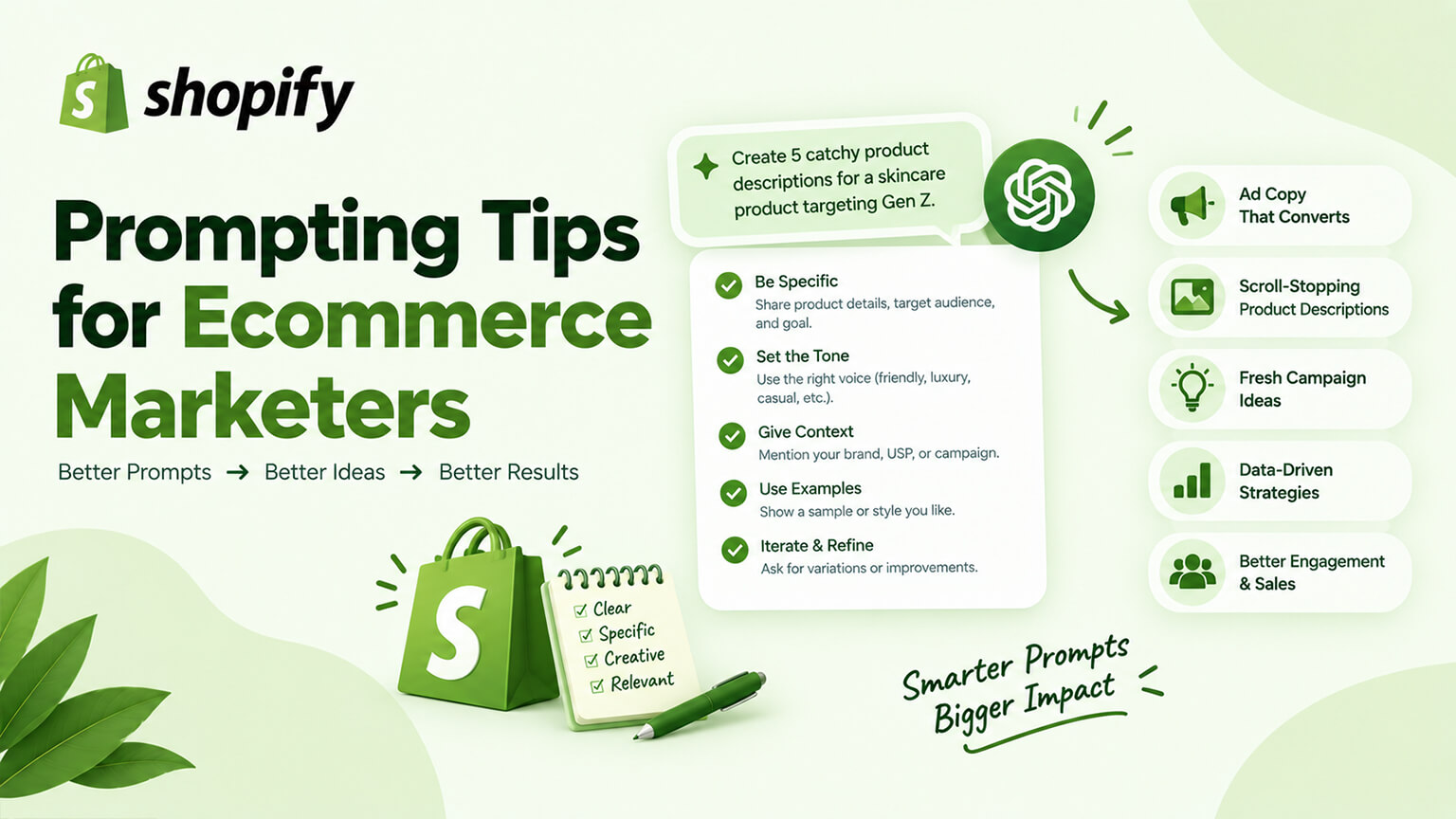
AI tools (ChatGPT, Claude, and others) have become useful for ecommerce marketing tasks — drafting content, brainstorming, analysing, summarising, and more (as the AI-for-ecommerce discussions cover). But there’s a big difference between the results different people get from the same AI tools, and much of that difference comes down to prompting: how you ask the AI for what you want. A vague, thoughtless prompt gets a vague, generic result; a clear, well-constructed prompt gets a much more useful, on-target result. Prompting well is a practical skill that dramatically improves the value you get from AI tools — and it’s learnable, not magic. For ecommerce marketers using AI (with human oversight, as the ethical-AI and AI-content discussions emphasise), better prompting means better AI output, saving time and getting more useful results. This piece provides practical prompting tips for ecommerce marketers: why prompting matters, the key principles of good prompting, specific tips for ecommerce marketing tasks, and how to prompt well overall. (This connects to the AI-for-ecommerce, AI-content, and ethical-AI discussions; this focuses on prompting tips.)
This piece covers why prompting matters, the key principles of good prompting, specific prompting tips for common ecommerce marketing tasks, and how to prompt well. Because prompting well dramatically improves AI output, and it’s a learnable skill worth developing. Let me walk through it.
Why prompting matters
Prompting matters because it largely determines the quality and usefulness of AI output. Same tool, different results — different people get very different results from the same AI tools, and much of that difference is prompting (how they ask) — so prompting is a major determinant of the value you get from AI, not just the tool. Vague prompts get vague results — a vague, unclear, or thoughtless prompt gets a vague, generic, or off-target result (the AI doesn’t know what you really want, so it gives something generic) — so poor prompting wastes AI’s potential. Clear prompts get useful results — a clear, specific, well-constructed prompt gets a much more useful, on-target, relevant result (the AI understands what you want and delivers it) — so good prompting unlocks AI’s usefulness. It’s how you direct the AI — prompting is how you direct the AI (telling it what you want, in what form, with what context) — so it’s the primary lever for getting useful output (directing the tool well). It saves time and improves output — good prompting saves time (getting useful results faster, with less back-and-forth or bad output) and improves the output quality — practical benefits for busy marketers. It’s a learnable skill — prompting well is a learnable, practical skill (not magic or requiring technical expertise) — so any marketer can improve their prompting and thus their AI results. And it amplifies AI’s value — since AI is useful for marketing tasks (with oversight, as the ethical-AI discussion covers), and prompting determines how useful, good prompting amplifies the value you get from AI across your marketing tasks. So prompting matters because it largely determines AI output quality (same tool, very different results based on prompting), vague prompts get vague results while clear prompts get useful ones, it’s how you direct the AI (the primary lever for useful output), it saves time and improves output, it’s a learnable skill, and it amplifies AI’s value. So developing your prompting skill is high-value for getting the most from AI tools. So learn to prompt well — it’s the key to useful AI output. The next section covers the key principles.
The key principles of good prompting
Several key principles underpin good prompting. Be clear and specific — be clear and specific about what you want (the task, the output, the details), since vague prompts get vague results and specific prompts get on-target results — clarity and specificity are the foundation of good prompting. Provide context — provide relevant context (about your brand, product, audience, goals, situation), so the AI’s output is relevant and tailored (versus generic) — context makes the output fit your needs. Specify the format and length — specify the output format and length you want (e.g., “a 100-word product description,” “5 bullet points,” “an email in this tone”), so you get the output in the form you need (versus a mismatched format) — specificity about output form. Give examples (if helpful) — provide examples of what you want (a good example, your brand’s style, a template), since examples guide the AI toward your desired output (especially for style/format) — examples are powerful for guiding output. Specify the tone and style — specify the tone and style (your brand voice, formal/casual, etc.), so the output matches your brand and needs (versus a generic tone) — important for on-brand content. Assign a role or perspective (if useful) — assigning a role/perspective (“as an ecommerce copywriter,” “from the customer’s perspective”) can help the AI adopt the right framing — a useful technique for some tasks. Break complex tasks down — break complex tasks into clear steps or parts (versus one vague big ask), so the AI handles them well — structuring complex prompts. Iterate and refine — iterate: if the first result isn’t right, refine your prompt (clarify, add context, adjust) — prompting is often iterative (refining toward the desired output), so iterate rather than accepting a poor first result. And review and edit the output — always review and edit the AI’s output (for quality, accuracy, brand, as the AI-content and ethical-AI discussions cover), since good prompting improves but doesn’t guarantee perfect output — human review remains essential. So the key principles of good prompting are: be clear and specific, provide context, specify format and length, give examples (if helpful), specify tone and style, assign a role/perspective (if useful), break complex tasks down, iterate and refine, and review and edit the output. These principles — clarity, context, specificity, examples, iteration, and review — produce much better AI output. So apply these principles to prompt well. The next section covers specific tips for ecommerce tasks.
Specific prompting tips for ecommerce marketing tasks
Applying the principles to common ecommerce marketing tasks gives specific tips. Product descriptions — for product descriptions (as the AI-descriptions discussion covers): provide the product details (features, benefits, specifications), specify the tone/brand voice, length, and format, give an example of your style, and specify the audience — so the AI writes on-brand, relevant descriptions (versus generic ones), which you then review and edit (as those discussions cover). Marketing copy (emails, ads) — for marketing copy: provide the context (the campaign, offer, audience, goal), specify the format (email, ad, length), tone, and key points, and give brand-voice examples — so the copy fits your campaign and brand (reviewed and edited). Content ideas and brainstorming — for brainstorming (content ideas, angles): provide context (your brand, audience, topics, goals) and ask for specific types of ideas (e.g., “10 blog post ideas for [audience] about [topic]”), so the ideas are relevant — a good use of AI (idea generation, with human selection). Content drafts — for content drafts (blog posts, etc., as the AI-content-workflow discussion covers): provide the topic, key points, audience, tone, structure, and length, so the draft is on-target (then heavily reviewed/edited, since AI drafts need human work, as those discussions cover). Analysis and summarisation — for analysis/summarisation (data, feedback, as the AI-CRO and review-mining discussions cover): provide the data/text and specify what to analyse or summarise (the focus, format), so the output is useful (verified by you, as those discussions cover). Social media content — for social content: provide the context, platform, tone, and goal, specifying format and length, for on-brand social posts (reviewed). And SEO/GEO content (with care) — for SEO/content (as the SEO and GEO discussions cover): provide context and specifics, but ensure quality and accuracy (AI content needs human oversight for SEO quality and accuracy, as the AI-content and GEO discussions cover) — using AI to assist, not replace, quality content work. So specific prompting tips for ecommerce tasks: for product descriptions (details, tone, format, examples, audience), marketing copy (context, format, tone, key points, examples), brainstorming (context, specific idea types), content drafts (topic, key points, tone, structure — then edit), analysis/summarisation (data, focus, format — then verify), social content (context, platform, tone, format), and SEO content (context, specifics, with quality oversight) — applying the principles to each task. So apply the prompting principles to your specific ecommerce marketing tasks, providing the right context, specifics, and examples for each. The next section covers prompting well overall.
How to prompt well overall
Prompting well overall involves developing the skill and using AI effectively and responsibly. Practice and develop the skill — practice prompting (it’s a learnable skill that improves with practice), developing your ability to get useful AI output over time — the more you prompt well, the better your results. Iterate toward good output — prompt iteratively (refining prompts toward the desired output, versus accepting poor first results), since good prompting is often a refining process — iterate to get the best output. Build reusable prompts — build a set of reusable, effective prompts for your common tasks (a “prompt library” of prompts that work well for your product descriptions, emails, etc.), saving time and ensuring quality — reusing good prompts. Provide your brand context consistently — provide your brand context (voice, audience, positioning) in prompts consistently (or via reusable prompts/context), so AI output is consistently on-brand — leveraging context for brand consistency. Always review and edit — always review and edit AI output (for quality, accuracy, brand, and responsibility, as the AI-content and ethical-AI discussions cover), since prompting improves but human oversight remains essential — the recurring, crucial point (AI assists, humans ensure quality and responsibility). Use AI responsibly — use AI (and prompting) responsibly and ethically (as the ethical-AI discussion covers): honestly, with human oversight, maintaining quality — good prompting within responsible AI use. Match AI use to where it helps — use AI (with good prompting) where it helps (drafting, brainstorming, analysis, as the AI-for-ecommerce discussions cover), not for everything — matching AI use to value. And keep learning — keep learning prompting techniques (as AI tools and prompting evolve), staying effective — an evolving, learnable skill. So prompt well overall by practicing and developing the skill, iterating toward good output, building reusable prompts (a prompt library), providing brand context consistently, always reviewing and editing output (human oversight essential), using AI responsibly, matching AI use to where it helps, and keeping learning. The keys are developing the prompting skill (practice, iteration, reusable prompts), providing good context and specifics, and always reviewing/editing output (human oversight). So develop your prompting skill and use it (with human oversight, responsibly) to get much better, more useful AI output across your ecommerce marketing tasks. So prompting well is a high-value, learnable skill that amplifies AI’s usefulness for ecommerce marketing — worth developing, applied with human oversight and responsibility.
A worked example: a bad prompt vs. a good one
Nothing illustrates the difference like seeing the same task prompted two ways. Suppose a marketer needs a product description for a merino wool sweater. The bad prompt: “Write a product description for a wool sweater.” What comes back is generic and forgettable — vague benefits, a bland tone, wrong length, nothing distinctive — because the AI had nothing to work with, so it produced the average of everything. The good prompt supplies what the AI needs: “Write a 90-word product description for a men’s merino wool crew-neck sweater. Key features: 100% ethically-sourced merino, naturally temperature-regulating, machine-washable, available in five muted colours. Audience: style-conscious professionals aged 30–50 who value quality and sustainability. Tone: warm, confident, understated — here’s an example of our brand voice: [paste a description you like]. Focus on the everyday versatility and the quality of the material. Avoid hype and clichés.” That prompt yields something on-brand, on-length, audience-appropriate, and specific — a useful first draft the marketer can polish, rather than start over from.
The difference wasn’t the AI or luck; it was the prompt carrying clarity, specifics (features, length, format), context (audience, brand), an example (brand voice), tone direction, and even a constraint (avoid hype). And if the first result still isn’t quite right, the marketer iterates — “make it a bit more playful,” “lead with the sustainability angle,” “tighten to 70 words” — refining toward the target rather than accepting the first attempt. This is the whole skill in miniature: the good prompt did the work of directing the tool, so the output needed light editing rather than a rewrite. Build a handful of these strong, reusable prompts for your common tasks (descriptions, emails, social posts) with your brand context baked in, and you get consistently better output far faster — while still, always, reviewing and editing before anything ships. That combination — strong prompting plus human review — is what turns AI from a source of generic filler into a genuine time-saver that produces on-brand, useful marketing material.
The bottom line
AI tools have become useful for ecommerce marketing tasks — drafting content, brainstorming, analysing, summarising, and more — but there’s a big difference between the results different people get from the same tools, and much of it comes down to prompting: how you ask the AI for what you want. A vague, thoughtless prompt gets a vague, generic result; a clear, well-constructed prompt gets a much more useful, on-target result. Prompting well is a practical, learnable skill (not magic) that dramatically improves the value you get from AI tools. It matters because it largely determines AI output quality, it’s how you direct the AI (the primary lever for useful output), it saves time and improves output, and it amplifies AI’s value across your marketing tasks. The key principles of good prompting are: be clear and specific (the foundation — vague prompts get vague results), provide relevant context (about your brand, product, audience, and goals, so output is tailored not generic), specify the output format and length, give examples of what you want (powerful for guiding style and format), specify the tone and style (for on-brand output), assign a role or perspective if useful, break complex tasks down, iterate and refine (prompting is often iterative — refine rather than accepting a poor first result), and always review and edit the output (human oversight remains essential). Apply these to specific ecommerce tasks: product descriptions (provide details, tone, format, examples, audience), marketing copy (context, format, tone, key points, brand-voice examples), brainstorming (context and specific idea types), content drafts (topic, key points, tone, structure — then edit heavily), analysis and summarisation (data, focus, format — then verify), social content (context, platform, tone, format), and SEO content (context and specifics, with quality and accuracy oversight). Prompt well overall by practicing and developing the skill, iterating toward good output, building a library of reusable effective prompts for your common tasks, providing your brand context consistently (for on-brand output), always reviewing and editing AI output (for quality, accuracy, brand, and responsibility — the crucial, recurring point that human oversight remains essential), using AI responsibly and ethically, matching AI use to where it helps, and continuing to learn as tools and techniques evolve. The keys are developing the prompting skill (practice, iteration, reusable prompts), providing good context and specifics, and always reviewing and editing the output. Done this way, prompting well is a high-value, learnable skill that amplifies AI’s usefulness for ecommerce marketing — getting you much better, more on-target, more useful AI output that saves time and improves results, applied always with the human oversight and responsibility that good, ethical AI use requires. So invest in developing your prompting skill; it’s one of the highest-leverage things you can do to get more value from the AI tools increasingly central to ecommerce marketing.
Frequently asked questions
Why does prompting matter so much for AI results?
Because it largely determines the quality and usefulness of what the AI produces — different people get very different results from the same AI tools, and much of that difference comes down to how they prompt. A vague, unclear, or thoughtless prompt gets a vague, generic, or off-target result, because the AI doesn’t know what you really want, so it gives something generic. A clear, specific, well-constructed prompt gets a much more useful, on-target, relevant result, because the AI understands what you want and delivers it. Prompting is how you direct the AI — telling it what you want, in what form, with what context — so it’s the primary lever for getting useful output. Good prompting saves time (fewer bad results and less back-and-forth) and improves output quality, and it’s a learnable skill that any marketer can develop. Since AI is useful for marketing tasks and prompting determines how useful, developing your prompting skill dramatically amplifies the value you get from AI.
What makes a good AI prompt?
Clarity, specificity, and context, above all. Be clear and specific about what you want (the task, the output, the details), rather than vague. Provide relevant context (about your brand, product, audience, and goals) so the output is tailored rather than generic. Specify the output format and length you want (a 100-word description, five bullet points, an email in a particular tone). Give examples of what you’re after (a good example or your brand’s style) — examples are powerful for guiding the AI toward your desired output. Specify the tone and style (your brand voice), and if useful, assign a role or perspective (“as an ecommerce copywriter”). Break complex tasks into clear steps rather than one vague big ask. Iterate — if the first result isn’t right, refine your prompt (clarify, add context, adjust) rather than accepting a poor first attempt. And always review and edit the output. These principles — clarity, context, specificity, examples, iteration, and review — produce much better results than a vague, one-shot prompt.
How should I prompt AI for ecommerce tasks like product descriptions?
Apply the general principles with task-specific details. For a product description, provide the product’s details (features, benefits, specifications), specify your brand’s tone and voice, the length and format you want, and the target audience, and give an example of your existing style — so the AI writes an on-brand, relevant description rather than a generic one, which you then review and edit. For marketing copy (emails, ads), provide the campaign context, offer, audience, and goal, and specify the format, tone, and key points, with brand-voice examples. For brainstorming, give context and ask for specific types of ideas (“10 blog post ideas for [audience] about [topic]”). For content drafts, provide the topic, key points, audience, tone, structure, and length (then edit heavily). For analysis or summarisation, provide the data or text and specify what to focus on and the format (then verify). The pattern is consistent: give the right context, specifics, and examples for each task, then always review and edit.
Can good prompting replace reviewing AI output?
No — this is crucial. Good prompting dramatically improves AI output, but it doesn’t guarantee perfect, accurate, on-brand, or appropriate results, so reviewing and editing the output remains essential. AI can still produce inaccuracies, generic or off-brand passages, or content that needs refinement, and for anything customer-facing, human oversight ensures the quality, accuracy, brand fit, and responsibility that good, ethical AI use requires (as the AI-content and ethical-AI discussions cover). So think of prompting and reviewing as complementary: good prompting gets you a much better starting point (saving time and improving quality), and human review and editing turn that into finished, trustworthy output. The pattern across all AI use in marketing is AI accelerating and assisting while humans direct (through good prompting) and ensure quality and responsibility (through review and editing). So develop your prompting skill to get better AI output, but always keep the human review step — the two together are how you use AI well.