
Shopify Rich Results: Reviews, FAQs, and Breadcrumbs
On this page
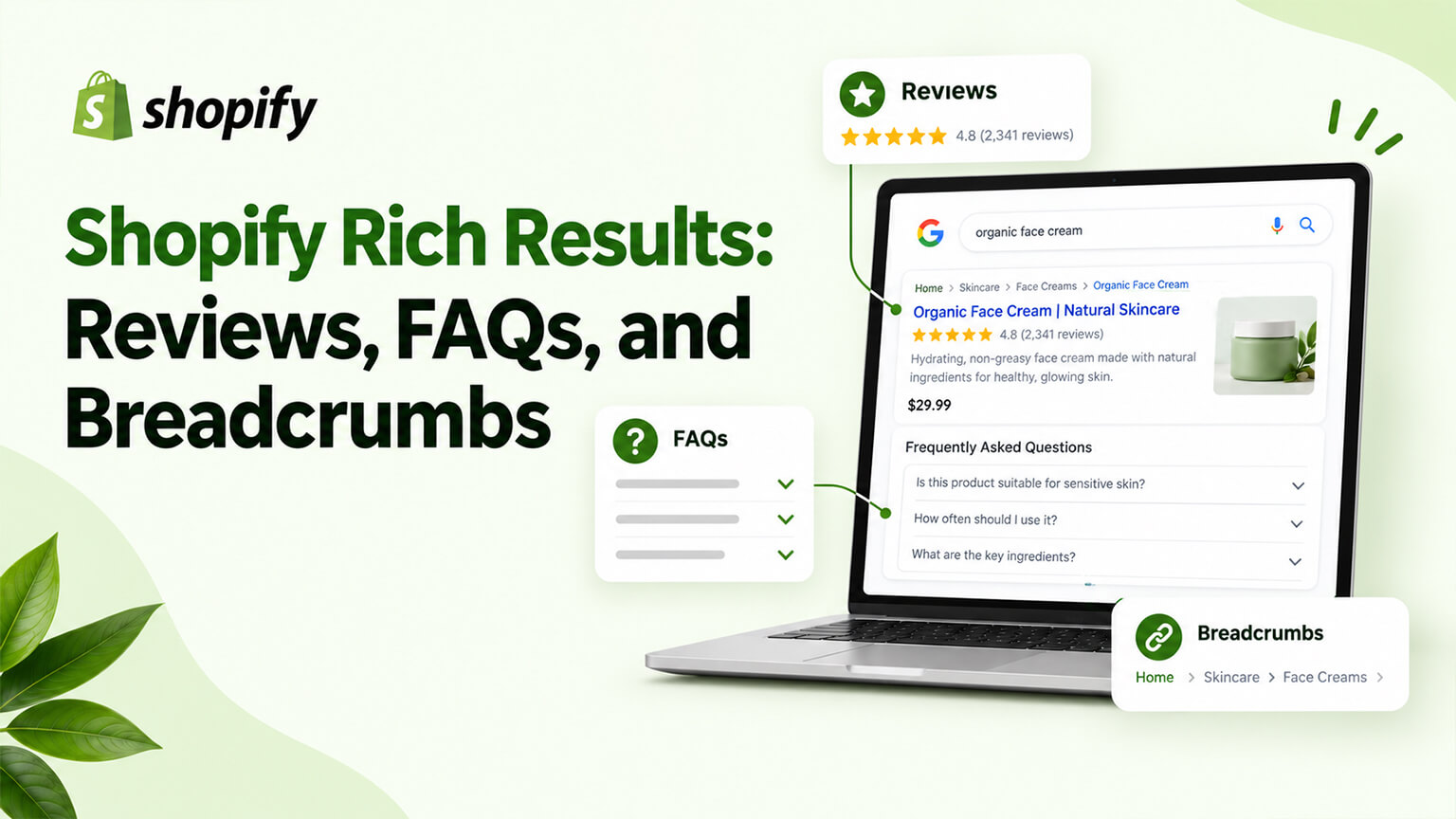
When you search Google, some results stand out from the plain blue links: a product with star ratings and review counts, a page with expandable FAQ questions, a result showing its breadcrumb path. These are rich results — enhanced search listings that display extra information, made possible by structured data (schema, as that discussion covers). Rich results can make your listings more prominent, informative, and clickable — a real SEO benefit (better visibility and click-through) — so earning them is worthwhile. For Shopify stores, the most relevant rich results are review/rating stars (on product pages), FAQ rich results (though Google has reduced these, as the FAQ-schema discussion covers), and breadcrumb rich results (showing your site structure in the listing). This piece covers Shopify rich results — reviews, FAQs, and breadcrumbs specifically — how they work, how to earn them, and realistic expectations (since Google’s rich-result behavior evolves and varies). (This connects to the structured-data and FAQ-schema discussions; this focuses on rich results — reviews, FAQs, and breadcrumbs.)
This piece covers what rich results are and why they matter, review/rating rich results, FAQ rich results (with realistic expectations), breadcrumb rich results, and how to earn them well. Because rich results enhance your search listings, and earning them (via structured data) is a worthwhile SEO opportunity. Let me walk through it. (Note: Google’s rich-result eligibility and behavior evolve and vary, so verify current specifics; this covers the general picture.)
What rich results are and why they matter
Let’s understand rich results and their value. Enhanced search listings — rich results are search listings enhanced with extra information beyond the standard title, URL, and description — such as star ratings, FAQ questions, breadcrumbs, images, and other elements, displayed in the search results — making the listing richer and more prominent. Powered by structured data — rich results are made possible by structured data (schema markup on your pages, as that discussion covers): the structured data tells Google about your content (reviews, FAQs, breadcrumbs, etc.), enabling Google to display it as a rich result — so structured data is how you become eligible for rich results. Why they matter: prominence and click-through — rich results make your listing more prominent and eye-catching (standing out from plain results) and more informative (showing ratings, FAQs, structure), which can improve your click-through rate (more clicks from the same ranking) — a real SEO benefit (more traffic without ranking higher). Trust and appeal — elements like star ratings add trust and appeal (social proof in the listing, as the social-proof discussion covers), making your result more attractive. More search real estate — some rich results (FAQs, etc.) take more space in the results, giving your listing more prominence. But Google controls display — importantly, Google decides whether to display a rich result (structured data makes you eligible, but Google chooses whether/how to show it, and this varies and changes) — so rich results aren’t guaranteed by adding structured data; you become eligible, and Google displays them at its discretion. So rich results are enhanced search listings (with stars, FAQs, breadcrumbs, etc.), powered by structured data, that matter because they improve prominence and click-through (more traffic), add trust and appeal, and take more search real estate — though Google controls whether they display (structured data makes you eligible, Google decides). So earning rich results (via structured data) is a worthwhile SEO opportunity (better listings and click-through), with the caveat that display isn’t guaranteed. So implement the structured data to become eligible for rich results, understanding Google controls display. The next sections cover the specific rich results.
Review and rating rich results
Review/rating rich results (star ratings in listings) are among the most valuable for ecommerce. What they are — review rich results display star ratings and review counts in the search listing (e.g., a product showing “4.8 ★ 2,000 reviews”), making the listing show your product’s ratings — highly appealing and trust-building (social proof in the listing). Value for ecommerce — for product pages, star ratings in the listing are valuable: they add social proof and appeal, standing out and building trust, which can improve click-through (as the social-proof discussion covers) — a real benefit for product listings. How to earn them — earn review rich results via review/rating structured data (Product schema with aggregateRating/review, as the structured-data discussion covers) on your product pages, telling Google about your product’s ratings and reviews — making you eligible for review rich results. Requires real reviews — you need genuine reviews and ratings (from real customers, as the reviews discussion covers) to mark up — review rich results reflect real review data (and marking up fake or non-existent reviews violates guidelines, as the reviews and structured-data discussions cover). Review apps often handle it — many review apps (Judge.me, Yotpo, etc., as the reviews discussion covers) add the review structured data automatically, so using a review app often provides the review structured data (and thus rich-result eligibility) — a common way to get it. And Google’s guidelines — follow Google’s guidelines for review structured data (genuine reviews, proper markup, eligible content), since violations (fake reviews, improper markup) can result in penalties or ignored markup. So review/rating rich results (star ratings in listings) are valuable for ecommerce (social proof and appeal improving click-through), earned via review/rating structured data (Product schema with aggregateRating/review) on product pages, requiring genuine reviews (often provided by review apps that add the structured data), following Google’s guidelines. So implement review structured data (often via a review app) with genuine reviews to earn review rich results — a valuable enhancement for product listings. The next section covers FAQ rich results.
FAQ rich results (with realistic expectations)
FAQ rich results (expandable FAQ questions in listings) require realistic expectations, given Google’s changes (as the FAQ-schema discussion covers). What they were — FAQ rich results displayed expandable FAQ questions/answers in the search listing (your FAQs shown in the result, expandable), taking more space and showing your Q&As — a prominent enhancement. Google has reduced them — importantly, Google significantly reduced FAQ rich results (they now appear rarely, mainly for authoritative health/government sites, as the FAQ-schema discussion covers) — so for most sites, FAQ structured data no longer produces FAQ rich results, and you shouldn’t add it primarily expecting them. Realistic expectations — so set realistic expectations: FAQ rich results are largely gone for most sites (Google’s change), so don’t add FAQ structured data expecting rich results (that benefit is diminished) — a key realistic caveat. FAQ schema still useful for other reasons — FAQ structured data is still useful for other reasons (search understanding, and especially AI/GEO — helping AI engines use your Q&A content, as the FAQ-schema and GEO discussions cover), so it’s worth using for those (not the diminished rich results). How to earn (if eligible) — if you’re in a category where FAQ rich results still appear (rare), earn them via FAQPage structured data (as the FAQ-schema discussion covers) with genuine, visible FAQs — though for most, don’t expect the rich results. So FAQ rich results, once a prominent enhancement, are now largely gone for most sites (Google reduced them to mainly authoritative health/government sites), so don’t add FAQ structured data primarily expecting them — though FAQ schema remains useful for search understanding and especially AI/GEO (as the FAQ-schema discussion covers). So use FAQ schema for its current benefits (understanding, AI/GEO), not the diminished rich results, with realistic expectations. The next section covers breadcrumb rich results.
Breadcrumb rich results
Breadcrumb rich results (showing your site’s structure/path in the listing) are a useful, achievable enhancement. What they are — breadcrumb rich results display your page’s breadcrumb path (e.g., “Home > Category > Subcategory > Product”) in the search listing instead of just the URL, showing the page’s place in your site structure — a cleaner, more informative listing. Value — breadcrumbs in the listing make it cleaner and more informative (showing the page’s context/structure), which is a modest but real enhancement (a tidier, more structured-looking listing, potentially aiding click-through and conveying your site structure). How to earn them — earn breadcrumb rich results via BreadcrumbList structured data (as the structured-data discussion covers) on your pages, marking up the breadcrumb path — making you eligible for breadcrumb rich results. Often from breadcrumbs on the page — breadcrumb structured data usually accompanies breadcrumb navigation on the page (as the internal-linking and navigation discussions cover — breadcrumbs aiding UX and internal linking too), so implementing breadcrumbs (with their structured data) serves both UX/navigation and breadcrumb rich results. Theme/implementation — breadcrumbs and their structured data are implemented in the theme (some themes include them; otherwise a developer adds them), so ensure your theme has breadcrumbs with BreadcrumbList structured data. And relatively reliable — breadcrumb rich results are relatively commonly displayed (Google often shows breadcrumbs in listings when marked up), so they’re a fairly achievable enhancement (versus the diminished FAQ ones). So breadcrumb rich results (showing your site structure/path in the listing) are a useful, fairly achievable enhancement, earned via BreadcrumbList structured data (usually accompanying breadcrumb navigation on the page, serving UX and internal linking too), implemented in the theme. So implement breadcrumbs with BreadcrumbList structured data (serving UX, internal linking, and breadcrumb rich results), a worthwhile, achievable enhancement. The next section covers earning rich results well overall.
How to earn them well
Earning rich results well overall involves implementing the structured data correctly and with realistic expectations. Implement the structured data — implement the relevant structured data (Product with aggregateRating/review for reviews, BreadcrumbList for breadcrumbs, FAQPage for FAQs — though with reduced rich-result expectation, as covered) correctly on your pages (as the structured-data discussion covers) — becoming eligible for the rich results. Use genuine, compliant content — mark up genuine, compliant content (real reviews, real visible FAQs, real breadcrumbs), following Google’s structured-data guidelines (as the structured-data and reviews discussions cover) — since violations (fake reviews, non-visible/fabricated FAQs, improper markup) risk penalties or ignored markup. Ensure valid markup — ensure the structured data is valid (correctly formed, testable via Google’s Rich Results Test, as the structured-data discussion covers), so it’s parseable and eligible. Use apps/theme where they provide it — leverage tools that provide the structured data: review apps (for review structured data), themes with breadcrumb schema, and schema apps or your theme/developer for other structured data — a practical way to implement it (weighing app use, as the app discussions cover). Set realistic expectations — set realistic expectations: structured data makes you eligible, but Google decides whether to display rich results (and this varies and changes — e.g., FAQ rich results largely gone) — so implement for eligibility, but don’t over-count on display (especially for FAQ). Focus on the reliable, valuable ones — focus on the reliably-displayed, valuable rich results (review/rating for products — valuable and often shown; breadcrumbs — fairly reliable), while using FAQ schema for its other benefits (not the diminished rich results). Test and monitor — test your structured data (Rich Results Test) and monitor rich-result performance (Search Console’s rich-result/enhancement reports, as the measuring-SEO discussion covers), catching issues and seeing what’s displayed. And keep it a part of good SEO — treat rich results (via structured data) as part of good technical SEO (as those discussions cover), a worthwhile enhancement layered on solid SEO. So earn rich results well by implementing the relevant structured data correctly, using genuine compliant content (following guidelines), ensuring valid markup, leveraging apps/theme that provide it, setting realistic expectations (eligibility not guaranteed display, especially FAQ), focusing on the reliable valuable ones (reviews, breadcrumbs), testing and monitoring, and treating it as part of good SEO. The keys are correct, compliant, valid structured data, realistic expectations (Google controls display), and focusing on the reliably-valuable rich results (reviews, breadcrumbs). So implement the structured data well and with realistic expectations, earning the valuable, reliably-displayed rich results (review stars, breadcrumbs) that enhance your listings — a worthwhile SEO enhancement.
The bottom line
Rich results — enhanced search listings that display extra information like star ratings, FAQ questions, and breadcrumbs, made possible by structured data — can make your listings more prominent, informative, and clickable, a real SEO benefit (better visibility and click-through without ranking higher). For Shopify stores, the most relevant are review/rating rich results, FAQ rich results (though diminished), and breadcrumb rich results. Review/rating rich results (star ratings and review counts in the listing) are valuable for ecommerce — adding social proof and appeal that stand out and can improve click-through — earned via review/rating structured data (Product schema with aggregateRating/review) on product pages, requiring genuine reviews (often provided automatically by review apps like Judge.me or Yotpo, which add the structured data) and following Google’s guidelines (no fake reviews). FAQ rich results (expandable FAQ questions in the listing) require realistic expectations: Google has significantly reduced them (they now appear rarely, mainly for authoritative health and government sites), so for most sites, don’t add FAQ structured data primarily expecting rich results — though FAQ schema remains useful for search understanding and especially AI/GEO (helping AI engines use your Q&A content). Breadcrumb rich results (showing your page’s path, like “Home > Category > Product,” in the listing) are a useful, fairly achievable enhancement — a cleaner, more informative listing — earned via BreadcrumbList structured data, which usually accompanies breadcrumb navigation on the page (serving UX and internal linking too) and is implemented in the theme; they’re relatively commonly displayed, making them a reliable enhancement. Earn rich results well by implementing the relevant structured data correctly, marking up only genuine, compliant content (real reviews, real visible FAQs, real breadcrumbs) following Google’s guidelines (violations risk penalties or ignored markup), ensuring valid markup (testable via Google’s Rich Results Test), leveraging tools that provide the structured data (review apps, themes with breadcrumb schema, schema apps or your developer), setting realistic expectations (structured data makes you eligible, but Google decides whether to display rich results — and this varies and changes, especially the diminished FAQ ones), focusing on the reliably-displayed valuable rich results (review/rating for products, breadcrumbs) while using FAQ schema for its other benefits, and testing and monitoring (Rich Results Test and Search Console’s enhancement reports). The keys are correct, compliant, valid structured data; realistic expectations (Google controls display); and focusing on the reliably-valuable rich results (reviews, breadcrumbs). Done this way, rich results are a worthwhile SEO enhancement that makes your search listings stand out and earn more clicks — layered on top of solid SEO — with reviews and breadcrumbs being the reliably-valuable ones for Shopify stores.
Frequently asked questions
What are rich results?
Rich results are search listings enhanced with extra information beyond the standard title, URL, and description — such as star ratings and review counts, expandable FAQ questions, breadcrumb paths, images, and other elements displayed in Google’s search results. They’re made possible by structured data (schema markup on your pages), which tells Google about your content (your reviews, FAQs, breadcrumbs) so it can display them as rich results. Rich results matter because they make your listing more prominent and eye-catching (standing out from plain blue links) and more informative, which can improve your click-through rate — bringing more traffic from the same ranking position — and elements like star ratings add trust and appeal. Importantly, Google decides whether to actually display a rich result: adding structured data makes you eligible, but Google chooses whether and how to show it, and this varies and changes over time — so rich results aren’t guaranteed just by adding the markup.
How do I get star ratings to show in my search listings?
Through review/rating structured data on your product pages — specifically Product schema with aggregateRating or review data, which tells Google about your product’s ratings and review counts, making you eligible for review rich results (the star ratings and review counts shown in the listing). You need genuine reviews and ratings from real customers to mark up — marking up fake or non-existent reviews violates Google’s guidelines and can result in penalties or ignored markup. The good news is that many review apps (like Judge.me and Yotpo) add the review structured data automatically, so using a review app often provides both the reviews and the structured data needed for review rich results. Follow Google’s guidelines (genuine reviews, proper markup, eligible content), ensure the markup is valid (test it with Google’s Rich Results Test), and remember that Google decides whether to display the stars — but review rich results are among the more valuable and commonly-shown ones for ecommerce product listings.
Do FAQ rich results still work?
Largely not, for most sites. Google significantly reduced FAQ rich results — they now appear rarely, mainly for authoritative health and government sites — so for typical ecommerce and business sites, adding FAQ structured data no longer reliably produces the expandable FAQ questions in your listing, and you shouldn’t add it primarily expecting rich results (that benefit is largely gone). However, FAQ structured data (FAQPage schema) remains useful for other reasons: it helps search engines understand your FAQ content, and — most valuably now — it helps AI engines understand and use your Q&A content (supporting being cited, the GEO benefit). So use FAQ schema for those current benefits (search understanding and AI/GEO), not the diminished rich results, and set realistic expectations. Mark up only genuine, visible FAQs following Google’s guidelines regardless of the reduced rich-result likelihood.
Are breadcrumb rich results worth implementing?
Yes — breadcrumb rich results are a useful, fairly achievable enhancement. They display your page’s breadcrumb path (like “Home > Category > Subcategory > Product”) in the search listing instead of just the URL, making the listing cleaner and more informative by showing the page’s place in your site structure. You earn them via BreadcrumbList structured data on your pages, which usually accompanies breadcrumb navigation on the page — so implementing breadcrumbs serves multiple purposes: better UX, internal linking (as those discussions cover), and breadcrumb rich results. They’re implemented in the theme (some themes include them; otherwise a developer adds them), and they’re relatively commonly displayed by Google when marked up (versus the diminished FAQ rich results), making them a reliable enhancement. So implementing breadcrumbs with BreadcrumbList structured data is worthwhile — it improves your listings while also aiding navigation and internal linking, a good multi-purpose investment.