
Inventory and Order Management at Scale on Shopify
On this page
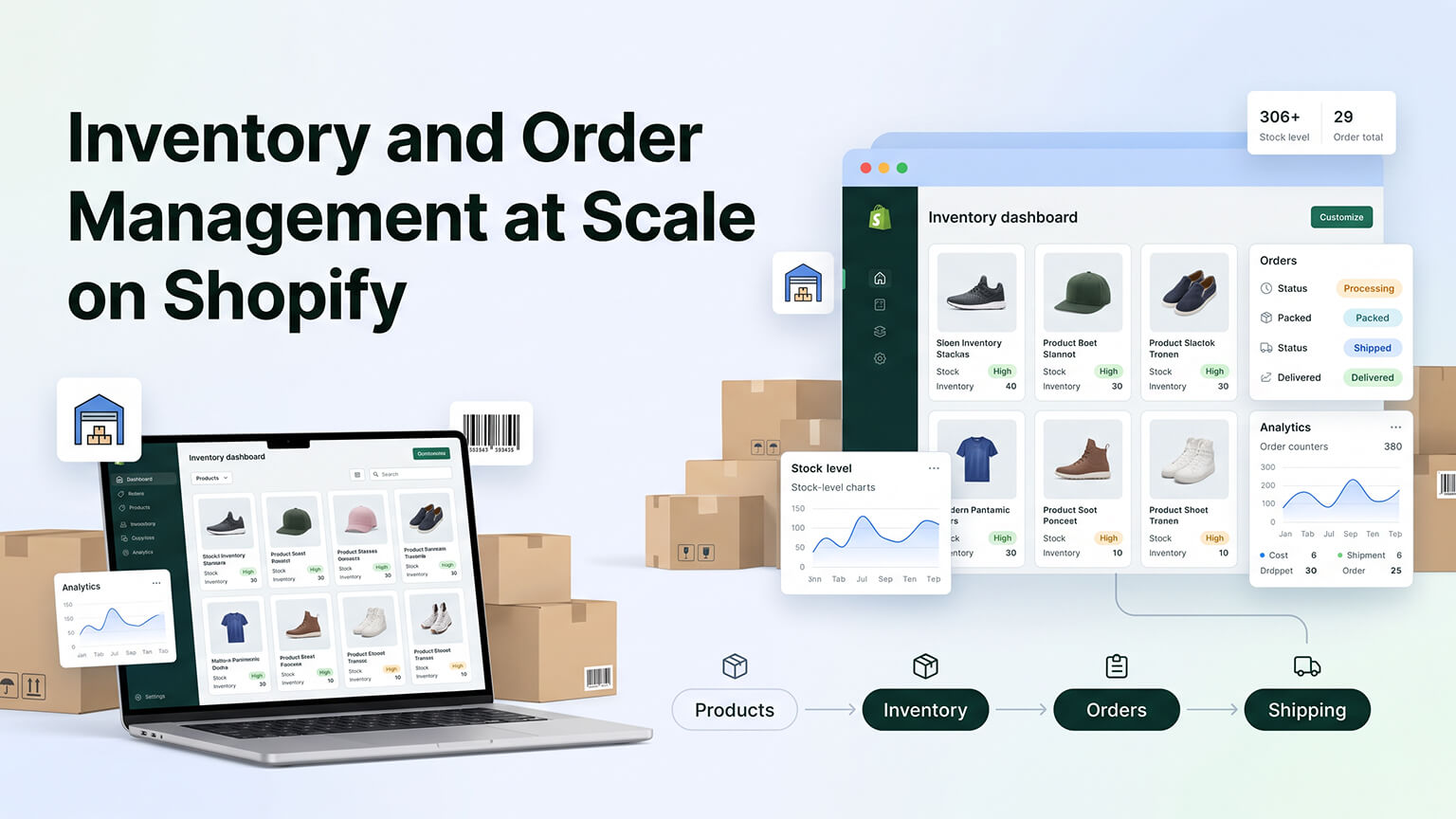
When a Shopify store is small, inventory and order management are simple — a manageable number of products and orders, handled with Shopify’s built-in tools. But as a store scales — more products, more orders, more locations, more channels, more complexity — inventory and order management become challenging, and handling them well becomes critical to operating smoothly (avoiding stockouts, overselling, fulfillment errors, and operational chaos). At scale, you’re dealing with inventory across multiple locations and channels, high order volumes needing efficient processing and fulfillment, and the integrations (ERP, 3PL, warehouse systems, as those discussions cover) that connect it all. So inventory and order management at scale is a real operational discipline, and getting it right — through good processes, the right tools and integrations, and sound practices — is essential to scaling smoothly. This piece covers how to handle it well.
This piece covers why inventory and order management get hard at scale, handling inventory at scale, handling orders and fulfillment at scale, and the tools and integrations involved. Because operating smoothly at scale depends on getting these right, and the complexity is real — understanding how to handle it helps you scale without operational chaos. Let me walk through it.
Why it gets hard at scale
Inventory and order management get hard at scale for several reasons. Volume — high order volumes mean processing, fulfilling, and managing many orders efficiently (manual or inefficient processes break down at volume), requiring efficient, often automated processes. Multiple locations — inventory across multiple locations (warehouses, stores, fulfillment centers) must be tracked and managed accurately (where is stock, what’s available, how to fulfill from the right location), adding complexity. Multiple channels — selling across channels (online store, marketplaces, retail, wholesale) means inventory and orders across channels must be synced (avoiding overselling — selling stock you don’t have because it sold on another channel), a real challenge. Accuracy at scale — inventory accuracy (knowing exactly what you have and what’s available) is harder but more critical at scale (errors cause stockouts, overselling, fulfillment problems), requiring good systems. Fulfillment complexity — fulfilling many orders, possibly from multiple locations, possibly via 3PLs, efficiently and accurately, is complex at scale. And integration needs — at scale, you often have systems (ERP, 3PL, ms, as those discussions cover) that must integrate with Shopify, syncing inventory and orders, adding integration complexity.
So inventory and order management get hard at scale due to volume (efficient processing needed), multiple locations (tracking and fulfilling accurately), multiple channels (syncing to avoid overselling), accuracy demands (more critical, harder), fulfillment complexity (many orders, multiple locations/3PLs), and integration needs (connecting systems). These challenges mean the simple tools and manual processes that work when small break down at scale, requiring better systems, processes, and integrations. So as you scale, recognition that inventory and order management become a real operational discipline needing investment (tools, processes, integrations), not something to handle ad-hoc. The cost of getting it wrong at scale (stockouts, overselling, fulfillment errors, chaos) is high, so investing in handling it well is essential. The next sections cover how.
Handling inventory at scale
Handling inventory well at scale involves several things. Accurate, real-time inventory — maintain accurate, real-time inventory data (knowing exactly what you have and what’s available, updated in real time as orders and restocks happen), the foundation of good inventory management (inaccurate inventory causes stockouts and overselling). Multi-location management — manage inventory across locations (Shopify supports multi-location inventory; track stock per location, and fulfill from the right location), accurately. Channel sync — sync inventory across all sales channels (so stock is accurate everywhere and you don’t oversell — selling the same stock on multiple channels), often via integration or inventory-management tools. Inventory tracking and forecasting — track inventory levels, set reorder points, and forecast demand (possibly with AI, as the demand-forecasting discussion covers) to avoid stockouts and overstock (good inventory planning). A central source of truth — at scale, you often need a central inventory source of truth (Shopify, an ERP, or an inventory-management system) that all channels and systems sync to, avoiding fragmentation and inaccuracy. And the right tools — Shopify’s native inventory tools (decent, multi-location), inventory-management apps/systems, or an ERP (for larger operations, as the ERP discussion covers) — chosen for your scale and complexity.
So handle inventory at scale with accurate real-time data (the foundation), multi-location management, channel sync (avoiding overselling), tracking and forecasting (avoiding stockouts/overstock), a central source of truth (avoiding fragmentation), and the right tools (native, apps, or ERP for your scale). The core goals are accuracy (knowing what you have/can sell) and avoiding overselling/stockouts (the main inventory failures), achieved through real-time, synced, well-tracked inventory with a clear source of truth. So invest in accurate, synced, well-managed inventory (with the right tools for your scale) — the foundation of operating smoothly at scale. Inventory accuracy especially is critical (everything depends on knowing what you actually have and can sell), so prioritise getting that right (real-time, synced, single source of truth).
Handling orders and fulfillment at scale
Handling orders and fulfillment well at scale involves several things. Efficient order processing — process orders efficiently (at volume, manual processing breaks down, so automate and streamline order processing — order routing, fulfillment triggering, status updates), often via automation (Shopify Flow, as that discussion covers, or order-management tools). Order routing — route orders to the right fulfillment location/method (fulfilling from the optimal location — nearest, in-stock, lowest-cost — at scale with multiple locations), often automated. Fulfillment integration — integrate with fulfillment (3PLs, warehouses, as the 3PL discussion covers), syncing orders to fulfillment and tracking back, so fulfillment is efficient and accurate at volume. Accurate, fast fulfillment — fulfill orders accurately (right items) and fast (meeting customer expectations) at scale, which depends on good processes, integration, and possibly automation. Order status and tracking — keep order status accurate and customers informed (tracking, updates), important for customer experience at scale. Returns at scale — handle returns efficiently at scale (a returns process/system, as returns volume scales too). And exception handling — handle exceptions (out-of-stock, errors, special cases) well, since at volume, exceptions need efficient handling.
So handle orders and fulfillment at scale with efficient (automated) order processing, order routing (to the optimal location), fulfillment integration (3PLs/warehouses), accurate and fast fulfillment, order status/tracking (keeping customers informed), efficient returns handling, and exception handling. The core goals are efficiency (processing/fulfilling volume without manual bottlenecks — via automation and integration) and accuracy/speed (fulfilling correctly and fast), achieved through streamlined, automated, integrated order and fulfillment processes. So invest in efficient, automated, integrated order and fulfillment processes (with order routing, fulfillment integration, and exception handling) — handling order volume smoothly and fulfilling accurately and fast at scale. Automation (reducing manual processing) and fulfillment integration (3PLs/warehouses) are often the keys to handling order volume at scale, so prioritise these.
Tools and integrations
Handling inventory and order management at scale often involves tools and integrations beyond Shopify’s natives. Shopify’s native tools — Shopify’s built-in inventory (multi-location), order management, and fulfillment tools are decent and sufficient for many stores, even at moderate scale — so start by using these well before adding complexity. Shopify Flow — for automation (order processing, routing, inventory alerts, exception handling), Shopify Flow (Plus) automates workflows, as the Flow discussion covers. Inventory-management systems — dedicated inventory-management tools/apps (for advanced multi-channel inventory, forecasting, central source of truth) for stores needing more than native. ERP — for larger operations, an ERP (as the ERP discussion covers) centralises inventory, orders, and operations, integrating with Shopify as the storefront — common for larger, complex businesses. 3PL/ms — for fulfillment at scale, 3PLs or warehouse management systems (integrated with Shopify, as the 3PL discussion covers) handle fulfillment. Order-management systems (OMS) — for complex multi-channel order management, an OMS can orchestrate orders across channels and fulfillment. And integration quality — these systems must integrate well with Shopify (syncing inventory, orders, fulfillment reliably, as the ERP/3PL discussions cover), since integration quality determines whether the systems work together smoothly or cause sync problems.
So the tools and integrations range from Shopify’s natives (decent, sufficient for many — use well first) through Shopify Flow (automation), inventory-management systems, ERP (for larger operations), 3PL/ms (for fulfillment), and OMS (for complex multi-channel) — chosen for your scale and complexity, and integrated well with Shopify (integration quality being critical). The principle is to use Shopify’s capable native tools well first, and add tools/integrations (inventory systems, ERP, 3PL, OMS) as your scale and complexity require — not over-engineering before you need to, but investing as you scale. So assess your scale and complexity, use native tools well, and add the right tools and integrations (well-integrated) as you grow — building the inventory and order management infrastructure your scale needs. Done well — right tools for your scale, well-integrated, with good processes and automation — you handle inventory and orders smoothly at scale; done poorly (outgrowing tools, poor integration, manual processes), you hit operational chaos.
A worked example: a brand outgrowing its manual processes
Picture a brand that scaled fast — from a few dozen orders a day on a single channel to several hundred a day across its Shopify store, a couple of marketplaces, and a growing wholesale side, shipping from two warehouses. The processes that worked at the start started failing in telling ways. Inventory wasn’t synced across channels, so the brand oversold popular items that had sold out on a marketplace but still showed available on the store — leading to cancellations, refunds, and angry reviews. Orders were processed and routed manually, so at peak volume the team fell behind, fulfilment slowed, and errors crept in (wrong items, wrong warehouse). Nobody had a single trustworthy view of stock, so buying decisions were guesswork and stockouts were frequent.
The fix was staged, not a big-bang overhaul. First, they established inventory accuracy and a single source of truth, syncing stock across all channels in real time so the same unit couldn’t be sold twice — which immediately stopped the overselling. Second, they automated order processing and routing (orders automatically routed to the warehouse that could fulfil fastest and had the stock, with status and tracking updated automatically), removing the manual bottleneck that was breaking at peak. Third, as wholesale and volume grew further, they integrated a 3PL for part of fulfilment and connected the whole operation to a central system so inventory, orders, and fulfilment stayed in sync. They didn’t jump straight to an ERP they didn’t yet need; they used Shopify’s native multi-location and automation capabilities well first, and added integrations as the complexity demanded. The result was an operation that handled several times the volume without the chaos — no overselling, fast accurate fulfilment, and a reliable view of stock for buying. The lesson is the staged approach: fix accuracy and overselling first (the most damaging failures), automate the volume bottlenecks next, and add heavier systems and integrations as scale requires — rather than either limping along on manual processes or over-engineering before you need to.
The cost of getting it wrong
It’s worth being concrete about why this discipline deserves investment, because the failures are expensive and customer-facing in ways that compound. Overselling — selling stock you don’t actually have — forces cancellations and refunds, generates support load, and produces exactly the kind of negative reviews and lost trust that are hard to recover from (and that the trust-signals and returns discussions show how costly trust damage is). Stockouts quietly cost sales every time a customer wants something you can’t sell them, and frequent stockouts push customers to competitors. Fulfilment errors (wrong items, delays) drive returns, support contacts, and dissatisfaction, eroding the post-purchase experience that drives repeat business and lifetime value.
At scale, these failures don’t stay small — they scale with your volume, so a sync or process problem that was a minor annoyance at a few orders a day becomes a serious, revenue-draining, reputation-damaging issue at several hundred. That’s the real argument for treating inventory and order management as an operational discipline worth investing in: the cost of getting it wrong rises with your success, and the failures hit the customer experience directly. Conversely, getting it right — accurate synced inventory, efficient automated fulfilment, reliable order handling — is largely invisible to customers (things just work), which is exactly the point. Smooth operations are a foundation for growth: they let you scale volume, add channels, and expand without the operational chaos that otherwise caps how big you can get without breaking. So invest ahead of the pain where you can, fix the most damaging failures (overselling, inaccuracy) first, and treat operational excellence as part of what makes scaling sustainable rather than an afterthought you address only once something breaks.
The bottom line
When a Shopify store is small, inventory and order management are simple, but as it scales — more products, orders, locations, and channels — they become challenging, and handling them well becomes critical to operating smoothly (avoiding stockouts, overselling, fulfillment errors, and chaos). They get hard at scale due to volume (efficient processing needed), multiple locations (accurate tracking and fulfillment), multiple channels (syncing to avoid overselling), higher accuracy demands, fulfillment complexity, and integration needs — so the simple tools and manual processes that work when small break down. Handle inventory at scale with accurate real-time data (the foundation — inaccurate inventory causes stockouts and overselling), multi-location management, channel sync (avoiding overselling), tracking and forecasting (avoiding stockouts and overstock), a central source of truth (avoiding fragmentation), and the right tools for your scale — prioritising inventory accuracy, since everything depends on knowing what you actually have and can sell. Handle orders and fulfillment at scale with efficient, automated order processing (manual breaks down at volume), order routing (to the optimal location), fulfillment integration (3PLs, warehouses), accurate and fast fulfillment, order status and tracking, efficient returns handling, and exception handling — prioritising automation (reducing manual bottlenecks) and fulfillment integration. The tools and integrations range from Shopify’s capable natives (use well first), through Shopify Flow (automation), inventory-management systems, ERP (for larger operations), 3PL/ms (fulfillment), and OMS (complex multi-channel) — chosen for your scale and complexity and integrated well with Shopify (integration quality being critical to smooth operation). The principle is to use Shopify’s native tools well first and add tools and integrations as your scale requires — not over-engineering early, but investing as you grow. Done well — right tools for your scale, well-integrated, with good processes and automation — you handle inventory and orders smoothly at scale; done poorly, you hit operational chaos. So treat inventory and order management as the real operational discipline it becomes at scale, and invest in handling it well, as it’s essential to scaling smoothly.
Frequently asked questions
Why do inventory and order management get harder as a store grows?
Because scale brings complexity that simple tools and manual processes can’t handle: high order volumes (manual processing breaks down, needing automation), inventory across multiple locations (tracking and fulfilling accurately), selling across multiple channels (syncing inventory to avoid overselling stock that sold elsewhere), higher accuracy demands (errors cause stockouts, overselling, and fulfillment problems, and accuracy is harder at scale), fulfillment complexity (many orders, possibly multiple locations and 3PLs), and integration needs (connecting ERP, 3PL, and warehouse systems to Shopify). The simple, often manual approaches that work for a small store break down under this complexity, so scaling requires investing in better systems, processes, and integrations to operate smoothly.
What’s the most important thing for inventory management at scale?
Accuracy — maintaining accurate, real-time inventory data so you know exactly what you have and what’s available, everywhere you sell.Almost everything depends on this: inaccurate inventory causes stockouts (losing sales), overselling (selling stock you don’t have, leading to cancellations and unhappy customers), and fulfillment problems. Achieving accuracy at scale means real-time inventory updates, syncing inventory across all sales channels (so you don’t oversell the same stock on multiple channels), managing multi-location inventory correctly, and having a central source of truth that all channels and systems sync to. Get inventory accuracy right, with proper syncing and a single source of truth, and you avoid the main inventory failures that plague stores at scale.
How do I handle high order volumes efficiently?
Through automation and integration, because manual order processing breaks down at volume. Automate order processing and routing (Shopify Flow on Plus can automate workflows like routing orders to the right fulfillment location, triggering fulfillment, and handling exceptions), integrate with your fulfillment (3PLs or warehouses, syncing orders out and tracking back), and streamline the whole order-to-fulfillment flow so it doesn’t depend on manual steps that bottleneck at volume. Route orders to the optimal fulfillment location (nearest, in-stock, lowest-cost), keep order status and tracking accurate to keep customers informed, and handle returns and exceptions efficiently. The keys are reducing manual processing through automation and integrating fulfillment, so order volume flows through smoothly and is fulfilled accurately and fast.
Do I need an ERP or 3PL to handle scale on Shopify?
Not necessarily — Shopify’s native inventory (multi-location), order management, and fulfillment tools are decent and sufficient for many stores even at moderate scale, so use them well before adding complexity. You add tools and integrations as your scale and complexity require: an inventory-management system for advanced multi-channel inventory and forecasting, an ERP for larger, complex operations (centralising inventory, orders, and operations, with Shopify as the storefront), a 3PL or warehouse management system for fulfillment at scale, or an order-management system for complex multi-channel orchestration. The principle is to avoid over-engineering early — use Shopify’s capable native tools well first, and invest in ERP, 3PL, or other systems (well-integrated with Shopify) when your scale and complexity actually warrant them, not before. A useful trigger is pain: when overselling, stockouts, or fulfilment bottlenecks start recurring despite using the native tools well, that’s the signal to add the next layer of system or integration.