
Landing Page Optimization for Paid Traffic
On this page
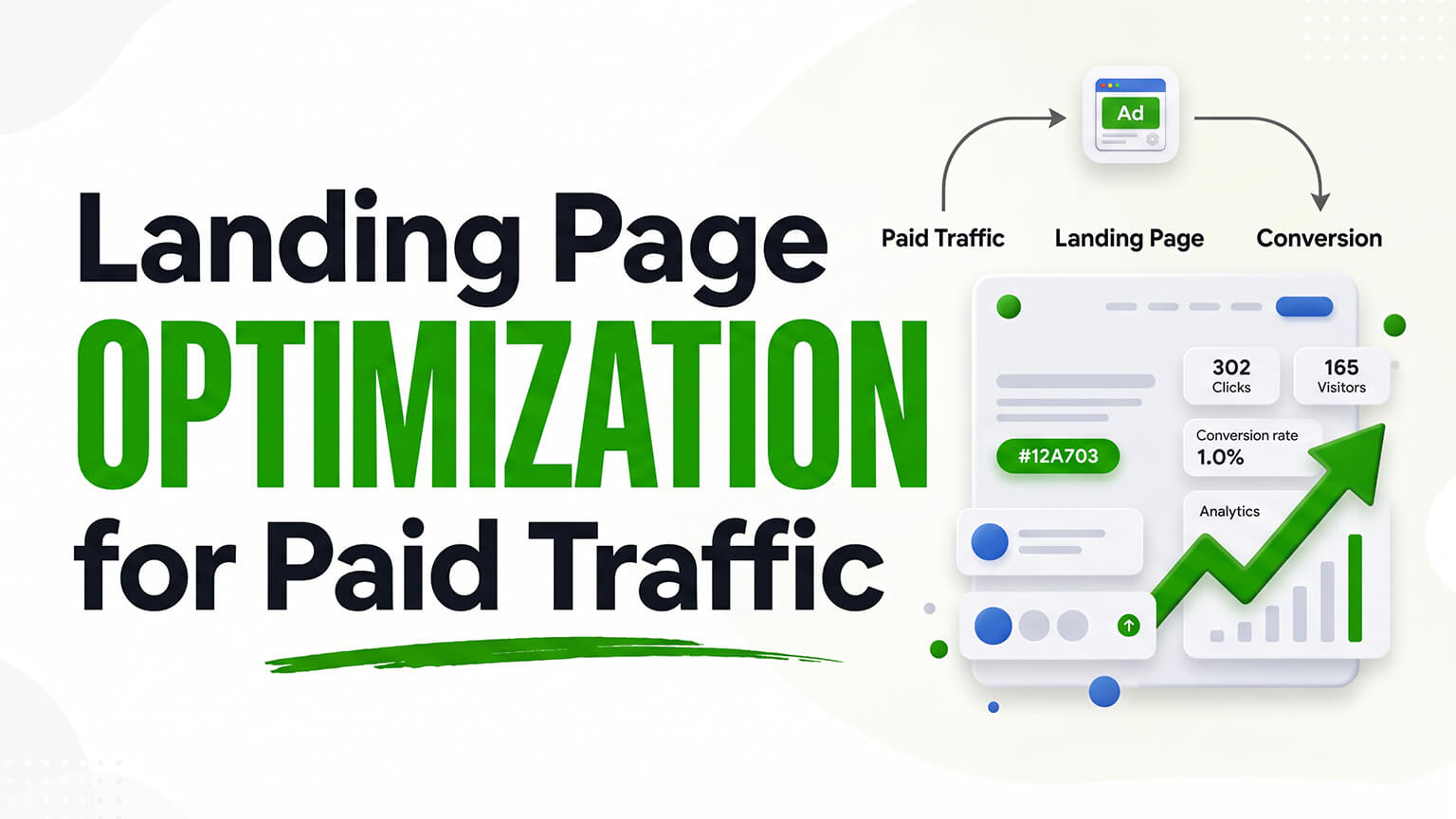
When you run paid ads, you’re paying for every visit, which makes the page that visit lands on disproportionately important — because the landing page’s ability to convert directly determines whether your ad spend turns into sales or is wasted. A great ad that sends traffic to a poor landing page wastes the money you spent on the click; the landing page is where the paid visit either converts or doesn’t. Yet many stores spend heavily on ads while sending the traffic to generic pages (the homepage, an unoptimized product page) that don’t convert that paid traffic well, quietly wasting a chunk of their ad spend. Landing page optimization for paid traffic is therefore high-leverage — improving where your paid traffic lands directly improves your return on ad spend.
This piece covers why landing pages matter so much for paid traffic, the crucial concept of message match, when to use dedicated landing pages, the elements of a converting paid landing page (with speed and mobile especially critical), and testing. Because you’re paying for the traffic, optimizing where it lands is one of the higher-return things you can do for your paid performance — and it’s commonly neglected in favor of optimizing the ads themselves while the landing page wastes the clicks. Let me walk through it.
Why landing pages matter so much for paid traffic
The core reason is simple: with paid traffic, you’ve paid for each visit, so the landing page’s conversion rate directly determines your return on that spend. If you pay for a click and the landing page converts well, the spend pays off; if the landing page converts poorly, you’ve paid for a visit that didn’t convert — wasted spend. So the landing page is the hinge on which your paid ROI turns: the same ad spend produces very different returns depending on whether the landing page converts the traffic well. This makes landing page optimization for paid traffic directly tied to your ad ROI in a way that’s more immediate than organic traffic (which you didn’t pay per-visit for).
This is why landing page optimization is high-leverage for paid: improving the landing page’s conversion improves the return on all the ad spend driving traffic to it, often more cost-effectively than improving the ads themselves. Many stores focus on optimizing their ads (creative, targeting, bidding) while neglecting the landing page the ads send traffic to — but a poor landing page wastes the clicks the optimized ads bought, so the landing page is often where the bigger conversion opportunity lies. So recognize that with paid traffic, the landing page directly determines whether your spend converts, making landing page optimization a high-leverage lever for paid ROI that’s commonly under-attended. The clicks you’re paying for deserve a landing page that converts them; optimizing that page is optimizing the return on your ad spend, which is why it matters so much for paid traffic specifically.
Message match: the crucial concept
The single most important concept for paid landing pages is message match — the continuity between the ad and the landing page. When someone clicks an ad, they have an expectation set by that ad (its message, offer, product, promise), and the landing page should match that expectation — continuing the message, delivering on the ad’s promise, showing what the ad led them to expect. When the landing page matches the ad (message match), the visitor’s expectation is met and they’re more likely to convert; when it mismatches (the ad promised one thing, the landing page shows something else or something generic), the visitor is disoriented or disappointed, and they leave — wasting the click.
So message match is crucial: the landing page should continue the ad’s message and deliver on its promise, so the visitor lands on what they expected. An ad for a specific product should land on that product (or a page featuring it), not the generic homepage; an ad with a specific offer should land on a page reflecting that offer; an ad’s message and the landing page’s message should align. This continuity from ad to landing page is a major factor in whether paid traffic converts, and message mismatch (sending paid traffic to a page that doesn’t match the ad) is a common, costly mistake — the visitor clicked expecting one thing and got another, so they leave. So ensure message match: align your landing pages with the ads driving traffic to them, so visitors land on what the ad led them to expect, continuing the message and delivering the promise. This is the crucial paid-landing-page concept, and getting it right (matching landing page to ad) versus wrong (mismatch, generic pages) is a major determinant of whether your paid traffic converts or bounces.
Dedicated landing pages vs existing pages
A practical question: should you send paid traffic to dedicated landing pages or to existing pages (products, collections)? It depends on the campaign. For some paid traffic, sending to a relevant existing page works well — an ad for a specific product can land on that product page (if it’s good and matches the ad), an ad for a category on the relevant collection. For other campaigns, a dedicated landing page — built specifically for that campaign, with the message match, focus, and conversion optimization the campaign needs — converts better, especially for campaigns with a specific offer, message, or audience that an existing page doesn’t serve as well.
So the choice depends on whether an existing page serves the campaign well (good message match, converts the traffic) or whether a dedicated landing page (purpose-built for the campaign’s message and conversion goal) would do better. Dedicated landing pages make sense when you want tight message match and focus for a specific campaign, offer, or audience — building a page that exactly matches the ad and is optimized for that campaign’s conversion. Sending to existing pages makes sense when a relevant existing page already serves the campaign well. Many stores benefit from dedicated landing pages for their important paid campaigns (the message match and focus improving conversion), while using relevant existing pages for other traffic. And — connecting to the Online Store 2.0 discussion — a store built on OS 2.0 lets your team build dedicated landing pages from sections without a developer, making dedicated landing pages practical to create for campaigns. So consider, per campaign, whether a dedicated landing page (purpose-built, tight message match, focused) or a relevant existing page serves better, using dedicated landing pages where the campaign warrants the message match and focus they provide.
The elements of a converting paid landing page
A converting paid landing page has several key elements. A clear value proposition matching the ad — immediately delivering on the ad’s promise and message (message match), so the visitor sees what they came for. Focus on the conversion goal — the page focused on the action you want (the purchase, the signup), with minimal distraction from that goal. Trust and social proof — reassuring the visitor (especially paid traffic that may be first-time visitors), as the trust signals discussion covers. Fast loading — critical, because paid traffic is impatient (and you paid for it), so a slow landing page loses the visitor and wastes the spend (as the speed discussion emphasizes). Mobile optimization — critical, because much paid traffic is mobile, so the landing page must work well on mobile (as the mobile conversion discussion covers). A clear call to action — the action obvious and easy. And minimal friction and distraction — the page focused, removing distractions from the conversion goal.
So a converting paid landing page matches the ad (message match, clear value prop), focuses on the conversion goal (minimal distraction), reassures (trust, social proof), loads fast (critical for impatient paid traffic), works on mobile (where much paid traffic is), has a clear CTA, and minimizes friction. Speed and mobile are especially critical for paid landing pages: paid traffic is impatient and often mobile, and a slow or poor-mobile landing page wastes the spend that brought the visitor, so the speed and mobile optimization (covered in those discussions) matter doubly for pages receiving paid traffic. So optimize your paid landing pages with these elements — message match, focus, trust, speed, mobile, clear CTA, minimal friction — recognizing that speed and mobile are especially critical given paid traffic’s impatience and mobile skew. A landing page with these elements converts the paid traffic well, paying off the ad spend; one missing them (mismatched, slow, poor mobile, distracting) wastes the clicks you paid for. These elements are how you make the landing page convert the paid traffic it receives.
Testing landing pages
Paid traffic is excellent for testing landing pages, because you control the traffic going to them, which is worth taking advantage of. You can A/B test landing pages (as the testing discussion covers) by sending your paid traffic to different versions and measuring which converts better — and because you control and can direct paid traffic, this testing is often more practical than testing organic-traffic pages. So use your paid traffic to test and optimize your landing pages: test different value propositions, layouts, offers, and elements, measuring which converts the paid traffic best, and iterate toward better-converting landing pages.
This testing is high-value because improving the landing page’s conversion improves the return on all the ad spend driving traffic to it — so finding better-converting landing pages through testing directly improves your paid ROI. The testing discipline applies (proper testing, enough traffic, statistical rigor, hypothesis-driven), and paid traffic’s controllability makes it practical. So take advantage of paid traffic’s testability to optimize your landing pages — testing toward better conversion, which improves your paid ROI. Many stores test their ads but not their landing pages, missing this high-value optimization; testing your landing pages (using the paid traffic you control) is often where significant paid ROI improvement lies. So test your paid landing pages, using the controllable paid traffic, applying the testing discipline, to find better-converting pages that improve the return on your ad spend. This is a high-leverage, often-neglected optimization, complementing ad optimization with landing-page optimization where a big conversion opportunity often sits.
A worked example: the wasted ad spend
To see the stakes, picture a store spending real money on ads but sending all the traffic to its homepage. The ads are decent and drive clicks, but the homepage is generic — it doesn’t match any specific ad’s message, it’s not focused on a conversion goal, and it makes the visitor figure out where to go next. So a chunk of the paid visitors, having clicked an ad expecting something specific, land on a generic homepage, don’t find what they expected, and leave. The store is paying for those clicks and wasting many of them on a landing experience that doesn’t convert them — the ad spend is leaking through a poor landing page, and the store may not even realize it (they see the ad costs and the overall conversion, but not specifically that the homepage is wasting their paid clicks).
Now the store optimizes its paid landing. For each important campaign, it sends traffic to a page that matches the ad — an ad for a specific product to that product’s page (or a dedicated landing page featuring it), an ad with a specific offer to a page reflecting that offer — with message match, focus on the conversion goal, trust signals, fast loading, and mobile optimization. The paid visitors now land on what they expected, on a focused page built to convert them, and a much larger share convert. The same ad spend now produces far better returns, because the landing pages convert the traffic instead of wasting it. The store improved its paid ROI not by changing the ads but by fixing where the traffic lands.
This captures the whole point: with paid traffic, the landing page determines whether the spend converts, and sending paid traffic to generic or mismatched pages (like the homepage) wastes a chunk of it, while optimizing the landing pages (message match, focus, speed, mobile, trust) converts the traffic and improves the ROI. The wasted-ad-spend scenario is extremely common — stores optimizing ads while sending the traffic to pages that don’t convert it well — and fixing it (optimizing the landing pages) is high-leverage. The store didn’t spend more on ads; it stopped wasting the spend it was already making by ensuring the paid traffic landed somewhere built to convert it. That’s the landing-page-optimization opportunity for paid in a nutshell.
The ad-cost connection
A bonus reason to optimize paid landing pages, relevant especially for search ads: landing page quality and relevance can affect your ad costs. Ad platforms (Google in particular) factor landing page experience and relevance into their quality metrics, which influence what you pay and how your ads perform — a relevant, good landing page can improve these quality signals, potentially lowering your costs and improving your ad performance, while a poor or irrelevant landing page can hurt them. So optimizing your landing pages (relevance/message match, quality, speed, mobile) can help not just conversion but your ad costs and performance, a double benefit for paid.
This strengthens the case for landing page optimization in paid: it improves conversion of the traffic (the direct benefit) and can improve your ad platform quality metrics and costs (a bonus benefit), so a good, relevant, fast landing page helps your paid performance on multiple fronts. So when optimizing paid landing pages, know that the relevance and quality you’re building (message match, good experience, speed, mobile) serves both conversion and your ad economics. This is particularly relevant for search advertising where landing page experience is an explicit quality factor, but the broader principle — that good landing pages help paid performance beyond just conversion — applies generally. So optimize your paid landing pages for both the conversion benefit and the ad-cost benefit, recognizing that a relevant, quality, fast landing page improves your paid performance comprehensively: converting the traffic better and helping your ad economics. (Verify the current specifics of how each ad platform factors landing page quality, since the details evolve, but the principle that landing page quality and relevance matter to ad platforms holds.)
The bottom line
With paid traffic, you pay for every visit, so the landing page where that visit lands directly determines whether your ad spend converts or is wasted — making landing page optimization high-leverage for paid ROI, and commonly neglected in favor of optimizing the ads while the landing page wastes the clicks. The crucial concept is message match: the landing page should continue the ad’s message and deliver on its promise, so the visitor lands on what they expected — mismatch (sending paid traffic to generic or non-matching pages) is a common, costly mistake. Consider, per campaign, whether a dedicated landing page (purpose-built, tight message match, focused — practical to build on Online Store 2.0) or a relevant existing page serves better, using dedicated landing pages where the campaign warrants their message match and focus. Optimize your paid landing pages with the key elements — a clear value proposition matching the ad, focus on the conversion goal, trust and social proof, fast loading, mobile optimization, a clear CTA, and minimal friction — with speed and mobile especially critical given paid traffic’s impatience and mobile skew (a slow or poor-mobile landing page wastes the spend that brought the visitor). And take advantage of paid traffic’s controllability to test and optimize your landing pages, finding better-converting pages that improve the return on all your ad spend — a high-value, often-neglected optimization. Because you’re paying for the traffic, optimizing where it lands is one of the higher-return things you can do for your paid performance: the clicks you pay for deserve a landing page that converts them, and optimizing that page directly improves your ad ROI.
Frequently asked questions
Why do landing pages matter so much for paid traffic?
Because with paid traffic you’ve paid for every visit, so the landing page’s conversion rate directly determines your return on that spend — a great ad sending traffic to a poor landing page wastes the money you spent on the click. The landing page is the hinge on which your paid ROI turns. Many stores optimize their ads while neglecting the landing page, but a poor landing page wastes the clicks the ads bought, so the landing page is often where the bigger conversion opportunity (and ROI improvement) lies.
What is message match?
The continuity between the ad and the landing page. When someone clicks an ad, they have an expectation set by it (its message, offer, product, promise), and the landing page should match that — continuing the message and delivering on the promise, so the visitor lands on what they expected. Message match (aligning landing page to ad) makes paid traffic more likely to convert; message mismatch (sending paid traffic to a generic or non-matching page) disorients and disappoints the visitor, who leaves — wasting the click. It’s the crucial paid-landing-page concept.
Should I send paid traffic to dedicated landing pages or product pages?
It depends on the campaign. A relevant existing page (a good product or collection page matching the ad) can work well for some traffic. But for campaigns with a specific offer, message, or audience, a dedicated landing page — purpose-built for tight message match, focus, and the campaign’s conversion goal — often converts better. Many stores benefit from dedicated landing pages for important paid campaigns while using existing pages for other traffic. Online Store 2.0 makes dedicated landing pages practical to build from sections without a developer.
What makes a paid landing page convert?
Key elements: a clear value proposition matching the ad (message match), focus on the conversion goal with minimal distraction, trust and social proof (especially for first-time paid visitors), fast loading, mobile optimization, a clear call to action, and minimal friction. Speed and mobile are especially critical, because paid traffic is impatient (and you paid for it) and often mobile, so a slow or poor-mobile landing page wastes the spend that brought the visitor. Also test your landing pages using the paid traffic you control, since better-converting pages improve the return on all your ad spend.