
Mining Customer Reviews and Feedback for Insights With AI
On this page
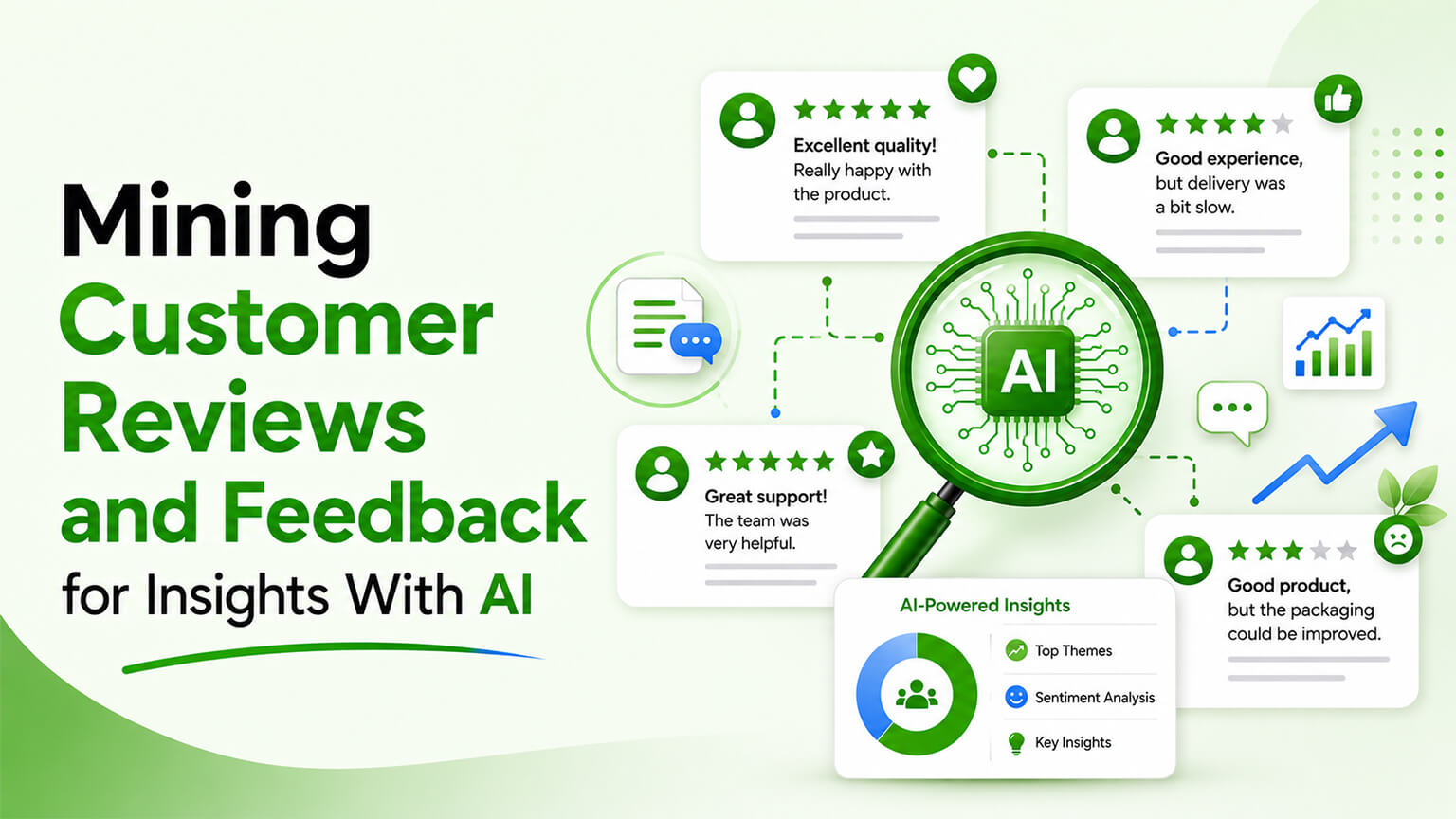
Your customers are constantly telling you valuable things — in their reviews, their support messages, their survey responses, their social posts. Collectively, this feedback is a goldmine of insight: what customers love and dislike, what they want, why they buy and why they return, what confuses them, what they wish you offered. The problem is scale. A store with hundreds or thousands of reviews and a steady stream of support and feedback can’t manually read, synthesize, and extract insight from it all — so most of this insight goes unmined, the feedback accumulating unread-in-aggregate while the patterns it contains stay hidden. This is exactly the kind of large-scale text analysis AI is good at, which makes mining customer feedback for insight one of the more useful AI applications in ecommerce.
This piece covers the goldmine that customer feedback represents, what AI does well in mining it, the specific insights you can extract, the cautions (AI summarization has its own limits), and how to turn the insights into action. Because the value here is real — turning raw, voluminous customer feedback into actionable insight at scale — when used with appropriate human interpretation and judgment. Let me walk through it.
The goldmine you’re not fully mining
Start with what your customer feedback contains, because it’s valuable and underused. Across your reviews, support tickets, survey responses, and social mentions, your customers are telling you: what they love about your products (informing what to emphasize), what disappoints them (informing what to fix), why they bought (informing your positioning and marketing), why they returned (informing returns reduction, as discussed), what confused them (informing your product pages and content), what they wish you offered (informing your roadmap), and how they feel about your brand and products (sentiment). This is direct, voluntary insight from your actual customers about your actual products and experience — arguably some of the most valuable market research available, and you already have it.
The trouble is that at scale, this insight is locked in volume. A handful of reviews you can read and absorb; thousands of reviews plus a stream of support and feedback, you can’t manually synthesize into clear patterns and insights. So the insight exists but stays largely unmined — individual pieces of feedback get read (a support ticket here, a review there) but the aggregate patterns (what customers consistently say, the recurring themes, the overall sentiment) stay hidden because no one can manually process the volume. This is the opportunity AI addresses: unlocking the aggregate insight in your voluminous customer feedback that’s currently going unmined. Recognizing that your feedback is a goldmine of insight you’re not fully mining (because of scale) is the first step to using AI to mine it.
What AI does well in mining feedback
AI is good at exactly the large-scale text analysis that mining customer feedback requires. It can process large volumes of feedback (far more than a human could read), find themes and patterns across that volume (what customers consistently mention, the recurring topics), analyze sentiment (how customers feel, overall and on specific aspects), summarize the feedback (distilling thousands of reviews into the key points), and surface insights you’d miss manually (patterns that only emerge across the aggregate). This turns the unmined goldmine into accessible insight — AI reads and synthesizes the volume you can’t, surfacing the themes, sentiment, and patterns that were hidden in the aggregate.
So AI’s genuine value here is making the aggregate insight in your customer feedback accessible — processing the volume, finding the patterns, summarizing the themes, analyzing sentiment, and surfacing insights that manual reading would miss. For a store with substantial feedback (enough that manual synthesis is impractical), this is valuable: it unlocks insight that was effectively inaccessible due to scale, turning your accumulated reviews and feedback into actionable understanding. This is a strong example of AI doing something useful — large-scale text synthesis that humans can’t do at the volume but that contains real value — rather than AI hype. The application passes the “real problem, real value” test clearly: the problem (insight locked in unmanageable volume) is real, and AI’s text-analysis capability addresses it. So mining customer feedback is one of the AI applications worth using, for stores with enough feedback to benefit.
The specific insights you can extract
Concretely, here are the kinds of insights AI feedback mining surfaces, each actionable. Theme extraction — what customers consistently mention (recurring praise, complaints, requests), telling you what matters to them about your products and experience. Sentiment analysis — how customers feel overall and about specific aspects, flagging what’s well-received and what’s problematic. Product insights — recurring praise (what to emphasize in marketing and product pages) and recurring complaints (what to fix in the product or set expectations about), directly informing product, copy, and page improvements. Return-reason analysis — why customers return (connecting to the returns reduction discussion, surfacing the expectation gaps to fix). Issue identification — spotting recurring problems early (a defect, a confusing aspect, a common frustration) before they’re widely damaging. And broader understanding — what customers want, why they buy, how they perceive your brand, informing strategy, positioning, and roadmap.
Each of these is actionable insight that improves your business: theme and sentiment analysis tells you what to emphasize and fix; product insights improve your products and pages; return-reason analysis reduces returns; issue identification catches problems early; broader understanding informs strategy. So mining your feedback with AI isn’t just interesting — it surfaces specific, actionable insights across products, pages, returns, CX, and strategy. The value is in acting on these insights: the recurring complaint you fix, the praise you emphasize, the expectation gap you close, the problem you catch early, the customer want you address. AI surfaces the insights from the volume; acting on them is where the value is realized. So use AI feedback mining to extract these specific, actionable insights, then act on them to improve your products, pages, returns, experience, and strategy — turning your customers’ voluminous feedback into concrete improvements.
The cautions: AI summarization has limits
As with all AI, be aware of the limits, because AI summarization and analysis isn’t flawless. AI can miss nuance (oversimplifying complex or subtle feedback), it can occasionally misinterpret or hallucinate (drawing conclusions the feedback doesn’t support, as AI sometimes does), and it can flatten the texture of individual feedback into generic summaries that lose important specifics. So AI feedback mining gives you the patterns and summaries, but those should be treated as a starting point for human interpretation, not as flawless conclusions — verify important conclusions against the actual feedback, and apply human judgment to interpret what the patterns mean and what to do about them.
This is the familiar human-in-the-loop principle applied to feedback mining: AI does the large-scale synthesis (finding patterns, summarizing, analyzing sentiment) that humans can’t do at volume, while humans interpret the results, verify important conclusions, and decide what to act on. Over-trusting AI summaries without verification or interpretation risks acting on misread patterns or oversimplified conclusions; using AI to surface patterns that humans then interpret and verify gets the benefit (accessing the aggregate insight) while guarding against AI’s limits. So treat AI feedback mining as surfacing patterns and summaries for human interpretation — verify the important conclusions against actual feedback, apply judgment to what the patterns mean, and decide what to act on. The combination (AI synthesis plus human interpretation and verification) gets you the genuine value (accessible aggregate insight) while avoiding the pitfalls (acting on misread or oversimplified AI conclusions). Don’t over-trust the AI summaries; use them as a powerful starting point that human judgment interprets and verifies.
Connecting your feedback sources
A practical note: your customer feedback lives across multiple sources — reviews, support tickets, surveys, social mentions — and mining it comprehensively means drawing on these sources, ideally together. Reviews tell you about products and experience; support tickets reveal problems, confusion, and frustrations; surveys gather targeted feedback; social mentions show unprompted sentiment. Each source offers a different window on customer insight, and together they give a fuller picture. So consider mining across your feedback sources, not just one — the patterns across reviews, support, surveys, and social give richer insight than any single source.
This connects to the broader data and integration themes — bringing your feedback sources together (or at least mining each) gives the fullest insight. For many stores, reviews and support tickets are the richest, most accessible sources to start with (high volume, full of insight), with surveys and social adding to the picture. The practical approach is to mine your most insight-rich feedback sources (reviews and support to start), drawing on others as useful, to build a comprehensive picture of what your customers are telling you. The more of your customer feedback you mine, the fuller the insight, so consider your feedback across sources as the goldmine to mine, not just your reviews in isolation. That said, start with the richest, most accessible sources rather than waiting to perfectly connect everything — mining your reviews and support feedback alone surfaces substantial insight.
A worked example: the insight hiding in the reviews
To see the value concretely, picture a store with thousands of reviews accumulated over time. The team reads new reviews as they come in and has a vague sense of customer sentiment, but they’ve never synthesized the whole — there are simply too many to manually analyze in aggregate. So they run their reviews through AI analysis, and patterns emerge that were invisible in the day-to-day reading. A particular product, well-rated overall, has a recurring complaint in its reviews about one specific aspect — a pattern no one noticed because each individual review was just one voice, but in aggregate it’s a clear, fixable issue. Across many products, customers consistently praise a particular quality, suggesting what to emphasize in marketing. A recurring theme reveals a common point of confusion the product pages could address. And the return-related reviews cluster around specific expectation gaps.
These insights were all sitting in the reviews the whole time, but locked in the volume — accessible only once AI synthesized the aggregate. The team now has a list of actionable findings: fix the recurring product complaint, emphasize the consistently-praised quality, address the common confusion on the product pages, close the expectation gaps causing returns. They verify the important ones against actual reviews (applying human interpretation, guarding against AI over-reading), then act. The reviews they’d been passively accumulating became a source of concrete improvements, simply because AI made the aggregate insight accessible and humans interpreted and acted on it.
This is the everyday value of AI feedback mining: insight that was always there, locked in volume, made accessible and actionable. The store didn’t gather new feedback; it finally mined the feedback it already had. The patterns (recurring complaints, consistent praise, common confusion, return expectation gaps) were invisible in day-to-day reading but clear in AI-synthesized aggregate, and acting on them improved products, marketing, pages, and returns. Most stores are sitting on exactly this kind of unmined insight in their accumulated feedback; AI feedback mining, with human interpretation, unlocks it. The worked example shows both the value (actionable insight from existing feedback) and the method (AI synthesizes, humans interpret and verify, then act).
Start simple
A reassuring practical note: you don’t necessarily need a fancy, dedicated tool to start mining your feedback with AI. While there are specialized feedback-analysis tools, you can begin simply — even feeding batches of your reviews or feedback into a general AI tool and asking it to identify themes, sentiment, and recurring points surfaces real insight, as a starting point. The barrier to beginning is low, which makes the widespread under-mining of feedback even more of a missed opportunity — this insight is accessible without major investment.
So don’t let the absence of a sophisticated tool stop you from mining your feedback; start simply with the AI tools available, see the insight it surfaces, and invest in more sophisticated or integrated approaches if the value warrants. The important thing is to start mining the feedback goldmine you’re sitting on, in whatever simple way gets you the insight, rather than leaving it unmined because you’re waiting for the perfect tool or process. As with much of this, starting simple and proving the value beats waiting for a perfect setup — mine your reviews with an available AI tool, act on what it surfaces (with human interpretation), and build from there. The feedback is already there; the main thing is to start mining it, which you can do simply and cheaply, capturing insight that’s currently going to waste.
The bottom line
Your customer feedback — across reviews, support, surveys, and social — is a goldmine of valuable insight: what customers love and dislike, why they buy and return, what confuses them, what they want, how they feel. But at scale, this insight is locked in volume; a store with substantial feedback can’t manually synthesize it all, so the aggregate patterns and insights go largely unmined. AI is good at exactly this large-scale text analysis — processing the volume, finding themes and patterns, analyzing sentiment, summarizing, and surfacing insights manual reading would miss — making feedback mining one of the useful AI applications, clearly passing the “real problem, real value” test. It surfaces specific, actionable insights: theme extraction (what customers consistently mention), sentiment, product insights (praise to emphasize, complaints to fix), return-reason analysis (the expectation gaps to close), early issue identification, and broader understanding for strategy. The cautions are the familiar ones — AI summarization can miss nuance, oversimplify, or occasionally misinterpret, so treat its output as patterns for human interpretation and verification, not flawless conclusions, applying the human-in-the-loop principle (AI synthesizes the volume, humans interpret, verify, and decide what to act on). Mine across your feedback sources (reviews and support to start, others adding to the picture) for the fullest insight, and crucially, act on the insights — the value is in the improvements you make (fixing recurring complaints, emphasizing praise, closing expectation gaps, catching issues early) from the insight AI unlocks. Used this way, AI feedback mining turns your voluminous, underused customer feedback into actionable insight at scale, which is valuable for any store with enough feedback to mine. Most stores are sitting on exactly this kind of unmined insight — accumulated reviews and feedback full of patterns they’ve never synthesized — and the barrier to mining it is low, since you can start simply with available AI tools rather than waiting for a sophisticated setup. So mine the goldmine you already have: feed your reviews and feedback into AI analysis, let it surface the themes, sentiment, and patterns hidden in the volume, interpret and verify the important findings with human judgment, and act on them to improve your products, pages, returns, and experience. The feedback is already there, full of insight going to waste; AI makes that insight accessible, and acting on it turns your customers’ voices into concrete improvements — one of the clearer, more useful applications of AI in ecommerce. And because the insight comes straight from your own customers about your own products and experience, it’s some of the most relevant, trustworthy guidance you can get — not generic best practices, but what your actual customers are telling you about your actual business. Mining it well, with AI surfacing the patterns and human judgment interpreting and acting on them, lets your customers’ collective voice guide your improvements, which is exactly the kind of customer-led decision-making that builds a better store. So treat your accumulated feedback as the valuable, customer-sourced guidance it is, mine it with AI to make it accessible, and let it inform what you build and fix.
Frequently asked questions
What can AI find in my customer reviews and feedback?
AI can process large volumes of feedback and surface themes (what customers consistently mention), sentiment (how they feel, overall and about specific aspects), product insights (recurring praise to emphasize and complaints to fix), return reasons (the expectation gaps causing returns), early signs of recurring issues, and broader understanding of what customers want and why they buy. It unlocks the aggregate insight locked in feedback volume that you can’t manually synthesize, turning accumulated reviews and feedback into actionable understanding.
Why use AI for this instead of just reading the feedback?
Scale. A handful of reviews you can read and absorb, but a store with hundreds or thousands of reviews plus a stream of support and feedback can’t manually synthesize it all into clear patterns and insights — so the aggregate insight stays hidden. AI processes the volume you can’t, finding the patterns, summarizing the themes, and analyzing sentiment across the whole, surfacing insights that only emerge in aggregate. It makes accessible the insight that volume otherwise locks away.
Can I trust AI’s analysis of my feedback?
Treat it as a powerful starting point for human interpretation, not flawless conclusions. AI summarization can miss nuance, oversimplify, or occasionally misinterpret or draw conclusions the feedback doesn’t fully support. So verify important conclusions against the actual feedback and apply human judgment to interpret what the patterns mean and what to do. The right approach is human-in-the-loop: AI does the large-scale synthesis humans can’t, while humans interpret, verify, and decide what to act on — getting the benefit while guarding against AI’s limits.
What should I do with the insights AI surfaces?
Act on them — the value is in the improvements, not the analysis itself. Fix the recurring complaints, emphasize the recurring praise in your marketing and product pages, close the expectation gaps causing returns, address what customers say confuses them, catch recurring issues early, and let the broader understanding inform your products, positioning, and roadmap. AI surfaces the actionable insights from your feedback volume; realizing the value means turning those insights into concrete improvements across your products, pages, returns, experience, and strategy.