
Continuous CRO: Building a Program That Compounds
On this page
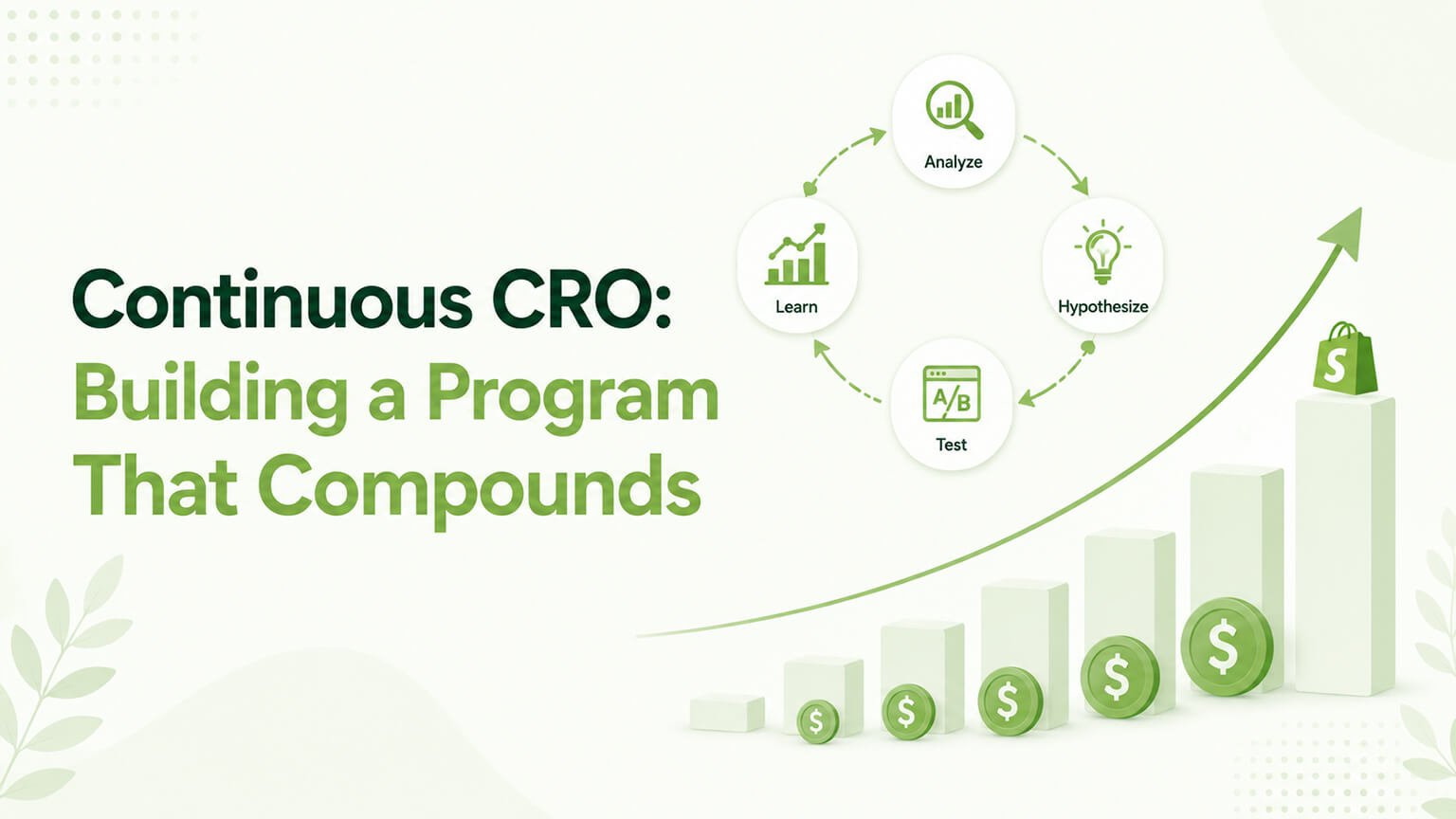
Many stores treat conversion optimization as a project: a burst of effort (“let’s do some CRO this quarter”), a few tests and changes, some gains, and then… it fizzles out and attention moves elsewhere. This one-off approach captures some early wins but then plateaus, leaving most of CRO’s value on the table. The stores that get the most from CRO treat it differently — as a continuous program: an ongoing, systematic practice of researching, testing, learning, and improving that runs continuously, compounding gains over time. The difference is significant: a one-off project gets a bump then stalls, while a continuous program keeps improving conversion month after month, and — crucially — compounds (each improvement builds on the last, and the accumulated learning makes each round smarter), producing far more total value over time. Building a continuous CRO program isn’t about doing dramatically more at once; it’s about making CRO an ongoing rhythm rather than a one-time effort. This piece covers building a continuous CRO program that compounds: why continuous beats one-off, what a continuous program looks like, how to build and sustain it, and the compounding effect. (This connects to the CRO-guide, hypothesis, and prioritisation discussions, which cover the CRO process; this focuses on making it continuous and compounding.)
This piece covers why continuous CRO beats one-off, what a continuous CRO program looks like, how to build and sustain it, and how it compounds. Because one-off CRO plateaus while continuous CRO compounds, and building a continuous program captures far more value. Let me walk through it.
Why continuous CRO beats one-off
Continuous CRO beats one-off CRO for several compounding reasons. One-off plateaus — a one-off CRO effort captures some early wins (the obvious improvements) then stops, so the gains plateau (you got the initial bump, then nothing more) — leaving most of CRO’s potential value unrealised. Continuous keeps improving — a continuous program keeps researching, testing, and improving over time, so conversion keeps improving (round after round of gains) rather than plateauing — far more total improvement. Compounding gains — continuous improvements compound: each conversion improvement builds on the previous (a series of gains multiplying up), and small ongoing improvements accumulate into large total gains over time (versus a single one-off bump) — the compounding effect is where continuous CRO’s big value is. Accumulating learning — a continuous program accumulates learning (as the hypothesis discussion covers): each test teaches you about your customers and what works, and this knowledge compounds (each round is smarter, informed by all the prior learning), making the program increasingly effective over time — versus a one-off effort that doesn’t build this compounding knowledge. Keeps pace with change — your store, customers, market, and traffic change over time, so continuous CRO keeps optimising for the current reality (versus a one-off effort optimising for a past moment then becoming stale) — staying relevant. Deeper opportunities — continuous CRO can pursue deeper, less-obvious opportunities over time (beyond the initial obvious wins), finding value a one-off effort wouldn’t reach. And it’s how the leaders do it — the stores that excel at CRO run continuous programs (ongoing testing and improvement), which is how they achieve their strong, ever-improving conversion — continuous CRO is the approach of CRO leaders. So continuous CRO beats one-off because one-off plateaus (early bump then stalls) while continuous keeps improving (round after round), the improvements compound (accumulating into large total gains), the learning compounds (each round smarter), it keeps pace with change (staying relevant), it pursues deeper opportunities, and it’s how CRO leaders operate. The compounding of both gains and learning is the key advantage — continuous CRO’s value compounds over time, far exceeding a one-off effort. So treat CRO as a continuous program (not a one-off project) to capture this compounding value. The next section covers what a continuous program looks like.
What a continuous CRO program looks like
A continuous CRO program is an ongoing, systematic rhythm (versus a one-off burst). An ongoing cycle — a continuous program runs the CRO cycle (as the CRO-guide discussion covers) continuously: ongoing research (understanding barriers via analytics, heatmaps, feedback), a pipeline of hypotheses (as the hypothesis discussion covers), prioritised testing (as the prioritisation discussion covers), analysing and learning, and iterating — running this cycle continuously rather than once. A research pipeline — continuous research (ongoing gathering of data, heatmaps, session recordings, feedback, analytics) feeds a continuous understanding of barriers and opportunities, keeping the pipeline of things to test full. A hypothesis backlog — a maintained backlog of prioritised hypotheses (as the hypothesis and prioritisation discussions cover), so there’s always a queue of good things to test (versus running out of ideas), keeping testing continuous. A testing cadence — an ongoing cadence of tests (running tests continuously — one or several at a time as traffic allows, as the A/B-testing discussion covers), so testing is continuous (versus a one-off burst) — a steady stream of tests. Learning capture — capturing learning from each test (what worked, what didn’t, what it taught you about customers, as the hypothesis discussion covers), building the compounding knowledge base that makes the program smarter over time. Regular rhythm — a regular rhythm (e.g., ongoing research, a steady testing cadence, regular review of results and learnings), making CRO a sustained practice rather than sporadic. Supporting habits and infrastructure — the supporting elements: measurement (analytics, as the GA4 and metrics discussions cover), testing tools/capability, and a culture of evidence-based, continuous improvement — the infrastructure for a continuous program. And it’s woven into operations — a continuous program is woven into how the store operates (an ongoing function, resourced and prioritised), not a side project — so it’s sustained. So a continuous CRO program looks like an ongoing cycle (research, hypotheses, prioritised testing, learning, iterating) running continuously, fed by a research pipeline and a hypothesis backlog, with an ongoing testing cadence, learning capture, a regular rhythm, supporting habits and infrastructure, and woven into operations — a sustained, systematic practice versus a one-off burst. So a continuous program is CRO made ongoing and systematic. The next section covers building and sustaining it.
How to build and sustain a continuous CRO program
Building and sustaining a continuous CRO program involves making it an ongoing, resourced practice. Commit to it as ongoing — commit to CRO as an ongoing program (not a one-off project), allocating ongoing resources, attention, and priority to it — the foundational commitment (without which it reverts to sporadic). Establish the cycle and rhythm — establish the ongoing cycle and rhythm (continuous research, a hypothesis backlog, a testing cadence, regular result reviews and learning capture), so the program runs continuously as a rhythm (versus starting and stalling). Set up the infrastructure — set up the supporting infrastructure: measurement (analytics, as the GA4/metrics discussions cover), testing tools/capability (A/B testing, as that discussion covers), and processes for research, hypothesising, prioritising, testing, and learning — the machinery of a continuous program. Resource it — resource the program (people’s time and attention — whether an in-house person/team focused on CRO, or an agency/partner running it, or a defined ongoing allocation), since a continuous program needs sustained resourcing (a one-off gets a burst; a program needs ongoing capacity). Maintain the backlog and pipeline — keep the research pipeline and hypothesis backlog full (ongoing research generating opportunities, a queue of prioritised hypotheses), so the program always has good things to test (never idling). Capture and use learnings — capture learnings from every test (building the knowledge base) and use them (informing future hypotheses and decisions), realising the compounding-learning benefit. Sustain the discipline — sustain the discipline (evidence-based, systematic, continuous — as the CRO-guide discussion covers), resisting the drift back to sporadic or hack-driven CRO, keeping the program rigorous and ongoing. Build the culture — build a culture of continuous, evidence-based improvement (valuing testing, learning, and ongoing optimisation), so the program is supported and sustained (versus deprioritised). And consider a partner — many stores sustain a continuous CRO program via an agency/partner (running the ongoing research, testing, and improvement), which provides the capability and consistency (versus relying on sporadic internal effort), a common way to sustain a continuous program. So build and sustain a continuous CRO program by committing to it as ongoing (resourced, prioritised), establishing the cycle and rhythm, setting up the infrastructure (measurement, testing, processes), resourcing it (in-house or partner), maintaining the backlog and pipeline, capturing and using learnings, sustaining the discipline, building the culture, and considering a partner. The keys are the ongoing commitment and resourcing (versus a one-off burst), the sustained rhythm and pipeline (keeping it running), and the discipline and learning capture (keeping it rigorous and compounding). So build it as a sustained, resourced, disciplined ongoing practice, and it becomes a continuous program that compounds. The next section covers the compounding effect.
The compounding effect
The compounding effect is why continuous CRO is so valuable, and it’s worth understanding fully. Gains compound — conversion improvements compound: a series of improvements (say, a sequence of conversion-rate gains over time) multiply up, so ongoing small improvements accumulate into large total gains — far more than a single one-off bump. For example, steady modest improvements compounding over a year or years produce substantial cumulative conversion improvement (and revenue, since it multiplies across all your traffic, as the CRO-guide discussion covers). Learning compounds — the knowledge you build compounds (as the hypothesis discussion covers): each test teaches you about your customers and what works, and this accumulated understanding makes each subsequent round of CRO smarter and more effective (better hypotheses, better-targeted tests, higher win rates) — so the program becomes increasingly effective over time, not just accumulating gains but accelerating. Value across all traffic — because conversion improvements apply to all your traffic (and all your future traffic and acquisition spend), the compounding conversion gains compound in value across everything (all your traffic becomes more productive), amplifying the effect. A durable advantage — the accumulated learning (deep understanding of your customers and what converts) is a durable competitive advantage (hard for competitors to replicate quickly), built by the continuous program — so continuous CRO builds lasting advantage, not just gains. The gap widens over time — because of compounding, the gap between a continuous program and a one-off effort (or no CRO) widens over time: the continuous program keeps compounding while the one-off plateaus, so the difference grows — making continuous CRO increasingly worthwhile the longer it runs. And it’s why it’s worth the commitment — the compounding effect (of gains, learning, value, and advantage) is why committing to a continuous program (versus one-off CRO) is so worthwhile: the compounding value over time far exceeds the sum of one-off efforts, justifying the ongoing commitment and resourcing. So the compounding effect — gains compounding into large cumulative improvement, learning compounding into an increasingly-effective and smarter program, value compounding across all traffic, and a durable advantage building over time, with the gap versus one-off widening — is why continuous CRO is so much more valuable than one-off, and why it’s worth the ongoing commitment. So understand and pursue the compounding effect: it’s the core reason continuous CRO beats one-off, and the payoff for building a sustained program. So commit to continuous CRO to capture this compounding — the accumulating gains, learning, and advantage that make it far more valuable than sporadic effort.

A worked example: the compounding gap over two years
Picture two stores that both start serious about CRO at the same time. Store A runs a one-off project: a focused quarter of research and testing that lifts conversion meaningfully (the obvious wins), after which attention moves elsewhere and CRO effectively stops. Store B commits to a continuous program: an ongoing rhythm of research, a maintained hypothesis backlog, a steady testing cadence, and disciplined learning capture, resourced continuously (via a small internal focus and an agency partner). In the first few months, the two look similar — both get early gains. But then they diverge, and the gap widens.
Store A’s conversion sits roughly where the project left it — a one-time bump, now static (and slowly going stale as the store, customers, and market change). Store B keeps improving: each month brings new tests, some winning, and the wins compound on each other. Just as important, Store B is accumulating learning — after a year it understands its customers and what converts far better than Store A ever did, so its hypotheses get sharper and its win rate climbs, meaning the program accelerates rather than just adding up. It also pursues deeper, less-obvious opportunities Store A never reached, and keeps optimising for current reality rather than a past snapshot. Two years in, the difference is stark: Store A had a bump and a plateau, while Store B has a substantially higher, still-climbing conversion rate, a deep body of customer insight that informs not just CRO but product and marketing, and a durable advantage that’s hard for competitors to catch. The extra effort Store B spent wasn’t dramatically more per month — it was steady rather than sporadic — but the compounding of gains and learning turned that steadiness into a large, widening lead. That widening gap is the whole case for continuous CRO: it’s not that any single month does more, it’s that the compounding over time produces far more total value than any one-off burst, which is exactly why the ongoing commitment is worth making.
The bottom line
Many stores treat conversion optimization as a project — a burst of effort, a few tests and changes, some early wins, then it fizzles out — but this one-off approach captures the initial bump then plateaus, leaving most of CRO’s value on the table. The stores that get the most from CRO treat it as a continuous program: an ongoing, systematic practice of researching, testing, learning, and improving that runs continuously and compounds over time. Continuous CRO beats one-off because one-off plateaus (early bump then stalls) while continuous keeps improving (round after round), and crucially both the gains and the learning compound — improvements accumulate into large cumulative conversion gains (far exceeding a single bump, and multiplying across all your traffic), and accumulated learning makes each round smarter and more effective (better hypotheses, higher win rates), so the program accelerates. It also keeps pace with change (your store, customers, and market evolve), pursues deeper opportunities over time, and is how CRO leaders operate. A continuous program looks like the CRO cycle (research, hypotheses, prioritised testing, learning, iterating) running continuously — fed by an ongoing research pipeline and a maintained hypothesis backlog, with a steady testing cadence, learning capture, a regular rhythm, supporting infrastructure (measurement, testing tools, processes), and woven into operations as a sustained practice. Build and sustain it by committing to CRO as ongoing (allocating resources, attention, and priority — the foundational commitment), establishing the cycle and rhythm, setting up the infrastructure, resourcing it (an in-house person or team, or an agency/partner, or a defined ongoing allocation), maintaining the research pipeline and hypothesis backlog (so it never idles), capturing and using learnings (realising the compounding-knowledge benefit), sustaining the discipline (evidence-based, systematic — resisting drift back to sporadic or hack-driven CRO), building a culture of continuous evidence-based improvement, and considering an agency/partner to provide the capability and consistency. The compounding effect is the core payoff: gains compound into large cumulative improvement, learning compounds into an increasingly effective and smarter program, value compounds across all your traffic (all of it becoming more productive), and a durable competitive advantage (deep customer understanding) builds over time — with the gap between a continuous program and a one-off effort widening the longer it runs, making continuous CRO increasingly worthwhile. So don’t treat CRO as a one-off project that gets a bump then stalls; build it as a continuous program that compounds — sustained, resourced, disciplined, and ongoing. The compounding value over time far exceeds the sum of sporadic efforts, which is why a continuous CRO program is one of the highest-leverage things a store can build for long-term, ever-improving conversion and growth.
Frequently asked questions
Why is continuous CRO better than a one-off project?
Because a one-off effort captures the initial obvious wins then plateaus, while a continuous program keeps improving conversion round after round — and, crucially, both the gains and the learning compound. Conversion improvements accumulate: a series of gains over time multiplies into large cumulative improvement, far exceeding a single one-off bump, and because conversion applies to all your traffic, that improvement multiplies across everything. Meanwhile, each test teaches you about your customers and what works, and this accumulated learning makes each subsequent round smarter and more effective (better hypotheses, higher win rates), so the program accelerates rather than just adding up. A continuous program also keeps pace with your evolving store, customers, and market (rather than optimising for a past moment then going stale), pursues deeper opportunities over time, and builds a durable competitive advantage (deep customer understanding). The gap between a continuous program and a one-off effort widens the longer it runs, which is why continuous CRO is far more valuable.
What does a continuous CRO program look like?
It’s the CRO cycle run continuously as an ongoing rhythm rather than a one-time burst. That means ongoing research (continuously gathering analytics, heatmaps, session recordings, and customer feedback to understand barriers and opportunities), a maintained backlog of prioritised hypotheses (so there’s always a queue of good things to test), a steady testing cadence (running tests continuously as traffic allows), regular analysis and learning capture (recording what each test taught you), and continuous iteration. It’s supported by infrastructure — proper measurement (analytics), testing tools and capability, and processes for research, hypothesising, prioritising, testing, and learning — and a culture of evidence-based, continuous improvement. Critically, it’s woven into how the store operates as a sustained, resourced function rather than a side project, so it keeps running rather than starting and stalling. The essence is making CRO an ongoing systematic practice with a full pipeline and steady rhythm, rather than a sporadic effort.
How do I build and sustain a continuous CRO program?
Start with the foundational commitment: treat CRO as an ongoing program (not a one-off project) and allocate ongoing resources, attention, and priority to it. Establish the cycle and rhythm (continuous research, a hypothesis backlog, a testing cadence, regular result reviews and learning capture), and set up the supporting infrastructure (measurement, testing tools and capability, and processes). Resource it sustainably — whether an in-house person or team focused on CRO, an agency or partner running it, or a defined ongoing allocation — since a continuous program needs sustained capacity that a one-off burst doesn’t. Keep the research pipeline and hypothesis backlog full so the program never idles, capture learnings from every test and use them to inform future hypotheses (realising the compounding-knowledge benefit), and sustain the discipline (evidence-based and systematic, resisting drift back to sporadic or hack-driven CRO). Build a supporting culture of continuous improvement. Many stores sustain a continuous program via an agency or partner, which provides the capability and consistency that sporadic internal effort often lacks.
What is the compounding effect in CRO?
It’s the core reason continuous CRO is so valuable — the way gains and learning build on each other over time. Gains compound: a series of conversion improvements multiply into large cumulative improvement (steady modest gains over a year or more produce substantial total conversion and revenue improvement, far more than a single bump), and because conversion applies to all your traffic, that improvement compounds in value across everything (all your traffic and acquisition spend become more productive). Learning compounds: each test teaches you about your customers and what converts, and this accumulated understanding makes each subsequent round of CRO smarter and more effective, so the program accelerates. Over time, this builds a durable competitive advantage (deep customer understanding that’s hard for competitors to replicate). And because of compounding, the gap between a continuous program and a one-off effort widens the longer the program runs. This compounding of gains, learning, value, and advantage is why committing to a continuous CRO program is so much more worthwhile than sporadic one-off efforts.