
How to Build Trust on a Brand-New Shopify Store
On this page
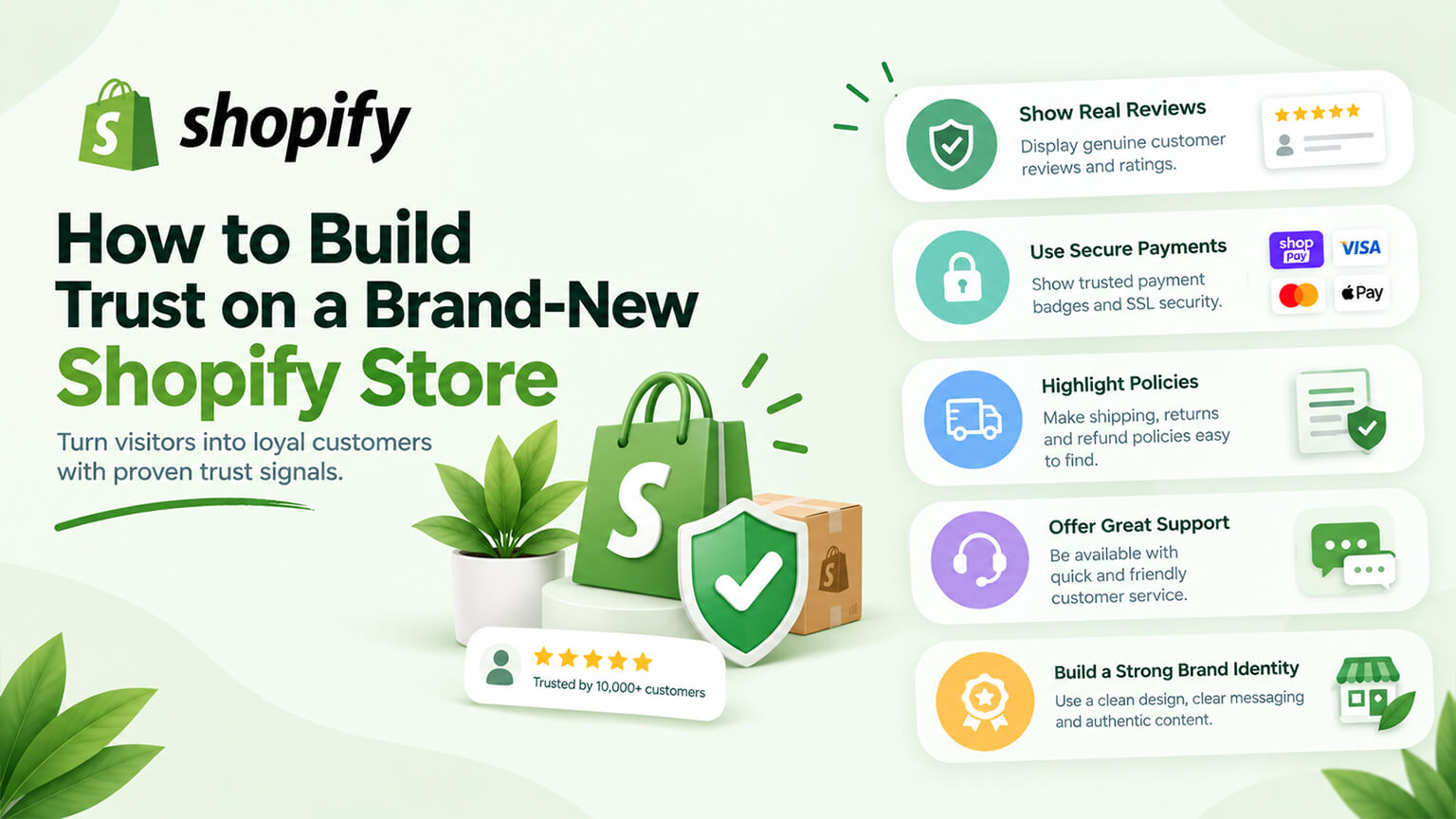
Trust is essential for conversion (as the trust and social-proof discussions cover), but a brand-new store faces a particular challenge: it has no track record, no reviews yet, no established reputation, no recognisable brand — the very things that build trust and that established stores have. Yet a new store still needs trust to convert its first customers (who are, by definition, first-time buyers taking a chance on an unknown store). This is a real hurdle: new stores often struggle to convert because visitors don’t yet trust them. But it’s not insurmountable — there’s a lot a brand-new store can do to build trust even without a track record, by getting the trust fundamentals right and building trust signals from the start. This piece covers how to build trust on a brand-new Shopify store: the new-store trust challenge, the trust fundamentals a new store can control, how to build early social proof and credibility, and how trust compounds as the store grows. (This connects to the trust-signals and social-proof discussions, which cover trust broadly; this focuses on building trust specifically for a new store.)
This piece covers the new-store trust challenge, the trust fundamentals a new store can control, building early social proof and credibility, and how trust compounds over time. Because new stores face a trust hurdle but can build trust from the start, and doing so helps them convert. Let me walk through it.
The new-store trust challenge
Let’s understand the specific trust challenge a new store faces. No track record — a new store has no track record (no history of orders, satisfied customers, or proven reliability), so visitors can’t see evidence of the store delivering — a key trust gap (no proof of reliability). No reviews yet — a new store has few or no reviews (the most important social proof, as the social-proof and reviews discussions cover), so it lacks the review-based trust that reassures buyers — a significant gap (no reviews to build trust). No established reputation — a new store has no established reputation or brand recognition (people don’t know it), so it lacks the trust that comes from being a known, reputable brand — an unknown-brand gap. First customers are first-time buyers of an unknown store — a new store’s first customers are, by definition, first-time buyers taking a chance on an unknown store (with no track record, reviews, or reputation), which is the hardest trust situation (as the trust discussion covers — first-time buyers need the most trust) — so new stores face the hardest trust situation with the fewest trust assets. This causes conversion struggles — as a result, new stores often struggle to convert (visitors don’t trust the unknown store enough to buy), a common new-store challenge — the trust gap hurting conversion. But it’s addressable — the challenge is real but addressable: a new store can build trust from the start (the fundamentals it controls, early social proof, credibility, as covered next), overcoming much of the gap even without a track record — so it’s a hurdle to address, not an insurmountable barrier. So the new-store trust challenge is that a new store lacks the track record, reviews, and reputation that build trust, faces the hardest trust situation (first-time buyers of an unknown store), and often struggles to convert as a result — but the challenge is addressable by building trust from the start (the fundamentals, early social proof, credibility). So recognise the challenge (a real trust gap hurting conversion) and address it (building trust from the start, as covered next). So the new-store trust challenge is real but addressable — the focus is building trust despite no track record.
The trust fundamentals a new store can control
Even without a track record, a new store can control the trust fundamentals — the signals that make it seem legitimate, professional, and trustworthy. A professional, quality store — a professional, well-designed, quality store (good design, no errors, polished, working well, as the trust and store-setup discussions cover) signals legitimacy and quality (versus an amateur, broken, or sloppy store that signals untrustworthiness) — the foundation (a professional store builds baseline trust). This a new store fully controls. Clear policies — clear, fair, prominent policies (returns, refunds, shipping, privacy, as the trust discussion covers) reassure buyers (they know what to expect, that they can return, that they’re protected) — a key trust signal a new store can have from the start. Security signals — security signals (HTTPS, secure checkout, trust badges, as the trust discussion covers) reassure buyers their payment and data are safe — a trust fundamental a new store controls. Clear contact and about information — clear contact information (how to reach you) and a good about page (who you are, your story, legitimacy, as the trust discussion covers) signal a real, legitimate, contactable business (versus a faceless or dubious one) — building trust in the store’s legitimacy, which a new store controls. Professional product presentation — professional product presentation (quality images, good descriptions, complete information, as the product-page discussions cover) signals quality and legitimacy (versus poor presentation signalling the opposite) — a trust signal via professionalism. Transparency and honesty — transparency (clear information, honest practices, no dark patterns, as the trust and ethical discussions cover) builds trust (versus hidden or deceptive practices eroding it) — trustworthy conduct a new store controls. Good UX and no red flags — good UX (a smooth, working, professional experience) and no red flags (no errors, broken things, sketchy elements, or trust-eroding issues) signal a trustworthy store — controllable by getting the store right. And trust signals throughout — trust signals throughout the store (security, policies, guarantees, professional presentation, as the trust discussion covers), especially at decision points (product pages, checkout), reassuring buyers — which a new store can implement from the start. So the trust fundamentals a new store can control are a professional, quality store (the foundation), clear fair policies, security signals, clear contact and about information (legitimacy), professional product presentation, transparency and honesty, good UX with no red flags, and trust signals throughout — all controllable from the start (not requiring a track record). So a new store can build significant trust by getting these fundamentals right (professional, transparent, secure, legitimate, well-presented), even without a track record — the first, controllable step. So get the trust fundamentals right from the start, building baseline trust. The next section covers building early social proof and credibility.
How to build early social proof and credibility
Beyond the fundamentals, a new store can build early social proof and credibility (even starting from zero). Generate early reviews — actively generate reviews from your first customers (asking satisfied early customers for reviews, as the reviews discussion covers), building up review-based social proof as soon as you have customers — so even a new store starts accumulating the reviews that build trust (a priority — get early reviews). Seek early UGC — encourage early user-generated content (customer photos, as the reviews/UGC discussion covers) from first customers, building authentic social proof. Use any available social proof — use whatever social proof you can early: early reviews and UGC (as they come), any testimonials, social media presence and following (building it), press or mentions (if any), and other credibility signals — using what’s available (versus none) and building more. Build credibility signals — build credibility through signals a new store can establish: a professional brand presence, an about page telling your story and expertise (as the trust and EEAT discussions cover), demonstrated expertise/experience (quality content, as the EEAT discussion covers), and any credentials, affiliations, or endorsements (if applicable) — establishing credibility even without a long track record. Leverage guarantees — offer guarantees (money-back guarantee, satisfaction guarantee, easy returns, as the trust discussion covers), which reduce the perceived risk for first-time buyers (reassuring them they can buy safely, reducing the trust barrier) — a powerful new-store trust builder (reducing risk when you lack track record). Build social media presence — build a social media presence (active, professional social profiles with followers and engagement), which provides social proof and credibility (a real, active brand) — buildable from the start. Be authentic and transparent — be authentic and transparent (your story, who you are, honest communication), which builds trust and connection (people trust authentic, transparent brands, especially new ones without a track record) — leveraging authenticity. And prioritise early reviews above all — since reviews are the most important social proof (as the social-proof discussion covers), prioritise generating early reviews (from your first customers) as the top way to build social proof as a new store — the highest-impact early social-proof action. So build early social proof and credibility by generating early reviews (the priority — from first customers) and UGC, using whatever social proof is available and building more, building credibility signals (professional presence, about/story, expertise, credentials), leveraging guarantees (reducing first-time-buyer risk), building a social media presence, being authentic and transparent, and prioritising early reviews above all. So actively build early social proof (especially reviews) and credibility from the start, plus leverage guarantees to reduce risk — building trust despite starting from zero. The next section covers how trust compounds over time. So a new store builds early social proof and credibility actively, especially generating early reviews and using guarantees.
How trust compounds as the store grows
Trust for a new store isn’t static — it compounds as the store grows, so the early trust-building sets up a compounding trajectory. Early trust enables first sales — the early trust (fundamentals, early social proof, credibility, guarantees) enables the first sales (getting first-time buyers to trust enough to buy), which is the crucial first step — building initial trust to start converting. First customers generate social proof — those first customers (if satisfied) generate reviews, UGC, and word-of-mouth (as the reviews and social-proof discussions cover), building the social proof the store lacked — so getting first sales starts generating the social proof that builds more trust (a virtuous cycle beginning). Track record builds — as the store fulfils orders and satisfies customers, it builds a track record (a history of reliability and satisfied customers), which builds trust (evidence of delivering) — so trust grows with the track record. Reviews and reputation accumulate — reviews accumulate (more reviews, stronger social proof) and reputation builds (the store becomes known, trusted, reputable), compounding the trust — so trust compounds as reviews and reputation grow. Trust compounds into easier conversion — as trust compounds (track record, reviews, reputation), converting gets easier (the store is more trusted, so more visitors trust and buy), and the store’s trust advantage grows — so early trust-building compounds into stronger conversion over time. The early work pays off compounding — the early trust-building (fundamentals, early social proof, guarantees) is what starts the cycle (enabling first sales, which generate social proof, building trust, compounding), so the early investment pays off in a compounding trust trajectory — worth prioritising early (to start the cycle). And keep building trust — keep building trust as you grow (continuing the fundamentals, accumulating reviews, building reputation, as the trust and reviews discussions cover), sustaining the compounding — so trust-building is ongoing (compounding over the store’s life). So trust compounds as a new store grows: early trust enables first sales, first customers generate social proof, the track record and reviews and reputation accumulate, and trust compounds into easier conversion and a growing trust advantage — so the early trust-building starts a compounding cycle that pays off over time. So the new-store trust challenge is a starting hurdle that, once overcome (early trust enabling first sales), compounds into growing trust as the store builds a track record, reviews, and reputation — so build trust from the start to start the compounding cycle. So a new store’s trust grows and compounds over time, making the early trust-building a high-value investment in a compounding trajectory.
The bottom line
Trust is essential for conversion, but a brand-new store faces a particular challenge: it has no track record, few or no reviews, no established reputation, and no recognisable brand — the very things that build trust and that established stores have — yet it still needs trust to convert its first customers, who are by definition first-time buyers taking a chance on an unknown store (the hardest trust situation). As a result, new stores often struggle to convert, but the challenge is real and addressable, not insurmountable. Even without a track record, a new store can control the trust fundamentals: a professional, well-designed, quality store (the foundation — signalling legitimacy versus an amateur or broken store), clear and fair policies (returns, refunds, shipping, privacy — reassuring buyers), security signals (HTTPS, secure checkout, trust badges), clear contact and about information (signalling a real, legitimate, contactable business), professional product presentation (quality images and descriptions), transparency and honesty (no dark patterns), good UX with no red flags, and trust signals throughout the store (especially at decision points) — all controllable from the start, building significant baseline trust without needing a track record. Beyond the fundamentals, a new store can actively build early social proof and credibility: generate early reviews from its first customers (the priority, since reviews are the most important social proof), encourage early user-generated content, use whatever social proof is available and build more, establish credibility signals (a professional brand presence, an about page telling its story and expertise, demonstrated expertise, and any credentials or endorsements), leverage guarantees (money-back or satisfaction guarantees and easy returns, which reduce the perceived risk for first-time buyers — a powerful new-store trust builder when you lack a track record), build a social media presence, and be authentic and transparent. And crucially, trust compounds as the store grows: the early trust (fundamentals, early social proof, credibility, guarantees) enables the first sales, those first satisfied customers generate reviews, UGC, and word-of-mouth (building the social proof the store lacked), the store builds a track record as it fulfils orders and satisfies customers, reviews and reputation accumulate, and trust compounds into easier conversion and a growing trust advantage — so the early trust-building starts a virtuous, compounding cycle that pays off over time. So a brand-new store overcomes the trust hurdle by getting the trust fundamentals right from the start (professional, transparent, secure, legitimate store with clear policies and trust signals), actively building early social proof (especially generating early reviews) and credibility, and leveraging guarantees to reduce first-time-buyer risk — building enough trust to convert its first customers, which starts the compounding cycle of track record, reviews, and reputation that grows trust over time. The new-store trust challenge is a starting hurdle, not a permanent barrier: build trust from the start to clear it and start the compounding, and trust grows into a real advantage as the store matures. So if you’re launching a new store, prioritise building trust from day one — the fundamentals, early reviews, guarantees, and credibility — to overcome the new-store trust gap and start the compounding trust trajectory that turns a trusted store into a converting, growing one.
Frequently asked questions
Why do new Shopify stores struggle to build trust?
Because a brand-new store lacks the very things that build trust and that established stores have: it has no track record (no history of orders, satisfied customers, or proven reliability), few or no reviews (the most important social proof), no established reputation or brand recognition, and no recognisable brand. Yet it still needs trust to convert its first customers — who are, by definition, first-time buyers taking a chance on an unknown store, which is the hardest trust situation, since first-time buyers need the most reassurance. So a new store faces the hardest trust situation with the fewest trust assets, which is why new stores often struggle to convert (visitors don’t yet trust the unknown store enough to buy). The good news is that this challenge, while real, is addressable — a new store can build significant trust from the start through the fundamentals it controls, early social proof, credibility, and guarantees, overcoming much of the gap even without a track record.
How can a new store build trust without a track record or reviews?
By getting the trust fundamentals right — all of which a new store fully controls, no track record needed. Build a professional, well-designed, quality store (the foundation — signalling legitimacy and quality versus an amateur or broken store). Have clear, fair, prominent policies (returns, refunds, shipping, privacy) that reassure buyers. Show security signals (HTTPS, secure checkout, trust badges) so buyers know their payment and data are safe. Provide clear contact information and a good about page (who you are, your story), signalling a real, legitimate, contactable business. Present products professionally (quality images, good descriptions, complete information), be transparent and honest (no dark patterns), ensure good UX with no red flags (errors, broken things, sketchy elements), and place trust signals throughout the store, especially at decision points like product pages and checkout. Together these build significant baseline trust from day one. On top of the fundamentals, actively generate early reviews from your first customers, leverage guarantees to reduce first-time-buyer risk, and build credibility (professional presence, your story, demonstrated expertise).
What’s the most powerful way for a new store to build trust?
Two things stand out. First, generating early reviews from your first customers — since reviews are the most important social proof, actively asking satisfied early customers for reviews (and encouraging user-generated content like customer photos) is the highest-impact way to start building the social-proof-based trust a new store initially lacks. Even a handful of genuine early reviews meaningfully reassures subsequent visitors. Second, leveraging guarantees — offering a money-back or satisfaction guarantee and easy returns directly reduces the perceived risk for first-time buyers, which is exactly the barrier a new store faces (buyers hesitating to risk buying from an unknown store). A strong guarantee reassures them they can buy safely, lowering the trust hurdle when you don’t yet have a track record. Combined with getting the trust fundamentals right (a professional, transparent, secure, legitimate store), prioritising early reviews and offering guarantees are the most powerful early trust builders — they help you convert your first customers, which then starts the compounding cycle of accumulating reviews, track record, and reputation.
Does trust get easier to build as a store grows?
Yes — trust compounds as a new store grows, which is why the early trust-building is so valuable. The early trust you build (fundamentals, early social proof, credibility, guarantees) enables your first sales — getting first-time buyers to trust enough to buy. Those first satisfied customers then generate reviews, user-generated content, and word-of-mouth, building the social proof the store initially lacked. As the store fulfils orders and satisfies customers, it builds a track record (evidence of reliability), reviews accumulate (stronger social proof), and reputation builds (the store becomes known and trusted) — all of which compound the trust. As trust compounds, converting gets easier (the store is more trusted, so more visitors buy), and its trust advantage grows. So the new-store trust challenge is a starting hurdle, not a permanent barrier: the early trust-building starts a virtuous, compounding cycle. This is exactly why prioritising trust from day one matters — it clears the initial hurdle and sets off the compounding trajectory that turns trust into a growing advantage as the store matures.