
The Complete Guide to Shopify CRO
On this page
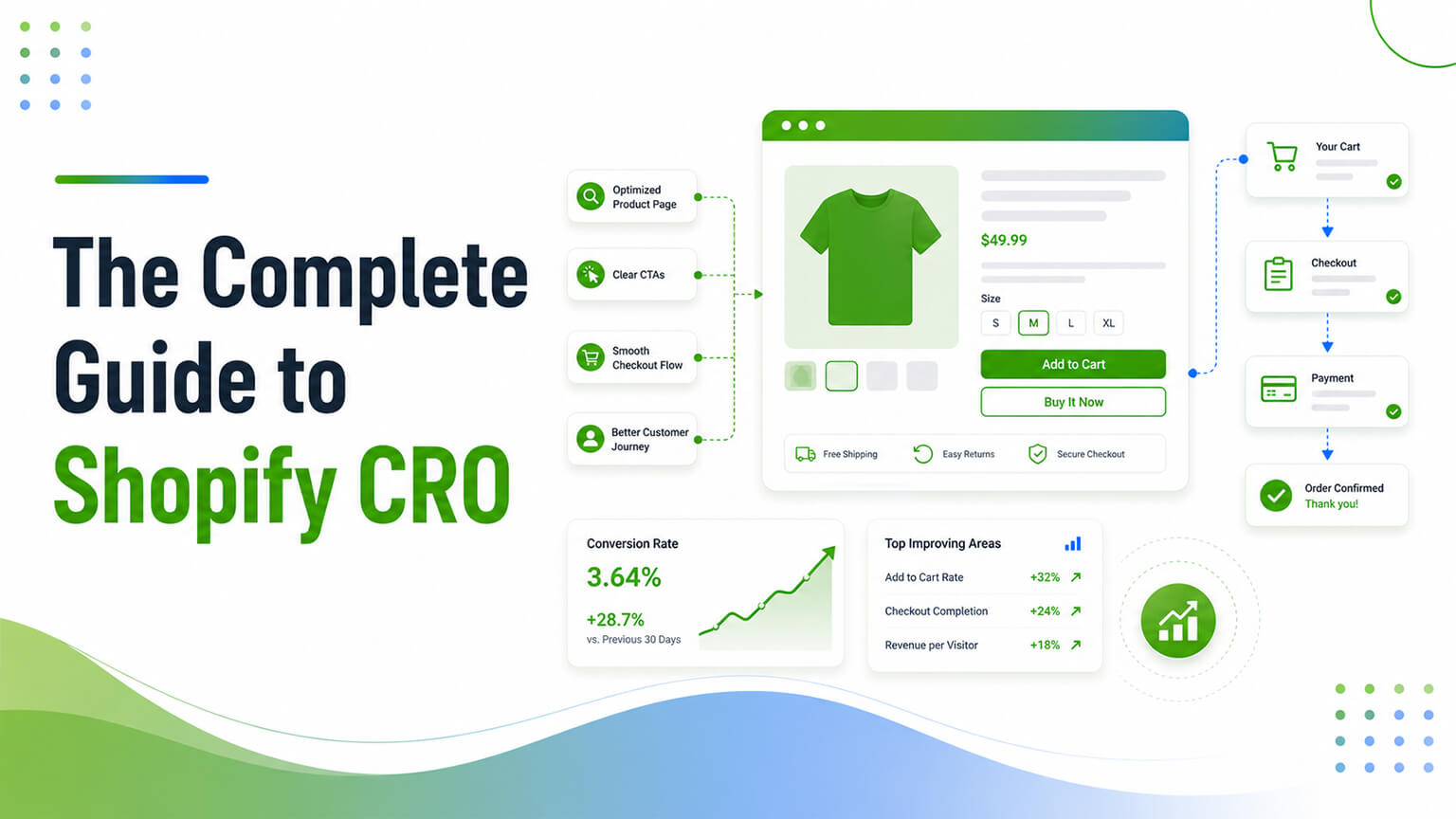
Conversion rate optimization (CRO) is one of the highest-leverage things a Shopify store can invest in, because it makes the traffic you already have more valuable. Every visitor you’ve paid (through ads, SEO, content, and effort) to attract either converts or doesn’t, and CRO is the discipline of systematically increasing the proportion who do — turning more of your existing traffic into sales, without spending more on acquisition. A small improvement in conversion rate flows straight to revenue and profit (since the traffic cost is already paid), which is why CRO often delivers better returns than chasing more traffic. But CRO done well isn’t a bag of “conversion hacks”; it’s a systematic, evidence-based discipline of understanding why visitors don’t convert and methodically improving. This guide covers CRO for Shopify stores comprehensively — what it is, why it matters, the systematic process, where to focus, and how to do it well — pulling together the CRO threads (A/B testing, product pages, cart abandonment, trust, AOV, metrics) into one complete picture. This piece is the overview; the linked discussions go deeper on each area.
This piece covers what CRO is and why it matters, the systematic CRO process, the key areas to optimise, and how to do CRO well (and avoid the common mistakes). Because CRO is high-leverage and systematic, and a complete understanding helps you do it well. Let me walk through it.
What CRO is and why it matters
CRO is the discipline of systematically increasing the proportion of visitors who take a desired action (primarily purchasing, but also adding to cart, signing up, etc.). What it is — CRO is systematically understanding why visitors don’t convert and methodically improving the store (the experience, pages, flow, persuasion, friction) to increase conversion — an evidence-based, iterative discipline, not random tweaks or “hacks.” Why it matters — it matters because it makes existing traffic more valuable: improving conversion rate means more sales from the same traffic, so the revenue gain flows straight to the bottom line (the traffic cost is already paid), making CRO high-ROI. High leverage — a conversion-rate improvement multiplies across all your traffic (a small percentage improvement on all visitors is significant revenue), so CRO is high-leverage. Often better ROI than more traffic — improving conversion is often cheaper and higher-ROI than acquiring more traffic (which costs more per visitor and is increasingly expensive, as the first-party-data discussion covers), so CRO is often the better investment. Compounds with everything — better conversion makes all your traffic (and all your acquisition spend) more productive, compounding with your other efforts. And it’s about the customer — good CRO improves the experience for customers (reducing friction, building trust, helping them buy), so it aligns with serving customers well, not tricking them. So CRO matters because it makes existing traffic more valuable (high-ROI, high-leverage), is often a better investment than more traffic, compounds with everything, and serves customers well — making it one of the highest-leverage disciplines for a store. So invest in CRO: systematically improving conversion is high-leverage, high-ROI work that turns your existing traffic and acquisition spend into more sales. The next sections cover how to do it.
The systematic CRO process
CRO done well is a systematic, iterative process, not random changes. Measure and understand — start by measuring conversion (overall and by segment/page, via analytics, as the metrics discussion covers) and understanding where and why visitors don’t convert: use analytics (where visitors drop off — the funnel), heatmaps and session recordings (how visitors behave, where they struggle, as that discussion covers), and other research (surveys, feedback) to understand the conversion barriers. Identify problems and opportunities — from the research, identify the specific problems (friction, confusion, lack of trust, barriers) and opportunities (where improvement could lift conversion), grounding CRO in evidence (not guesses). Hypothesise — form hypotheses (as the CRO-hypothesis discussion covers): “changing X will improve conversion because [reason based on the evidence],” turning problems into testable improvement ideas. Prioritise — prioritise the hypotheses/tests (by potential impact, ease, and confidence, as the prioritisation discussion covers), focusing effort on the highest-value opportunities. Test — test the changes (A/B testing where traffic allows, as that discussion covers, or careful before/after for lower traffic), measuring whether they actually improve conversion (evidence, not assumption). Analyse and learn — analyse the test results (did it improve conversion? what did you learn?), learning what works (and what doesn’t), building knowledge. And iterate — iterate continuously (more research, hypotheses, tests, learning), since CRO is an ongoing program, not a one-time project (as the continuous-CRO discussion covers). So the systematic CRO process is: measure and understand (research the barriers), identify problems/opportunities, hypothesise, prioritise, test, analyse and learn, and iterate — an evidence-based, iterative cycle. This systematic approach (versus random tweaks or copying “hacks”) is what makes CRO effective: grounded in evidence (research), focused (prioritised), validated (tested), and continuous (iterated). So do CRO systematically — research, hypothesise, prioritise, test, learn, iterate — rather than guessing or hacking, and it delivers reliable, compounding conversion improvement.
The key areas to optimise
CRO spans several key areas of the store, each a place to find and fix conversion barriers. Product pages — product pages are where buying decisions happen, so optimising them (imagery, descriptions, social proof, trust, clear add-to-cart, addressing objections, as the product-page discussion covers) is high-impact CRO. Cart and checkout — the cart and checkout are where intent converts to purchase, and reducing abandonment and friction there (as the cart-abandonment and checkout-optimisation discussions cover) directly lifts conversion. Trust — trust is essential for conversion (especially for first-time buyers, as the trust discussion covers), so trust signals (reviews, security, social proof, professionalism) throughout the store support conversion. Site speed and mobile — speed (as the speed discussions cover) and mobile experience (as the mobile-CRO discussion covers) affect conversion (slow or poor-mobile stores lose sales), so optimising them is foundational CRO. Navigation and findability — helping shoppers find products (navigation, search, filtering, as those discussions cover) supports conversion (can’t-find means can’t-buy). Homepage and landing pages — the homepage and landing pages (especially for paid traffic, as the landing-page discussion covers) shape first impressions and entry, affecting conversion. AOV (related) — while AOV (as that discussion covers) is about order value rather than conversion rate per se, it’s part of the broader optimisation of revenue per visitor. And the overall experience — the overall experience (clarity, ease, persuasion, friction reduction, trust) across the journey affects conversion. So the key CRO areas are product pages (where buying decisions happen), cart and checkout (where intent converts), trust (essential for conversion), speed and mobile (foundational), navigation and findability, homepage and landing pages, and the overall experience — each a place to find and fix conversion barriers. CRO works across these areas, finding and fixing the barriers wherever they are (which the research reveals). So optimise across these areas, guided by research (where your specific barriers are), focusing on the highest-impact opportunities. The product page, cart/checkout, and trust are often the highest-impact areas, but your research reveals your specific priorities.
How to do CRO well (and avoid mistakes)
To do CRO well and avoid the common mistakes, keep some principles in mind. Be evidence-based — ground CRO in evidence (research, data, testing), not guesses, opinions, or copying “hacks” (what works for another store may not work for yours), since evidence is what makes CRO reliable. Test properly — test changes properly (valid A/B tests where traffic allows, or careful measurement, as the A/B-testing and reading-results discussions cover), avoiding fooling yourself (false positives, insufficient data, misreading results — common CRO mistakes). Prioritise by impact — focus on the highest-impact opportunities (as the prioritisation discussion covers), not minor tweaks, since CRO effort should go where it matters most. Don’t chase hacks — avoid the “conversion hacks” trap (random tactics promised to boost conversion); real CRO is systematic and evidence-based, and hacks (aggressive popups, fake urgency, dark patterns) often hurt trust and experience (as the urgency/scarcity discussion covers). Serve the customer — good CRO improves the experience for customers (reducing friction, building trust, helping them buy), aligning conversion with serving customers well; manipulative tactics (dark patterns, deception) may lift short-term conversion but harm trust and long-term value, so optimise honestly. Be patient and iterative — CRO is a continuous program (ongoing research, testing, learning), not a one-time fix, so commit to the ongoing process (as the continuous-CRO discussion covers). And measure what matters — measure the right metrics (conversion, revenue, the metrics that matter, as that discussion covers), not vanity metrics, and judge CRO by real business impact. So do CRO well by being evidence-based (not guessing or hacking), testing properly (not fooling yourself), prioritising by impact, avoiding hacks and dark patterns (serving customers honestly), being patient and iterative (a continuous program), and measuring what matters. Avoiding the common mistakes (guessing, hacking, fooling yourself, dark patterns, impatience, vanity metrics) and following these principles is what makes CRO deliver reliable, sustainable conversion improvement. So approach CRO as the systematic, evidence-based, customer-serving, continuous discipline it is — and it’s one of the highest-leverage investments your store can make.
A worked example: the leverage of a small lift
It helps to see why CRO is described as high-leverage with actual numbers, so picture a store getting 100,000 visitors a month, converting at 2%, with an average order value of $80. That’s 2,000 orders and $160,000 a month. Now suppose a systematic CRO program — better product pages, reduced checkout friction, stronger trust signals — lifts the conversion rate from 2% to 2.5%. That half-a-percentage-point improvement isn’t small in effect: it takes the store from 2,000 to 2,500 orders a month, and from $160,000 to $200,000 — an extra $40,000 a month, roughly half a million a year, from the same traffic and the same ad spend. No additional acquisition cost; the visitors were already coming.
Compare that to the alternative of getting the extra revenue purely through more traffic: at the original 2% conversion, you’d need 25,000 more visitors a month to add those 500 orders — traffic you’d have to pay to acquire, at rising costs. This is the leverage CRO offers: because a conversion improvement multiplies across all your traffic, even modest percentage gains translate into large revenue numbers, and they flow to profit because the traffic is already paid for. It’s also why CRO compounds with acquisition rather than competing with it — a higher conversion rate makes every dollar of future ad spend more productive too. The example isn’t a promise of a specific result (real lifts vary, and they come from systematic work, not hacks), but it illustrates why so many stores find that optimising conversion is a better use of the next dollar than buying more traffic. The traffic you’ve already worked to earn is an asset; CRO is how you get more out of it.
Building CRO into how you operate
The final thing to understand about CRO is that it works best not as an occasional project but as an ongoing way of operating — a continuous program (as that discussion covers) woven into how the store is run. Stores that treat CRO as a one-off (“let’s do a CRO project this quarter”) get some gains and then plateau; stores that build it into their rhythm keep compounding improvements over time. Practically, that means maintaining an ongoing cycle: continuously gathering research (analytics, heatmaps, session recordings, customer feedback, support themes) to surface barriers, keeping a prioritised backlog of hypotheses, running a steady cadence of tests, learning from each (wins and losses both teach you something), and feeding those learnings back into the next round.
It also means building the supporting habits: proper measurement and tracking so you can trust your data (as the metrics and analytics discussions cover), a testing discipline so you don’t fool yourself, and a culture of deciding by evidence rather than the loudest opinion. Over time, a store running CRO this way accumulates not just a higher conversion rate but a deep understanding of its own customers — what they want, what stops them, what persuades them — which is itself a durable competitive asset that informs product pages, marketing, merchandising, and beyond. So rather than asking “should we do some CRO,” the more useful framing is “how do we make optimising conversion a permanent part of how we operate.” That’s where the compounding really happens, and it’s what separates stores that get a one-time bump from those that steadily, sustainably grow the value of every visitor they earn. CRO, in the end, is less a tactic than a habit of systematically getting better at turning visitors into customers — and that habit, sustained, is one of the most reliable engines of profitable growth a store has.
The bottom line
Conversion rate optimization (CRO) is one of the highest-leverage things a Shopify store can invest in, because it makes the traffic you already have more valuable — systematically increasing the proportion of visitors who convert turns more of your existing traffic and acquisition spend into sales, with the revenue gain flowing straight to the bottom line (the traffic cost is already paid). It’s often higher-ROI than chasing more traffic, it compounds with everything, and done well it serves customers (reducing friction, building trust, helping them buy) rather than tricking them. But CRO done well isn’t “conversion hacks” — it’s a systematic, evidence-based, iterative discipline: measure and understand where and why visitors don’t convert (via analytics, heatmaps, session recordings, and research), identify the specific problems and opportunities, form hypotheses, prioritise by impact, test the changes (valid A/B testing or careful measurement), analyse and learn, and iterate continuously. CRO spans the key areas where conversion barriers live: product pages (where buying decisions happen — high-impact), cart and checkout (where intent converts to purchase — reducing abandonment and friction), trust (essential for conversion, especially for first-time buyers), site speed and mobile (foundational), navigation and findability (can’t-find means can’t-buy), homepage and landing pages (first impressions and entry), and the overall experience — with your research revealing your specific priorities (often the product page, cart/checkout, and trust are highest-impact). To do CRO well and avoid the common mistakes, be evidence-based (not guessing or copying hacks), test properly (don’t fool yourself with bad data or misread results), prioritise by impact, avoid conversion hacks and dark patterns (serve customers honestly, since manipulative tactics harm trust and long-term value), be patient and iterative (CRO is a continuous program, not a one-time fix), and measure what matters (conversion and revenue, not vanity metrics). Approach CRO this way — systematic, evidence-based, customer-serving, continuous — and it becomes one of the highest-leverage investments your store can make, reliably and sustainably turning more of your existing traffic into sales.
Frequently asked questions
What is conversion rate optimization (CRO)?
CRO is the discipline of systematically increasing the proportion of your visitors who take a desired action — primarily making a purchase, but also adding to cart, signing up, and other goals. Rather than random tweaks or “conversion hacks,” good CRO is an evidence-based, iterative process: understanding why visitors don’t convert (through analytics, heatmaps, session recordings, and research), forming hypotheses about what would improve conversion, prioritising and testing changes, and learning from the results to improve continuously. The point is to make the traffic you already have more valuable — turning more of your existing visitors into customers without spending more on acquisition — which makes CRO one of the highest-leverage things a store can invest in.
Why is CRO worth investing in?
Because it makes your existing traffic and acquisition spend more valuable, with the gains flowing straight to the bottom line. You’ve already paid (through ads, SEO, content, and effort) to attract your visitors, so improving the proportion who convert means more sales from the same traffic — and that revenue gain is high-margin because the traffic cost is already paid. A conversion-rate improvement multiplies across all your traffic, making CRO high-leverage, and it’s often cheaper and higher-ROI than acquiring more traffic (which gets more expensive over time). CRO also compounds with everything else you do (making all your traffic more productive) and, done well, improves the experience for customers. For most stores, systematically improving conversion is one of the best investments available.
Where should I focus my CRO efforts?
Let research guide you to your specific barriers, but the generally highest-impact areas are product pages (where buying decisions happen — imagery, descriptions, social proof, trust, clear calls to action, addressing objections), the cart and checkout (where intent converts to purchase — reducing abandonment and friction), and trust (essential for conversion, especially for first-time buyers). Beyond those, site speed and mobile experience are foundational (slow or poor-mobile stores lose sales), navigation and findability matter (shoppers who can’t find products can’t buy), and homepage and landing pages shape first impressions. Use analytics, heatmaps, and session recordings to find where your visitors actually drop off and struggle, then prioritise the highest-impact opportunities rather than spreading effort thinly or guessing.
What’s the biggest mistake stores make with CRO?
Treating it as a bag of “conversion hacks” rather than a systematic, evidence-based discipline. Copying tactics that supposedly boost conversion (without evidence they help your store), guessing at changes instead of researching actual barriers, and not testing properly (fooling yourself with insufficient data or misread results) all undermine CRO. So does reaching for manipulative dark patterns (aggressive popups, fake urgency, deceptive design) that may lift short-term conversion but harm trust and long-term value. Real CRO is systematic (research, hypothesise, prioritise, test, learn, iterate), evidence-based, customer-serving (improving the experience honestly), patient (a continuous program, not a one-time fix), and judged by real business metrics (conversion and revenue, not vanity metrics). Avoiding the hacks-and-guessing trap and following the systematic process is what makes CRO reliably deliver.