
Wholesale and B2B Pricing Strategy on Shopify
On this page
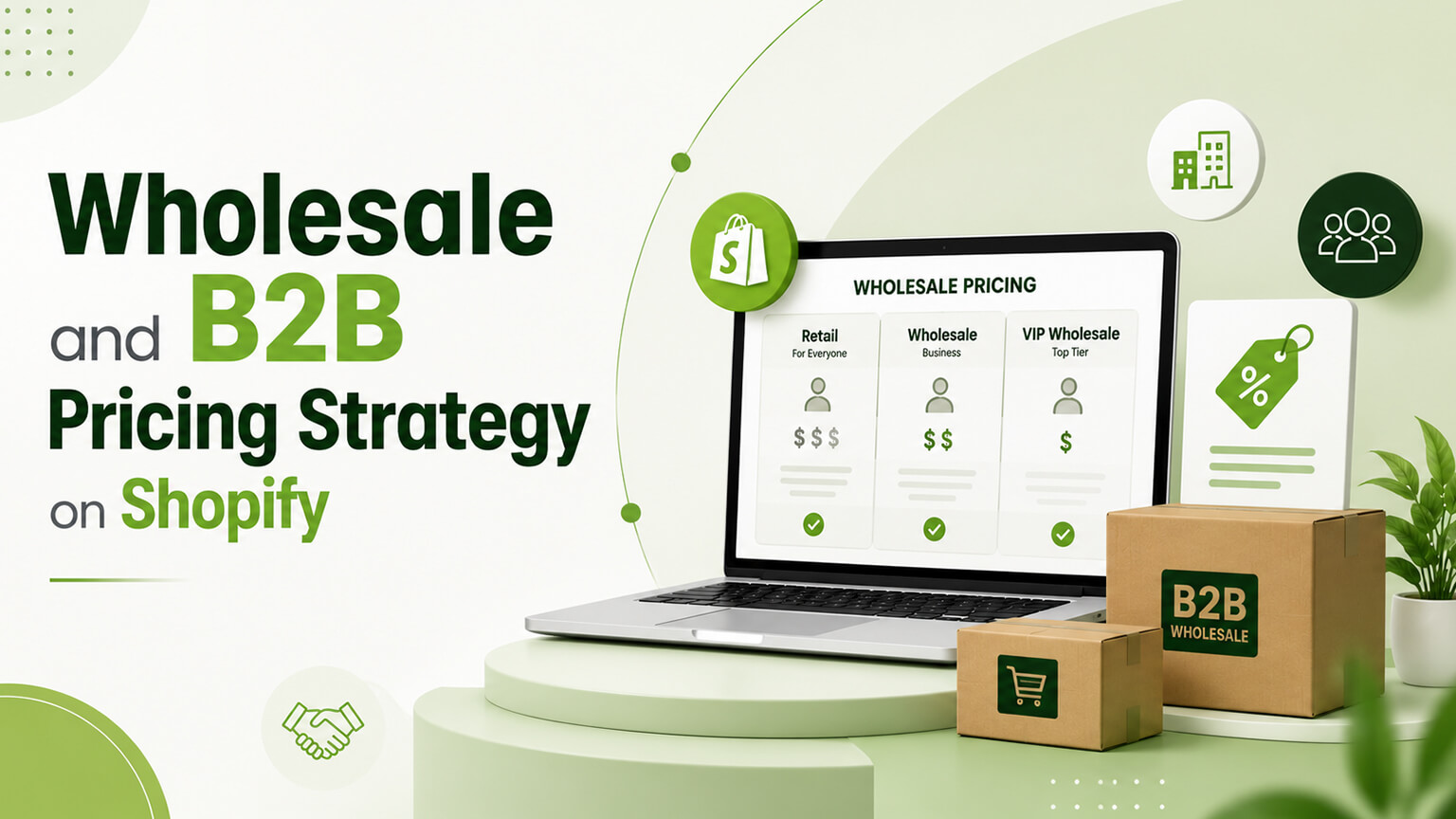
Selling B2B or wholesale isn’t just DTC with a discount — the pricing is strategically different, and getting it right is the difference between a healthy, profitable B2B channel and one that erodes your margins, angers your retailers, or undercuts your direct sales. B2B pricing involves volume-based and tiered structures, account-specific and negotiated pricing, payment terms, and the delicate balance of pricing across channels without conflict — considerations that simply don’t exist in straightforward DTC pricing. And while Shopify Plus’s native B2B handles the mechanics of implementing this (as covered in the native B2B discussion), the strategy of what your B2B pricing should be is a separate, important question.
This piece is about that strategy — the pricing models for wholesale and B2B, how to set wholesale pricing that works for both you and your retailers, volume incentives and account-specific pricing, payment terms, and crucially how to balance B2B and DTC pricing without channel conflict. The platform mechanics are one thing; the pricing strategy is another, and it’s the strategy that determines whether your B2B channel is profitable and healthy. Let me walk through it.
Why B2B pricing is strategically different
Start with why B2B pricing differs fundamentally from DTC, because the differences shape the whole strategy. DTC pricing is relatively straightforward — you set a price, customers pay it. B2B pricing is more complex and relational: it’s often volume-based (larger orders get better pricing), tiered (pricing levels by volume or customer type), account-specific (different customers, especially negotiated ones, get different pricing), and bound up with payment terms (net terms as part of the deal). It’s also relationship-based — B2B is about ongoing business relationships, not one-off transactions, so pricing reflects the relationship, the volume, and the negotiation.
And critically, B2B pricing has to leave room for your retailers’ margins. When you sell wholesale to a retailer who’ll resell, your wholesale price has to be low enough that the retailer can mark it up and still sell competitively while making their margin — you’re pricing for a reseller’s economics, not an end consumer’s. This is a fundamental difference from DTC: your B2B price isn’t the final price to a consumer but a price a business builds their own margin on top of. So B2B pricing involves volume, tiers, account-specificity, terms, relationships, and reseller margins — a strategically richer problem than DTC pricing. Understanding these differences is the foundation for setting B2B pricing well, because applying DTC pricing thinking to B2B (just discounting, ignoring tiers, terms, reseller margins, and channel balance) gets it wrong.
The B2B pricing models
There are several B2B pricing models, often used in combination, and choosing the right structure for your business is part of the strategy. Flat wholesale discount — a standard discount off your retail/MSRP for wholesale customers (simple, common, but doesn’t differentiate by volume or account). Tiered/volume pricing — better pricing at higher volumes or for higher tiers, incentivizing larger orders and rewarding bigger customers (encourages volume, aligns pricing with the value of larger accounts). Customer-specific pricing — different pricing for different accounts, especially negotiated deals with key customers (reflects the relationship and negotiation, common for significant B2B relationships). Negotiated/custom pricing — bespoke pricing negotiated per account, for major customers. And considerations like MSRP (manufacturer’s suggested retail price) and MAP (minimum advertised price) that shape the pricing ecosystem.
Most B2B operations use a combination — perhaps tiered pricing as the structure, with customer-specific pricing for negotiated key accounts, all relative to your MSRP. The right combination depends on your business, your customers, and your relationships. The strategy is choosing the pricing structure (flat, tiered, account-specific, or a combination) that fits your B2B model — rewarding volume where that matters, accommodating negotiated relationships, and reflecting the value of different accounts. Shopify Plus’s native B2B supports these structures (price lists, company-specific pricing, quantity rules), so the platform can implement your chosen strategy; the strategic decision is what structure to use. Tiered and account-specific pricing are powerful because they align your pricing with volume and relationships rather than treating all B2B customers identically, which is usually the more sophisticated and profitable approach.
Setting wholesale pricing that works for both sides
A core strategic challenge: setting wholesale pricing that works for both you and your retailers. Your wholesale price has to satisfy two constraints — it has to give you acceptable margin (you’re still making money at wholesale prices, which are lower than retail), and it has to leave your retailer enough margin to mark it up and sell profitably. If your wholesale price is too high, retailers can’t make their margin and won’t carry your product (or can’t sell it competitively); if it’s too low, you erode your own margin unnecessarily. The wholesale price has to thread this needle — profitable for you, workable for the retailer.
This requires understanding the retailer’s economics: they’ll typically mark up your wholesale price to a retail price (often around your MSRP), and the gap between your wholesale price and that retail price is their margin, which has to be enough for them to want to carry and sell your product. So set your wholesale pricing with the retailer’s margin in mind — low enough to give them a workable margin at the expected retail price, high enough to keep your own margin acceptable. Common wholesale pricing leaves the retailer a substantial margin (the standard “keystone” markup of doubling the wholesale price to retail is a traditional benchmark, though it varies by industry). The strategic point is that wholesale pricing is a two-sided calculation — your margin and your retailer’s margin both have to work — unlike DTC where you only consider your own. Getting this balance right is essential to a healthy wholesale channel: price so both you and your retailers profit, and they’ll carry and push your product; price so they can’t make margin, and the channel fails.
Volume incentives and account-specific pricing
Two of the more powerful B2B pricing strategies deserve emphasis. Volume incentives through tiered pricing — offering better pricing at higher order volumes — encourage larger orders and reward your bigger customers, aligning your pricing with the value of volume. This is strategically smart: it incentivizes the larger orders that are more efficient for you to fulfill and rewards the customers who buy more, often growing order sizes as customers reach for the next tier. Tiered volume pricing turns your pricing into an incentive structure that encourages the buying behavior you want (larger orders) while rewarding your most valuable accounts.
Account-specific pricing — different pricing for different customers, especially negotiated key accounts — reflects the reality that B2B relationships vary, and your most important or highest-volume accounts may warrant negotiated pricing. This lets you accommodate the negotiated deals that significant B2B relationships often involve, pricing each account according to its volume, relationship, and negotiation. Shopify Plus’s native B2B supports this through company-specific price lists, so you can implement account-specific pricing cleanly. The strategy is to use these tools — volume tiers to incentivize and reward larger orders, account-specific pricing to accommodate relationships and negotiations — rather than treating all B2B customers with one flat price. Sophisticated B2B pricing differentiates by volume and account, which is more profitable and more aligned with B2B reality than flat wholesale pricing, and the platform supports implementing it.
Payment terms as part of the deal
In B2B, payment terms are part of the pricing and the deal, unlike DTC where customers pay immediately. B2B customers often expect net terms (paying in 30, 60, or 90 days rather than upfront) and purchase orders, and offering appropriate terms is part of competing for and serving B2B accounts. Terms are effectively part of your pricing/deal strategy — they have a cost to you (you’re financing the customer’s purchase for the term period, with the associated cash flow and risk implications), so they’re a consideration alongside the price itself.
So factor payment terms into your B2B strategy: what terms will you offer, to which customers, and how does that affect your cash flow and risk? Offering terms is often necessary to compete in B2B (many business buyers expect them), but they carry cost and risk (financing the purchase, the risk of late or non-payment), so they’re a strategic decision, not just an accommodation. Shopify Plus’s native B2B supports net terms and purchase orders, so the platform can implement your terms strategy. The strategic point is that B2B “pricing” includes terms — the full deal is price plus terms — so consider terms as part of your B2B pricing strategy, balancing the competitive need to offer them against their cost and risk. Getting terms right (offering what’s needed to compete while managing the cash flow and risk) is part of a sound B2B pricing and deal strategy.
Balancing B2B and DTC: avoiding channel conflict
A critical strategic challenge for brands selling both wholesale and direct: avoiding channel conflict. If you sell DTC and also sell wholesale to retailers, your DTC pricing and your retailers’ pricing can conflict — if your DTC price undercuts your retailers (selling direct cheaper than they can), you undermine the retailers carrying your product, who won’t appreciate competing against your own cheaper direct sales. Conversely, you need your DTC channel to be healthy too. Managing this balance — pricing across channels so they don’t undermine each other — is a key B2B-plus-DTC strategic concern.
The common approaches involve maintaining pricing discipline across channels: typically keeping your DTC pricing at or around MSRP (so you’re not undercutting retailers selling at similar prices), using MAP (minimum advertised price) policies to prevent retailers from undercutting each other and your DTC into a race to the bottom, and generally pricing so the channels coexist rather than cannibalize. MAP especially is a tool for channel health — it sets a floor on advertised prices, protecting your retailers’ margins and your brand’s price integrity from destructive discounting. The strategic point is that selling both wholesale and DTC requires deliberate pricing coordination across channels to avoid conflict — don’t let your DTC undercut your retailers, use MAP to protect price integrity, and price so both channels are healthy. This is a consideration that pure-DTC or pure-wholesale brands don’t face, but for brands doing both (which Shopify Plus’s native B2B-plus-DTC capability enables), managing channel pricing conflict is essential to keeping both channels and your retailer relationships healthy.
A worked example: the wholesale price that didn’t work
To see why the two-sided calculation matters, take a brand setting its wholesale pricing for the first time. They look at their DTC margins, decide they want to keep a healthy margin on wholesale too, and set a wholesale price that’s only modestly below their retail price — protecting their own margin. It seems prudent. But when they pitch retailers, the retailers balk: at that wholesale price, after marking up to a competitive retail price, the retailer’s margin is too thin to make carrying the product worthwhile. The brand priced for their own margin while ignoring the retailer’s, and the result is retailers who won’t carry the product. The wholesale price “worked” for the brand and failed the channel.
Now the brand reconsiders with the retailer’s economics in mind. They understand that the retailer needs a substantial margin — enough to mark up the wholesale price to a competitive retail price and still profit meaningfully (the traditional benchmark being roughly doubling the wholesale price to retail, though it varies). So they set a wholesale price low enough to give retailers that workable margin, accepting a lower margin for themselves on wholesale than on DTC (which is normal — wholesale margins are lower, but the volume and reach of the channel compensate). Now the pricing works for both sides: retailers can profit and will carry and push the product, and the brand profits on the volume even at lower per-unit wholesale margin.
This captures the central B2B pricing lesson: wholesale pricing is a two-sided calculation, and pricing only for your own margin (ignoring the retailer’s) fails the channel. The brand had to shift from DTC thinking (maximize my margin) to wholesale thinking (price so both the retailer and I profit, accepting lower per-unit margin for the volume and reach). Brands new to wholesale routinely make this mistake — pricing for their own margin and finding retailers won’t bite — and the fix is always to factor in the retailer’s margin needs. Price so both sides profit, and you build a wholesale channel retailers want to be part of; price for yourself alone, and the channel never gets off the ground.
Review and evolve your B2B pricing
A final practical note: B2B pricing isn’t set-and-forget — review and evolve it as your business, costs, and relationships change. Your costs change (affecting the margins your pricing needs to preserve), your relationships evolve (an account that grows may warrant better tiered or negotiated pricing), market conditions shift, and what you learn about your channel’s economics improves your pricing. So periodically review your B2B pricing — are your tiers set well, is your wholesale pricing still working for both sides, are your account-specific deals appropriate, is your channel balance healthy, are your terms appropriate? — and adjust as needed.
This ongoing attention keeps your B2B pricing aligned with your evolving costs, relationships, and strategy, rather than drifting out of date. B2B relationships are long-term and evolving, so the pricing should evolve with them — rewarding accounts that grow, adjusting for changing costs, refining your tiers and structure as you learn. The brands that manage B2B pricing well treat it as an evolving strategy they review and refine, not a one-time setup. So build in periodic review of your B2B pricing strategy, adjusting for changing costs, relationships, and what you learn, to keep the channel profitable and healthy over time. Combined with getting the initial strategy right (the structure, the two-sided pricing, the tiers, the terms, the channel balance), this ongoing refinement keeps your B2B channel performing as your business grows and evolves.
The bottom line
B2B and wholesale pricing is strategically different from DTC — it’s volume-based, tiered, account-specific, relationship-based, bound up with payment terms, and crucially has to leave room for your retailers’ margins, since your wholesale price is one a reseller builds their own margin on, not a final consumer price. Choose the right pricing structure for your business (flat wholesale, tiered/volume pricing, customer-specific pricing, or a combination), generally favoring tiered and account-specific approaches that align pricing with volume and relationships rather than treating all B2B customers identically. Set wholesale pricing that works for both sides — profitable for you, leaving your retailers enough margin to mark up and sell profitably — because pricing so both profit keeps the channel healthy. Use volume incentives (tiered pricing) to encourage larger orders and reward bigger accounts, and account-specific pricing to accommodate negotiated relationships. Factor payment terms (net terms, POs) into your strategy as part of the deal, balancing the competitive need against their cost and risk. And if you sell both wholesale and DTC, manage channel conflict deliberately — keep DTC pricing from undercutting your retailers, use MAP to protect price integrity, and price so both channels are healthy. Shopify Plus’s native B2B implements all of this (price lists, account pricing, quantity rules, terms), but the strategy — what your pricing should be — is the separate, essential question that determines whether your B2B channel is profitable and healthy. Get the strategy right, and the platform implements a B2B channel that profits you, works for your retailers, and coexists with your DTC. The brands that build healthy, profitable B2B channels are the ones that treat pricing as the two-sided, multi-faceted strategy it is — accounting for their own margin and their retailers’, rewarding volume, accommodating relationships, factoring in terms, and managing channel balance — rather than defaulting to a flat discount and hoping. The platform makes the mechanics easy; the strategic thinking is what makes the channel work, and it’s well worth getting right given how much a healthy wholesale channel can add to a business.
Frequently asked questions
How is B2B pricing different from DTC pricing?
B2B pricing is volume-based, tiered, account-specific, relationship-based, and bound up with payment terms — far more complex than DTC’s straightforward “set a price, customers pay it.” Crucially, wholesale pricing has to leave room for your retailers’ margins, since your wholesale price is one a reseller marks up to make their own margin, not a final consumer price. Applying DTC thinking to B2B (just discounting, ignoring tiers, terms, reseller margins, and channel balance) gets it wrong.
How do I set wholesale pricing?
Thread two constraints: your wholesale price must give you acceptable margin and leave your retailer enough margin to mark it up and sell profitably. Too high and retailers can’t make margin and won’t carry your product; too low and you erode your own margin. Understand the retailer’s economics — they’ll mark up your wholesale price to a retail price (often around your MSRP), and that gap is their margin, which must be enough to motivate them. Price so both you and your retailers profit; that keeps the channel healthy.
What is channel conflict and how do I avoid it?
Channel conflict happens when your sales channels undermine each other — most commonly when your DTC pricing undercuts your wholesale retailers, who then compete against your own cheaper direct sales and resent it. Avoid it by coordinating pricing across channels: keep DTC pricing at or around MSRP so you’re not undercutting retailers, use MAP (minimum advertised price) policies to prevent destructive discounting, and price so both channels stay healthy. Brands selling both wholesale and DTC must manage this deliberately.
Does Shopify Plus handle B2B pricing?
Yes — Shopify Plus’s native B2B implements the mechanics: company-specific price lists, account-specific pricing, quantity rules for volume tiers, and net payment terms. So the platform supports tiered, account-specific, and terms-based B2B pricing. But the platform handles the implementation; the strategy — what your pricing structure and levels should be, how to balance your margin and your retailers’, how to manage channel conflict — is the separate, essential question that determines whether your B2B channel is profitable and healthy.