
Shopify Plus vs Other Enterprise Platforms: An Honest Comparison
On this page
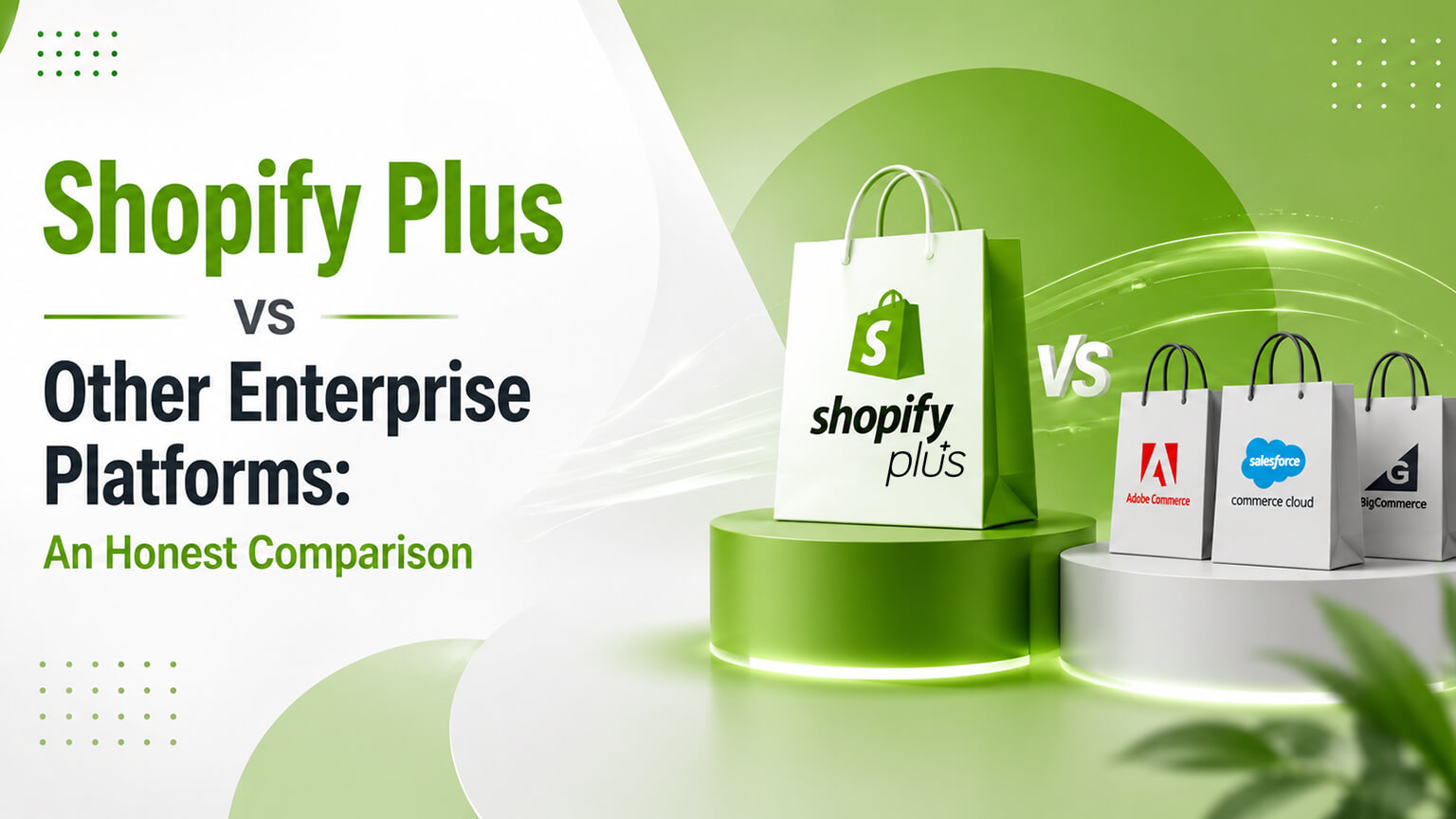
When a brand reaches enterprise scale, Shopify Plus is one option among several enterprise commerce platforms, and the choice between them is a significant one with long-term consequences. This is a space full of partisan takes — Shopify advocates declaring Plus the obvious choice, others championing more “powerful” or “flexible” platforms — and what’s useful is an honest comparison that explains where each fits rather than declaring a universal winner. Because there isn’t a universal winner: the right enterprise platform depends on your specific needs, and while Shopify Plus is the right choice for a large and growing share of brands, it isn’t right for everyone, and pretending otherwise serves no one.
So this is an honest comparison — Shopify Plus’s genuine strengths, its real limitations, the other platforms and their trade-offs, and how to figure out which fits your situation. I have a point of view (the calculus has shifted in Shopify’s favor for most brands, for reasons I’ll explain), but I’ll be straight about where other platforms fit and what you’re trading off. Let me walk through it.
The enterprise platform landscape
At the enterprise level, the main options brands weigh include Shopify Plus (Shopify’s enterprise tier — managed, increasingly capable), Adobe Commerce (formerly Magento — powerful, flexible, but self-managed and heavy, as discussed in the migration context), BigCommerce Enterprise (another SaaS platform competing with Plus), composable/headless-native approaches and platforms like commercetools (API-first, maximally flexible, for sophisticated composable builds), and Salesforce Commerce Cloud (enterprise platform often in larger, complex deployments), among others. These differ significantly in their fundamental approach — particularly the managed-versus-self-managed and the all-in-one-versus-composable dimensions.
The key distinction that shapes a lot of the comparison is managed (SaaS) versus self-managed, and integrated versus composable. Shopify Plus and BigCommerce are managed SaaS platforms — the vendor handles infrastructure, security, and updates, trading some ultimate flexibility for much lower operational burden. Adobe Commerce is powerful and flexible but self-managed, meaning you (or your team) handle the infrastructure, with the high cost and burden that implies. Composable platforms like commercetools maximize flexibility and are built for sophisticated composable architectures, suiting very specific, complex needs but requiring significant technical capability. So the landscape spans from managed-and-integrated (Plus) to self-managed-and-flexible (Adobe Commerce) to composable-and-maximally-flexible (commercetools), and where you should land depends heavily on which trade-offs fit your situation. Understanding this spectrum is the foundation for the comparison.
The dimensions that matter
To compare these honestly, weigh them on the dimensions that actually matter for an enterprise brand. Total cost of ownership — not just licensing but the full cost including the technical resources to build and run the platform (self-managed platforms have much higher TCO due to the infrastructure and expertise burden). Operational burden — how much you have to manage yourself (infrastructure, security, updates) versus how much the platform handles. Flexibility and customization — how much you can customize and control (open/composable platforms offer more ultimate flexibility; managed platforms offer plenty but within bounds). Time to market — how quickly you can build and launch (managed platforms are typically faster). Ecosystem — the apps, integrations, partners, and talent available. Scalability and reliability — handling enterprise volume and traffic. B2B and specific capabilities — how well it handles your particular needs. And headless/composable support — whether and how it supports those architectures if you need them.
Different platforms win on different dimensions, which is exactly why the choice depends on your priorities. If ultimate flexibility and control are paramount and you have the technical resources, a self-managed or composable platform’s flexibility may win despite its cost and burden. If lower TCO, low operational burden, fast time to market, and a huge ecosystem matter more (as they do for most brands), Shopify Plus’s managed model wins. So the comparison isn’t “which is best” in the abstract but “which trade-offs fit your priorities” — weighing these dimensions for your specific situation. Let me give my honest read on where Plus stands across them.
Shopify Plus’s genuine strengths
Shopify Plus’s strengths, honestly assessed, are substantial and explain why it’s the right choice for so many brands. It’s managed, with low operational burden — Shopify handles infrastructure, security, and updates, so you’re not running your own platform (a huge advantage over self-managed options like Adobe Commerce, where that burden is large and expensive). Its total cost of ownership is typically much lower than heavyweight self-managed platforms, because you’re not paying for the infrastructure and large engineering team those require — the licensing might be substantial, but the all-in TCO is often far lower than a self-managed enterprise platform. It’s fast to build and launch on relative to heavier platforms. It has a huge ecosystem of apps, integrations, partners, and available talent (a major practical advantage — you can find Shopify expertise and apps far more easily than for some other platforms). It has a strong, reliable, high-converting checkout. It handles enterprise scale and traffic well. And — crucially — the historical gaps that once pushed complex brands to other platforms have largely closed: Checkout Extensibility brought checkout customization, native B2B brought wholesale capability, and Shopify Functions brought custom commerce logic, so Plus now offers much of the customization and capability that used to require a more “powerful” platform, but with the managed, lower-burden model.
This last point is key to why the calculus has shifted toward Shopify for most brands: the main reasons a complex enterprise brand might historically have chosen Adobe Commerce or a composable platform over Shopify (checkout control, B2B, deep customization) are increasingly met by Plus, while Plus retains its advantages in managed convenience, lower TCO, speed, and ecosystem. So for a large and growing share of enterprise brands, Plus now offers enterprise capability without enterprise burden, which is a compelling combination. That’s my honest read on why Plus wins for most — not because it’s universally superior, but because for most brands the managed, lower-TCO, capable model fits better than the alternatives’ trade-offs.
Shopify Plus’s real limitations
To be honest rather than promotional, Plus has real limitations relative to some alternatives. As a managed SaaS platform, it doesn’t offer the ultimate, infinite flexibility of a fully open or composable platform — you customize within the bounds of what the platform allows (extensive, but not unlimited), whereas an open platform you control entirely can be customized in ways a managed platform can’t. For brands with truly unusual, highly specific requirements that exceed even Plus’s increasingly capable customization (a real but smaller set than is often claimed), a more flexible platform might fit better. There are also specific enterprise scenarios — certain very complex deployments, particular integration or architectural requirements, existing heavy investments in another platform — where another platform may be the better fit.
So Plus isn’t universally best: the trade-off for its managed convenience is that it’s not infinitely customizable like a fully open platform, and for a minority of brands with exceptional requirements, that limitation matters. The honest framing is that Plus offers extensive (and increasingly extensive) capability within a managed model, which fits most brands, but a fully open or composable platform offers more ultimate flexibility at the cost of much higher burden, which fits the minority whose requirements need that flexibility and who have the resources for the burden. Acknowledging this limitation is important — Plus advocates who claim it does everything for everyone overstate it, and the honest position is that Plus is the right managed-model choice for most while -exceptional requirements might warrant a more flexible (and more burdensome) alternative.
When Plus wins, and when another platform might fit
Pulling it together honestly. Shopify Plus is the right choice for most high-volume DTC brands and many B2B brands — those who want enterprise capability (checkout customization, B2B, custom logic, scale) without the cost and burden of a self-managed or maximally-composable platform, and who value the lower TCO, fast time to market, huge ecosystem, and managed model. This is a large and growing share of enterprise brands, especially as Plus’s capabilities have expanded to close the historical gaps. For these brands, Plus’s combination of capability and managed convenience at lower TCO is the best fit.
Another platform might fit when you have truly exceptional, highly specific requirements that exceed Plus’s customization (and you have the technical resources for a more flexible platform’s burden), when you have a significant existing investment in another platform that’s serving you, or in certain very complex enterprise scenarios where another platform’s particular strengths match your particular needs. These are real but represent a minority of cases — the brands for whom the flexibility of an open or composable platform outweighs the much higher cost and burden. The honest guidance is to evaluate your specific requirements against the platforms’ trade-offs rather than choosing on reputation or partisan claims: for most brands, Plus’s managed capability at lower TCO wins; for the minority with exceptional needs and the resources for the burden, a more flexible platform might fit. Neither is universally right; the right choice depends on whether your requirements need the flexibility that justifies the burden, or whether (as for most) the managed model serves you better.
How to evaluate for your situation
Practically, choose your enterprise platform by honestly assessing your requirements and resources against the trade-offs. What do you need — and can Plus’s (extensive, increasingly capable) customization meet it, or do you have truly exceptional requirements that need a more flexible platform? What technical resources do you have — can you handle the burden of a self-managed or composable platform, or do you benefit from a managed model? What’s your real total cost of ownership on each — including the infrastructure and expertise burden, not just licensing? How much do speed, ecosystem, and managed convenience matter to you? And be honest about whether you’d actually use the infinite flexibility of an open platform, or whether you’re over-valuing flexibility you won’t use at the cost of burden you’d rather avoid.
That last point catches many brands: over-valuing the theoretical flexibility of an open platform, choosing it for flexibility they won’t actually use, and taking on the much higher cost and burden for little real benefit. For most brands, the honest assessment reveals that Plus’s managed capability meets their genuine needs at lower TCO, and the “more powerful” platforms’ extra flexibility isn’t worth the burden for their actual requirements. So evaluate honestly — genuine requirements (not theoretical wants) against real trade-offs (including TCO and burden, not just capability) — and the right platform for your situation emerges, which for most brands is Plus, and for a genuine minority is something else. The mistake is choosing on platform reputation, partisan claims, or theoretical flexibility rather than your honest, specific assessment.
A worked example: the flexibility that wasn’t needed
The most common enterprise platform mistake is worth illustrating. A brand evaluating platforms is drawn to a maximally flexible open or composable platform, impressed by its power and the promise of being able to customize anything. The pitch emphasizes infinite flexibility, and it’s seductive — who wouldn’t want to be able to do anything? They’re leaning toward it over Shopify Plus, which feels more “boxed in” by comparison.
But an honest assessment of their actual requirements tells a different story. When they list what they need — checkout customization (now available on Plus via extensibility), B2B (native on Plus), some custom commerce logic (Shopify Functions), scale (Plus handles it), a strong checkout and ecosystem — every real requirement is met by Plus. The “infinite flexibility” of the open platform addresses requirements they don’t actually have; it’s theoretical flexibility they wouldn’t use. Meanwhile, choosing the open platform would mean taking on the infrastructure burden, the much higher TCO, the need for a large engineering team, and slower time to market — real, substantial costs — in exchange for flexibility their actual needs don’t require.
Confronted with the honest comparison — every genuine requirement met by Plus’s managed model at lower TCO, versus an open platform’s theoretical flexibility they won’t use at much higher cost and burden — the choice becomes clear: Plus fits their real situation far better. They almost over-bought flexibility, seduced by the power of the open platform, when their actual requirements were well within Plus’s increasingly capable managed model. This scenario is extremely common, which is why the honest, requirements-based assessment matters so much: it cuts through the seductive appeal of theoretical flexibility to reveal what you actually need, which for most brands is met by Plus at lower cost and burden than the “more powerful” alternatives. The brands that choose well assess their genuine needs honestly; the ones that over-buy are seduced by flexibility they’ll never use.
Don’t forget the migration cost
A practical consideration in any enterprise platform decision: switching platforms is a major, costly, risky project (as covered in the migration discussions), so the cost and risk of migrating to a platform is part of the decision, not just the platform’s ongoing merits. If you’re already on a platform that’s serving you reasonably, the substantial cost and risk of migrating to another must be justified by enough benefit to outweigh it — sometimes a platform that would be marginally better in the abstract isn’t worth the migration cost and risk to switch to. And if you’re choosing a platform you’ll commit to, factor in that you’re choosing something you’ll want to stay on, since switching later is expensive.
This cuts both ways. It’s a reason not to switch platforms casually for marginal gains — the migration cost can outweigh the benefit. And it’s a reason to choose well upfront, since the choice is sticky. For a brand on a burdensome self-managed platform, the migration cost to Plus is often well-justified by the ongoing reduction in burden and TCO (as the Magento migration discussion covers). For a brand already on a platform serving them well, switching needs strong justification. So weigh the migration cost and risk as part of the platform decision: it argues for choosing carefully (since switching is costly) and against switching casually (since the migration must be justified by sufficient benefit). The platform decision isn’t just “which is best” but “which is best enough to justify getting there and committing to,” which factors in the real cost of migration and the stickiness of the choice.
The bottom line
At enterprise scale, Shopify Plus is one option among several (Adobe Commerce, BigCommerce, composable platforms like commercetools, Salesforce Commerce Cloud, others), and the honest answer is that there’s no universal winner — the right platform depends on your specific requirements and resources weighed against each platform’s trade-offs. The key dimensions: total cost of ownership (including the infrastructure and expertise burden, where self-managed platforms are far costlier), operational burden (managed versus self-managed), flexibility (open/composable platforms offer more ultimate flexibility, managed platforms plenty within bounds), time to market, ecosystem, scalability, and specific capabilities. Shopify Plus’s genuine strengths — managed with low operational burden, much lower TCO than heavyweight self-managed platforms, fast, huge ecosystem, strong checkout, enterprise scale, and increasingly capable customization and B2B that have closed the historical gaps — make it the right choice for most high-volume DTC and many B2B brands wanting enterprise capability without enterprise burden, which is why the calculus has shifted in its favor. Its real limitation is that, as a managed platform, it isn’t infinitely customizable like a fully open one, so a minority of brands with exceptional requirements (and the resources for the burden) might fit a more flexible platform better. Evaluate honestly — your genuine requirements and real resources against the actual trade-offs including TCO and burden, not platform reputation or theoretical flexibility you won’t use — and the right choice emerges: for most brands, Plus’s managed capability at lower TCO; for a genuine minority, a more flexible alternative. The honest framing isn’t that Plus is universally best, but that it’s the best fit for most brands’ real situations, while -exceptional needs might warrant something else.
Frequently asked questions
Is Shopify Plus better than other enterprise platforms?
There’s no universal winner — it depends on your requirements and resources weighed against each platform’s trade-offs. That said, Shopify Plus is the right choice for most high-volume DTC and many B2B brands, because it offers enterprise capability (checkout customization, B2B, custom logic, scale) with a managed model, much lower total cost of ownership than heavyweight self-managed platforms like Adobe Commerce, fast time to market, and a huge ecosystem. Its increasingly capable customization has closed the historical gaps, shifting the calculus in its favor for most.
When would another platform be better than Shopify Plus?
When you have truly exceptional, highly specific requirements that exceed even Plus’s (extensive, growing) customization and you have the technical resources for a more flexible platform’s much higher burden; when you have a significant existing investment in another platform that’s serving you well; or in certain very complex enterprise scenarios where another platform’s particular strengths match your particular needs. These are real but a minority of cases — most brands’ genuine needs are met by Plus’s managed model at lower TCO.
What’s the main trade-off between Shopify Plus and a platform like Adobe Commerce?
Managed convenience versus ultimate flexibility and the burden that comes with it. Shopify Plus is managed — Shopify handles infrastructure, security, and updates, giving you lower operational burden, lower total cost of ownership, and faster time to market, but you customize within the platform’s (extensive) bounds. Adobe Commerce offers more ultimate flexibility and control but is self-managed, meaning you handle the infrastructure and expertise burden, with much higher TCO. For most brands the managed model wins; for those needing the flexibility and able to bear the burden, the open platform might fit.
How should I choose an enterprise commerce platform?
Honestly assess your genuine requirements (not theoretical wants) and real resources against each platform’s actual trade-offs — total cost of ownership including the infrastructure and expertise burden (not just licensing), operational burden, whether the customization meets your real needs, time to market, ecosystem, and scale. A common mistake is over-valuing the theoretical flexibility of an open platform you won’t actually use, taking on much higher cost and burden for little real benefit. For most brands, the honest assessment points to Plus’s managed capability at lower TCO; for a genuine minority with exceptional needs, something else.