
Hydrogen vs. Next.js for Shopify Storefronts
On this page
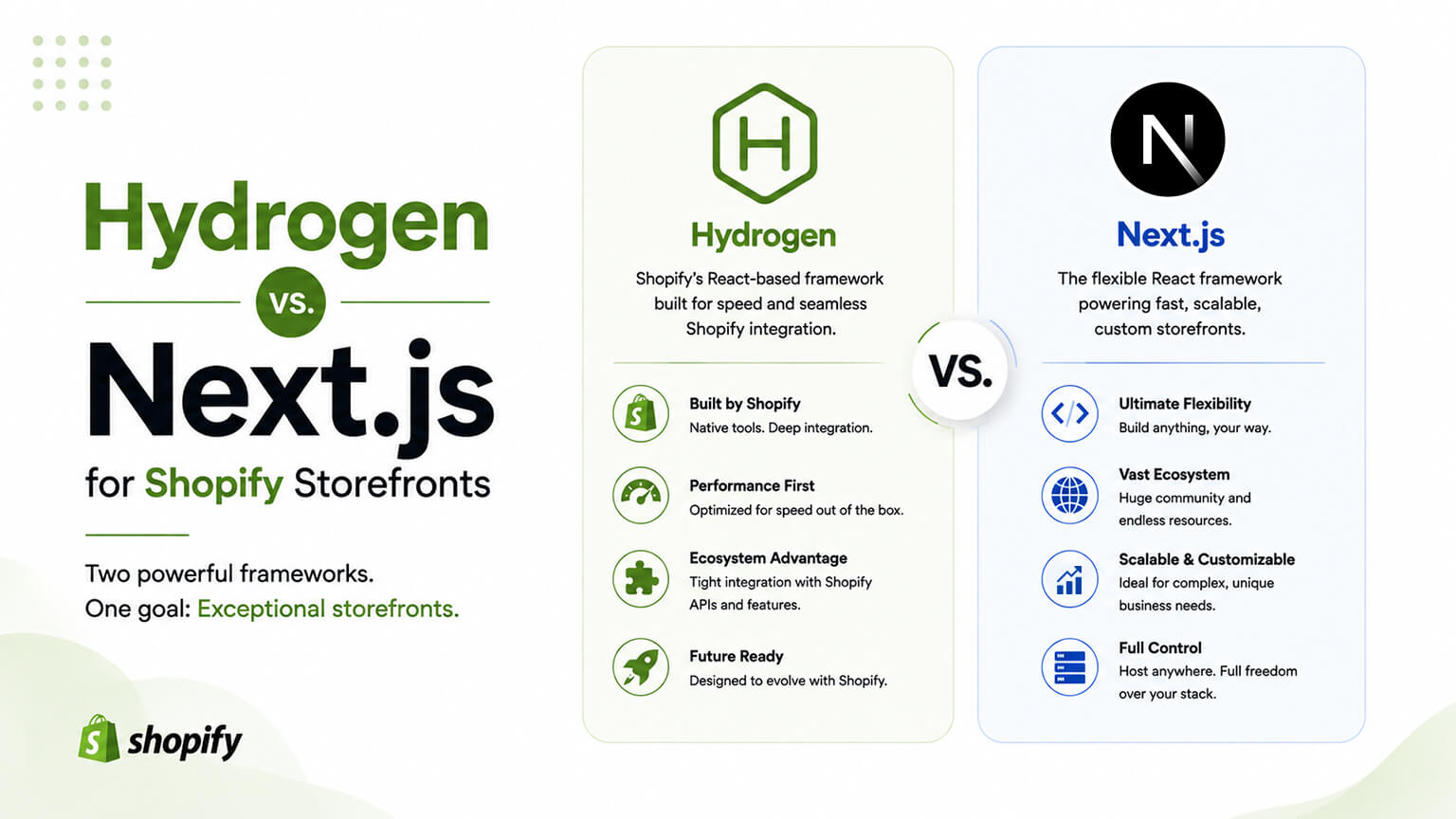
If you’ve decided to build a headless Shopify storefront — and that’s a big “if” you should have settled before reaching this article — the next fork in the road is which framework to build it on. The two names dominating the conversation are Hydrogen, Shopify’s own React-based framework, and Next.js, the popular general-purpose React framework. They’re both excellent, they overlap heavily, and the right choice depends more on your team and goals than on any technical knockout punch.
This is a more technical comparison than most of these articles, so if you’re a non-technical owner, the practical takeaway is near the end and you can skip there. If you’re making or influencing the architecture decision, here’s the real picture.
Both speak the same underlying language
First, the thing that makes this a genuine choice rather than an obvious one: both Hydrogen and Next.js are built on React, and both consume Shopify’s Storefront API (the GraphQL API that exposes your products, collections, cart, and so on to a custom front end). So at a fundamental level you’re writing similar code — React components fetching commerce data from the same Shopify API — regardless of which you pick. The differences are in the conveniences, the hosting, the defaults, and the ecosystem around that core, not in some deep incompatibility. A team comfortable in one would not be lost in the other.
This matters because it lowers the stakes of the decision. You’re not choosing between two alien worlds; you’re choosing between two flavors of the same React-plus-Storefront-API approach. Either can produce an excellent storefront. The question is which fits your situation better, and what you’d be giving up.
The case for Hydrogen
Hydrogen is purpose-built for Shopify commerce, and that focus is its whole pitch.
It ships with commerce-aware components and utilities — things like cart handling, product data fetching, and other commerce primitives — built in, so you’re not reinventing the commerce wheel. Where a general framework leaves you to wire up commerce logic yourself, Hydrogen gives you a head start with pieces designed for exactly this job. It’s tightly integrated with the Storefront API by design, so the path from “I have a Shopify store” to “I have a custom storefront pulling its data” is smoother and more opinionated.
Hydrogen is designed to deploy on Oxygen, Shopify’s own global hosting for headless storefronts. That’s a real convenience: hosting built and tuned for Hydrogen storefronts, integrated into the Shopify ecosystem, with deployment that’s meant to just work. You stay within Shopify’s world end to end — framework, hosting, and commerce engine all from one vendor that’s incentivized to make them work together.
The trade-off is that Hydrogen is younger and more specialized than Next.js, with a smaller ecosystem and community. It’s evolved significantly (it was rebuilt to work as a set of tools alongside a popular foundation rather than a wholly separate framework), but it’s still a more focused, less universally-known tool. Hiring developers specifically experienced in Hydrogen is harder than hiring Next.js developers, simply because there are fewer of them.
The case for Next.js
Next.js is one of the most popular React frameworks in the world, and its strengths flow from that ubiquity.
It’s mature, battle-tested, and supported by an enormous community and ecosystem. Whatever problem you hit, someone has hit it before and written it up. There’s a vast pool of developers who know it — not as a commerce tool, but as the framework they already use daily — which makes hiring and team-building far easier. If you have an existing engineering team, there’s a good chance they already know Next.js, which collapses the learning curve to nearly nothing.
It’s general-purpose and flexible, with its App Router and React Server Components offering powerful, modern rendering patterns. Because it’s not commerce-specific, it makes no assumptions and integrates with anything — Shopify for commerce, any CMS for content, any other service you want in the stack. For a content-heavy or unusually architected build that goes well beyond standard commerce, that neutrality and flexibility is an advantage.
The trade-off is the mirror image of Hydrogen’s: you don’t get commerce-specific conveniences out of the box. You (or your developers) build the commerce integration yourself against the Storefront API. That’s entirely doable — many excellent Shopify storefronts run on Next.js — but it’s more wiring than Hydrogen’s commerce-first approach, and you own more of the commerce plumbing. You also choose and manage your own hosting (commonly Vercel, which is made by the same company behind Next.js, or others), rather than the integrated Oxygen path.
A side-by-side
| Factor | Hydrogen | Next.js |
|---|---|---|
| Built for | Shopify commerce specifically | General-purpose React apps |
| Commerce conveniences | Built-in components & utilities | Build it yourself on the Storefront API |
| Hosting | Oxygen (Shopify, integrated) | Your choice (Vercel, others) |
| Ecosystem & community | Smaller, focused | Very large, general |
| Developer availability | Fewer specialists | Abundant |
| Best when | You want a Shopify-native, integrated path | You have/want flexibility or an existing Next.js team |
How to actually choose
Forget which framework is “better” in the abstract — they’re both good, and the comparison has no clean winner. Decide based on your situation.
Lean Hydrogen if you want to stay fully within the Shopify ecosystem, value the built-in commerce conveniences and the integrated Oxygen hosting, and you’re building a fairly commerce-focused storefront. The Shopify-native path is smoother when your project is squarely about commerce and you’d rather not assemble and host everything yourself. You’re betting on integration and a curated path.
Lean Next.js if you have an existing team that already knows it, want the flexibility of a general-purpose framework for a content-heavy or unconventional build, value the enormous ecosystem and easier hiring, or want full control over your hosting and architecture. The general-purpose path wins when the project extends well beyond standard commerce or when developer availability and ecosystem maturity are priorities. You’re betting on flexibility and ubiquity.
For most teams, honestly, the deciding factor is people, not technology. If your developers know Next.js, the productivity of building in a framework they already command usually outweighs Hydrogen’s commerce conveniences. If you’re starting fresh, hiring an agency, and want the most Shopify-integrated path, Hydrogen’s focus is attractive. Both will get you to an excellent storefront; the better choice is the one your actual team can build and maintain most effectively.
The content question that often decides it
One factor settles this choice more often than raw framework preference: how much non-commerce content your storefront needs to handle, and where that content lives. A storefront that’s almost entirely product browsing and buying has different needs from one that’s also a content destination — editorial, guides, lookbooks, a substantial blog, rich brand storytelling.
If your store is content-heavy, you’ll likely want a dedicated headless CMS alongside Shopify, and how cleanly your framework integrates with that CMS and renders its content becomes a deciding factor. Next.js’s general-purpose flexibility and enormous ecosystem mean it integrates smoothly with essentially any CMS and is well-suited to content-rich, editorially complex sites — that’s a big part of why content-led brands often lean Next.js. Hydrogen can absolutely work with a CMS too, but its center of gravity is commerce, so for a build where content is as important as commerce, Next.js’s neutrality is frequently the better fit.
Conversely, if your storefront is overwhelmingly about commerce — browse, evaluate, buy, with relatively little editorial — Hydrogen’s commerce-first conveniences shine and the content flexibility of Next.js matters less. So a useful shortcut when you’re torn: weigh how much of your storefront is commerce versus content. Commerce-dominant tilts toward Hydrogen’s focus; content-significant tilts toward Next.js’s flexibility. It’s not an absolute rule, but it resolves a lot of indecision.
Don’t forget the hosting and operational picture
Frameworks don’t run in a vacuum — they’re deployed and operated somewhere, and that operational picture should factor into the choice rather than being an afterthought. Hydrogen is designed to deploy on Oxygen, Shopify’s hosting for headless storefronts, which keeps everything within the Shopify ecosystem: framework, hosting, and commerce engine from one vendor, with deployment meant to be smooth and integrated. For a team that values having fewer vendors and a curated, supported path, that’s a real convenience worth weighting.
Next.js leaves hosting to you, most commonly Vercel (built by the same company behind Next.js, and tightly optimized for it) but potentially others. That’s more choice and more control, which suits teams that want to own their infrastructure decisions or already have hosting preferences, at the cost of being one more thing to set up and manage. Neither is better in the abstract — it depends on whether you prefer an integrated, fewer-decisions path or the flexibility of choosing and controlling your own stack. The operational reality of who deploys, monitors, and maintains the thing should sit alongside the coding experience in your decision, because you’ll live with it long after launch.
A note for non-technical decision-makers
If you’re a founder or operator rather than an engineer and you’ve read this far, the practical translation is short. Both frameworks are excellent and either can build you a superb storefront, so this is not a decision to agonize over or to let stall a project. The single most important factor is usually what your actual development team — whether in-house or an agency — knows and can maintain well. A team building confidently in the framework they command will deliver a better result than the same team forced onto a “better” framework they know less well. So if you’re hiring or working with developers, ask what they recommend for your specific build and why, and weight their answer heavily, because they’re the ones who have to execute and maintain it. Your job is less to pick the framework and more to make sure whoever builds it is good and that the build is done with the care that actually determines the outcome.
The two-year view: hiring and maintenance
Framework comparisons tend to focus on the build, but the decision you’re really making is who can build and maintain this storefront well over the next couple of years — and that reframes the choice in a useful way. A headless storefront is a custom application that needs ongoing care indefinitely: frameworks and dependencies update, things break, Shopify’s APIs evolve, and someone has to keep it all current and performant. The framework you pick shapes how easy that ongoing reality is to staff.
Next.js has a clear advantage on availability. It’s one of the most widely used React frameworks in the world, so the pool of developers who know it is deep, hiring is easier, and the odds that a future developer or agency can pick up your codebase without a steep ramp are higher. If you have an existing engineering team, there’s a good chance they already know it, which collapses both the initial learning curve and the long-term maintenance risk. The trade is that they’ll be building your commerce integration against the Storefront API themselves, so more of the commerce plumbing is yours to own and maintain.
Hydrogen’s picture is the mirror image. Its commerce-first conveniences and the integrated Oxygen hosting path mean less commerce plumbing to build and maintain yourself, and a more curated, supported environment where framework, hosting, and commerce come from one vendor incentivized to keep them working together. The cost is a smaller pool of developers with specific Hydrogen experience, which can make hiring for maintenance harder and raises the importance of choosing a team likely to stick around or hand off cleanly.
The practical way to weigh this is to be honest about your maintenance situation. If you have or can readily hire a team — especially one that already knows Next.js — the availability advantage is significant, and it argues for the framework your people can sustain without friction. If you’re relying on an agency and want the most integrated, fewer-moving-parts path, Hydrogen’s curated environment can reduce the surface area you’re responsible for, provided you trust the team maintaining it. Either way, the question that should carry the most weight isn’t which framework is more elegant on day one, but which one your actual people can keep healthy on day seven hundred. A storefront that’s a joy to build and a struggle to staff two years later isn’t the bargain it looked like at launch — so let the long-term maintenance and hiring reality, not just the initial developer experience, anchor the decision.
Don’t let the framework choice stall the project
A closing practical warning, because architecture decisions have a way of consuming energy out of proportion to their impact: don’t let the Hydrogen-versus-Next.js debate become a reason the project stalls. Both are excellent, both are built on React consuming the same Storefront API, and both can produce a superb storefront in capable hands. The cost of picking the “wrong” one of two good options is small; the cost of endless deliberation that delays the build, or of second-guessing a reasonable choice midway, is real.
So make the call with the sensible heuristics — weight it heavily toward what your team can build and maintain, tilt toward Next.js if you have people who know it or a content-heavy build, tilt toward Hydrogen if you want the Shopify-native, integrated path — and then commit and move on to the work that actually determines the outcome. That work is the engineering discipline: performance budgets held to field data, clean architecture, careful handling of images and payloads, a real maintenance plan. A team that picks either framework and executes with that discipline will sail past a team that agonized over the choice and then built carelessly. Choose deliberately, but choose, and put your energy where it counts.
Frequently asked questions
Which framework is easier to hire and maintain for long-term?
Next.js generally, on availability. It’s one of the most widely used React frameworks, so the developer pool is deep, hiring is easier, and a future developer can more readily pick up the codebase — though you own more of the commerce plumbing built against the Storefront API. Hydrogen means less commerce plumbing to maintain and a curated, integrated path with Oxygen hosting, but a smaller pool of developers with specific Hydrogen experience. Weigh which framework your actual people can keep healthy two years out, not just which is nicer to build on day one.
Is Hydrogen or Next.js better for a Shopify storefront?
Neither wins outright — they’re both excellent and built on React, both consuming Shopify’s Storefront API. Hydrogen is commerce-focused with built-in commerce conveniences and integrated Oxygen hosting; Next.js is general-purpose with a huge ecosystem and easier hiring. The better choice is usually the one your actual team can build and maintain most effectively.
Can I use the same developers for either framework?
Largely, yes. Because both are React-based and both use the Storefront API, a developer comfortable in one wouldn’t be lost in the other. That said, deep Next.js experience is far more common than Hydrogen-specific experience simply because Next.js is more widely used, which affects how easily you can hire and staff a project.
Which framework is better for a content-heavy store?
Often Next.js, because its general-purpose flexibility and large ecosystem integrate smoothly with any headless CMS and suit editorially complex sites. Hydrogen can work with a CMS too, but its center of gravity is commerce, so for builds where content matters as much as commerce, Next.js’s neutrality is frequently the better fit.
Where does each framework get hosted?
Hydrogen is designed for Oxygen, Shopify’s own hosting for headless storefronts, keeping everything in the Shopify ecosystem. Next.js leaves hosting to you, most commonly Vercel (made by the same company behind Next.js) but potentially others. Factor this operational picture into the choice, since you’ll live with deployment and maintenance long after launch.
Does the framework choice affect Core Web Vitals?
A question worth addressing directly, since performance is often the reason a brand went headless in the first place: does picking Hydrogen over Next.js, or vice versa, meaningfully change your Core Web Vitals? In practice, far less than people expect. Both frameworks are built on modern React with capable rendering approaches, both can deliver excellent loading, stability, and interactivity, and both can be built badly enough to perform poorly. The performance outcome is driven overwhelmingly by how the storefront is engineered — image handling, what loads when, payload discipline, caching strategy — rather than by the framework’s logo.
There are nuances. Hydrogen’s integration with Oxygen hosting gives a curated, optimized deployment path that can simplify getting good performance, while Next.js gives you fine-grained control and a mature set of performance features, particularly on hosting tuned for it. But these are differences in the path to good performance, not in the achievable ceiling — both can reach top-tier Core Web Vitals in capable hands, and both can disappoint in careless ones.
So if performance is your motivation, don’t agonize over the framework as if it’s the deciding factor; it isn’t. Direct that energy toward hiring people who build performant storefronts and toward holding the build to real performance budgets measured with field data. A well-engineered storefront on either framework will outperform a sloppy one on the other every time. The framework is a starting point; the engineering discipline is what determines whether you actually get the speed headless promised.
The thing that matters more than the framework
A closing reality check, because it’s easy to over-invest in this decision. Whichever framework you pick, the outcomes that actually matter — performance, maintainability, conversion — depend far more on how well the storefront is built than on Hydrogen versus Next.js. A well-architected Next.js store beats a sloppy Hydrogen one, and vice versa. The framework is a tool; the skill and discipline of the build is what determines whether you get the fast, flexible storefront headless promised, or an expensive, slow disappointment.
So make the framework choice thoughtfully, weight it heavily toward what your team can execute well, then put the bulk of your energy into building it properly — performance budgets, clean architecture, good practices, and ongoing maintenance. That’s what separates a headless build that was worth the money from one that wasn’t, far more than the logo on the framework.